
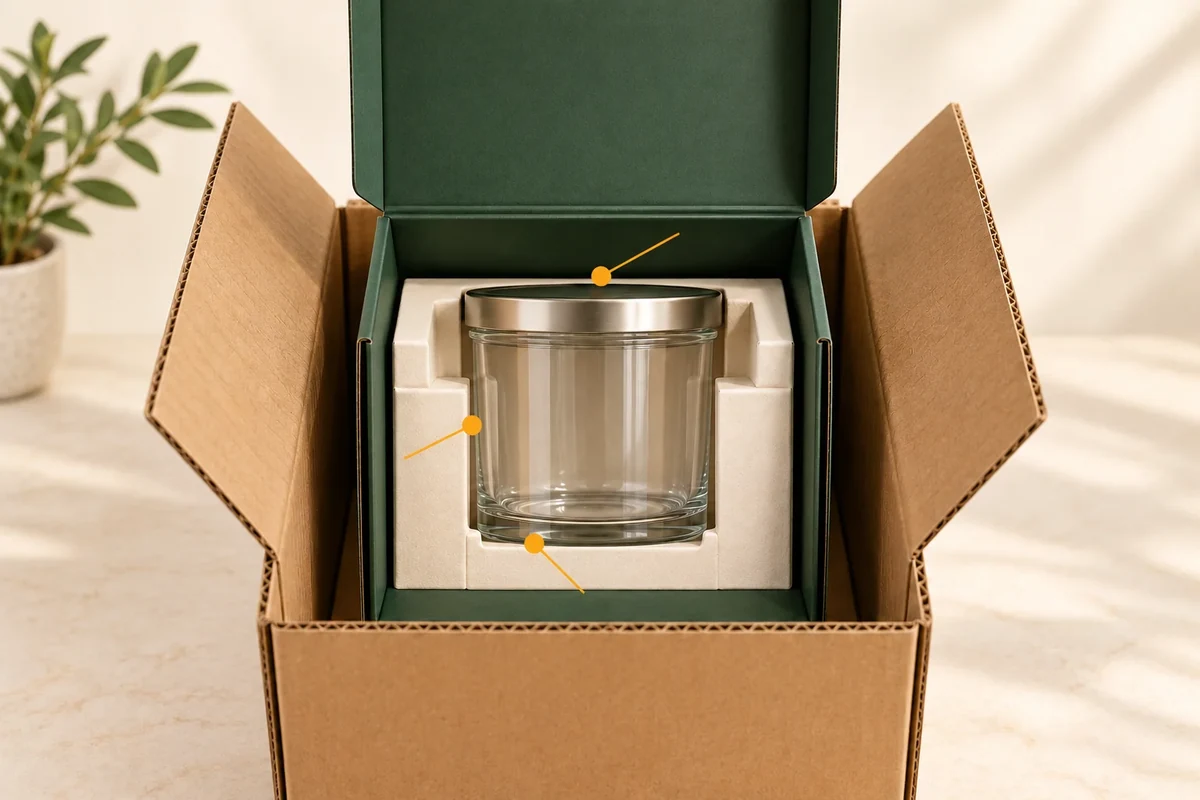
AI-assisted concept cover. Open the cover at full size.
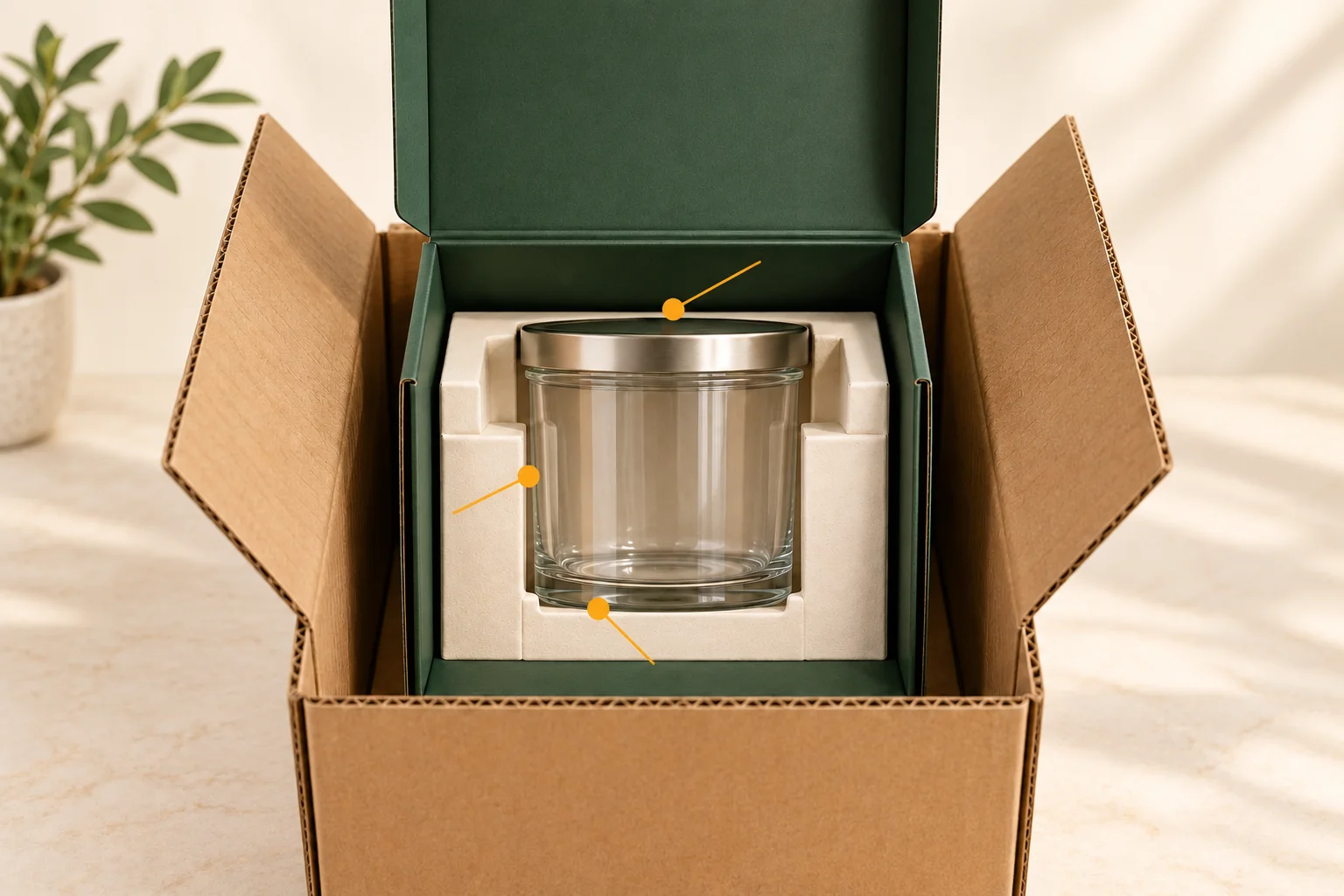
Map every intended and unintended contact around a glass candle vessel before deciding which packaging feature needs revision. Review the jar, lid, insert, presentation box and outer shipping pack as one identified configuration. Record contact, movement and loading observations separately, then agree what additional evidence is needed for the actual delivery route.
A jar can sit neatly in a cavity while its lid touches the gift box, or while a separate accessory rests against the glass. Those interactions need a location and an explanation. A contact map gives the supplier a practical starting point without assuming that tighter restraint will solve every concern.
Identify the vessel as it will be packed
Record the actual jar version with its lid, filled weight where available and external geometry. Include projections, shoulders, handles or raised details that affect how the insert meets it. Photograph the vessel from more than one angle and label the surfaces you want reviewed.
Separate intended support from clearance areas. The proposed insert may locate the base or sides, while the lid and visible finish have different contact requirements. Ask the product owner and supplier to agree which areas can be contacted and what evidence is needed for the proposed material.
Add the care card, dust cover, tool or other accessory to the configuration. Show where each sits and what separates it from the vessel. A drawing that leaves the accessory outside the pack cannot answer the interaction that occurs after the box closes.
Use the candle pack brief to identify the component layers. This map adds a more specific task: locating the contact relationships within and between those layers before requesting a correction.
Keep empty-vessel trials clearly identified if you use them for an early layout discussion. The intended filled product can have a different weight or handling behaviour. The responsible reviewer should say which decisions an early substitute can support and which remain open.
Review one contact relationship at a time
Place the actual vessel in the proposed insert and note the contact regions. Record the orientation and loading steps. If force is needed beyond the agreed method, stop that step and ask for review rather than altering the glass product or pushing harder to finish the trial.
Inspect the arrangement with the presentation box open and closed. Identify contact between the lid and box, between the jar and insert, and between accessories and the vessel. Describe each relationship using component IDs so a later material substitution is visible.
Add the outer pack in the proposed shipping state. Record how the presentation box sits, where surrounding material is placed and which components restrain movement. A presentation box and a shipping pack perform different roles even when they share the same outer appearance.
FedEx's guidance for breakable items discusses fragile-item packing and movement control. Its carrier instructions are contextual guidance; the proposed candle configuration needs an agreed route-specific evaluation rather than a universal padding allowance copied from a web page.
Use this original contact map as a review record. Enter observed conditions and agreed next actions, not assumed pass results.
| Relationship | Intended role | Observation to locate | Next evidence to request |
|---|---|---|---|
| Jar to insert | Proposed location and support | Contact area, loading or rubbing | Revised cavity or material sample |
| Lid to presentation box | Proposed clearance | Catching or pressure during closure | Complete closed-pack review |
| Accessory to jar | Defined separation | Position change or direct contact | Revised accessory location |
| Presentation box to outer pack | Defined shipment arrangement | Movement or unsupported areas | Packing proposal and route review |
Turn a problem location into a focused request
Write the observation first. "The care card edge rests against the upper glass wall when the box closes" names the interaction. Ask for a proposal that addresses that contact while preserving the intended card access and presentation.
Keep the proposed explanation separate. A supplier may attribute the issue to the card position, insert height or another feature. Request the evidence needed to distinguish those explanations instead of accepting a new material description as proof that the interaction is resolved.
For a hypothetical candle gift, one proposal might move the card into a separate position. Another might revise the insert's support geometry. Compare them with the same vessel and accessory versions, then record which other contact relationships the change affects.
A correction can move a concern elsewhere. Changing the base support may alter lid position; adding separation around the jar may change the space for removal. Revisit the affected rows rather than judging the new arrangement from its final photograph alone.
The sample revision record can connect a contact finding to its requested correction and replacement evidence. Keep the map with that record so the supplier can locate the issue without interpreting an unmarked image.
Keep fit review and transport evidence distinct
A loading and contact trial records what happened under its stated conditions. It does not establish that the pack protects glass in transit. If that protection is part of the project, agree the complete configuration, distribution environment, method and acceptance conditions with a suitable provider.
ISTA's retesting guidance explains why product, package and process changes can affect a retest decision. Ask whether a changed insert, vessel or accessory arrangement affects any existing evidence and retain that response with the new configuration.
Name what remains unknown before accepting the next step. Material compatibility, finished contact behaviour and shipment performance may need different evidence. Assign each question to the person able to answer it, with the configuration version included.
The mailer with insert direction can help describe one proposed outer packing arrangement. Its product name does not establish compatibility with the glass vessel or transit protection.
Bring the marked contact map to Packrivo's packaging inquiry together with the actual vessel, accessory and route details. A useful request explains where the components meet and which observation needs a decision, while keeping performance claims attached to appropriate evidence.
Carry a proposed correction across every affected contact
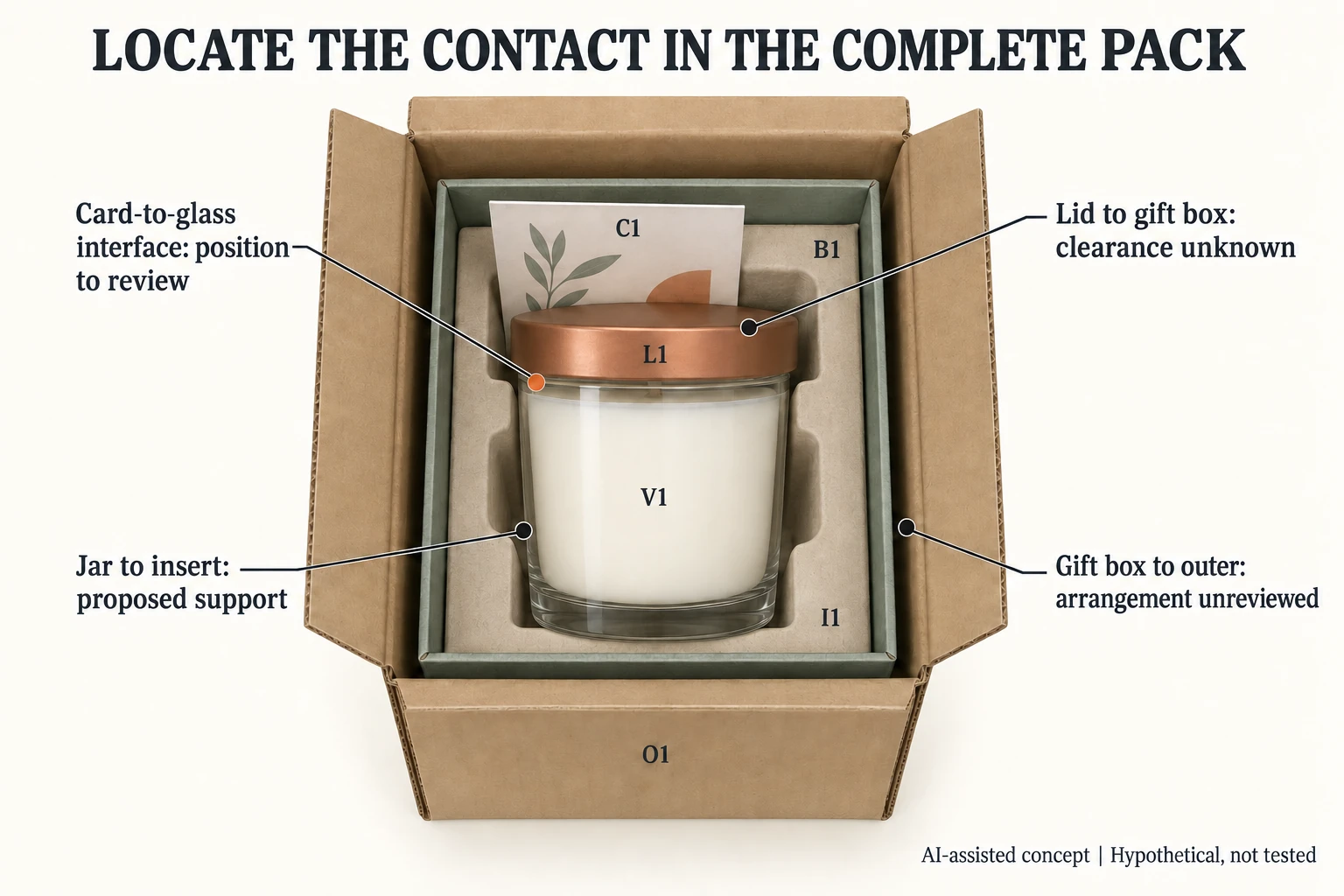
For invented configuration V1/L1/I1/B1/O1 with care card C1, map four interface questions before selecting a correction. The diagram is an open-view locator, not a closed-pack section or evidence of contact pressure. Its card callout identifies an interface to review, not a recorded defect.
Scroll horizontally if columns extend beyond the view.
| Interface | Current planning question | If the proposal changes | Recheck |
|---|---|---|---|
| V1 jar to I1 insert | Proposed support | I2 support geometry | Loading and jar/lid position |
| L1 lid to B1 gift box | Closed clearance unknown | Changed support height | Complete closure |
| C1 card to V1 glass | Card position unknown | Repositioned card C2 | Contact and retrieval |
| B1 gift box to O1 outer | Shipment arrangement unreviewed | Changed complete pack | Route-specific scope |
A revised insert can affect jar position and lid clearance, while a moved card can affect retrieval. Keep those linked questions visible instead of closing the entire map when one part looks improved. Do not treat the marker on the drawing as a real contact observation.
The CSV separates the proposed change from actual observation and technical explanation. Leave observations blank until the named configuration is reviewed. The gift-box lid is not shown closed, so that clearance remains specifically unobserved. No fit illustration establishes glass protection in transit; any changed complete system needs the appropriate responsible route/evaluation review.
Download the glass candle packaging contact points record (.csv). HYPOTHETICAL rows are invented examples. Use ACTUAL_BLANK for permitted project inputs; replace that row label only when recording actual facts. Empty evidence, observation and date fields mean unknown or not performed, never acceptance. Keep checkpoints and revisions separate.
Send the marked interfaces, proposed change and complete vessel/accessory/route identities without treating a new insert as proof every contact is resolved. Packrivo coordinates independent suppliers. These records establish no supplier offer, service availability or MOQ exception; its published baseline is 500 pieces per product/design.