
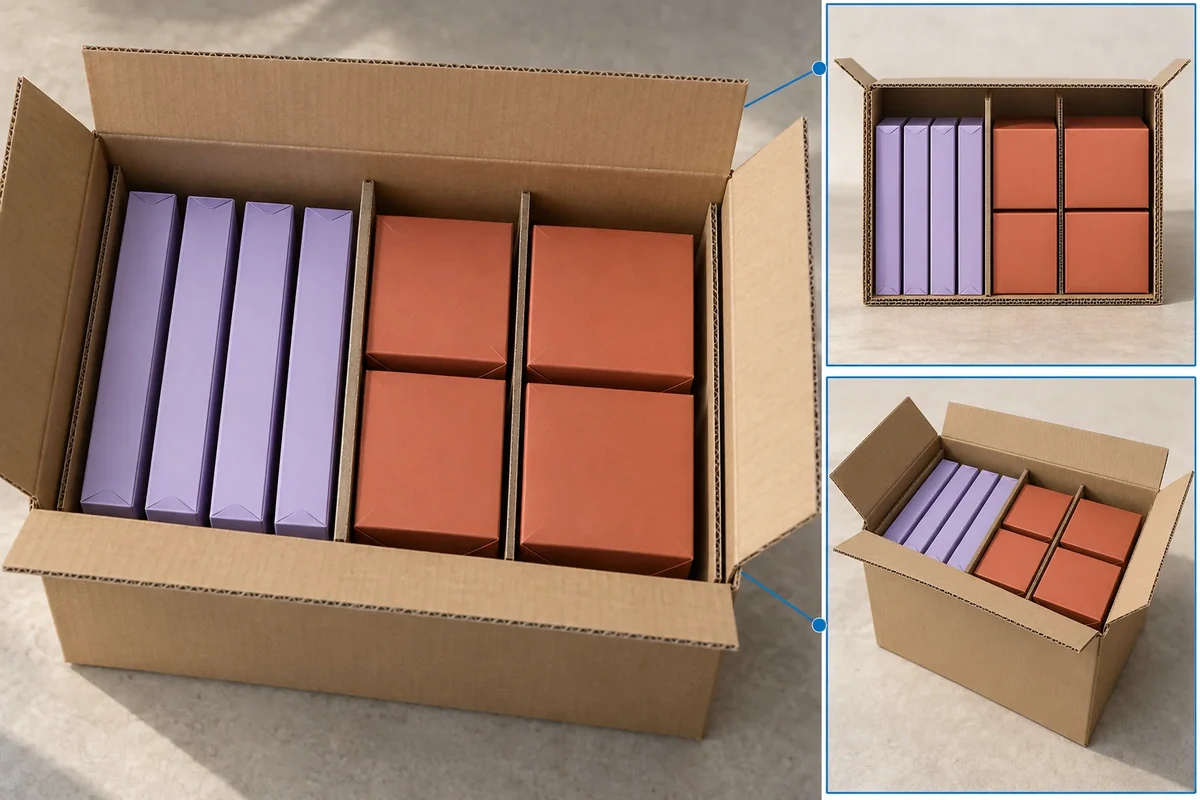
Record the orientation of each retail pack when several share an outer carton. Show rows, visible faces and divider relationships in a loaded map. Keep the packing and receiving instructions explicit; a preferred upright view does not establish how the parcel will be handled throughout transit.
The useful output is a top view plus one side section of the complete configuration. It makes a changed row or product face visible before the outer pack is closed.
Name the complete retail units
Use each retail pack’s finished outside envelope and actual weight, not the loose product dimensions. Include tags, wraps or other projecting pieces. Assign unit and row IDs where configurations differ.
The carrier packaging guidance treats internal packing and closures as shipment-preparation tasks. Use the applicable carrier and responsible packaging proposal for actual requirements. This map does not adopt a generic allowance or promise protection.
Keep freight carton data in a separate record. The loaded orientation explains the contents, while outside dimensions and weights serve another comparison task.
Show rows and separators in the loaded state
Mark which face points towards each carton wall and which unit sits above or beside another. Include divider height and position as proposed. An empty grid drawing alone doesn’t show the complete retail-pack relationship.
Record the loading sequence and the intended receiving order. If staff turn a unit before inserting it, include that action. A final arranged photo can hide the process needed to create it.
| Orientation-map field | Input | Evidence |
|---|---|---|
| Retail unit | Finished envelope and actual weight | Current pack identity |
| Row/position | Unit IDs and facing direction | Loaded top view |
| Vertical relationship | Stack or layer proposal | Loaded side section |
| Divider/contact | Named separators and meeting faces | Located relationship view |
| Loading | Order and any turning action | Packing sequence |
| Receiving | Opening and first unit route | Contents view before rearrangement |
Use the packed-system guide when support or distribution requirements need evaluation. A drawing of orientation is configuration evidence, not a transit result.
Follow a hypothetical mixed gift shipment
Suppose an outer carton contains two retail gift-box sizes. The buyer maps larger boxes in one row and smaller boxes in another, with a proposed separator. Their front faces and opening directions remain identified.
During packing, one small unit is rotated to complete the row. The record preserves that change and asks whether it belongs in the confirmed layout. It is not silently described as the same orientation.
At receiving, the reviewer opens the carton and photographs the contents before moving them. That view helps compare the actual layout with the intended map without assigning a cause to any movement observed.
Keep orientation preference separate from performance
Ask: ‘Please confirm row R2 and separator D2 with retail-pack revision U2 in the stated facing direction.’ It gives the source a located configuration. A total carton count alone leaves that relationship open.
A preferred top face can be useful for packing and receiving instructions. Any requirement about handling in different orientations needs a responsible complete-system evaluation rather than an assumption that an arrow prevents rotation.
If a retail pack changes size, height or weight, identify the affected rows and separators. The same outside carton can carry a different loaded system, which should remain traceable.
Send the loaded map
Bring unit identities, top/side views and the loading/receiving instruction through Packrivo’s enquiry. The next response should confirm the actual arrangement and any separate evaluation needed for its intended route.
One rotated unit needs its own facing record
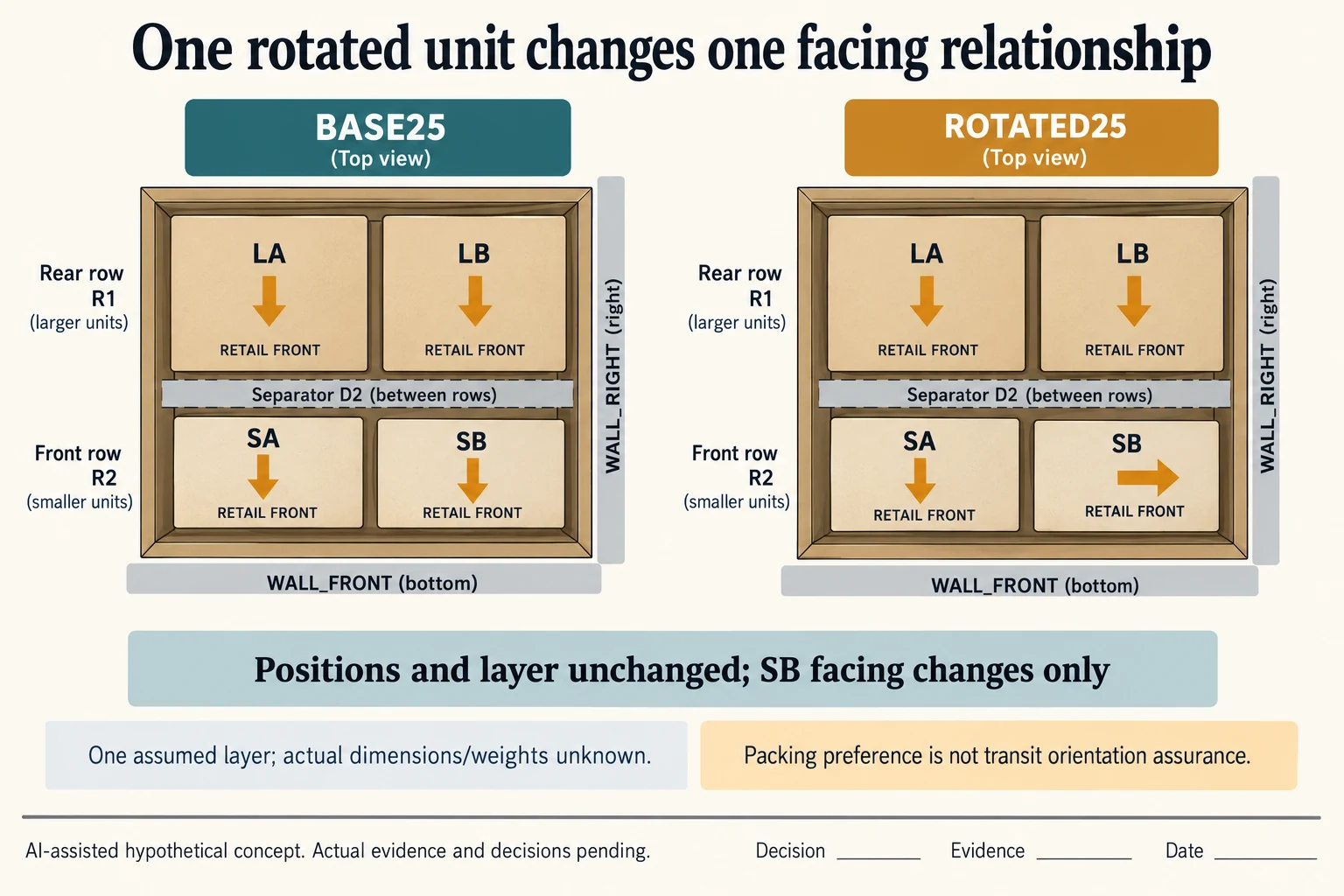
Use an invented single-layer layout containing two large retail packs LA and LB in positions R1P1 and R1P2, plus two smaller packs SA and SB in R2P1 and R2P2. Each position contains one complete retail unit, for four units in total. D2 is the proposed separator between the two rows. The position map assigns no actual dimensions, weight, divider height or protective capacity.
Scroll horizontally if columns extend beyond the view.
| Hypothetical configuration | Named object | Relationship | Input or next scope |
|---|---|---|---|
| BASE25 | LA | assigned to | R1P1; 1 retail packs |
| BASE25 | LA | front faces | WALL_FRONT |
| BASE25 | LB | assigned to | R1P2; 1 retail packs |
| BASE25 | LB | front faces | WALL_FRONT |
| BASE25 | SA | assigned to | R2P1; 1 retail packs |
| BASE25 | SA | front faces | WALL_FRONT |
| BASE25 | SB | assigned to | R2P2; 1 retail packs |
| BASE25 | SB | front faces | WALL_FRONT |
| ROTATED25 | LA | assigned to | R1P1; 1 retail packs |
| ROTATED25 | LA | front faces | WALL_FRONT |
| ROTATED25 | LB | assigned to | R1P2; 1 retail packs |
| ROTATED25 | LB | front faces | WALL_FRONT |
| ROTATED25 | SA | assigned to | R2P1; 1 retail packs |
| ROTATED25 | SA | front faces | WALL_FRONT |
| ROTATED25 | SB | assigned to | R2P2; 1 retail packs |
| ROTATED25 | SB | front faces | WALL_RIGHT |
| BASE25 | CARTON | calculated from | LA+LB+SA+SB; 4 retail packs |
| ROTATED25 | CARTON | calculated from | LA+LB+SA+SB; 4 retail packs |
BASE25 points every retail front toward WALL_FRONT. ROTATED25 keeps the same four identities, positions and layer, but points SB’s front toward WALL_RIGHT. That is one changed facing relationship, not a new unit or a missing pack. The CSV records each unit’s position, front-facing wall and layer independently, so a row description cannot hide the rotated small pack.
Review the affected opening face, separator contact, packing turn and first receiving route under the changed layout. If the unit had to turn during insertion, the instruction needs that action; a final four-unit photo does not recover its sequence. At receiving, preserve the first visible layout before anyone rearranges it. An observed difference should be located without guessing which transit event caused it.
Keep the fixed carton reference separate from an instruction that a parcel must remain upright in transit. A preferred packing view does not control all carrier handling. UPS supplies shipment-preparation context, while actual complete-system evaluation and service requirements remain separate. Reopen the affected map when a retail pack’s envelope, height, mass or opening construction changes.
Download the mixed carton retail unit orientation record (.csv). It includes the original table fields and scenarios alongside the added relationships. HYPOTHETICAL rows are editorial examples or required review scopes, not actual records. Actual quantity, configuration, component and file identities, materials, process, specification, copy, method, condition, observation, owner, decision, evidence and dates are blank. ACTUAL_BLANK is a separate empty starting row; enter permitted project evidence before using an actual record. A blank means unknown.
Use the Packaging Carton Data Makes Freight Inquiries Easier to Compare for its separate question. Use the Mailer Box With Insert: Build a Fit Brief From the Product for its separate question. Use the Carton Opening Needs a Map of Retail Packs Beneath the Seam for its separate question.
Source scope checked 16 October 2026. References cover only the named materials, processes or guidance. Added configurations and geometry are hypothetical, not supplier specifications, tests or production approval; they set no universal tolerances or machine limits. Confirm the actual material, process, drawing and formed sample for the project.
Discuss this packaging specification with Packrivo. We coordinate independent suppliers. MOQ: 500 pieces per product/design; illustrative quantities are not production offers. Confirm materials, samples, price and timing for your project.