
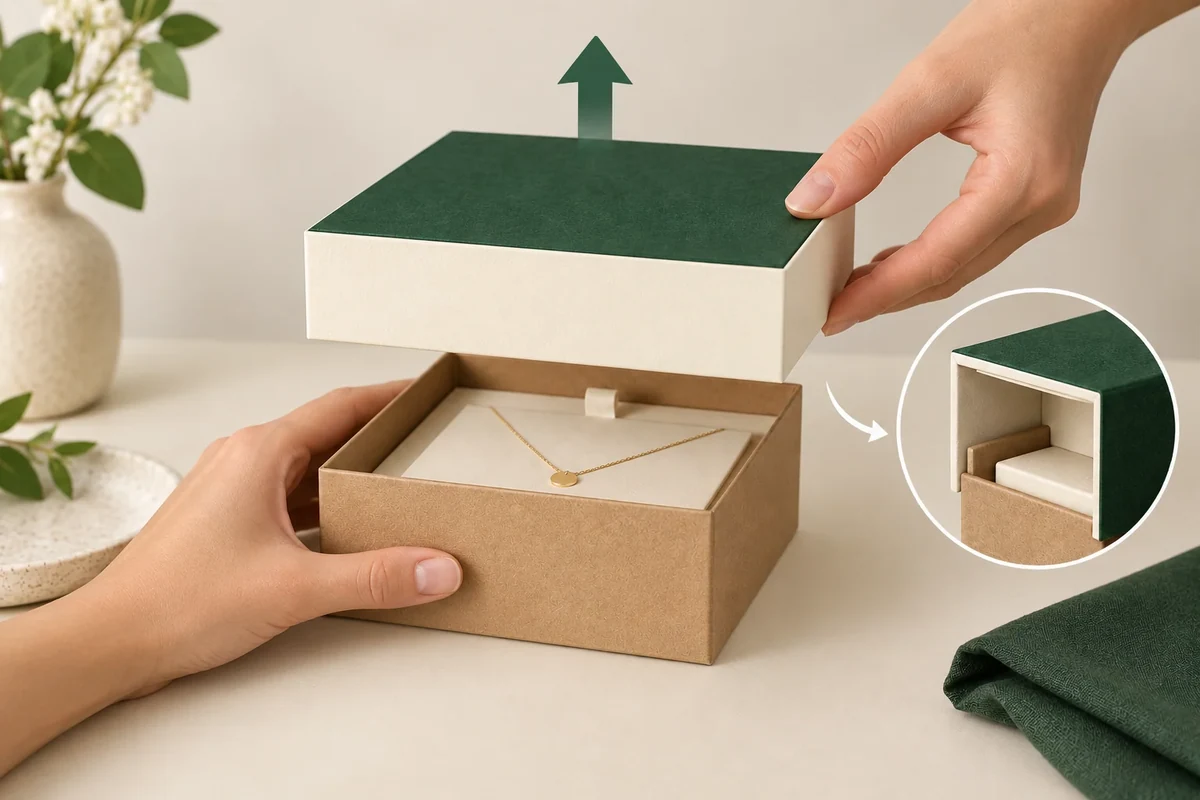
Leave a defined grip route for a lift-off lid and review it with the complete product and holder in place. Mark where fingers start and which edges they meet as the lid rises. An attractive close-fitting lid can still leave the intended opening action unresolved.
The Lid-and-Base Jewelry Box shows the two-piece opening arrangement relevant to this grip review. Mark the actual finger-entry position on the proposed sample rather than inferring access from the closed-box image.
The buyer’s task is to describe the intended action clearly enough to review. Do that before asking for a tighter lid, a deeper overlap or a new notch. Those are possible construction responses, not substitutes for an opening requirement.
Choose the opening position
State whether the box rests on a table, is held in one hand or uses another defined setup. Identify which faces the user can grip. A lid that is easy to lift in a carefully staged photograph may be handled differently in use.
PakFactory’s shoulder-neck reference identifies a lid-and-base-related structure with an additional neck. That supports distinguishing the parts. It doesn’t establish a universal grip area, lid fit or lifting force.
Show the proposed lid overlap and accessible base surfaces on a side view. Add the product and holder envelope. Keep the drawing reference clear about finished wrapped parts rather than bare board alone.
The jewelry insert fit guide concerns product location. This sketch adds the user’s finger route around the lid and rim.
Map finger entry and contact
Mark the starting grip areas on two sides or another proposed position. Show the direction the lid should rise. If a notch, tab or other opening aid is proposed, identify it and ask the supplier to confirm its construction.
On the sample, begin with the lid closed and complete contents inside. Record where fingers first touch and whether another part must be moved to obtain a grip. Keep that change visible in the action record.
View the opening through its first movement and later lift. Contact may happen at the start or after the lid edge passes a neck or rim. Name the stage rather than assigning a single overall ease score.
Record any product or holder contact separately. Finger space for the lid and access to the product are two linked tasks, but a successful lid lift doesn’t prove the item can then be removed.
Use a grip and access sketch
Keep a side sketch and a top sketch with matching face names. Add one row for each observed action stage.
| Stage | Location to mark | Observation |
|---|---|---|
| Start | Accessible lid and base grip areas | Actual finger entry and support |
| Initial lift | Lid rim against base or neck | Contact and any changed grip |
| Continued lift | Passing edge and product envelope | Movement clear of contents |
| Lid removed | Product and holder grip area | Next removal action |
| Reference | Finished-part and sample revisions | Final or substitute materials |
A contact observation should include the named face and stage. This gives the supplier a useful location to compare with its proposed fit.
Work through a hypothetical necklace box
Suppose a brand proposes a lift-off jewelry box with a lid extending close to the table. The customer is intended to hold the base steady and lift the lid from the sides. The buyer records that starting setup on the grip sketch.
The first sample leaves little exposed base at the chosen grip points. The reviewer records the actual change needed to lift it, rather than calling it approved after moving the box into a different position.
The supplier may propose a different overlap, an opening aid or another form. The buyer compares the revised action against the same loaded configuration. The choice remains specific to that use rather than a claim that shallower lids are always better.
Keep the intended starting position fixed
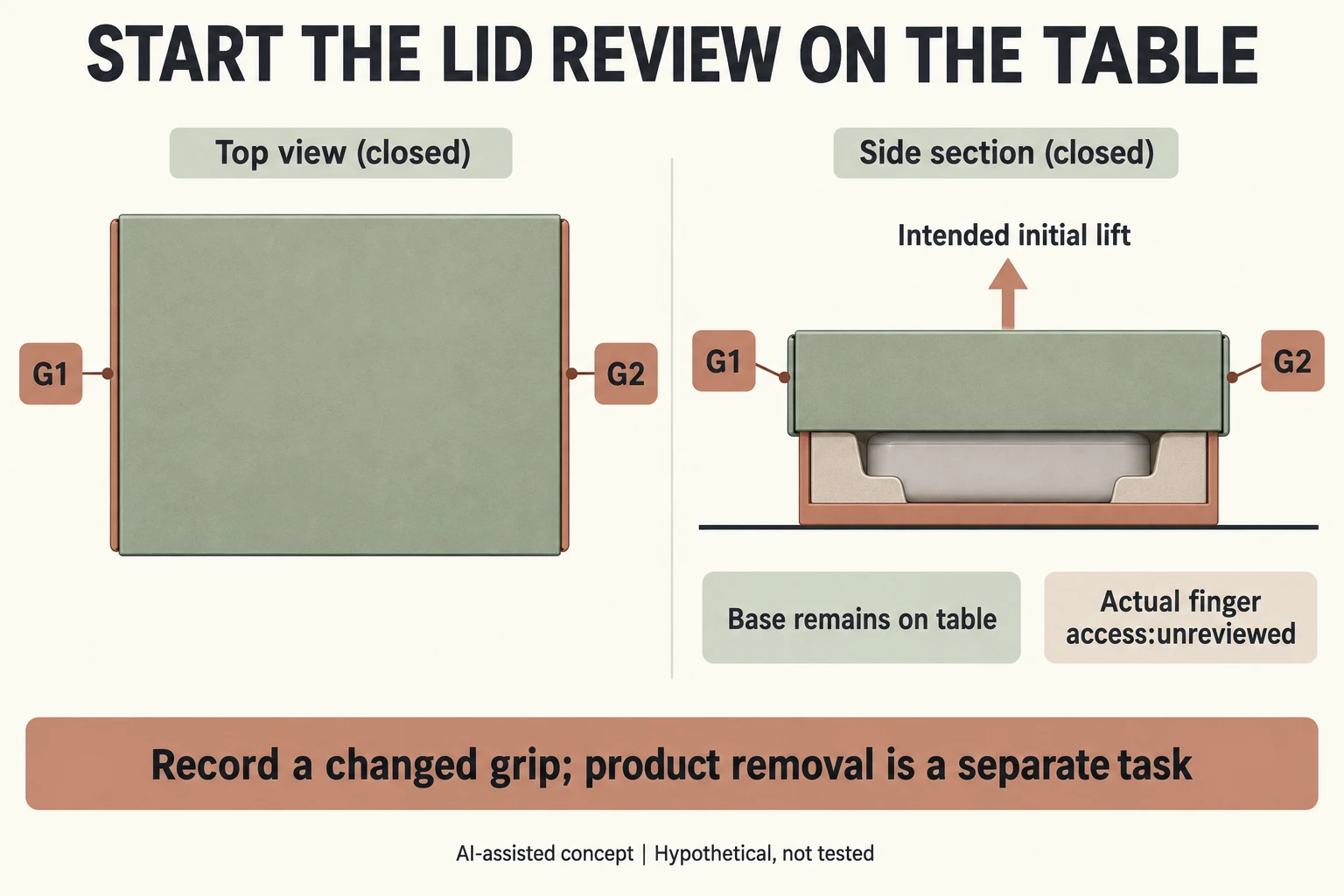
For the hypothetical necklace box, call the side grip points G1 and G2 and mark the table position in the sketch. Record the user support expected at the base. If the reviewer lifts the entire pack to find a grip, preserve that action as a deviation from the starting requirement.
Ask the supplier: ‘Please review access to G1 and G2 in the closed loaded state and propose a response for the intended table opening.’ This locates the task without prescribing a universal lid overlap. A supplier can then discuss the actual geometry or an opening aid.
For the revised sample, begin again from the table position and document the first lid movement. If another grip is part of the proposed use, update the sketch and review it deliberately rather than carrying over the original requirement unchanged.
Keep the lid action and product removal in separate rows. The lid may be accessible while the holder still blocks a card edge, or the product may be easy to remove after an awkward opening. The record should expose both tasks and keep any acceptance criteria tied to the actual finished sample state.
Send the grip requirement with the loaded envelope
Use Packrivo’s enquiry form to send the opening setup, grip sketches, loaded dimensions and located observations. Ask the responsible supplier to propose and confirm the interface. Any measured opening-force or repeated-use requirement needs a separately agreed method.
Record a changed starting grip before calling the lid action complete
For invented loaded box B1, the requirement is to begin on the table, keep the base supported there and start the lid lift at G1/G2. The diagram marks intended faces only; it does not establish finger access or a completed opening trial.
Scroll horizontally if columns extend beyond the view.
| Stage | Proposed requirement | Record separately |
|---|---|---|
| Start | B1 stays on table; G1/G2 identified | First unassisted grip |
| Initial lift | Lid moves; base remains supported | Any whole-box lift or changed grip |
| Continued lift | Contents remain identified | Lid/product contact |
| Lid removed | Separate product-removal route | Holder and product access |
If a reviewer lifts the whole pack first to find a grip, retain that action as a change from the stated starting requirement. The team can deliberately revise the intended use, or ask for another construction proposal; it should not keep the old requirement while hiding the different action.
The CSV separates starting setup, first action, assistance, deviation and product removal. All actual observation cells remain blank here. G1/G2 are planning locations, not guaranteed hand spaces or universal dimensions. A lid removed successfully would still leave product access to review. Any opening-force or repeated-use claim needs its own agreed method and evidence.
Download the lift off lid gift box opening record (.csv). HYPOTHETICAL rows are invented examples. Use ACTUAL_BLANK for permitted project inputs; replace that row label only when recording actual facts. Empty evidence, observation and date fields mean unknown or not performed, never acceptance. Keep checkpoints and revisions separate.
Send the starting setup, matched grip views, actual deviations and separate product-removal question with the loaded dimensions. Packrivo coordinates independent suppliers. These records establish no supplier offer, service availability or MOQ exception; its published baseline is 500 pieces per product/design.