
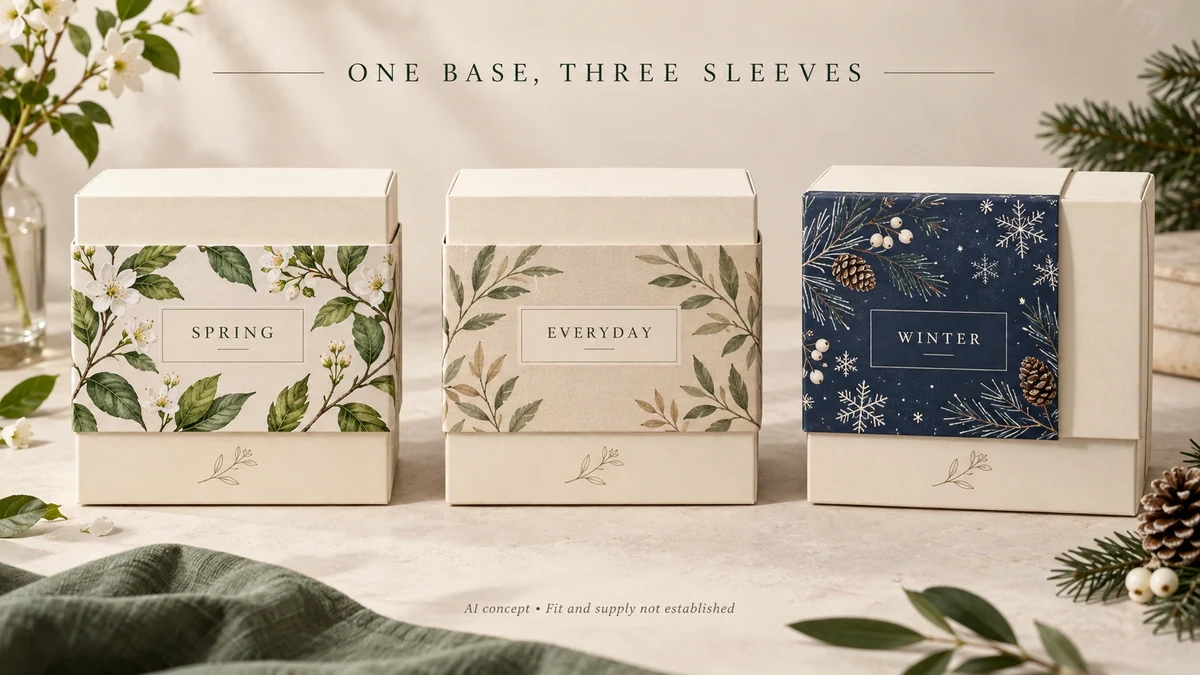
AI-assisted concept cover. Open the cover at full size.
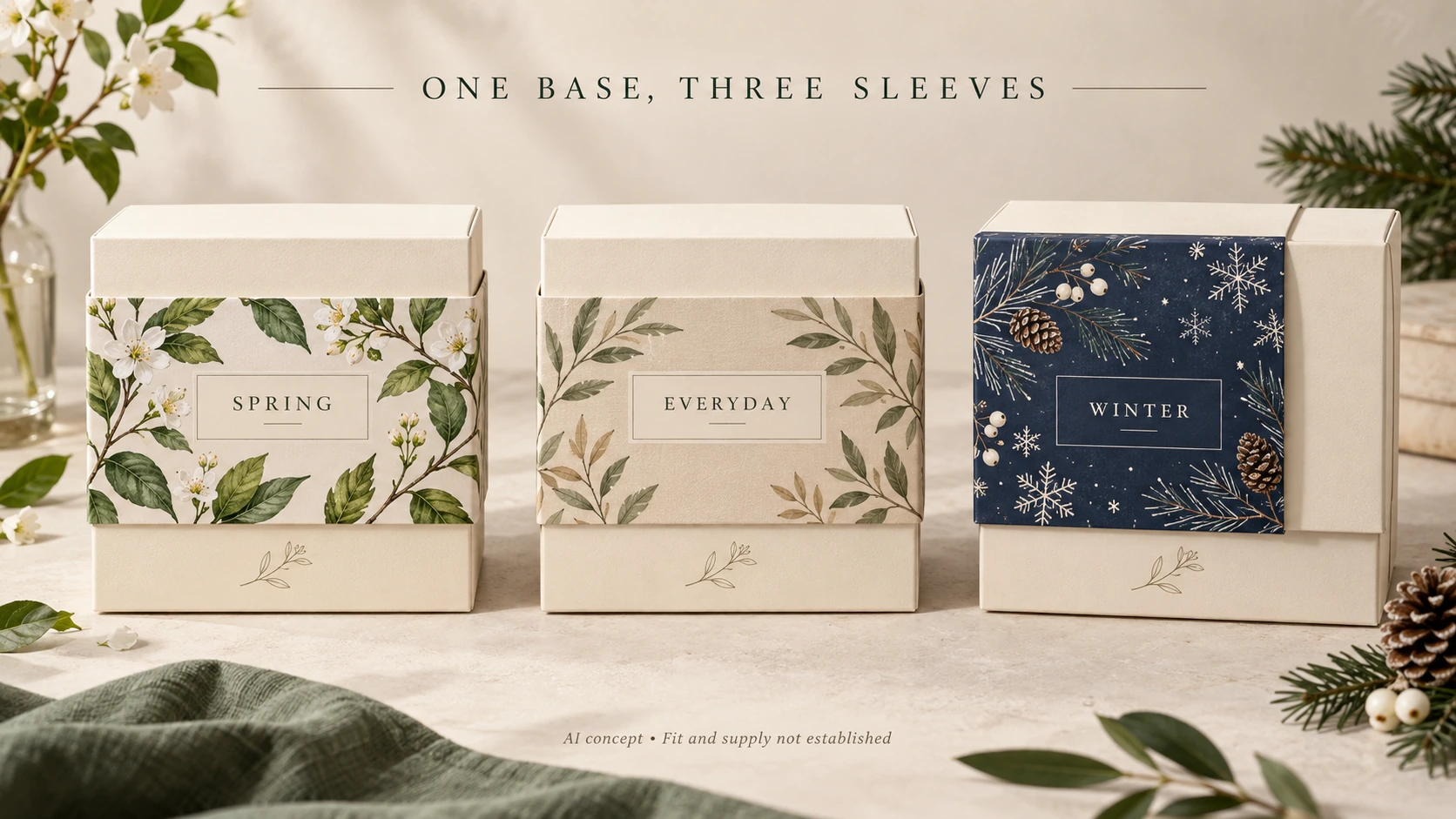
Choose seasonal packaging sleeves when the product arrangement and base box can stay the same across occasions. Choose a dedicated seasonal box when the contents, structure or opening experience change. An evergreen base with a removable sleeve separates those two decisions. Keep the lasting brand identity on the base box. Put the holiday artwork, collection name or event message on a removable sleeve. That gives the brand a consistent foundation and a separate surface for seasonal expression.
This approach is less useful when each season brings a different product size, a new arrangement or a gift format with its own opening experience. The important question is how much genuinely stays the same across the range. Start there, then decide whether sleeves belong in the system.
Separate the lasting identity from the occasion
An evergreen base box should feel complete in ordinary use. Choose a brand mark, color palette and visual character that remain appropriate after the seasonal sleeve comes off. A box that depends on a Christmas illustration to make sense will be harder to use for a birthday or thank-you gift.
The sleeve can carry the time-specific expression: a winter illustration, a spring collection title or an event theme. Keep a visual link between sleeve and box through typography, a repeated motif or a shared accent color. This lets seasonal versions vary without making each one appear to come from a different brand.
Gold Image Printing explicitly describes sleeves as a way to change launch, holiday or limited-edition artwork while keeping the underlying box. That supports the basic format choice. The right quantity and commercial value still depend on the individual project. Gold Image Printing, Packaging Sleeves
Design a complete opening sequence
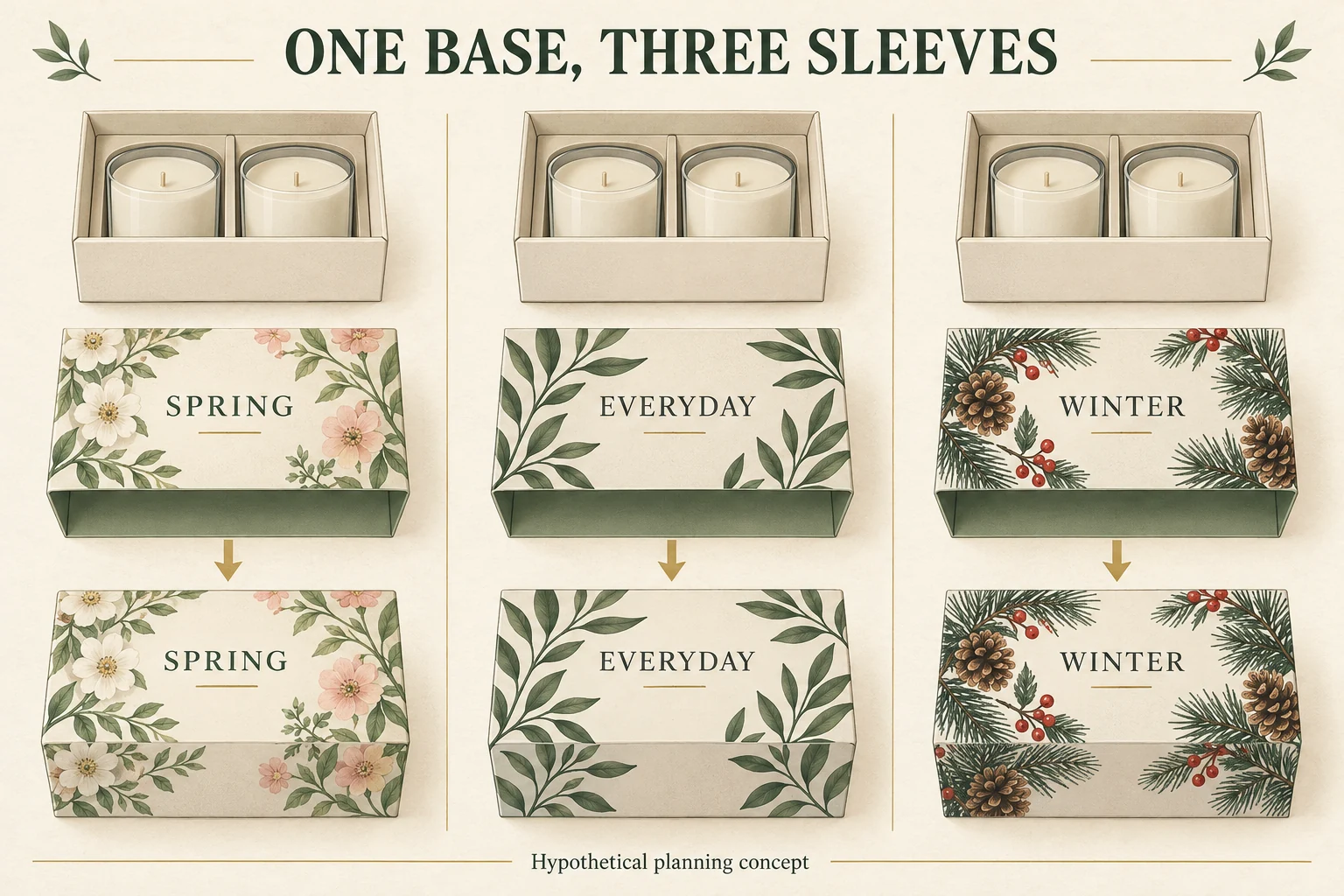
Treat sleeve removal as the first action in opening the gift. Think about what the recipient sees while the sleeve is in place, what appears as it moves and what remains when it has been set aside.
A sleeve that covers most of the lid can create a strong seasonal image. A narrower band leaves more of the base box visible. Neither needs to carry every decorative element. If the sleeve has a detailed illustration, a restrained box underneath can create a clear change of pace.
Decide what belongs on each component
The division below is a design starting point for a gift program. Product-specific requirements can change it.
Scroll horizontally if columns extend beyond the view.
| Element | Base box role | Seasonal sleeve role |
|---|---|---|
| Brand identity | Stable mark and year-round visual character | Supporting brand cue within campaign artwork |
| Occasion | Broad gifting suitability | Holiday, celebration or event theme |
| Collection expression | Design that works across the intended range | Specific collection title, illustration or palette |
| Product arrangement | Structure suited to the products it must hold | No substitute for a suitable box and insert |
| Future use | Suitable for the same product family after a campaign | Limited by the relevance of its printed message |
Keep a season off the base box if the purpose of the system is to share that base across occasions. Even a small printed year can narrow future use. Conversely, a special anniversary edition may deserve permanent dated artwork because the date is part of the gift’s meaning.
Choose how much change the sleeve should deliver
Not every campaign needs an entirely new visual language. A year-round botanical brand might change the illustration and headline while retaining the same typography and composition. A collaboration may need a much larger graphic change, with the base box providing continuity underneath.
Sleeve formats also affect the presentation and packing work. PackMojo lists flat, adhesive and pre-glued versions in its sleeve range, showing that a sleeve is not a single fixed construction. Discuss which form suits the intended box and packing process rather than assuming all versions arrive ready to slide on. PackMojo, Packaging Sleeves
Think about the visual result as a pair. A slim paper sleeve against a substantial rigid box may look deliberate or mismatched depending on the design. A wide sleeve might hide the part of the base box that makes it recognizable. Use an assembled concept with the real proportions to judge the combination.
Keep inventory flexible where it genuinely can be
Sharing a base box can leave more choices open when campaign demand changes. Unassigned base boxes may be directed to another occasion if the product fit, condition and branding remain suitable. Printed seasonal sleeves have a narrower use: a dated holiday message can become obsolete even when the box beneath it is still useful.
Those choices exist only if the components remain separable in practice. If every base box is sleeved well in advance, changing the allocation creates unpacking and repacking work. If different campaigns require different inserts, the apparent common box may still conceal several separate configurations.
Include sleeve production, application, storage and remaining stock when comparing the approach with a dedicated seasonal box. A sleeve is an additional component, so a smaller amount of changing artwork does not automatically mean a lower total cost or environmental impact. Each box and sleeve design also retains its own supplier quantity requirements; splitting the design into layers does not remove them.
A hypothetical three-occasion gift program
Imagine a candle brand planning the same two-candle set for spring, year-round thank-you gifts and winter. It expects 500 sets for each occasion. These figures are an illustrative planning scenario, not a procurement recommendation or Packrivo quotation.
The brand chooses one cream base-box design and three sleeve designs. If spring demand reaches only 400 sets, 100 spring sleeves remain tied to that campaign. Any unassigned base boxes may still serve the other two occasions, provided the products and packaging configuration remain suitable.
Now change the winter plan to three larger candles. The original box no longer serves the intended set. A new sleeve cannot solve that structural difference. The brand should compare a separate winter box with changing the product selection, rather than forcing every gift into the common format.
Turn the range into a purchasing allocation
For the hypothetical three-occasion program, compare the following purchasing lines. The quantities assume the same two candles, one insert design and 500 sets per occasion throughout. They are planning inputs, not a quotation.
Scroll horizontally if columns extend beyond the view.
| Purchase line | Shared base plus sleeves | Dedicated seasonal boxes | What to confirm |
|---|---|---|---|
| Base boxes | 1,500 of one design | 500 of each of three designs | Same structure and product fit across occasions |
| Sleeves | 500 spring, 500 everyday, 500 winter | None in this comparison | Each artwork is a separate quantity line |
| Inserts | 1,500 of one design, if unchanged | 1,500 shared only if all three structures allow it | Do not assume a common insert merely from matching outer dimensions |
| Application work | Apply the correct sleeve to each of 1,500 sets | No sleeve step | Record actual packing work and any consumables |
| Seasonal stock exposure | Printed seasonal sleeves plus any already allocated assemblies | Printed seasonal boxes | Record what remains usable if demand changes |
Packrivo’s services page states a starting MOQ of 500 pieces per product/design. Treat each proposed sleeve artwork and component design as its own line for project confirmation; three artworks should not be assumed to share a single 500-piece minimum. A forecast of 200 winter gifts therefore does not, by itself, justify assuming that 200 custom winter sleeves can be ordered.
Keep quantity allocation separate from cost. Request line-item prices for boxes, sleeves, inserts and setup, then include application work and expected leftover stock. A common base can preserve allocation choices, but the comparison may still favor dedicated boxes once the actual terms are known.
Separate common-box balance from seasonal sleeve balance
Use two stock lines for the same campaign decision. In the invented 1,500-box program, assume only the spring campaign has run and 400 gifts used one base box, one common insert and one spring sleeve each. No boxes have yet been assigned to the other occasions.
Scroll horizontally if columns extend beyond the view.
| Component | Starting quantity | Used | Remaining | Meaning |
|---|---|---|---|---|
| Common base box | 1,500 | 400 | 1,100 | Potential common stock, subject to condition and unchanged contents |
| Common insert | 1,500 | 400 | 1,100 | Reusable across campaigns only for the same confirmed fit |
| Spring sleeve | 500 | 400 | 100 | Spring-specific stock; not 100 extra complete gifts |
| Everyday sleeve | 500 | 0 | 500 | Unassigned everyday version |
| Winter sleeve | 500 | 0 | 500 | Unassigned winter version |
The 100 spring sleeves do not prevent the 1,100 unsleeved bases from being allocated elsewhere. If 100 boxes had already been sleeved for spring, record that assembled allocation separately and identify any work needed to change it. Keep a sleeve-version check on the packing ticket so remaining seasonal pieces are not mistaken for the next campaign.
Know when a dedicated seasonal box is stronger
Choose a separate box when the seasonal format is itself the experience: a compartmented countdown gift, a dramatically larger assortment or a keepsake design whose occasion is meant to remain visible. Use a shared base when product geometry and the core brand presentation are genuinely stable.
Explore gift-box directions and build a packaging brief with Packrivo. Describe the occasions, what stays inside the box and which elements should change. Packrivo can help organize the sourcing discussion around that system, with quantities, construction and timing confirmed for the specific project.
Keep the current record with the project brief
Download the seasonal component allocation CSV. It contains field definitions, clearly hypothetical examples and a blank actual-project row. Replace invented values with your own supported records; keep unknown fields open.
Packrivo coordinates packaging sourcing and project questions with independent suppliers. The worksheet is a discussion aid, not a confirmed quotation, manufacturing promise or sample approval. The published starting MOQ is 500 pieces per product/design; actual component, design and commercial scope require confirmation.
Source scope: Sleeve format and seasonal-artwork examples only; quantities, allocation and comparisons are original hypothetical planning aids. Public references checked 16 October 2026. All new illustrations are AI-assisted concepts. No real customer, test, shipment, stock, savings or production outcome is represented.