
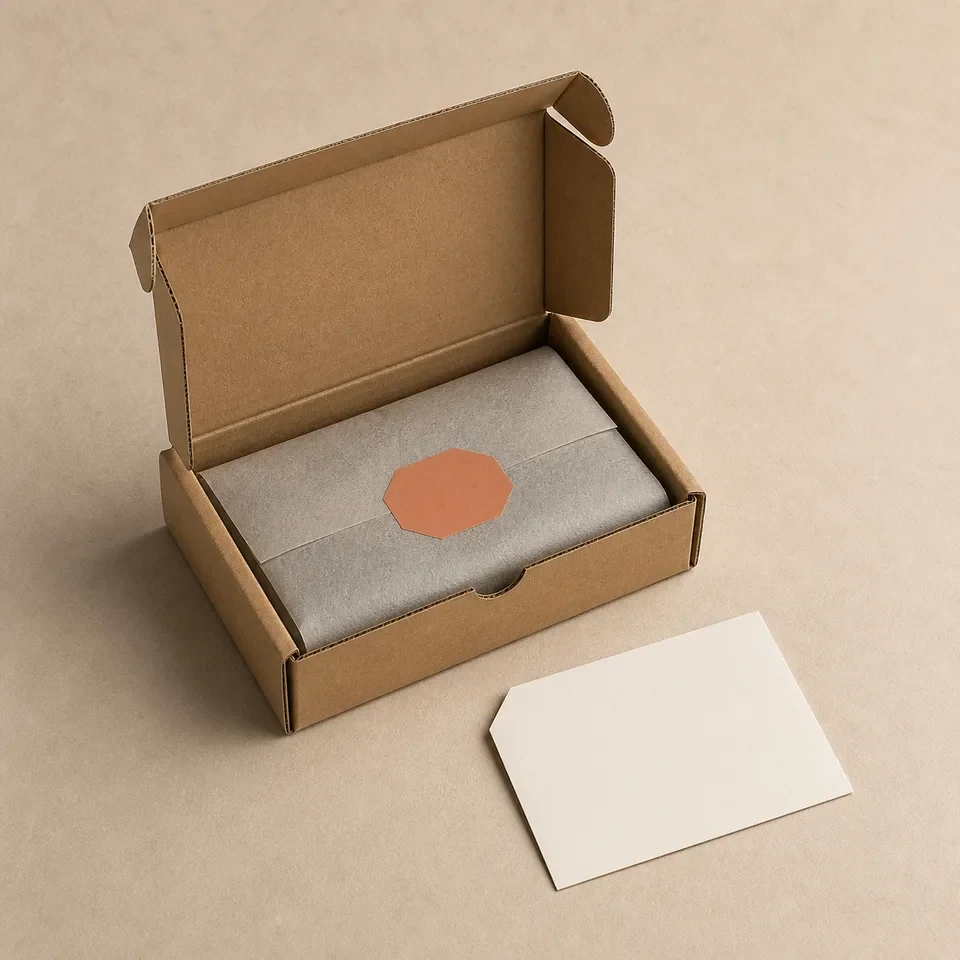
A small business needs enough shipping box sizes to handle its recurring orders sensibly, plus a clear plan for exceptions. The right number comes from the combinations customers actually buy, the space those products need when properly packed, and the storage and packing work each additional size creates. There is no reliable universal answer such as “three boxes for every small business.”
In this guide
- Group orders before grouping boxes
- Establish the packed requirement first
- Compare the common configurations
- Ask whether the extra size earns its place
- Use an order-mix worksheet before requesting prices
- A clearly hypothetical cost decision for the medium size
- Give unusual orders an explicit route
- Review the range when the business changes
- Sources and scope
- Give the exception route a real instruction
- Send the current configuration for review
Start by distinguishing product packaging from dispatch packaging. Six jewelry styles might share one customer-facing box and travel in two different shipping cartons depending on order quantity. One candle might need a different outer pack when sold with an accessory. Counting product SKUs will not tell you how many dispatch sizes to stock.
Group orders before grouping boxes
Review a representative period of actual orders, long enough to capture ordinary variation. Separate seasonal promotions, wholesale shipments and one-off oversized orders so they do not silently define the everyday range. A new brand can use a forecast, but should label its assumptions and revisit them once orders exist.
Group the records into physical order types: one small item, two small items, a candle with a lid, a gift set or another repeated combination. Include inserts, customer-facing packaging and enclosed materials. Two orders with different fragrances may belong to the same physical group; two orders for the same product may differ because one includes gift packaging.
The useful output is a ranked list of order configurations and their frequency. That reveals which combinations deserve a dedicated solution and which may be served by an exception route.
Establish the packed requirement first
A proposed box must accommodate the complete packing arrangement. The product’s bare dimensions do not account for its retail carton, separation from another item, cushioning or any other required support. Treat a box as a candidate until the actual configuration has been reviewed.
UPS provides general guidance on selecting outer packaging, securing contents and using cushioning. That guidance is a starting point for the shipment concerned, rather than proof that a particular proposed size protects your product. UPS packaging guidance.
Record usable internal dimensions for fit work and finished external dimensions for shipping comparisons. Keep the terms distinct. A slight change in board construction or closure can affect the relationship between the two. Where product protection requires more space, that requirement belongs in the decision rather than being treated as avoidable empty volume.
Compare the common configurations
The following example is hypothetical. Imagine a brand with 1,000 monthly orders and four recurring groups. Assume, only for this exercise, that initial packing trials have identified these candidate assignments. The stated dimensions are illustrative finished external dimensions; they are not recommended sizes or validated protective specifications.
Scroll horizontally if columns extend beyond the view.
| Order group | Monthly orders | Candidate everyday size | Illustrative external dimensions |
|---|---|---|---|
| One small retail pack | 650 | Small | 180 × 140 × 90 mm |
| Two small retail packs | 250 | Medium | 260 × 190 × 110 mm |
| Larger gift set | 80 | Large | 320 × 240 × 160 mm |
| Oversized or unusual order | 20 | Separate exception route | Established for each configuration |
With two everyday sizes, the brand could investigate small for the 650 single-item orders and large for the 330 paired or gift-set orders. With three sizes, the 250 paired orders move into the medium candidate, while the 80 gift sets remain in large. The exceptions still need their own suitable packaging plan.
The medium candidate occupies 5.434 liters of external geometric volume, compared with 12.288 liters for large. Moving 250 hypothetical orders from large to medium changes their combined external box volume by 1.7135 cubic meters. That arithmetic describes box volume only. It does not establish a freight saving, vehicle-space reduction or environmental benefit, and it assumes the medium configuration remains suitable after proper review.
Ask whether the extra size earns its place
The third size introduces a new stock line. It needs a storage location, replenishment decisions, a recognizable picking label and a clear rule explaining when to use it. If staff frequently confuse medium and large, a nominally more precise range can create rework.
Compare the full operational picture for the two proposals. Obtain actual packaging quotes at the intended quantities. Measure the storage occupied by delivered bundles or assembled boxes. Run a short packing trial with the people who will use them, including retrieval and replenishment at the bench. Record any added inserts or consumables, rather than comparing empty-box prices alone.
Then compare shipping charges using the actual carrier, service, destination and packed measurements. FedEx explains that dimensional weight reflects the relationship between package volume and actual weight, and that its applicable chargeable-weight comparison can use the greater of the two. The specific rules must be checked for the service being purchased. FedEx dimensional-weight guide.
In the example, three sizes may be worth investigating because the medium configuration serves a quarter of total orders. It is still possible that storage constraints, purchase quantities or the observed packing work favor two. The order share identifies a worthwhile comparison; it does not make the decision automatically.
Use an order-mix worksheet before requesting prices
Copy one row for each recurring order configuration. Use the complete packed arrangement, not bare product dimensions. Leave unknowns open rather than filling them with an assumed clearance.
Scroll horizontally if columns extend beyond the view.
| Order type | Orders per month and share | Complete packed requirement | Candidate dispatch size | Exception or unresolved constraint |
|---|---|---|---|---|
| Your single-item order | ___ orders / ___% | Product, retail pack, insert and support: ___ | Internal ___; external ___ | ___ |
| Your paired order | ___ orders / ___% | Product, retail packs, separation and support: ___ | Internal ___; external ___ | ___ |
| Your gift set | ___ orders / ___% | Gift presentation plus dispatch protection: ___ | Internal ___; external ___ | ___ |
| Unusual order | ___ orders / ___% | Named configuration: ___ | Agreed separate route: ___ | Decision owner: ___ |
Then compare monthly cost for the same order volume and service conditions:
Monthly comparison = orders × (box + consumables + packing labor + applicable shipping charge), summed across order types, plus storage, replenishment work and any consistently allocated setup cost.
Use the same treatment of overhead and setup in both alternatives. Avoid adding a cost again if it is already included in a quoted unit price.
A clearly hypothetical cost decision for the medium size
The following invented USD inputs apply only to the 250 paired orders in the example. Other order groups are assumed unchanged and cancel out of this comparison. Every amount must be replaced with actual quotes or measured work before a buying decision.
Scroll horizontally if columns extend beyond the view.
| Cost per paired order | Two-size plan using large | Three-size plan using medium |
|---|---|---|
| Box | $1.80 | $1.25 |
| Consumables | $0.40 | $0.30 |
| Packing labor | $0.60 | $0.65 |
| Applicable shipping charge | $5.50 | $5.50 |
| Total variable cost | $8.30 | $7.70 |
In this invented case, the difference is $0.60 × 250 = $150 per month before the extra stock line’s fixed costs. If the medium size adds $25 monthly storage, $15 replenishment work and $20 monthly setup allocation, the modeled difference becomes $90 per month. If those incremental costs instead total $170, the model favors the two-size plan by $20. This is a decision calculation, not a Packrivo price or promised saving; actual shipping charges may also differ.
Packrivo states a starting MOQ of 500 pieces per product/design. At the example’s 250 medium orders per month, 500 medium boxes represent two months of forecast consumption before any safety stock. At the invented $1.25 box price, that line’s initial box purchase would be $625. This is gross purchasing cash for that line, not the incremental cash requirement of the whole switch. Confirm actual quantity terms, usable storage, lead time and forecast reliability before adding the size.
Give unusual orders an explicit route
A rarely used product can distort the whole range if every parcel must accommodate it. Decide how to handle unusual combinations: a suitable additional stock carton, a separately developed pack or another agreed configuration. Specify who makes that choice and how the order is recognized.
Avoid a rule that lets staff improvise protection whenever an order falls outside the main sizes. An exception plan should still define a suitable packed configuration. Repeated exceptions are also useful evidence: if an unusual bundle becomes common, it may deserve an everyday size at the next review.
Review the range when the business changes
Revisit the decision after a meaningful shift in order mix, a new product, a seasonal range or a change of fulfillment location. Keep a record of what each size serves, how often it is used and what problems actually occur. Retire or add sizes based on that evidence.
When comparing storage or delivery of the packaging itself, Packrivo’s carton-data guide helps separate quantities, carton measurements and freight assumptions. Those inputs complement the customer-order analysis.
To develop a manageable range, bring your most frequent order combinations and current packing constraints to Packrivo’s packaging brief form. Packrivo can help organize sourcing questions and compare proposed configurations. The aim is a box range you can explain, stock and use consistently, with the actual project requirements confirmed before ordering.
Sources and scope
Access date for all sources: 6 October 2026.
- UPS packaging guidance. Official carrier guidance. Supports the need to consider outer packaging, contents and cushioning as a packed arrangement. No universal protective clearance, test pass or damage guarantee is inferred.
- FedEx dimensional-weight guide. Official carrier explanation of dimensional weight and comparison with actual weight. The article intentionally does not generalize a numeric divisor or tariff across carriers, countries or services.
- Packrivo carton-data guide, services and brief form. First-party explanatory links and service positioning; treated as one first-party service/reference group. No price, lead-time or manufacturing promise is adopted.
Calculation note: 260 × 190 × 110 ÷ 1,000,000 = 5.434 liters; 320 × 240 × 160 ÷ 1,000,000 = 12.288 liters; (12.288 − 5.434) × 250 ÷ 1,000 = 1.7135 cubic meters. All dimensions, order frequencies, cost inputs, storage and replenishment amounts, setup allocation and trial assumptions are invented solely for the worked examples. They are not a recommended pack specification or a Packrivo customer result.
Give the exception route a real instruction
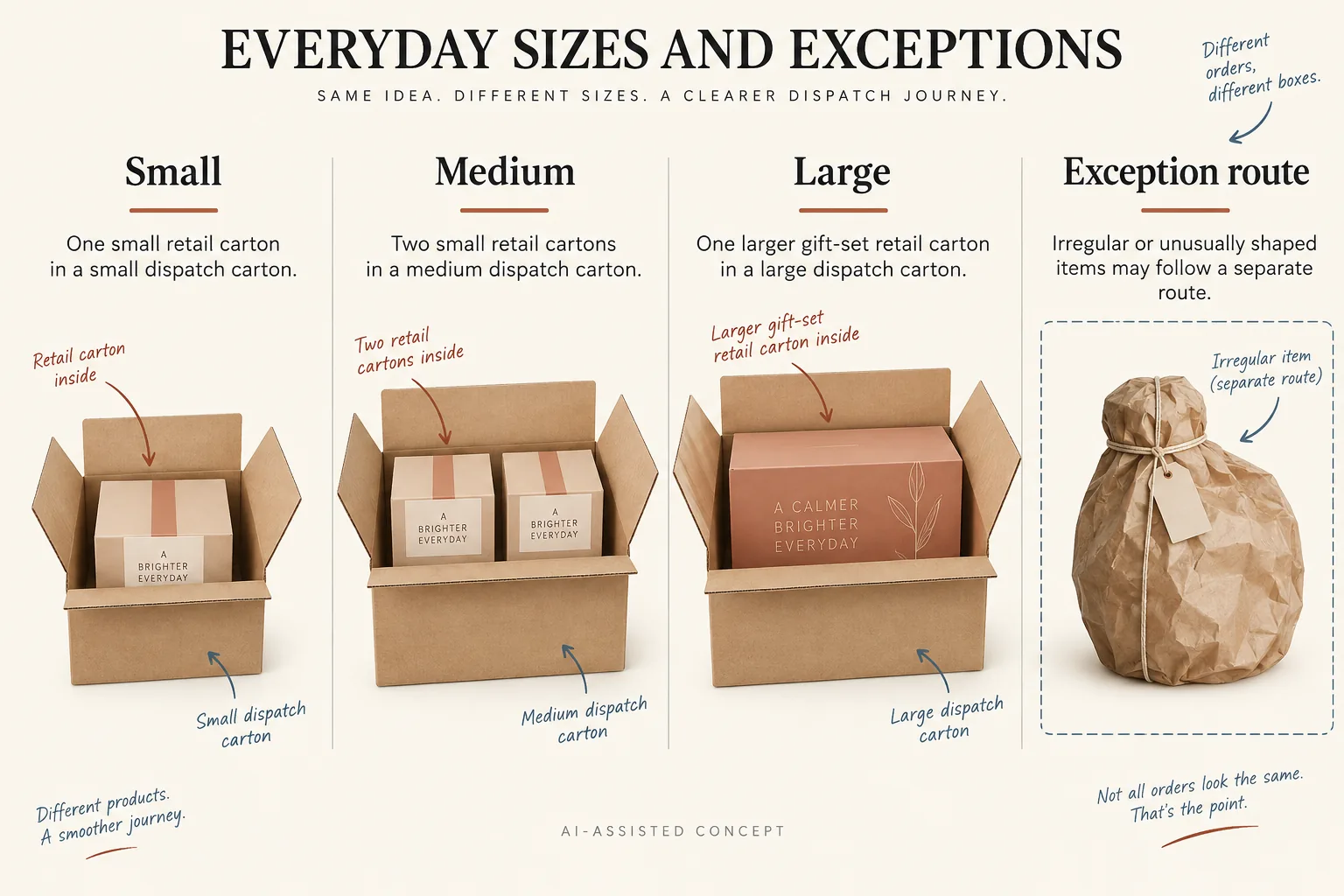
In the hypothetical 1,000-order example, the 20 unusual orders remain outside the everyday size assignments under both proposals. Retain their count in the total. Removing them from the box comparison should not remove their packing work, purchase cost or delivery decision from the business plan.
| Exception field | Hypothetical entry | Before dispatch |
|---|---|---|
| Recognize the order | Gift set plus oversized accessory | Order system or packing owner identifies combination |
| Packing route | Separate configuration EX1, not yet developed | Actual layout and protection review required |
| Packaging source | Stock or custom route remains open | Confirm quantity, cost and availability |
| Responsibility | Named packing owner | No improvised substitution without review |
| Review trigger | Unusual combination becomes recurrent | Revisit everyday range using actual frequency |
If those orders are unchanged between the two-size and three-size alternatives, their equal costs cancel in that particular incremental comparison. They still belong in the complete monthly budget. If the new range changes their route, include that difference instead of cancelling it.
Track why an exception happened. A genuine oversized product, a seasonal bundle and a stockout of the usual carton are different causes. A repeated stockout should prompt a replenishment question; it is not evidence that the product needs a permanently larger everyday box.
Before requesting a range quotation, send the frequent order groups, candidate packed arrangements and the unresolved exception configuration together. Keep the carrier classification record attached to actual measured parcels; it is separate from choosing how many empty carton sizes to buy.
Download the shipping box sizes for small business project record (.csv). The file has named planning fields and blank project rows. It contains no preset acceptance limits or approved results.
Send the current configuration for review
Bring the completed record, actual product or component references, requested quantity by design and destination to Packrivo’s packaging inquiry. Name the specific open decision above so the next sourcing discussion can address it. Packrivo coordinates sourcing questions; material, sample, price and delivery terms need project confirmation.