
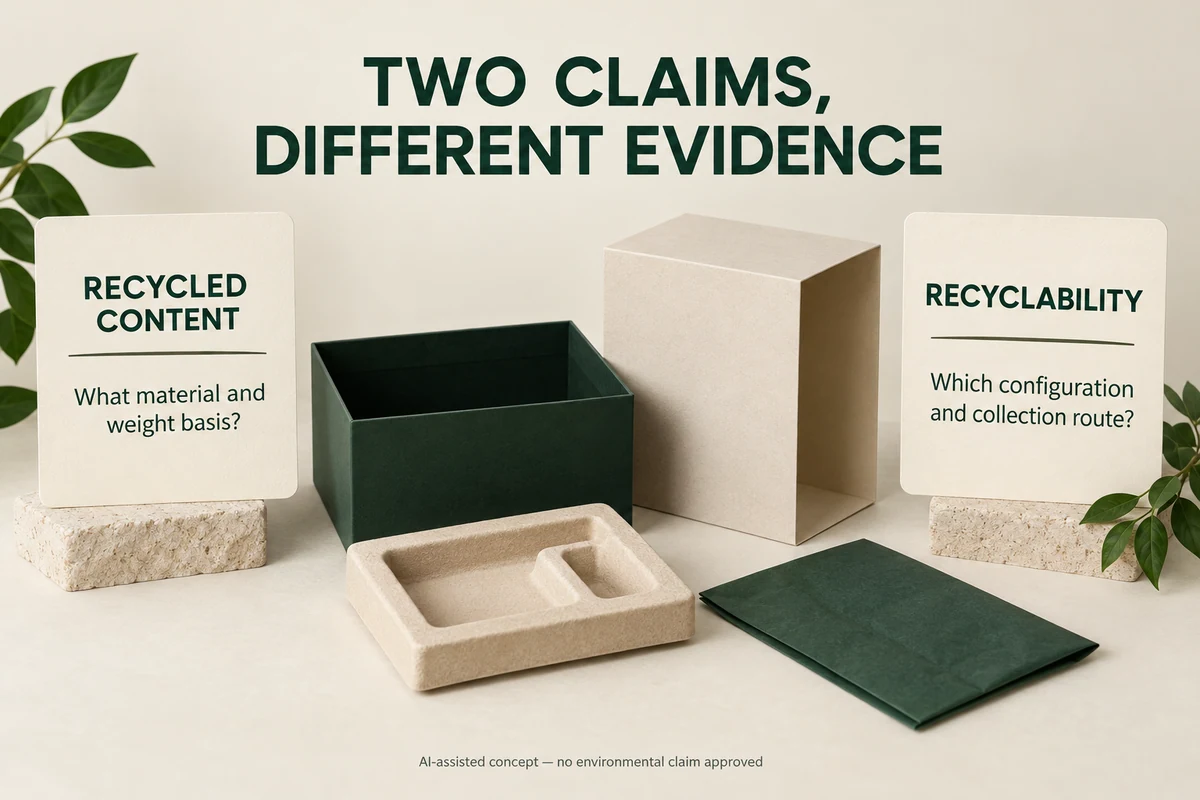
Recycled content describes material used to make packaging; recyclability concerns recovery after use through an appropriate recycling route. Evidence for one doesn’t establish the other. For US marketing, identify the exact component and claim, then review the relevant FTC guidance and supporting facts before placing wording or symbols on the pack.
A paperboard box may arrive with recycled-fiber information, while its completed construction raises separate recycling questions. Added layers, components and the places where customers receive it belong in that second review. The article below concerns US environmental marketing guidance, not a determination of compliance for a particular package.
Ask what the content percentage actually covers
The FTC’s recycled-content guidance addresses recovered material and qualifications for partial recycled content, including the percentage by weight. It also distinguishes claims about pre-consumer and post-consumer material. See 16 CFR 260.13.
Ask the supplier what the figure describes: fiber, a particular board grade, a box component or the complete finished package. Keep that basis visible. A percentage for the board cannot simply be assigned to a package containing other materials.
If a supplier says "post-consumer," ask for evidence supporting that specific description. Keep unknown component weights or content values open. Averaging percentages without a stated material and weight basis can produce a number that has no clear relationship to the package being sold.
Review the recovery route separately
The FTC’s recyclability guidance considers established recycling programs, facility availability and the actual item’s acceptance. Its substantial-majority threshold for unqualified claims is at least 60 percent of consumers or communities where the item is sold. See 16 CFR 260.12.
That percentage concerns access in the selling market. It isn’t a required percentage of paper in the package, a measured recycling rate or proof that an individual customer’s bin accepts the item.
Ask the responsible reviewer what evidence covers the final configuration and sales area. A material family name can help start the investigation, but it doesn’t establish an accepted collection route for a specific shape, size or assembled construction.
Keep the two investigations side by side
| Buyer question | Evidence to seek | What remains unanswered |
|---|---|---|
| What recycled content is in the box board? | Material-specific content and calculation basis | Whether the completed pack can enter a recycling route |
| What does the statement cover? | Exact component or complete-package scope | Whether customers will interpret it more broadly |
| Is the final item accepted for recycling? | Relevant configuration and established recovery route | Whether content claims about its manufacture are supported |
| Is qualification needed in the sales area? | Availability evidence and the proposed wording | Acceptance in markets outside the reviewed area |
Use the answers to prepare specific wording for review. Don’t treat the worksheet as an approval of a supplier’s environmental statement.
Work through a hypothetical mixed-component pack
Imagine a gift set with a paperboard box, fabric-faced insert and removable sleeve. The supplier provides content evidence for the box board. The brand still needs to identify what is known about the insert and sleeve before writing a whole-package statement.
For the recovery question, the reviewer examines the supplied configuration and the intended selling area. The team also considers how a customer would interpret the words and any symbols. Removing one component in a drawing is insufficient unless the review covers the actual product and communicated disposal route.
This example contains no assumed content percentages or claim that the described components are recyclable. It illustrates how one material document can answer a limited question while leaving other questions open.
Review the complete printed message
Show the claim in context, including symbols, nearby product copy and any qualification. A small note elsewhere may not resolve the impression created by the main label. Have the responsible market reviewer approve the exact presentation before production.
Packrivo’s material-claim evidence method helps connect that wording to the supplied configuration. Use its broader review process after keeping recycled content and recovery evidence separate.
Sources accessed 8 October 2026. The eCFR display used for this draft reported Title 16 current through 6 October 2026. These FTC Guides explain environmental marketing principles; other federal, state and destination-market requirements may also need review. No packaging claim or legal compliance decision is established here.
A subtotal with known content cannot become a whole-pack percentage
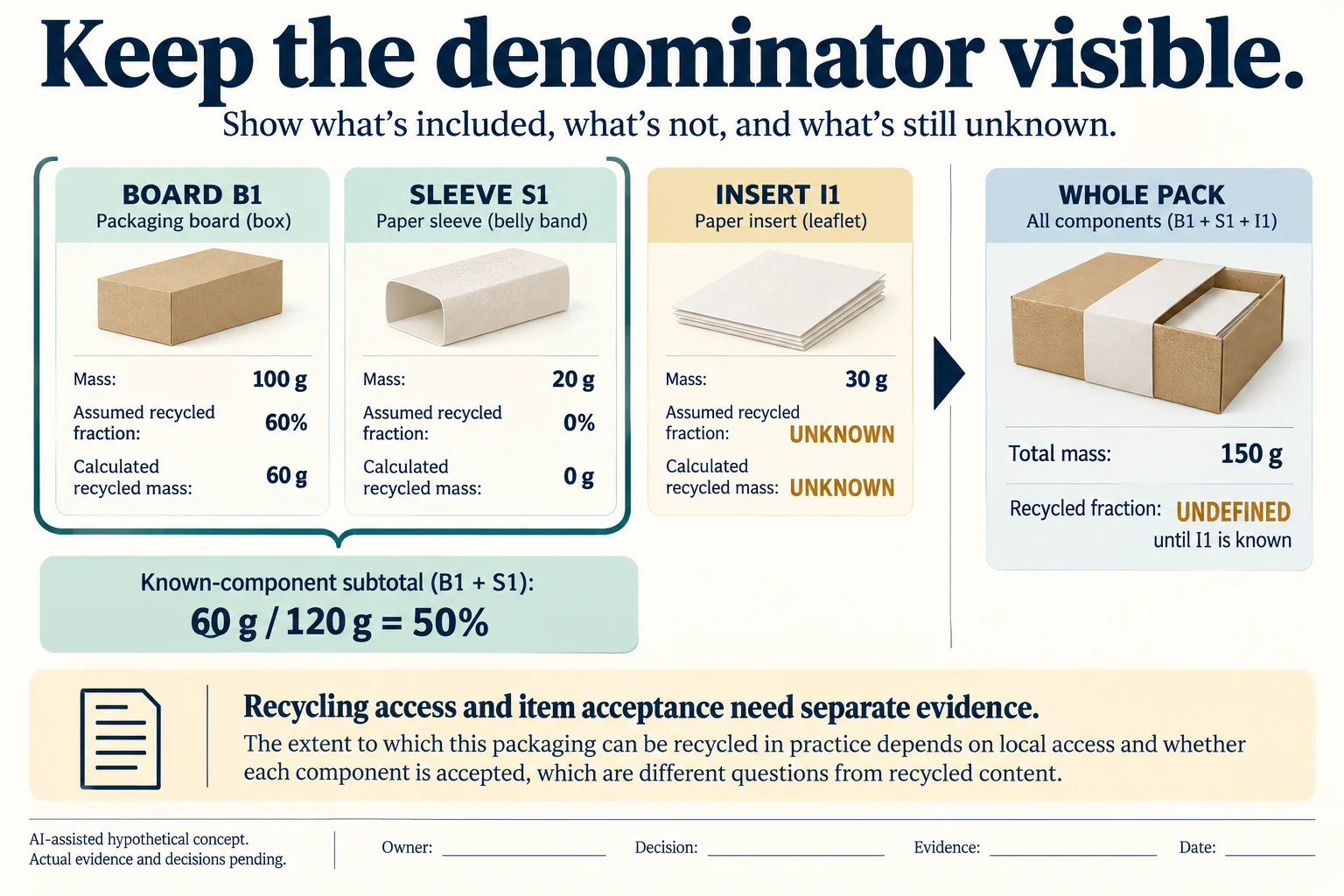
Use a separate, entirely invented mass calculation to see where a missing component stops the result. WEIGHT28 contains a 100 g board component B1 assumed to contain 60% recycled material by mass, a 20 g sleeve S1 assumed to contain none, and a 30 g insert I1 whose recycled fraction is unknown. These assumptions do not describe a supplied Packrivo material or an approved environmental claim.
Scroll horizontally if columns extend beyond the view.
| Hypothetical configuration | Named object | Relationship | Input or next scope |
|---|---|---|---|
| WEIGHT28 | BOARD_B1 | assumed mass | 100 g |
| WEIGHT28 | BOARD_B1 | assumed recycled mass fraction | Assumed solely for arithmetic; 0.6 fraction |
| WEIGHT28 | SLEEVE_S1 | assumed mass | 20 g |
| WEIGHT28 | SLEEVE_S1 | assumed recycled mass fraction | Assumed solely for arithmetic; 0 fraction |
| WEIGHT28 | INSERT_I1 | assumed mass | 30 g |
| WEIGHT28 | INSERT_I1 | assumed recycled mass fraction | Unknown for INSERT_I1; never substitute zero |
| WEIGHT28 | BOARD_B1 | calculated from | BOARD_B1_MASS*BOARD_B1_FRACTION; 60 g |
| KNOWN_COMPONENTS28 | B1_PLUS_S1 | calculated from | BOARD_B1_MASS+SLEEVE_S1_MASS; 120 g |
| KNOWN_COMPONENTS28 | B1_PLUS_S1 | calculated from | BOARD_RECYCLED+SLEEVE_RECYCLED; 60 g |
| KNOWN_COMPONENTS28 | B1_PLUS_S1 | calculated from | KNOWN_RECYCLED/KNOWN_MASS; 0.5 fraction |
| WHOLE_PACK28 | B1_PLUS_S1_PLUS_I1 | calculated from | KNOWN_MASS+INSERT_I1_MASS; 150 g |
| WHOLE_PACK28 | B1_PLUS_S1_PLUS_I1 | calculated from | (KNOWN_RECYCLED+INSERT_I1_MASS*INSERT_I1_FRACTION)/TOTAL_MASS; Undefined until insert fraction known; 50% is only known-components subtotal |
| US_RECOVERY28 | FTC_ACCESS_60_PERCENT | does not measure | RECYCLED_MASS_FRACTION; Facilities access in sales area; actual acceptance and claim qualification still open |
B1 contributes 100 × 0.60 = 60 g of assumed recycled mass. S1 contributes 20 × 0 = 0 g. The two known-content components weigh 120 g together, so their subtotal fraction is 60 ÷ 120 = 50%. Keep B1 plus S1 in the subject of that result. The complete example pack weighs 150 g, and its recycled fraction remains undefined until I1’s contribution is known. Treating the blank as zero would invent a component fact; copying 50% to the whole pack would change the denominator without support.
The download keeps each mass, fraction and calculated output in its own scope, with gram and dimensionless-fraction units and explicit input references. The whole-pack formula is present but its value is empty. If a real component is itself a composite, obtain the basis for the finished component rather than transplant a fiber-only figure. Any proposed pre-consumer or post-consumer wording needs its own substantiation; the arithmetic cannot classify the recovered source.
Recyclability remains a separate investigation after this calculation. The FTC’s 60% substantial-majority provision concerns access to facilities among consumers or communities where sold, with the item’s acceptance and any qualification still relevant. It does not validate this 60%-content board assumption or the example’s 50% subtotal. Give the responsible reviewer the complete configuration, actual component evidence, sales-area recovery evidence and exact proposed message before using a figure or symbol.
Download the packaging recycled content weighted component calculation record (.csv). It includes the original table fields and scenarios alongside the added relationships. HYPOTHETICAL rows are editorial examples or required review scopes, not actual records. Actual quantity, configuration, component and file identities, materials, process, specification, copy, method, condition, observation, owner, decision, evidence and dates are blank. ACTUAL_BLANK is a separate empty starting row; enter permitted project evidence before using an actual record. A blank means unknown.
Use the Packaging Material Claims: Match the Evidence Scope for its separate question.
Source scope checked 17 October 2026: US FTC sections 260.12 and 260.13 distinguish recycling access and recycled mass content; neither establishes actual component evidence or claim wording approval. The added configurations and calculations are hypothetical, with actual evidence and decisions pending.
Discuss this packaging specification with Packrivo. We coordinate independent suppliers. MOQ: 500 pieces per product/design; illustrative quantities are not production offers. Confirm materials, samples, price and timing for your project.