
Before proposing a refillable packaging claim for the US market, establish how a customer can actually refill the original container. Show where the refill comes from and what the customer must do. A box that can hold something else has a reuse possibility; that alone does not establish the refill route behind the proposed claim.
For a small gift brand, this is a service decision as well as a packaging decision. The container, refill offering and customer instructions must describe the same arrangement. Leave the claim unresolved when the route exists only in a future plan.
Identify the container and what is being replenished
Start with a sentence that names the original container and the replacement contents. For example, a hypothetical stationery gift tin might be intended to receive another pack of the same stationery items. Decide whether the proposed wording refers to the tin, an inner component or the entire presentation pack.
Then write down the actual next purchase or return step. An attractive removable insert does not tell the customer where to obtain replacement contents. Nor does a supplier’s willingness to manufacture another container establish a refill offer to the person who bought the first one.
Use the relevant sales market in this record. The method below concerns US environmental marketing guidance. A claim used elsewhere needs its own applicable review.
Distinguish the two refill routes from a reuse idea
The FTC’s refillable-claim guidance says an unqualified claim needs a provided means of refilling. Its two described routes are a collection-and-refill system or a product customers can purchase to refill the original package. The examples distinguish technical capability from an established customer route.
Use that distinction to compare the proposed offer:
| Proposed arrangement | Customer’s next action | Evidence needed for the wording review |
|---|---|---|
| Return the original container for refill | Follow the actual collection instructions | The operating collection and refill arrangement, including its scope |
| Buy replacement contents | Obtain the identified refill product | The actual offer and instructions connecting it to the original container |
| Keep the container for another purpose | Choose what to store in it | Support for accurate reuse wording; this does not establish either refill route |
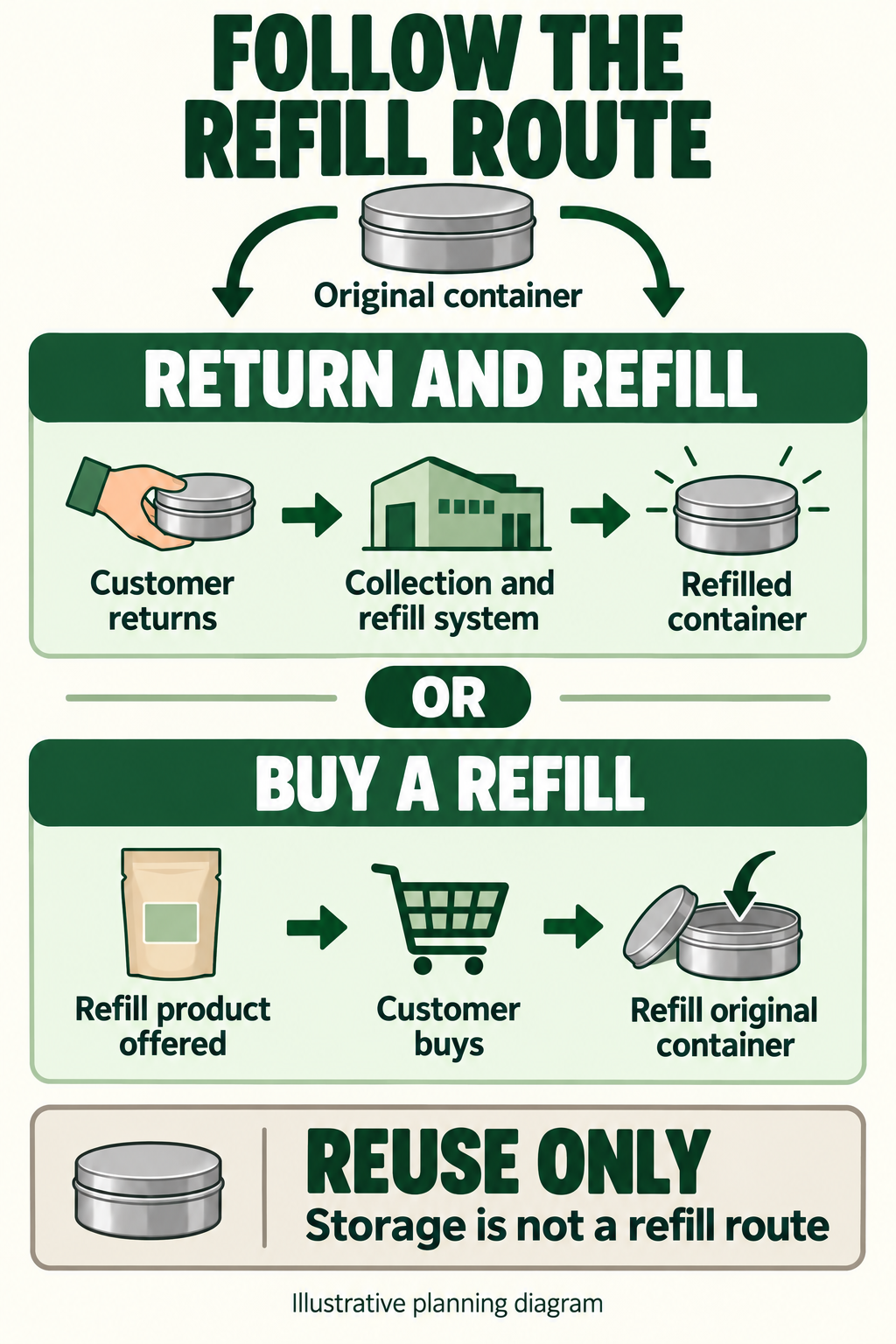
This comparison is a planning aid. It does not approve a particular claim, prove environmental benefits or supply product-safety evidence.
Walk through the route from the customer’s side
Imagine a buyer opens the stationery gift tin three months after purchase. The brand plans to use refillable on the pack. Follow the steps the printed instruction would ask that buyer to take, using the actual publicly available offering rather than the team’s intended future launch.
Can the buyer identify the correct replacement contents? Does the named purchase or return route exist? Do its instructions refer to this tin rather than a visually similar variant? Record an unavailable offer or unclear match as a gap in the customer route.
Do not invent a test period or a required number of refills. If the proposed wording includes a specific repeated-use promise, the responsible reviewer needs evidence for that additional promise. Merely drawing another load of contents inside the tin is not evidence of performance.
In this hypothetical example, suppose the brand currently sells only complete gift tins, provides no return arrangement and has not launched replacement contents. The container can still be kept for storage, but the proposed refill route is unfinished. The useful next decision is to hold the unqualified refillable wording for review, rather than mark it ready because another load fits inside.
Keep a compact route note: original tin identity, current refill source or missing offer, customer purchase/return action, instruction location and the gap to resolve. For the example above, the gap is the actual customer refill offer, not a missing drawing of the box.
Keep refill wording separate from material claims
A refill route does not answer whether the tin contains recycled material or enters a recycling program. Those are separate claims with different evidence. Conversely, a board-content document cannot explain how a customer obtains a refill.
For the wider evidence review, use Packrivo’s material-claim evidence method. Keep the refill route’s scope visible when the wording is reviewed alongside symbols, nearby text and other claims.
If the team changes the refill product, sales area or return arrangement, ask the responsible reviewer whether the old wording still describes the offer. Retain a clear customer instruction rather than using a broad environmental phrase to cover an uncertain service.
Choose the next step before printing
For a working refill offer, prepare the original-container identity, actual refill or collection instructions and proposed claim in context. For a future offer, complete and review that route before treating the wording as ready. For a reuse idea, develop an accurate description of the intended use without implying an operating refill system.
Packrivo can help keep the packaging question connected to supplier discussions. This article does not establish that Packrivo operates a refill service or that the hypothetical tin is available. The brand’s responsible market reviewer must decide the actual wording and any other applicable obligations.
Source accessed 9 October 2026. The eCFR display reported Title 16 current through 6 October 2026. The linked FTC Guides concern US environmental marketing; this planning example is not a legal compliance determination.
A refill offer needs the same container and the same customer market
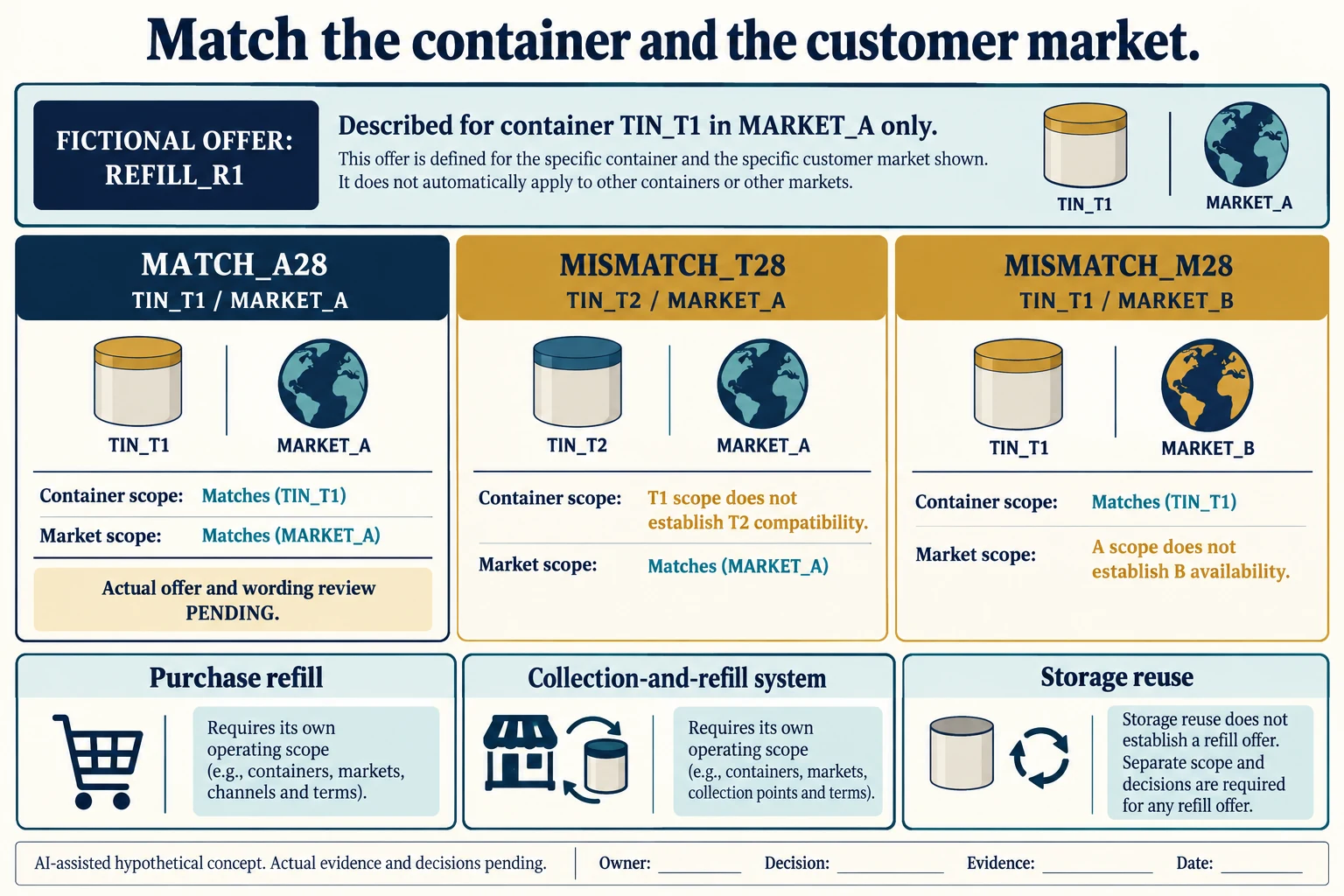
Give the container and the refill separate identities. In a fictional offer premise, REFILL_R1 is described for TIN_T1 in MARKET_A only. Compare that stated scope with three requests: T1 in A, another container T2 in A, and T1 in another market B. The tokens identify the comparison; no refill product, service area, fit or transaction has been verified.
Scroll horizontally if columns extend beyond the view.
| Hypothetical configuration | Named object | Relationship | Input or next scope |
|---|---|---|---|
| FICTIONAL_OFFER28 | REFILL_R1 | assumed describes | TIN_T1_IN_MARKET_A_ONLY |
| MATCH_A28 | MATCH_A28 | uses container | TIN_T1 |
| MATCH_A28 | MATCH_A28 | uses market | MARKET_A |
| MATCH_A28 | MATCH_A28 | requires | CONTAINER_MARKET_CURRENT_OFFER_AND_INSTRUCTION_MATCH |
| MISMATCH_T28 | MISMATCH_T28 | uses container | TIN_T2 |
| MISMATCH_T28 | MISMATCH_T28 | uses market | MARKET_A |
| MISMATCH_T28 | R1_SCOPE | does not establish | TIN_T2_COMPATIBILITY |
| MISMATCH_M28 | MISMATCH_M28 | uses container | TIN_T1 |
| MISMATCH_M28 | MISMATCH_M28 | uses market | MARKET_B |
| MISMATCH_M28 | R1_SCOPE | does not establish | MARKET_B_AVAILABILITY |
| RETURN28 | COLLECTION_SYSTEM | requires | OWN_OPERATING_SCOPE_AND_CUSTOMER_ROUTE |
| REUSE28 | STORAGE_POSSIBILITY | does not establish | REFILL_OFFER |
MATCH_A28 matches the premise’s container and market fields. It still needs evidence that the offer currently exists, appropriate product compatibility, usable purchase instructions and responsible wording review. MISMATCH_T28 cannot borrow T1’s compatibility for T2 merely because the tins look alike. MISMATCH_M28 cannot borrow availability in A for a customer in B. Matching two fields locates the remaining work; it is not permission to print refillable.
For a purchase route, retain the actual replacement-contents identity, where it can be obtained and the instruction connecting it to the original container. A collection-and-refill system has a different customer action and its own operating scope. Keep the two routes separate when comparing an offer. A proposed return address, future product launch or willingness to manufacture another complete tin does not show that the buyer can use either route now.
Reopen the relevant row when the container, contents, market or offer changes. Safety, hygiene and any specific repeated-use promise still require their own evidence. The original storage possibility can remain an honestly described reuse idea while the refill arrangement is unresolved. This worksheet narrows the missing decision to an actual offer and its intended users, rather than another drawing of contents fitting in a tin.
Download the refill packaging container market offer matching record (.csv). It includes the original table fields and scenarios alongside the added relationships. HYPOTHETICAL rows are editorial examples or required review scopes, not actual records. Actual quantity, configuration, component and file identities, materials, process, specification, copy, method, condition, observation, owner, decision, evidence and dates are blank. ACTUAL_BLANK is a separate empty starting row; enter permitted project evidence before using an actual record. A blank means unknown.
Use the Packaging Material Claims: Match the Evidence Scope for its separate question.
Source scope checked 17 October 2026: US FTC section 260.14 concerns an actually offered collection/refill system or purchasable refill product; storage reuse and technical capacity alone do not establish that route. The added configurations and calculations are hypothetical, with actual evidence and decisions pending.
Discuss this packaging specification with Packrivo. We coordinate independent suppliers. MOQ: 500 pieces per product/design; illustrative quantities are not production offers. Confirm materials, samples, price and timing for your project.