
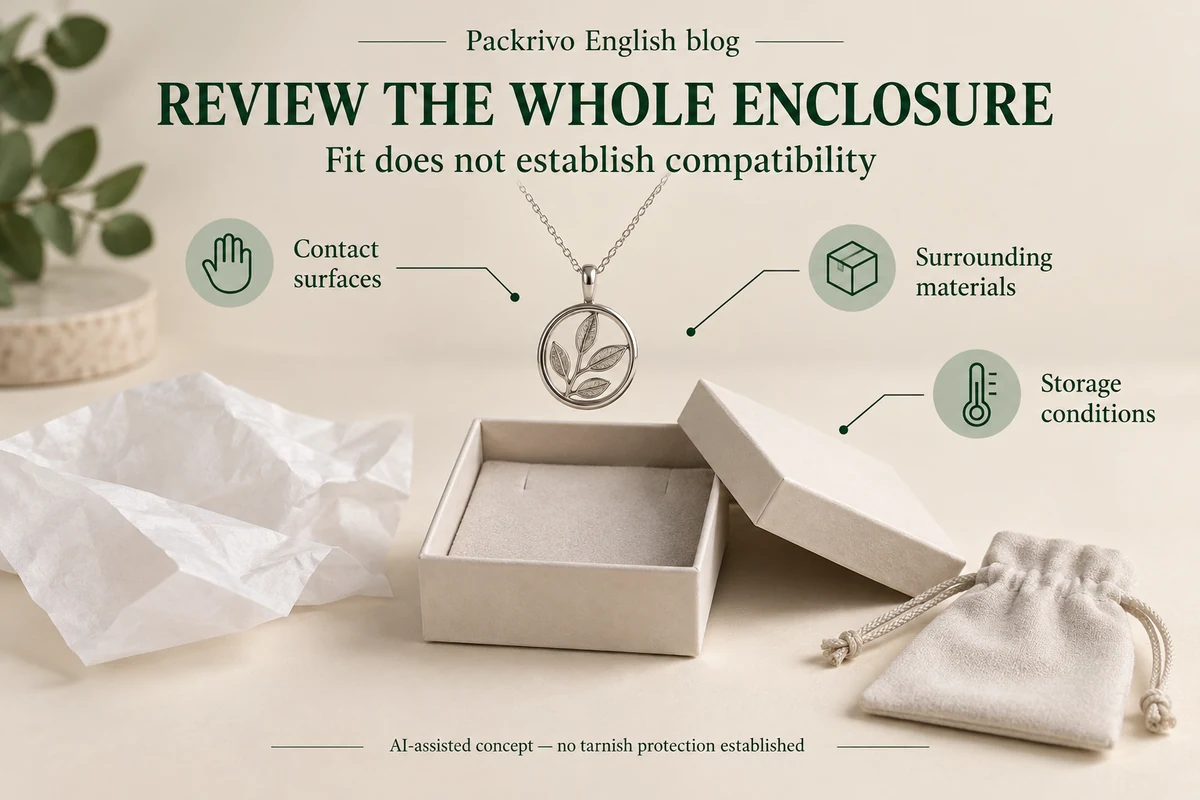
AI-assisted concept cover. Open the cover at full size.
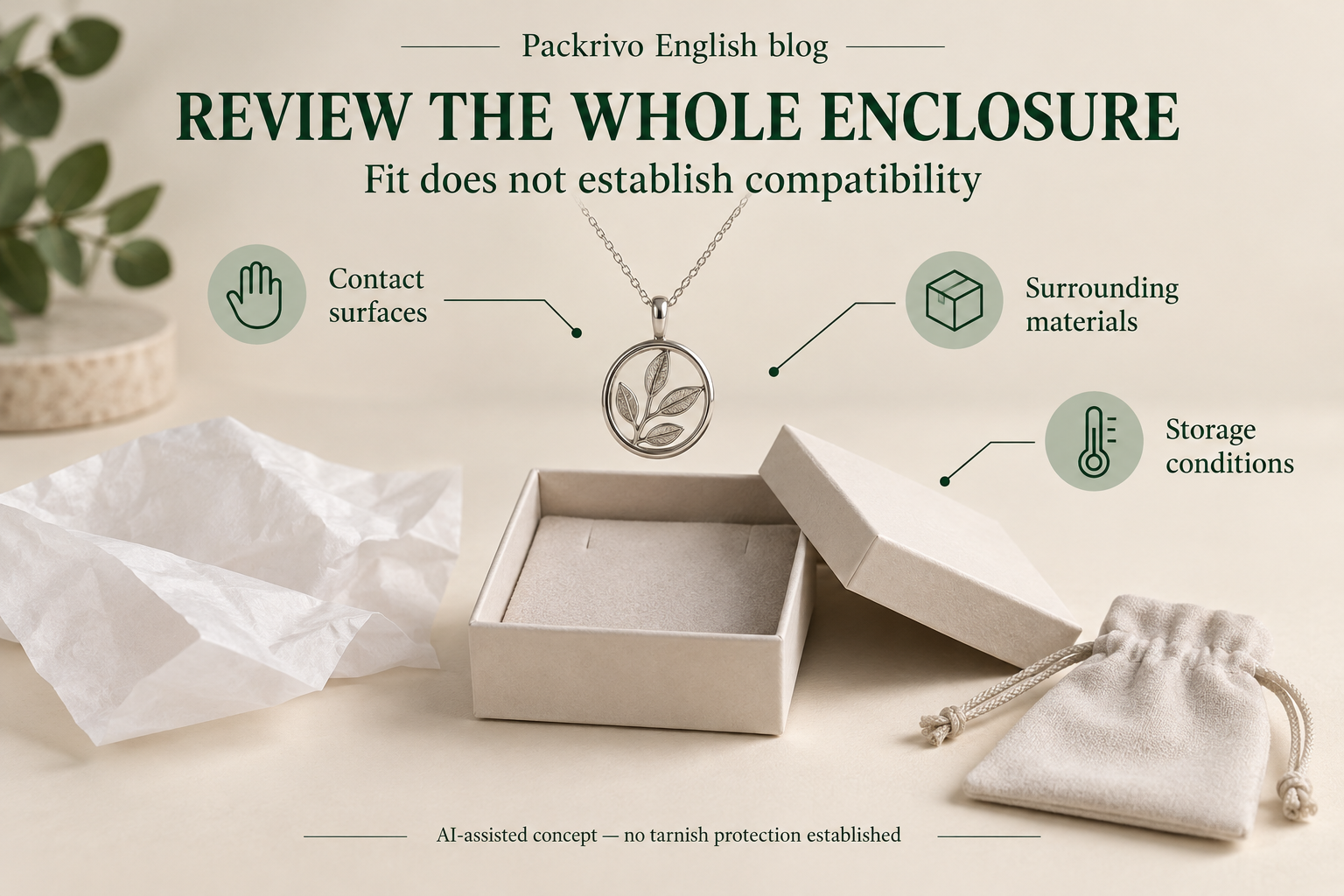
Choose silver jewelry packaging by reviewing the actual metal finish, surrounding materials and expected storage conditions together. A soft insert can hold a piece securely while leaving its chemical compatibility unresolved. Ask the jewelry maker and packaging supplier what evidence supports the complete arrangement before describing it as tarnish resistant.
Small jewelry brands often start with the box shape and presentation. Silver introduces another question: what the item will encounter while enclosed. The right investigation depends on the piece, its finish and the time it may remain in the package.
Identify the metal before choosing a protective claim
Record whether the piece is silver, sterling silver, silver plated or another material, using the maker’s actual specification. Include stones, coatings and other parts that may impose their own care restrictions. A packaging proposal for one finish should not automatically become a proposal for the whole collection.
The Canadian Conservation Institute explains that silver tarnish forms through reaction with sulfur-containing gases. Its silver tarnish explanation concerns conservation science. It doesn’t establish a safe storage duration for a commercial jewelry set or certify a particular packaging material.
Use that distinction to ask a better question. "Can this finished piece remain in the proposed complete package under our intended storage conditions?" needs a response from the people who know the piece and offered materials. A generic description such as "premium velvet" doesn’t answer it.
Map the enclosure as well as direct contact
List the insert face, exposed edges, box lining, tissue, pouch and any added cloth or sachet. Ask the supplier to identify the actual offered materials and treatments. Include whether the package will stay closed in a warehouse or be opened regularly by a retailer.
Separate direct contact from surrounding components. A material can sit elsewhere in the enclosed box and still deserve investigation; looking only at the surface under the jewelry is an incomplete description of the configuration.
CCI’s silver care and storage note discusses specified conservation materials and enclosed storage approaches. Its tissue recommendation includes sulfur-free, archival-quality and unbuffered qualifications. The word "acid-free" on an unrelated commercial tissue description should not be treated as evidence that all those properties have been verified.
Don’t turn museum storage advice into an automatic retail packaging recipe. The jewelry maker needs to review any proposed barrier or protective accessory for the actual piece and its other components.
Ask three different evidence questions
| Question | Information to obtain | Decision it helps |
|---|---|---|
| Does the pack hold and release the piece suitably? | Actual fit, handling and contact observations | Mechanical arrangement |
| Are the offered materials suitable around this finish? | Identified materials and relevant compatibility evidence | Material proposal |
| Can a protective statement be made? | Evidence covering the finished configuration and stated conditions | Customer-facing wording |
A fit sample answers the first question only within its review scope. It doesn’t establish a chemical result or support a promise that silver will stay bright for a stated period.
Compare complete candidates under an agreed review
In a hypothetical project, a brand considers a fabric-faced insert and a separate pouch for the same silver pendant. One candidate has a visually attractive exposed board edge; the other encloses the pendant in a proposed fabric layer. Both need the actual material identities before the brand can compare them usefully.
Have the jewelry maker or qualified reviewer define the appropriate assessment. Identify the pieces, packaging candidates, initial condition and intended exposure. Keep observations tied to that assessment. A photograph taken immediately after packing is a starting view, not proof of long-term protection.
If a candidate changes, identify whether the insert, lining, protective layer or jewelry finish changed. Compare the new complete arrangement rather than retaining a protective claim from a different configuration.
Keep presentation and care instructions consistent
Review any printed instruction with the jewelry maker. A suggestion to retain the box for storage needs to match the package’s assessed purpose. Avoid adding an unverified "anti-tarnish" promise merely because a component supplier uses that phrase.
Packrivo’s packaging contact review helps distinguish visible handling marks from an assumed cause. Its insert fit measurements cover the separate mechanical fit question.
Bring the actual jewelry specification, intended storage use and complete material proposal into the packaging discussion. That allows sourcing questions to proceed while the responsible product reviewer decides compatibility and care wording.
Sources checked 8 October 2026. CCI guidance concerns collection conservation; this buyer planning article provides no cleaning instructions, validated retail storage period or Packrivo tarnish-prevention guarantee.
Reopen the enclosure review when a nearby material changes
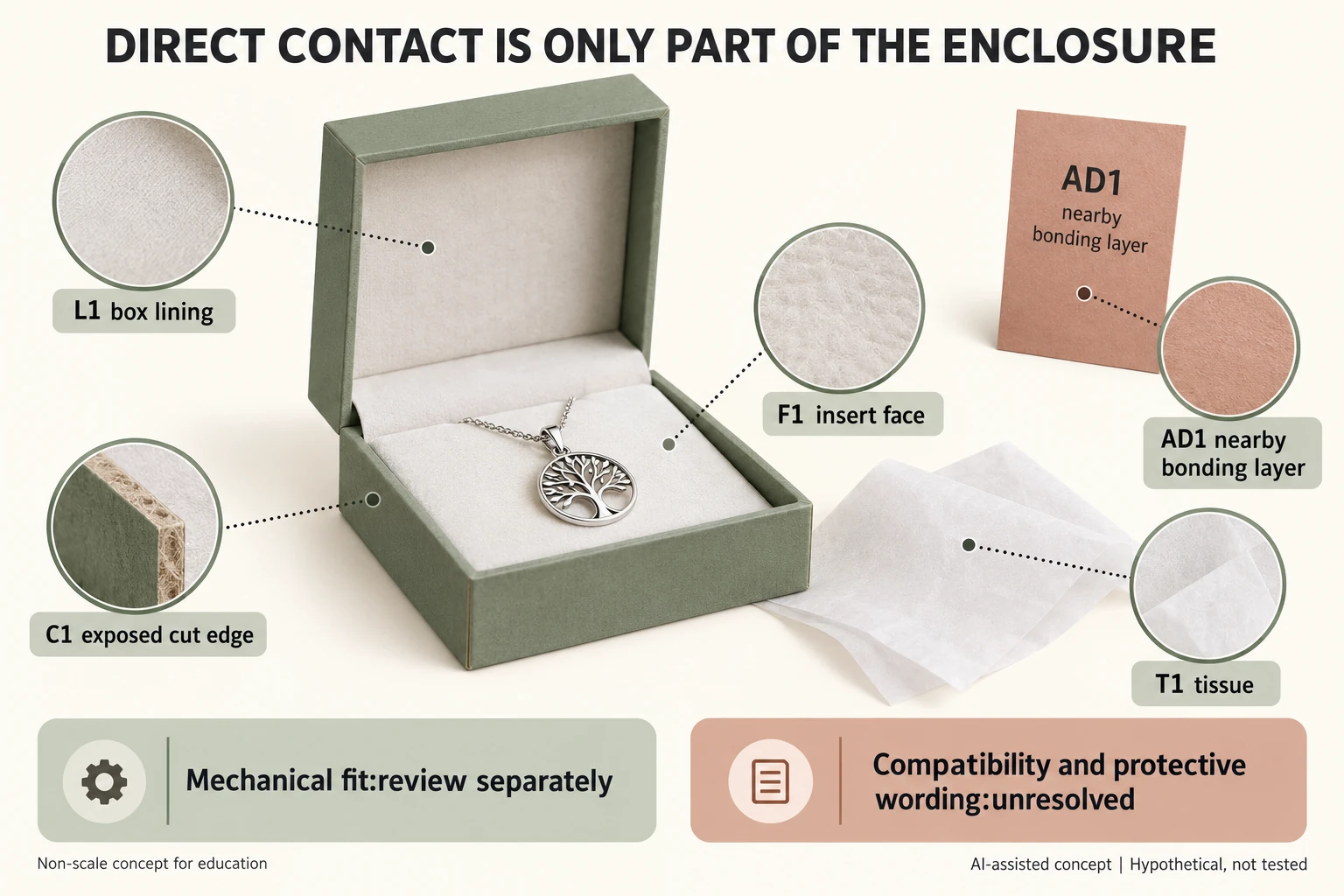
For an invented silver-colored pendant package, list F1 insert face, C1 exposed cut edge, L1 lining, AD1 bonding layer and T1 tissue. These identities are proposals, not verified material compositions. Actual metal/finish identification must come from the maker; a silver appearance alone is insufficient.
Scroll horizontally if columns extend beyond the view.
| Identity | Relationship to investigate | Evidence still needed |
|---|---|---|
| F1 face | Proposed direct support | Actual material and finish compatibility |
| C1 edge | Nearby; contact may change in handling | Exposed construction and actual location |
| L1 lining | Surrounding enclosure | Offered material/treatment |
| AD1 layer | Nearby bonding proposal | Actual identity and enclosure scope |
| T1 tissue | Proposed surrounding component | Actual properties; no claim inferred |
If AD1 changes to AD2 while mechanical fit appears unchanged, retain the fit observation under its scope and return the changed enclosure to the responsible material reviewer. Do not carry a protective claim across that change simply because the pendant still sits neatly.
The connectors identify materials to ask about; they show no gas path or assessed exposure. Tissue outside the box is a material symbol, not an approved packing or storage instruction. CCI's conservation guidance explains why silver and its surroundings deserve specific review, but it does not certify these proposed materials or define a retail storage period. Keep chemical compatibility, mechanical fit and customer-facing wording separate. No sulfur-free, anti-tarnish or cleaning claim is supplied.
Download the silver jewelry packaging tarnish record (.csv). HYPOTHETICAL rows are invented examples. Use ACTUAL_BLANK for permitted project inputs; replace that row label only when recording actual facts. Empty evidence, observation and date fields mean unknown or not performed, never acceptance. Keep checkpoints and revisions separate.
Send the maker's actual finish specification, complete enclosure materials and intended storage/use scope before requesting compatibility or protective wording. Packrivo coordinates independent suppliers. These records establish no supplier offer, service availability or MOQ exception; its published baseline is 500 pieces per product/design.