
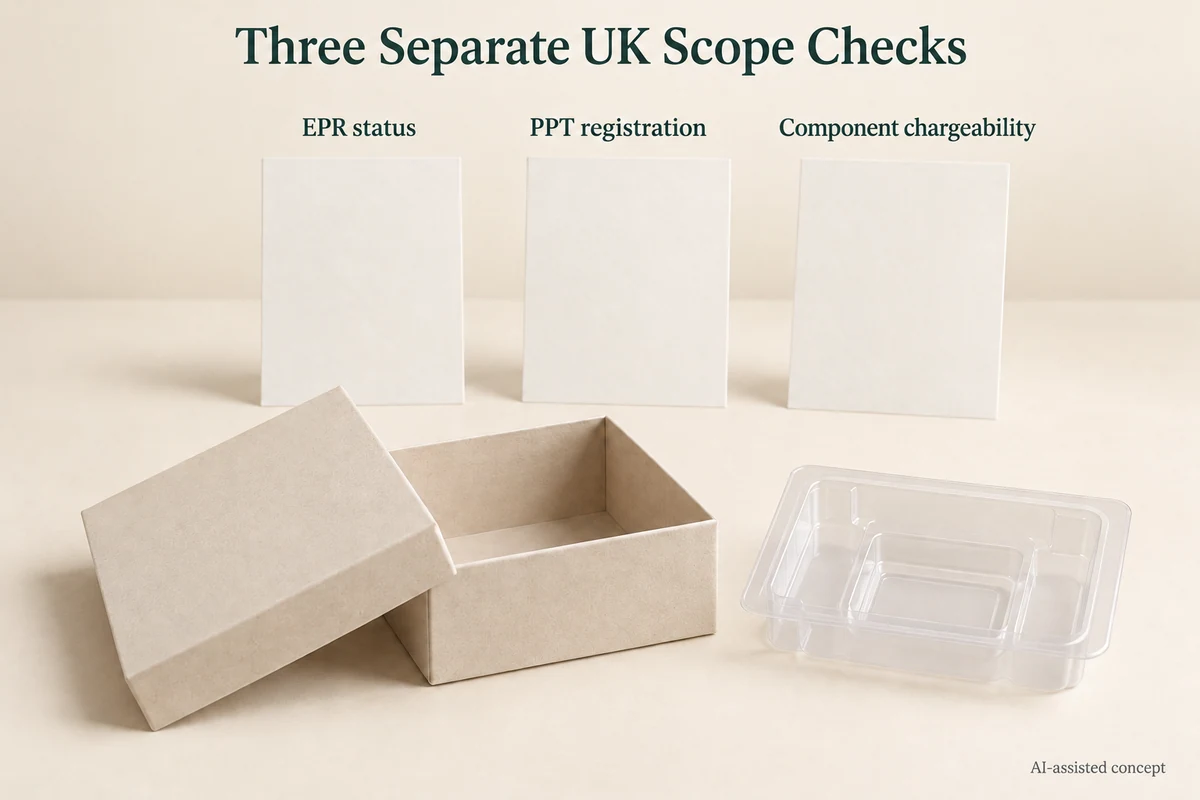
Assess UK packaging EPR, Plastic Packaging Tax registration and component chargeability separately. EPR examines the responsible organisation and its packaging activities; Plastic Packaging Tax examines finished plastic components manufactured or imported by the relevant person. A recycled-plastic claim or a complete-carton weight cannot answer all three questions.
The comparison below is general packaging education. It does not determine a particular business’s reporting, registration or tax position.
Keep the responsible party and measurement basis distinct
The UK EPR eligibility guidance starts with packaging activities, UK establishment, relevant organisation or group, turnover and attributable packaging quantities. Activity-allocation rules determine which packaging the person must count.
HMRC’s Plastic Packaging Tax registration guidance starts with UK manufacture or import of finished plastic packaging components. It includes relevant components imported filled with goods and explains whose behalf an import is made on. Its responsible-person test cannot simply be replaced with the EPR brand-owner result.
| Question | UK packaging EPR | Plastic Packaging Tax |
|---|---|---|
| Who needs assessment? | The relevant UK-established organisation or group carrying out packaging activities | The relevant manufacturer or importer of finished plastic components |
| What quantity is counted? | Attributable packaging across the relevant materials and activities | In-scope finished plastic components, with the applicable exclusion rules |
| Which time basis applies? | The assessment year and packaging/accounts reference periods specified for EPR | The rolling 12-month and expected next-30-day registration tests |
| What result is required? | Organisational status and applicable producer responsibilities | Registration position, then a separate chargeability result for each component |
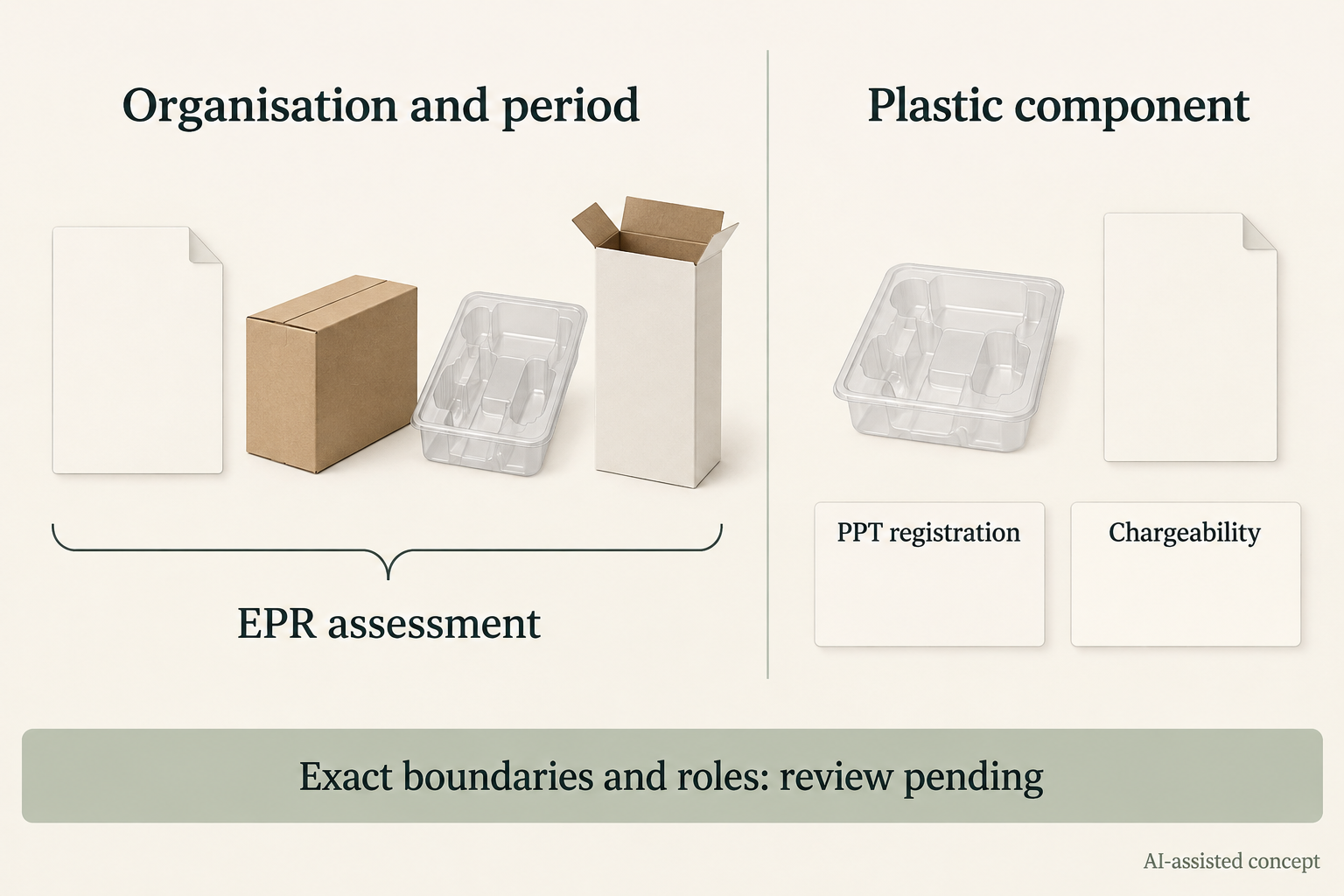
For a hypothetical brand buying finished empty boxes and plastic inserts from a UK supplier, that purchase alone does not make the brand the PPT manufacturer or importer. The supplier’s role and the brand’s own packaging activities still need review under their respective rules.
For a hypothetical import of already packed gifts, identify the party responsible for the import and the EPR allocation of each packaging item. A carrier or intermediary’s name on a document does not by itself settle every role. No real company or shipment is assumed in these examples.
Separate component weight from the recycled-plastic percentage
A paperboard box and a separately manufactured plastic insert should remain identifiable. Do not combine them with the goods into one carton-weight figure and use it for both regimes.
Under HMRC’s component-scope guidance, a mixed-material component is treated as plastic when plastic weighs more than each relevant other material. That test differs from simply asking whether plastic exceeds half of the total weight. The material groups and adhesive conditions in the guidance also matter.
Once the component’s scope is established, the recycled-plastic percentage uses qualifying recycled plastic divided by all plastic in that component. Non-plastic board or metal is not added to that percentage’s denominator. The whole component’s relevant weight and the plastic-content percentage therefore answer different questions.
Obtain the actual component specification and supported material weights. A supplier’s recycled-content wording without its basis cannot establish the tax calculation. The material-claim evidence guide helps identify what a document covers; it does not determine UK tax treatment.
Use the correct registration clock and preserve boundary questions
HMRC’s registration guide uses 10 tonnes or more of relevant finished plastic components manufactured or imported in the previous rolling 12 months, or expected in the next 30 days. The look-back test is made from the last day of the month; the forward test can apply when the expectation arises. Follow the guide’s liability-date and registration requirements rather than converting both tests into one calendar-year total.
EPR uses another basis. For its 2026 assessment guidance, Defra directs readers to packaging supplied or imported during 2025 and the specified accounts available before 7 April 2026. An eligibility reference period and the packaging-data period being reported must not be treated as interchangeable.
Regulation 24 of the 2024 EPR regulations uses “more than” turnover and packaging thresholds, with defined relative-year and group conditions. The government overview contains an inconsistent wording boundary around exactly £1 million. Keep a business at an exact boundary unresolved for review against the current regulations and relevant regulator guidance; this article does not resolve its classification from a summary table.
Every threshold record should identify the entity, applicable packaging, measurement period and source version. A box drawing contains none of the necessary organisational history or future manufacturing/import quantities by itself.
Non-chargeable components can still count for registration
HMRC’s component guidance states that plastic packaging with at least 30% qualifying recycled plastic is not chargeable on that basis, but still counts towards the applicable registration threshold. Retain evidence for the proportion and material source. This is why a supplier’s 30% statement cannot support a blanket no-registration conclusion.
HMRC also distinguishes tax exemptions from exclusions and does not treat them all identically for registration. The exemptions and exclusions guidance includes a conditional imported transport-packaging exemption. It must not be extended to every retail box or insert merely because the consignment travelled internationally.
Check the actual component and use. A plastic presentation insert and a separate outer transport component can need different treatments. The article has not established an exemption for either hypothetical item.
The component guide updated 28 August 2026 also announces a change to qualifying pre-consumer recycled plastic from 1 April 2027. That future change is not already effective on the 9 October 2026 review date. Keep production/import dates and the supporting source with any recycled-plastic record.
Close three outcomes with their own evidence
Keep an EPR organisational-status result, a PPT registration result and a PPT component-chargeability result. Record unresolved roles or weights in the specific investigation they affect.
If only a combined carton weight is available, request the component and material breakdown. If recycled content is unsupported, leave the relevant chargeability assumption open. If the organisation’s reference-year or group position is unknown, the packaging specification cannot close its EPR assessment.
Packrivo can help organize packaging specifications and supplier questions for the responsible UK business to review. This does not create a tax-advice, registration or regulatory-filing service.
Sources accessed 9 October 2026. EPR eligibility guidance was updated 19 August 2026; the cited PPT component guide was updated 28 August 2026 and registration guide 31 March 2023. Current legislation was read separately from government summaries; exact boundary and real-business applicability remain subject to the appropriate review. No accounts, tax amounts, return or registration were assessed or submitted. UK EPR is separate from EU PPWR. Any accompanying illustration is an AI-assisted concept.
A plastic minority can still be the heaviest material category
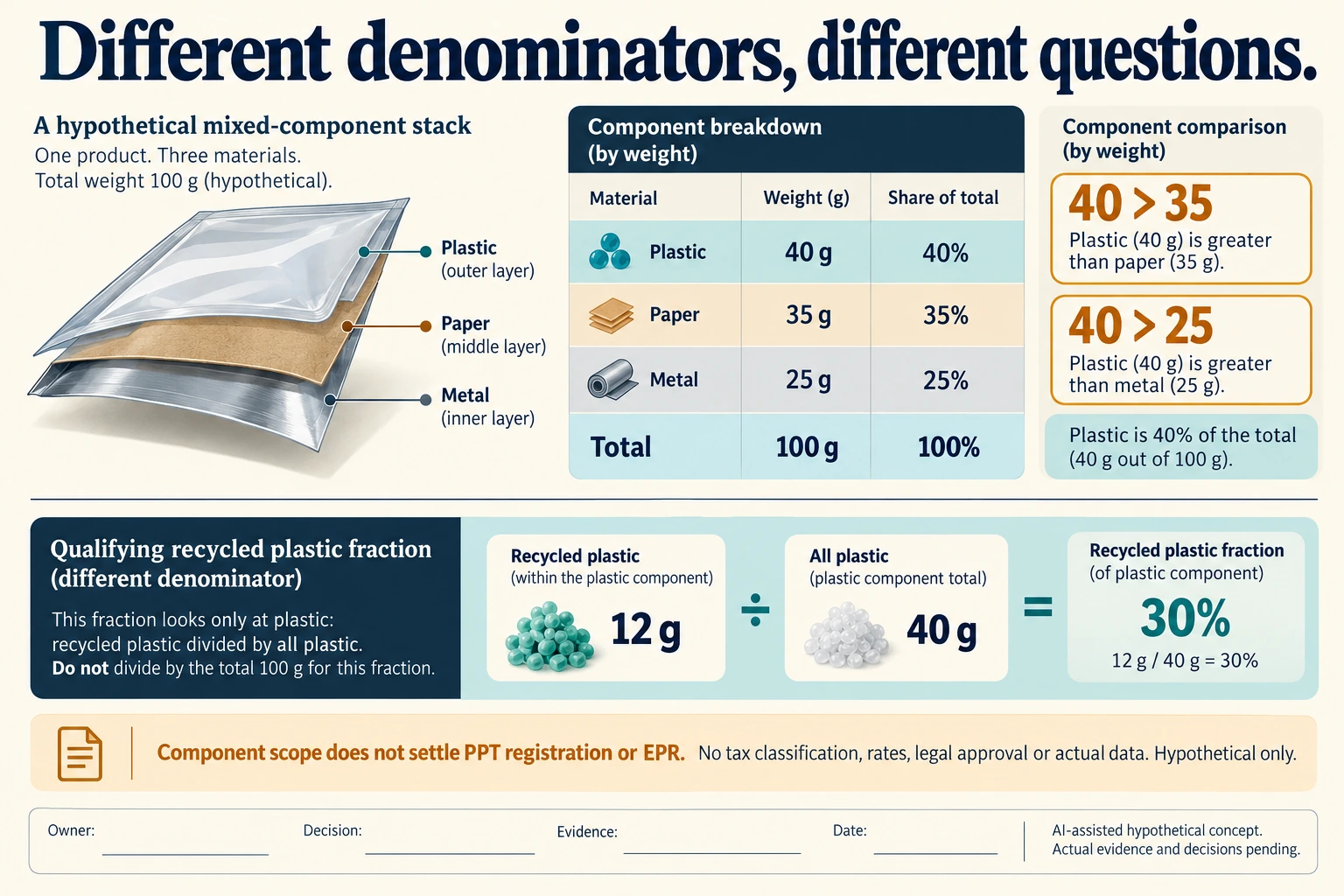
Use a separate invented component, MIX29, to test two different denominators. Assume it is a single finished component containing 40 g plastic, 35 g paper and 25 g metal, with the categories established on the relevant guidance basis and no separate adhesive question hidden in those figures. Its total is 100 g. Plastic is only 40% of the total, but 40 exceeds both 35 and 25. Under the stated HMRC material comparison, being below half of the total does not remove the plastic-component question.
Scroll horizontally if columns extend beyond the view.
| Hypothetical configuration | Named object | Relationship | Input or next scope |
|---|---|---|---|
| MIX29 | PLASTIC | assumed input | 40 g |
| MIX29 | PAPER | assumed input | 35 g |
| MIX29 | METAL | assumed input | 25 g |
| MIX29 | COMPONENT | calculated from | PLASTIC_MASS+PAPER_MASS+METAL_MASS; 100 g |
| MIX29 | PLASTIC | calculated from | PLASTIC_MASS/TOTAL_MASS; 0.4 fraction |
| MIX29 | QUALIFYING_RECYCLED_PLASTIC | assumed input | 12 g |
| MIX29 | PLASTIC_ONLY | calculated from | RECYCLED_MASS/PLASTIC_MASS; 0.3 fraction |
| MIX29 | PLASTIC40 | strictly greater than | PAPER35_AND_METAL25 |
| EPR_A29 | RELEVANT_QUANTITY | assumed input | 25.4 tonnes |
| EPR_A29 | REG24_6_QUANTITY | calculated from | nearest_tonne(EPR_A29_RAW); 25 tonnes |
| EPR_B29 | RELEVANT_QUANTITY | assumed input | 25.6 tonnes |
| EPR_B29 | REG24_6_QUANTITY | calculated from | nearest_tonne(EPR_B29_RAW); 26 tonnes |
| EPR29 | ROUNDED_QUANTITY | test strict gt | 25_TONNES_NOT_RAW25_01 |
| MIX29 | RECYCLED_CONTENT | does not settle | PPT_REGISTRATION_OR_EPR |
Now assume 12 g of its 40 g plastic is qualifying recycled plastic under the applicable dated rules. The illustrative recycled-plastic fraction is 12 ÷ 40 = 30%, not 12 ÷ 100 = 12%. The non-plastic material does not belong in this fraction’s denominator. Recycled qualification, component scope and the actual evidence remain distinct. A hypothetical fraction at 30% supplies no actual non-chargeability decision; even an established non-chargeable component can still count for registration under the relevant rules.
EPR has a separate rounding issue. Regulation 24(6) requires the relevant packaging amount to be expressed to the nearest tonne. Assuming the correct relevant-year, organisation/group and allocation basis has first been established, invented amounts 25.4 tonnes and 25.6 tonnes become 25 and 26 tonnes respectively. Under a strict more-than-25-tonne quantity limb they land on different sides. This is only a quantity-limb illustration, not an organisational classification; neither raw 25.01 tonnes nor an overview table alone supplies the full answer.
The later source check actually obtained Regulation 24 and read its key clauses, while the earlier WebGPT access limitation remains part of the historical research record. The GOV.UK prose and table still differ around exact turnover and tonnage boundaries. Keep that discrepancy open rather than silently adding an equals sign. Ask the responsible UK reviewer to reconcile the actual entity, period, group, allocation and rounding before combining any EPR outcome with PPT registration or component treatment. The announced April 2027 recycled-plastic change is not applied early here.
Download the mixed packaging plastic weight recycled fraction UK scope record (.csv). It includes the original table fields and scenarios alongside the added relationships. HYPOTHETICAL rows are editorial examples or required review scopes, not actual records. Actual quantity, configuration, component and file identities, materials, process, specification, copy, method, condition, observation, owner, decision, evidence and dates are blank. ACTUAL_BLANK is a separate empty starting row; enter permitted project evidence before using an actual record. A blank means unknown.
Use the Packaging Material Claims: Match the Evidence Scope for its separate question.
Source scope checked 17 October 2026: HMRC component, registration and exemption guidance use distinct scopes. The later independent check obtained Regulation 24 and read clauses 1–7, including nearest-tonne treatment; GOV.UK prose/table boundary differences remain unresolved. No actual organisation, registration, exemption or tax position was decided. The added configurations and calculations are hypothetical, with actual evidence and decisions pending.
Discuss this packaging specification with Packrivo. We coordinate independent suppliers. MOQ: 500 pieces per product/design; illustrative quantities are not production offers. Confirm materials, samples, price and timing for your project.