
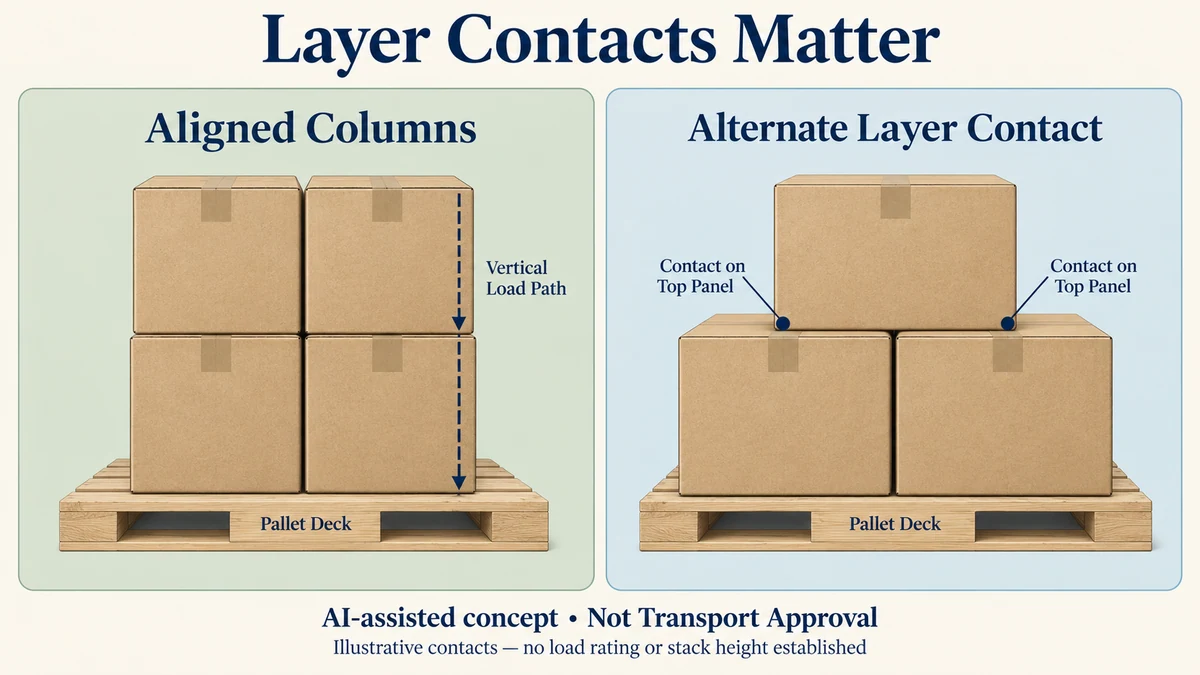
A pallet pattern should do more than fit the maximum number of cartons into a rectangle. It must also support the cartons above, preserve support at the pallet deck and allow the complete load to be restrained during handling.
Use the Regular Slotted Shipping Cartons: Size Around the Inner Pack as a structural reference when identifying the cartons in the proposed pallet pattern. Obtain the actual carton dimensions, condition and loading evidence; the concept does not provide a stacking-strength rating.
Straight column stacking and interlocking layers address different parts of this problem. Aligned columns generally preserve a clearer vertical load path. Interlocking arrangements can help resist movement between layers under suitable conditions, but they change where upper cartons bear on those below.
Neither pattern is automatically safe. A useful packaging proposal shows the actual carton arrangement, pallet construction, loaded weight, layer contacts and intended restraints before anyone decides whether the complete load is suitable for a particular journey.
Column stacking preserves a clearer vertical load path
In a column-stacked arrangement, each carton sits directly above a carton in the previous layer. The vertical edges and corners remain aligned from one layer to the next.
This alignment matters because a corrugated shipping carton is not a solid block. Its erected walls, corners, panels and closures form a structure that responds to the loads applied to it.
When identical cartons are stacked directly above one another, the upper carton can transfer load towards corresponding structural regions below. Moving an upper carton across a lower carton’s panel or joint changes that contact relationship.
FedEx Freight’s US LTL packing guidance, accessed 10 October 2026, recommends column stacking to improve top-to-bottom compression strength. It also describes load-protector pads between tiers as a way to improve stability.
This is a general carrier recommendation, not a compression rating for a particular carton.
A column arrangement can still move sideways if the cartons are inadequately restrained. It can also perform poorly when the pallet deck fails to support important parts of the bottom layer.
Column alignment answers a vertical-support question. It does not independently establish that the entire pallet is stable.
Interlocking layers change the contact between cartons
An interlocking arrangement changes the positions or orientations of cartons between layers. Instead of every upper carton sitting directly above the same footprint, some cartons can span joints between cartons below.
This may help limit relative movement in a suitably designed load. However, it also changes the vertical support points.
Consider an upper shipping carton whose corner sits over the top panel of a lower carton rather than over the corresponding lower corner. The load is no longer being introduced at the same structural location as it would be in a column stack.
Whether that difference is acceptable depends on the real carton construction, contents, contact surfaces, load and handling conditions. A top-view pattern cannot quantify the effect.
FedEx’s US pallet guidance, accessed 10 October 2026, describes interlocking as a possible stability improvement when carton contents are rigid. It also advises maintaining appropriate corner-to-corner and edge-to-edge contact.
That rigid-content condition matters. Cartons holding glass candles, lightweight empty gift boxes or jewellery packaging components may have very different internal support arrangements. Their outer dimensions alone do not establish whether the contents provide suitable support.
A historical UPS Air Freight Packaging Pointers guide from 2005 favours corner-aligned column stacking and also identifies interlocking as a possible stability improvement when the contents are rigid. Its rigid-content condition and appropriate corner-to-corner and edge-to-edge support matter; the guidance is not a blanket contrast with FedEx’s conditional advice. This older source is historical context, not a current acceptance rule for every UPS service.
These recommendations should not be reduced to a universal winner. The buyer needs to ask two separate questions: how does vertical load pass through this arrangement, and how will the cartons be kept together during handling?
Twelve cartons fit the hypothetical footprint on paper
Consider an entirely hypothetical planning example.
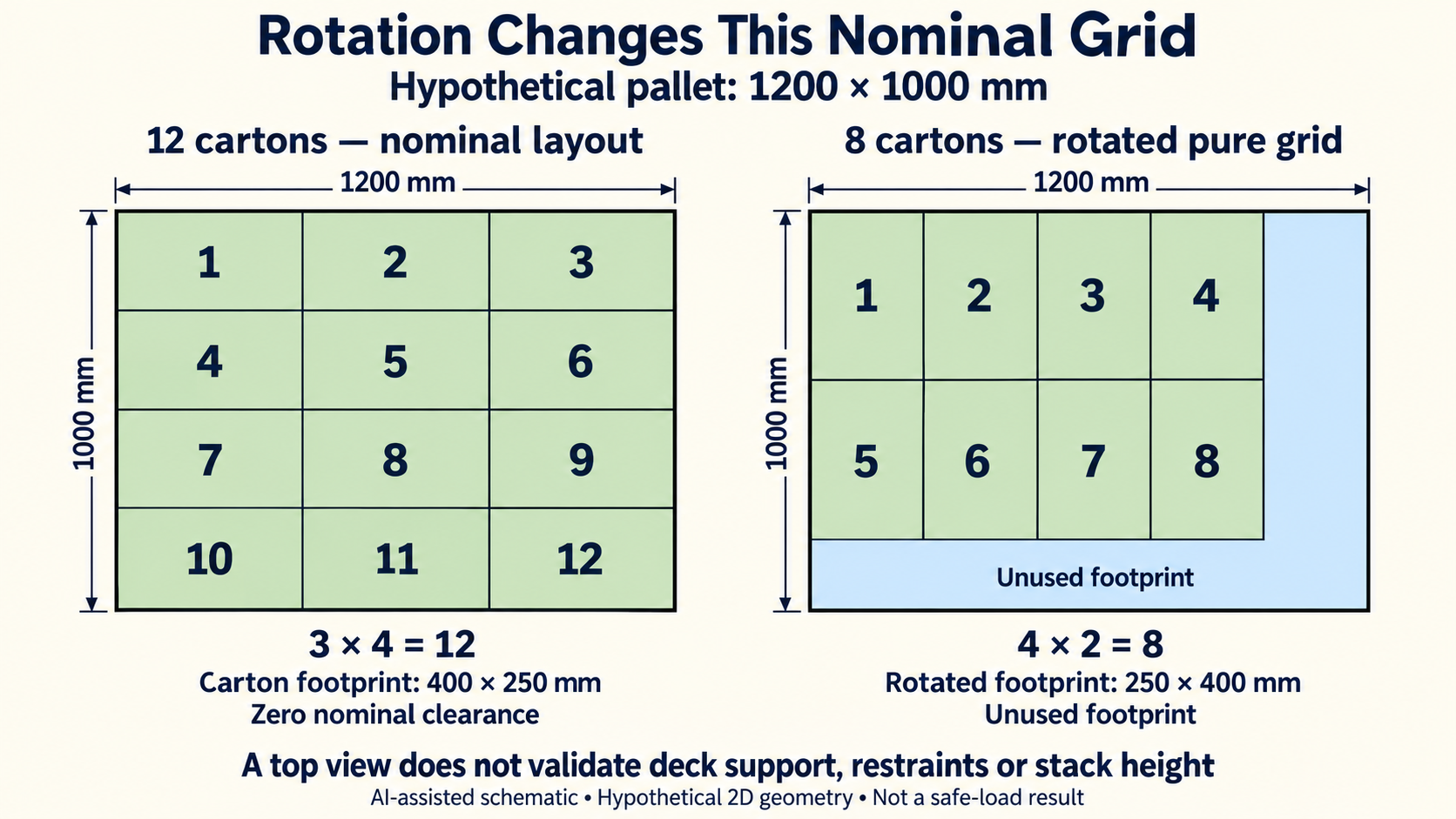
A brand proposes a pallet with a nominal footprint of 1200 × 1000 mm. Each finished, closed shipping carton has a proposed outside footprint of 400 × 250 mm.
For an aligned layout:
- Three cartons along the 1200 mm direction occupy 3 × 400 = 1200 mm.
- Four cartons along the 1000 mm direction occupy 4 × 250 = 1000 mm.
- The resulting rectangular layer contains 3 × 4 = 12 cartons.
The area calculation agrees. Each carton occupies a nominal 0.10 m², and twelve occupy 1.20 m², equal to the nominal pallet footprint.
That is a geometric planning result, not evidence of a feasible loaded pallet.
The layout has zero nominal clearance. It does not account for differences between nominal and actual usable pallet-deck dimensions, dimensional variation in finished cartons, bulging, tape or other projections, or the practical positioning of cartons during loading.
Even a small change in the finished footprint can prevent the proposed arrangement from fitting as drawn.
Turning every carton through 90 degrees does not automatically preserve the twelve-carton grid. In that uniform rotated orientation, each carton occupies 250 mm along the 1200 mm direction and 400 mm along the 1000 mm direction. Neither pallet dimension divides evenly by its corresponding carton dimension.
A mixed-orientation layout might be proposed, but it must be drawn and checked carton by carton. It cannot inherit the aligned layout’s count simply because the total carton area is unchanged.
Most importantly, twelve cartons in one layer says nothing about the permissible number of layers, total payload or safe stacking height.
The bottom layer must meet the actual pallet deck
A pallet’s nominal outside dimensions do not describe every support surface beneath the cartons.
Wooden pallets may have spaces between their top deck boards. Different pallet constructions also distribute support differently. A carton can be fully inside the pallet perimeter while one of its bottom corners lies over a gap.
The position of each carton therefore matters relative to the actual deck boards, not just the pallet’s rectangular outline.
The packing reviewer should overlay the bottom-layer layout onto the deck-board arrangement. This reveals where carton corners and edges are supported and where the proposed base might bridge unsupported spaces.
FedEx’s pallet guidance describes bottom load-protector pads as a means of providing a more level surface and helping prevent cartons from entering gaps between boards.
Such a pad is not automatically a structural solution. Its proposed material, construction and effect on the loaded system still need evaluation.
Avoid cartons extending beyond the pallet perimeter. Also avoid treating a visually neat, flush edge as proof that the base is properly supported.
A stable unit needs more than an efficient layer pattern
Even well-aligned cartons need a way to remain together as one handling unit.
A palletized load may encounter lifting, changes in direction, vibration, braking, temporary storage and contact with other freight. These conditions create demands that are different from a static top-down load.
Interlayer sheets, load protectors, edge boards, stretch film and banding have different roles. For example, a tier sheet may change contact between layers, while suitable restraint can help prevent cartons from separating or shifting relative to the pallet.
The proposed securing method must be assessed as part of the actual load, including how the restraint connects the cartons to the pallet.
FedEx Freight’s current packing guidance distinguishes stacking methods from securing materials, including edge boards, banding and stretch wrap. These are related but separate design decisions.
Adding more wrapping does not automatically restore lost carton support. Likewise, a correctly aligned column pattern does not replace the need to evaluate the restraint system.
Neither a wrapping specification nor a safe stacking height can be inferred from the twelve-carton footprint calculation.
Compare complete pallet candidates at the layer interfaces
Return to the hypothetical 1200 × 1000 mm pallet.
Candidate A uses the aligned 3 × 4 arrangement. Its nominal count is twelve cartons per layer, and corresponding carton footprints align between consecutive layers.
This gives a clear starting arrangement for reviewing vertical contacts. But the reviewer still needs the actual carton height and mass, intended number of layers, pallet-deck construction, support conditions and proposed restraint system.
Candidate B uses an alternative rotated or interlocking arrangement. Before treating it as a competing solution, the packing party must resolve its complete geometry. The carton count, gaps, orientation and support relationships cannot be assumed from Candidate A.
For Candidate B, a layer-interface view should show whether upper carton edges and corners bear over supported regions of the lower layer or cross joints and panels differently.
Compare the two candidates using the same actual filled-carton specification and intended handling conditions. Otherwise, changes to the cartons or contents could be mistaken for effects of the layer pattern.
A useful comparison package contains a dimensioned top view of every distinct layer and a side section showing the proposed vertical arrangement. It also identifies the contact between layers, carton orientation, deck boards and gaps, pallet perimeter, load distribution, proposed restraint materials and complete loaded dimensions and mass.
Mark estimated values as estimates. Unknown carton strength, content rigidity, actual weight and handling conditions remain open questions rather than values to infer from the drawing.
The meaningful output is not a preferred pattern in isolation. It is a complete candidate unit load that a responsible packing, engineering or freight reviewer can evaluate.
The intended transport service determines the next evaluation
Different distribution routes can expose the same pallet to different handling and stacking conditions.
A pallet intended for warehouse storage, domestic less-than-truckload transport, air freight or an international shipment may need different checks. Carrier rules also depend on the actual service, contents, dimensions, weight and handling arrangement.
Use the selected carrier’s applicable current terms and packing guidance rather than treating one general article as approval for all services.
If the technical reviewer cannot yet establish whether the cartons can support the proposed load, or whether the restraints will keep the unit stable, the buyer should leave the pattern unresolved and obtain the necessary project-specific assessment.
For a small jewellery, candle or gift brand, the immediate purchasing decision is therefore straightforward: compare layer patterns by vertical support, deck support and restraint as one loaded system, not by cartons per layer alone.
Packrivo can help organise the packaging specifications and coordinate the questions through a packaging enquiry. The packing party, qualified technical reviewers and relevant carrier remain responsible for evaluating the actual arrangement and its intended transport conditions.
Source scope: FedEx and FedEx Freight’s undated US carrier guidance was accessed on 10 October 2026. The UPS reference is historical, dating to 2005. No actual pallet, carton, restraint system or transport performance was tested or verified for this article.
Access boundary: the relevant UPS page-8 wording was checked through the official indexed document excerpt. Direct PDF access failed in this review, so this article does not claim a fresh visual review of the complete historical PDF or access to a current UPS acceptance standard.
Recheck the declared grid when finished carton dimensions change
Extend the nominal 1200 x 1000 mm example with a separate invented finished footprint of 401 x 251 mm. The declared 3 x 4 grid would occupy 1203 x 1004 mm, exceeding that nominal rectangle by 3 and 4 mm. This is hypothetical geometry, not a standard tolerance, measured carton or safe pallet decision.
Scroll horizontally if columns extend beyond the view.
| Case | Declared3x4 extent | Nominal rectangle comparison | What remains open |
|---|---|---|---|
| 400x 250 mm input | 1200x 1000 mm | Zero nominal margin | Actual deck, contacts and restraint |
| 401x 251 mm input | 1203x 1004 mm | 3 mm /4 mm excess | Cannot retain this declared grid as fitting |
| Layer/deck/restraint | Three separate views | No alternative count calculated | Complete unit-load technical review |
Do not round the second footprint back to the first or infer that some different mixed pattern must hold twelve. Any alternative needs its own complete layer geometry. These assumed one-millimetre changes are not a supplier tolerance or a prediction of bulging.
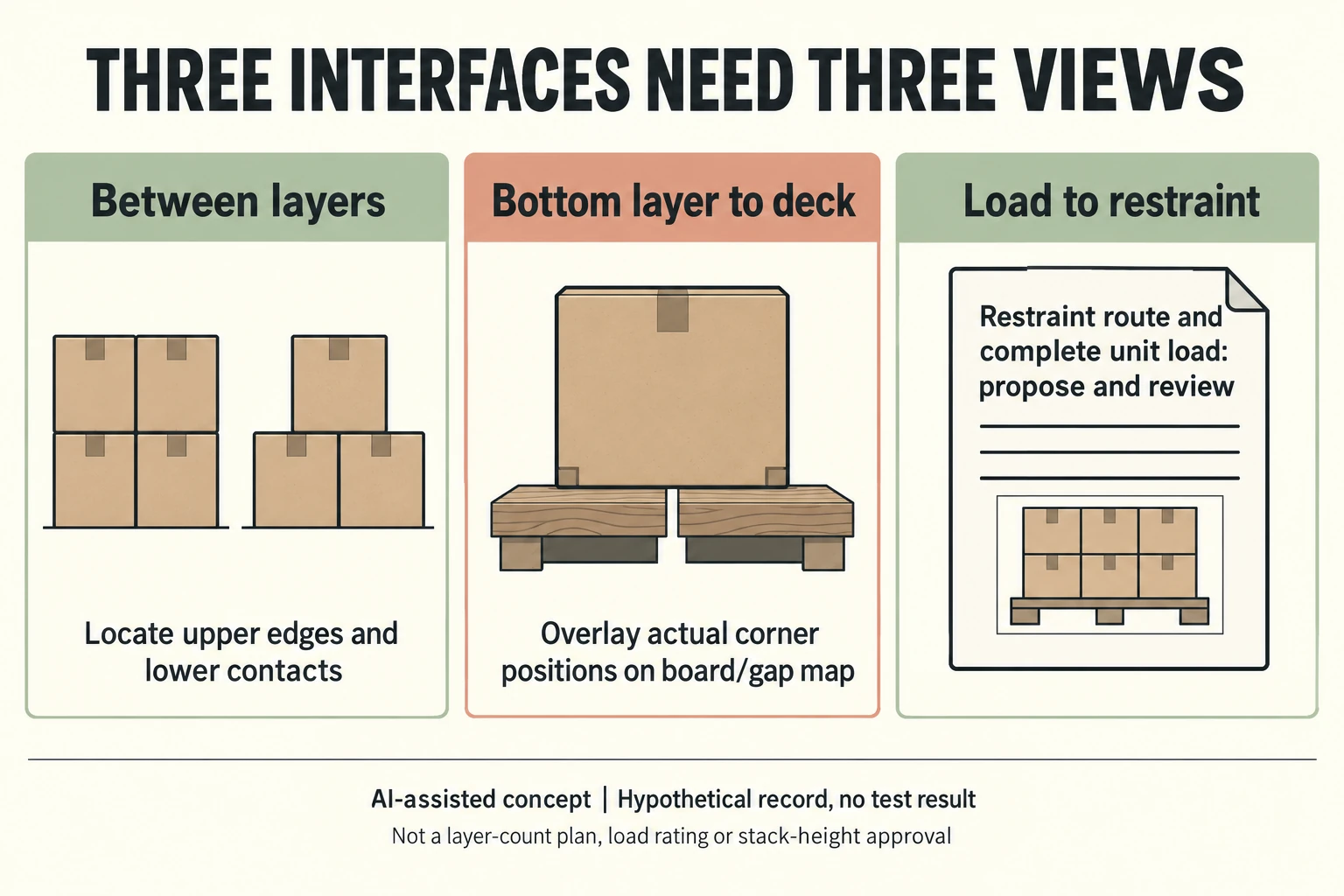
The figure illustrates contact locations, not equal carton counts or a complete interlocking plan. Overlay actual bottom corners on the actual deck-board/gap map and obtain the restraint route separately. A footprint calculation supplies no payload, number of layers or stack height. The CSV leaves actual support and technical decisions blank; no drawing authorizes loading a shipment.
Download the column versus interlocking pallet stacking record (.csv). HYPOTHETICAL rows are invented examples. Use ACTUAL_BLANK for permitted project inputs; replace that row label only when recording actual facts. Empty evidence, observation and date fields mean unknown or not performed, never acceptance. Keep checkpoints and revisions separate.
Send every actual layer drawing, finished measurements, deck overlay and proposed restraint as one unit-load review package. Packrivo coordinates independent suppliers. These records establish no supplier offer, service availability or MOQ exception; its published baseline is 500 pieces per product/design.