

A cushion that lowers a product's response to one impact can still increase its movement during some vibration inputs. The packed product and its supports have a response that depends on frequency, so a favourable shock result doesn't establish favourable vibration behaviour.
For a glass candle or a delicate gift, the useful comparison is between the motion entering through the packaging and the motion reaching the product. That requires information about the assembled system, rather than a general preference for softer foam.
Repeated base motion introduces a different question
A drop delivers an impact over a short time. Vibration makes the support move repeatedly, and the product's response develops while that motion continues. An impact curve may help compare candidate cushioning under its stated impact conditions; it doesn't give the product's movement at each vibration frequency.
Imagine a product resting on compliant supports inside a box. As the box base moves up and down, the supports transmit forces to the product. Product mass, support stiffness and energy dissipation influence the resulting motion. Side restraints and contact with the lid may introduce additional paths.
The relevant system therefore includes the contents, support geometry and restraints. Replacing a glass jar with a heavier jar can change the question even if the foam looks identical. Tightening the lid against the product can also change the system by creating another contact.
Westpak's vibration testing overview discusses how packaging can reduce or increase vibration response. Its provider description is useful context for this mechanism, not evidence that a particular gift box has been tested.
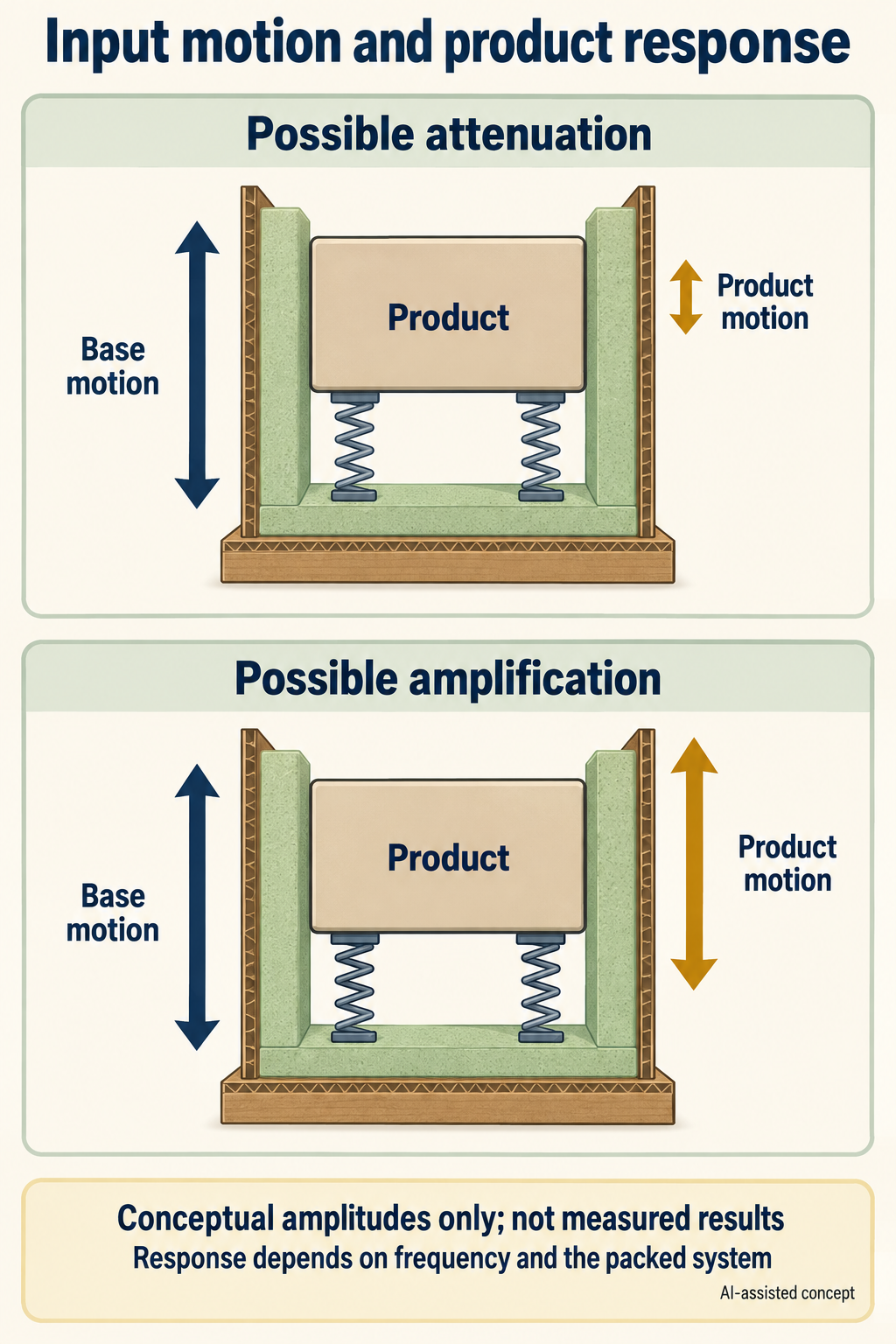
Input frequency and natural frequency describe different things
Input frequency describes how often the imposed motion repeats. A system's natural frequency describes its free oscillation behaviour. When a forcing frequency is close to a relevant natural frequency, resonance can increase the response. Damping, which dissipates energy, affects that behaviour.
The glossary in Sorbothane's Engineering Design Guide distinguishes frequency, natural frequency, damping and transmissibility. Those definitions don't make its material-specific design tables applicable to an unspecified packaging foam.
For a simplified system driven by a steady sinusoidal input, the steady forced response repeats at the input frequency. A larger product motion doesn't mean that the product has acquired an unrelated second frequency. Its amplitude and phase can differ from those of the moving base.
Real transport vibration can contain a range of frequencies. The simplified case helps explain the vocabulary; it doesn't reproduce a distribution route or establish how an actual candle behaves.
Compare the same motion quantity at the input and the product
Transmissibility compares a response amplitude with an excitation amplitude for a defined quantity and configuration. A useful interpretation needs matching quantities: compare displacement with displacement, or acceleration with acceleration, under the stated measurement conditions.
If a suitable report shows a response-to-input ratio greater than one, the response is amplified for that measured quantity and condition. A ratio below one indicates attenuation there. Neither statement, by itself, establishes whether a fragile product survives.
An acceleration result and a displacement result answer different questions. Acceleration may matter to a component's inertial loading; relative displacement may matter to whether the jar strikes a nearby wall. A report should identify which result it presents and where it was measured.
A single maximum value with no input description can hide the frequency at which the response occurred. Likewise, a graph for an unloaded foam pad cannot automatically describe a product constrained inside an assembled box.
Follow a hypothetical candle-pack comparison
Suppose a gift brand is comparing two candidate supports for the same glass candle. Both configurations use the same outer box and jar, but the support material differs. This is a teaching example, with no measured performance results.
The buyer has an impact comparison for each candidate. That comparison supports a discussion of the specified shock event. To investigate vibration, the reviewer considers the actual packed configurations and measures an identified input and product response under a relevant evaluation arrangement.
At one input frequency, a candidate might show less product motion than base motion. At another, its product motion might exceed base motion. The candidate hasn't changed identity between those observations; the excitation condition has changed.
The buyer should read those observations against the relevant failure concern. Greater jar movement could matter if clearance to the lid is limited, while a decorated surface might be vulnerable to rubbing at another contact. A response peak isn't automatically a breakage result, and a reduced response isn't automatically sufficient protection.
This comparison also explains why selecting the softer candidate by touch is incomplete. Touch doesn't identify the packed system's frequency response, and it doesn't establish the product's damage threshold.
Match the evidence to the assembled configuration
The public scope of ASTM D3580-22 concerns vibration evaluation of unpackaged products. That is a different specimen boundary from a complete jar, support, retail box and shipping carton. The public scope isn't the full paid procedure or a package-specific acceptance requirement.
A vibration report becomes more useful when the reader can identify the product mass and revision, supports and contact arrangement, input description, response locations and measured quantities. The reviewer also needs to know whether the setup represents the system being selected.
Changing a pad, adding a retaining strap or altering the packed orientation can change how forces reach the product. Such a revision warrants checking the relevant evidence boundary, rather than carrying over a favourable result solely because the outer carton is unchanged.
Packrivo's packaging insert materials guide helps define the component configuration. Its mailer protection guide addresses the separate assembled-package question.
For a mailer with a fitted insert, keep the impact comparison and the vibration comparison as distinct evidence. Select the relevant packed-system evaluation with the responsible technical reviewer, then compare the identified response with the actual product concern. This provides a basis for choosing a support without treating softness, an isolated drop result or a resonance label as proof of protection.
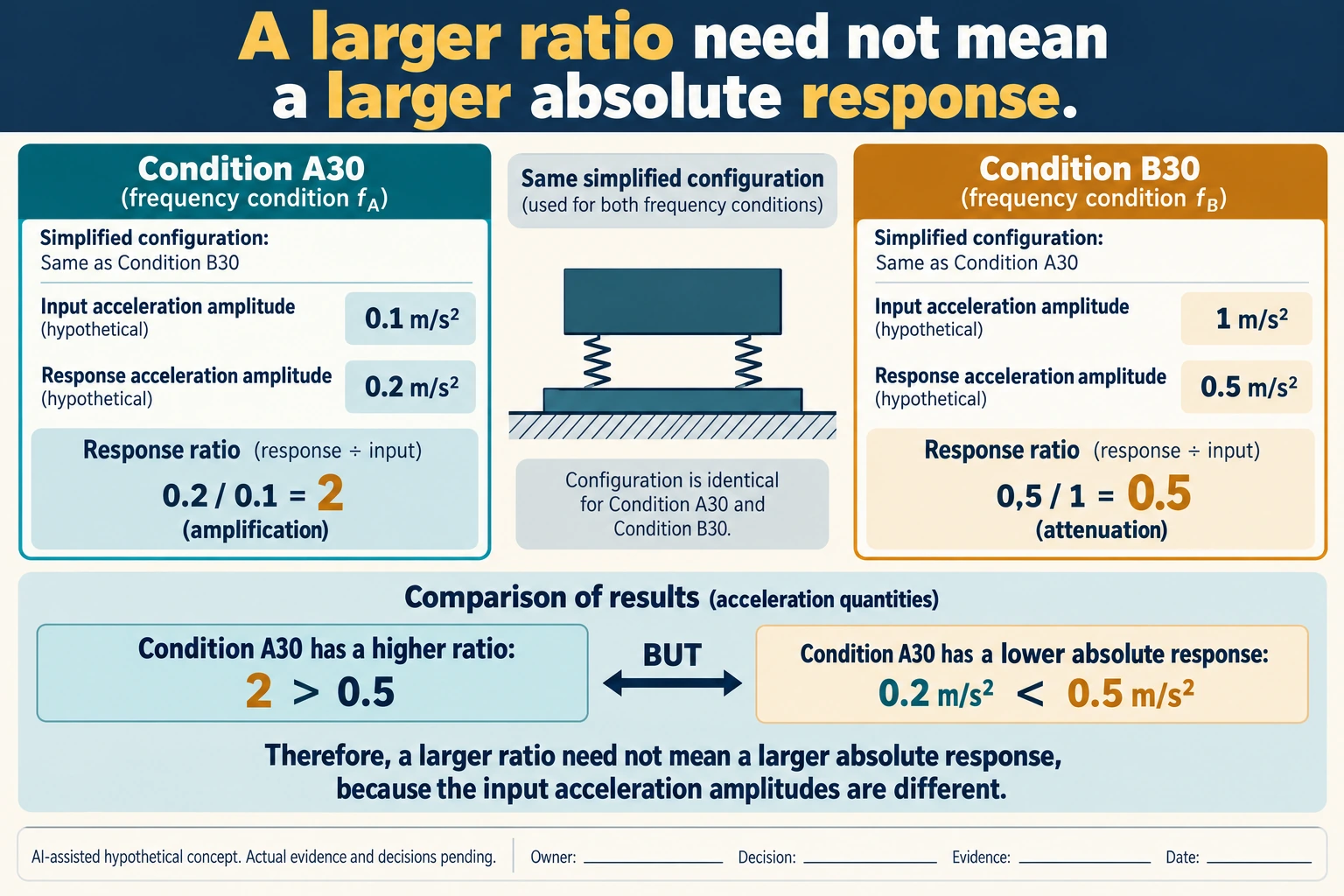
A higher response ratio need not be the larger absolute response
Use two invented frequency conditions for one named simplified configuration, with no real frequency values or test recommendation. CONDITION_A30 has input acceleration amplitude 0.1 m/s² and product response 0.2 m/s². CONDITION_B30 has input 1 m/s² and response 0.5 m/s². Both compare acceleration with acceleration, not displacement with acceleration.
Scroll horizontally if columns extend beyond the view.
| Hypothetical configuration | Named object | Relationship | Input or next scope |
|---|---|---|---|
| CONDITION_A30 | ACCELERATION_INPUT_AMPLITUDE | assumed input | 0.1 m/s2 |
| CONDITION_A30 | ACCELERATION_RESPONSE_AMPLITUDE | assumed input | 0.2 m/s2 |
| CONDITION_A30 | RESPONSE_INPUT_RATIO | calculated from | CONDITION_A30_RESPONSE/CONDITION_A30_INPUT; 2 ratio |
| CONDITION_B30 | ACCELERATION_INPUT_AMPLITUDE | assumed input | 1 m/s2 |
| CONDITION_B30 | ACCELERATION_RESPONSE_AMPLITUDE | assumed input | 0.5 m/s2 |
| CONDITION_B30 | RESPONSE_INPUT_RATIO | calculated from | CONDITION_B30_RESPONSE/CONDITION_B30_INPUT; 0.5 ratio |
| VIBRATION30 | A30_VS_B30 | assumes | DIFFERENT_FREQUENCY_CONDITIONS_fA_fB_NO_HZ_VALUES |
| VIBRATION30 | SIMPLIFIED_CONFIGURATION | same for | TWO_HYPOTHETICAL_CONDITIONS |
| VIBRATION30 | A_RATIO2 | greater than | B_RATIO0_5 |
| VIBRATION30 | A_RESPONSE0_2 | less than | B_RESPONSE0_5 |
| VIBRATION30 | RATIO_OR_ABSOLUTE_RESPONSE | does not establish | DAMAGE_PROTECTION_OR_ROUTE_ACCEPTANCE |
| SOURCE30 | UNPACKAGED_PRODUCT | not a | COMPLETE_PACK_TEST_RESULT |
A’s response-to-input ratio is 0.2 ÷ 0.1 =2, indicating amplification for that invented quantity and condition. B’s ratio is 0.5 ÷ 1 =0.5, indicating attenuation. Yet A’s absolute product response 0.2 m/s² is lower than B’s 0.5 m/s² because the inputs differ. Ranking only the ratios would miss that separate comparison.
The output is not that either condition is safe, damaging or representative of a shipping route. No damage threshold, response location, natural frequency or measured assembly is supplied. A technical review must retain the input spectrum, relevant quantity, configuration and concern before interpreting a response. A high ratio can matter without being the largest absolute acceleration in a different excitation.
Keep shock performance and movement-clearance questions separate too. The public D3580 scope concerns unpackaged products/components, not a complete product/insert/retail-pack/shipper system. Sorbothane’s own design data is not generic foam data. Request the appropriate packed-system evidence instead of selecting a support from a ratio, a soft feel or one impact result alone.
Download the vibration transmissibility ratio absolute acceleration comparison record (.csv). It includes the original table fields and scenarios alongside the added relationships. HYPOTHETICAL rows are editorial examples or required review scopes, not actual records. Actual quantity, configuration, component and file identities, materials, process, specification, copy, method, condition, observation, owner, decision, evidence and dates are blank. ACTUAL_BLANK is a separate empty starting row; enter permitted project evidence before using an actual record. A blank means unknown.
Use the Packaging Insert Materials: Compare Form and Fit for its separate question.
Source scope checked 17 October 2026: Westpak vibration explanations, Sorbothane’s material-specific engineering guide and ASTM D3580-22 public scope support response concepts with distinct specimen limits. Copyright 2018 is not a verified publication date; D3580 is for unpackaged products/components. No paid method, actual resonance frequency, threshold, protection or transport approval is established. The added configurations and calculations are hypothetical, with actual evidence and decisions pending.
Discuss this packaging specification with Packrivo. We coordinate independent suppliers. MOQ: 500 pieces per product/design; illustrative quantities are not production offers. Confirm materials, samples, price and timing for your project.