
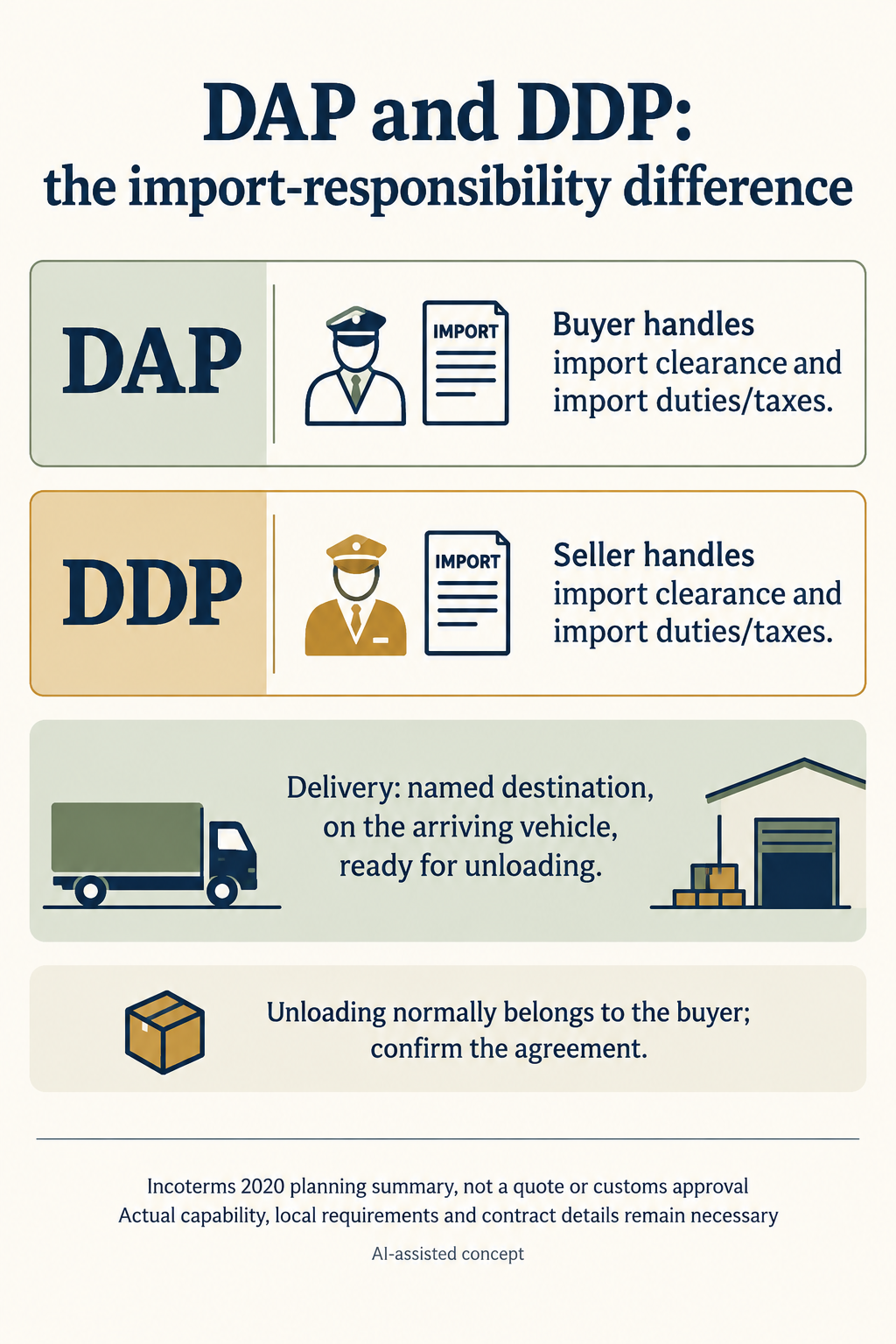
DAP and DDP can both name delivery at a destination, but they allocate import-clearance responsibilities differently. Under the ordinary Incoterms 2020 allocation, the buyer handles import formalities and duties or taxes with DAP; the seller carries those responsibilities with DDP.
For a brand ordering empty gift boxes overseas, a statement that transport reaches the warehouse doesn't settle this difference. Identify the named place, actual import arrangement and commercial scope before comparing the proposals.
Delivery at destination and import clearance are distinct jobs
The ICC Academy's DAP and DDP explanation describes the shared destination-delivery condition and the different import responsibilities. Both normally involve goods on the arriving vehicle at the named destination, ready for unloading.
That condition doesn't mean the seller must carry the cartons inside the buyer's building. Unloading ordinarily belongs to the buyer under these rules; the actual contract and transport arrangement should identify the relevant work and any agreed treatment.
The import distinction matters before the truck reaches that place. A buyer who expects to perform no import work needs a proposal that actually addresses the responsibility, rather than one that only describes the final transport leg.
Name the destination precisely
A country or city may leave the actual delivery point ambiguous. A depot, receiving bay and warehouse can imply different operational arrangements. Keep the chosen term, named place and rule version together so the parties can identify the same intended event.
The ICC Incoterms 2020 overview describes allocation of costs, risks and obligations. It also distinguishes delivery before unloading under DAP from the unloaded delivery of DPU. A proposal should not silently combine these different conditions.
The rules form part of a wider agreement. They don't replace every commercial, payment or local legal requirement. Actual variations need to be explicit rather than hidden behind a familiar abbreviation.
Follow two hypothetical gift-box proposals
Imagine a brand comparing two proposals for the same empty-box order to the same named destination. One uses DAP; the other uses DDP. No quantities, costs, customs facts or actual shipment are supplied in this teaching example.
The DAP proposal leaves the buyer with the ordinary import-clearance and import-charge responsibilities. The buyer needs to understand the actual arrangement for carrying them out. A transport price alone doesn't identify that work.
The DDP proposal assigns those import responsibilities to the seller, but the term doesn't establish that this particular seller can fulfil them lawfully in the destination. The parties need an actual workable arrangement, including the relevant roles and local requirements.
Consequently, the brand hasn't received two identical services with different prices. First establish the different obligations and the facts needed to perform them. Only then can the commercial comparison reflect what each proposal covers.
Keep import capability separate from the abbreviation
The party assigned a responsibility still needs a suitable way to carry it out. Destination rules can affect the importer role, registrations and available representation. This article determines none of those facts for a specific seller, buyer or country.
An invoice carrying DDP isn't evidence that an import arrangement has been confirmed. Equally, a DAP proposal shouldn't assume that the buyer has a broker or other necessary arrangements without confirmation.
Return the identified gaps to the contracting and appropriate customs parties before relying on the proposed delivery. The choice should reflect actual capability as well as the intended allocation.
Compare the quote on the complete responsibility basis
Packrivo's carton freight-data guide describes the separate count, size and weight inputs. Its EXW and FCA handover guide concerns origin-side collection and delivery conditions, rather than destination import responsibility.
For the DAP/DDP comparison, keep the named point, import allocation, actual performance arrangement and quoted inclusions visible. A term shouldn't become an unsupported promise that every possible fee or extra service has been covered.
Sources accessed 11 October 2026. This is a bounded Incoterms 2020 planning explanation based on public ICC materials, not the complete rule publication, a quotation or a customs determination. Packrivo's shipment history, export capability and contract terms are not established by the hypothetical example.
Resolve allocated import work before treating the route as workable
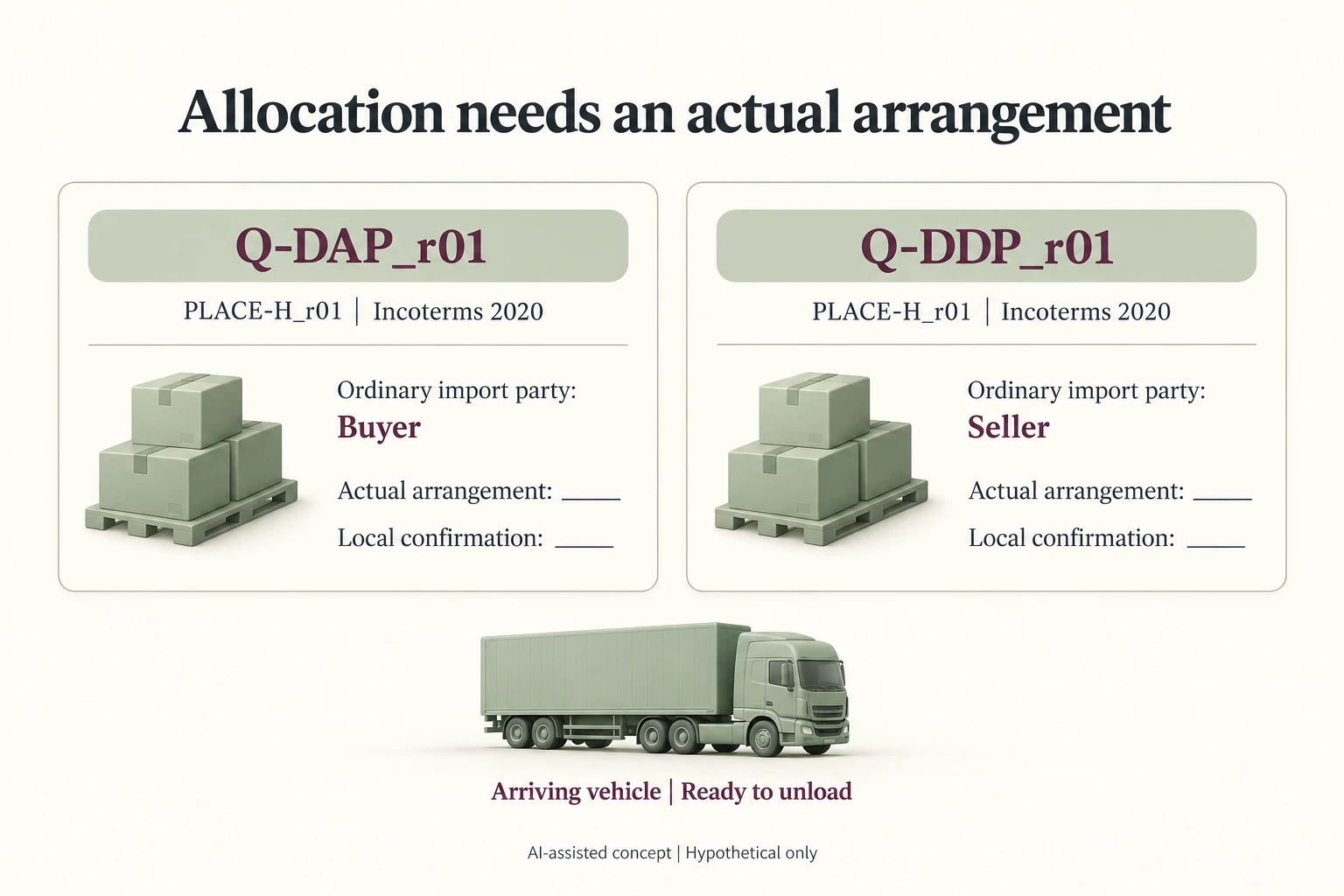
The new hypothetical destination reference PLACE-H_r01 is a placeholder for an exact agreed point, not a real depot. Quote proposals Q-DAP_r01 and Q-DDP_r01 share that point and Incoterms 2020; neither is an actual offer.
Scroll horizontally if columns extend beyond the view.
| Proposal | Ordinary import allocation | Operational question |
|---|---|---|
| Q-DAP_r01 | Buyer | Who will lawfully carry out the applicable import work? |
| Q-DDP_r01 | Seller | What actual lawful import arrangement supports that commitment? |
| Both at PLACE-H_r01 | On arriving vehicle, ready to unload | Identify the receiving/unloading arrangement and contract scope |
| Any variation | Express agreement required | Keep variation separate from the ordinary rule summary |
A responsibility label does not establish registrations, representation or local legal eligibility. Leave the actual arrangement and its confirmation empty until the contracting parties and appropriate customs advisers resolve it for the destination.
Keep the named point exact across the quote, transport instruction and comparison. A city-level label is not silently expanded into inside-building delivery. If unloading or another service is included by agreement, record that separately rather than rewriting the ordinary DAP/DDP allocation.
No duty rate, tax amount, broker service, importer identity or all-inclusive fee is invented here. This worksheet is bounded planning education, not the complete ICC rules, a binding contract interpretation or a customs determination.
Download the DAP versus DDP packaging record (.csv). HYPOTHETICAL rows are invented examples. Use ACTUAL_BLANK for permitted project inputs; replace that row label only when recording actual facts. Empty evidence, observation and date fields mean unknown or not performed, never acceptance. Keep checkpoints and revisions separate.
Bring the exact named point and unresolved import arrangement through the packaging enquiry for the responsible contracting and customs parties to review. Packrivo coordinates independent suppliers. These records establish no supplier offer, service availability or MOQ exception; its published baseline is 500 pieces per product/design.