
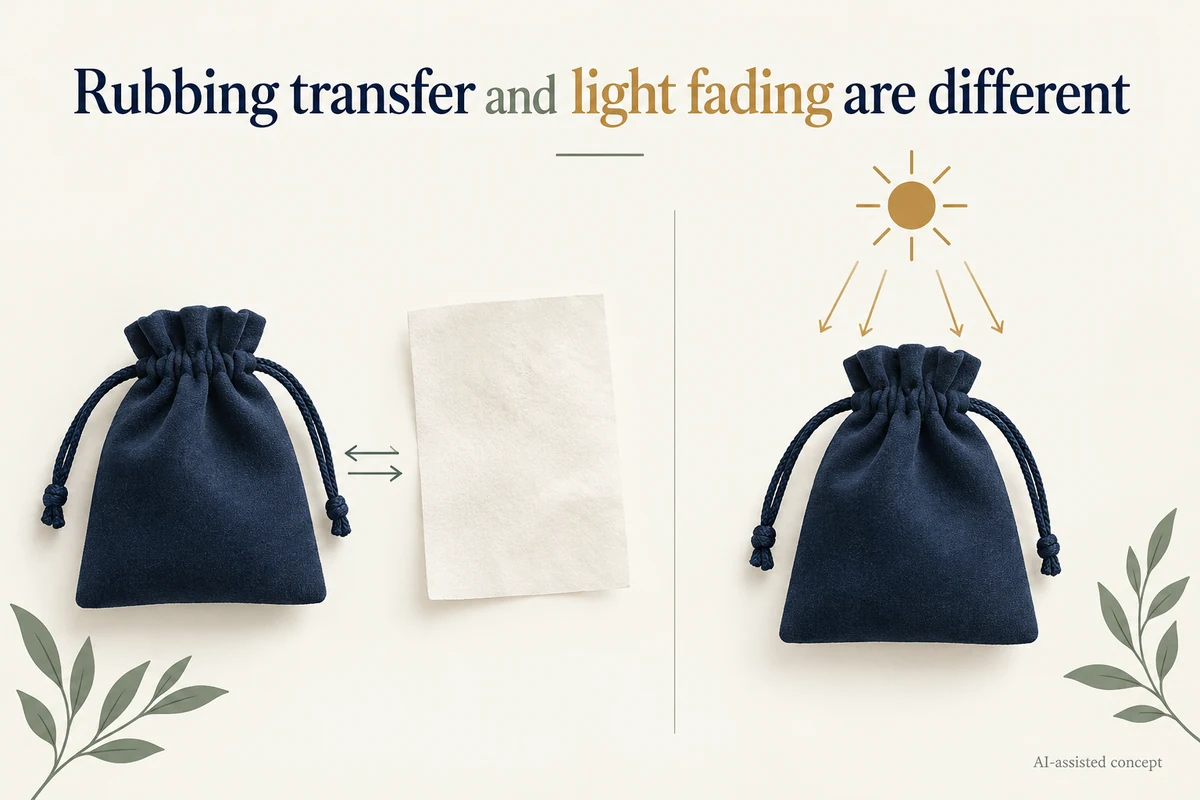
A dark fabric pouch transferring colour to a pale lining presents a different question from the pouch losing colour during light exposure. Rubbing transfer concerns contact between surfaces; light fading concerns an exposure-related change in the coloured material.
For a jewelry brand selecting a pouch, define the actual contact pair and expected use before interpreting a colourfastness claim. A lightfastness result doesn't establish resistance to rubbing, and a rubbing result doesn't describe every later contact.
Identify where the colour change appears
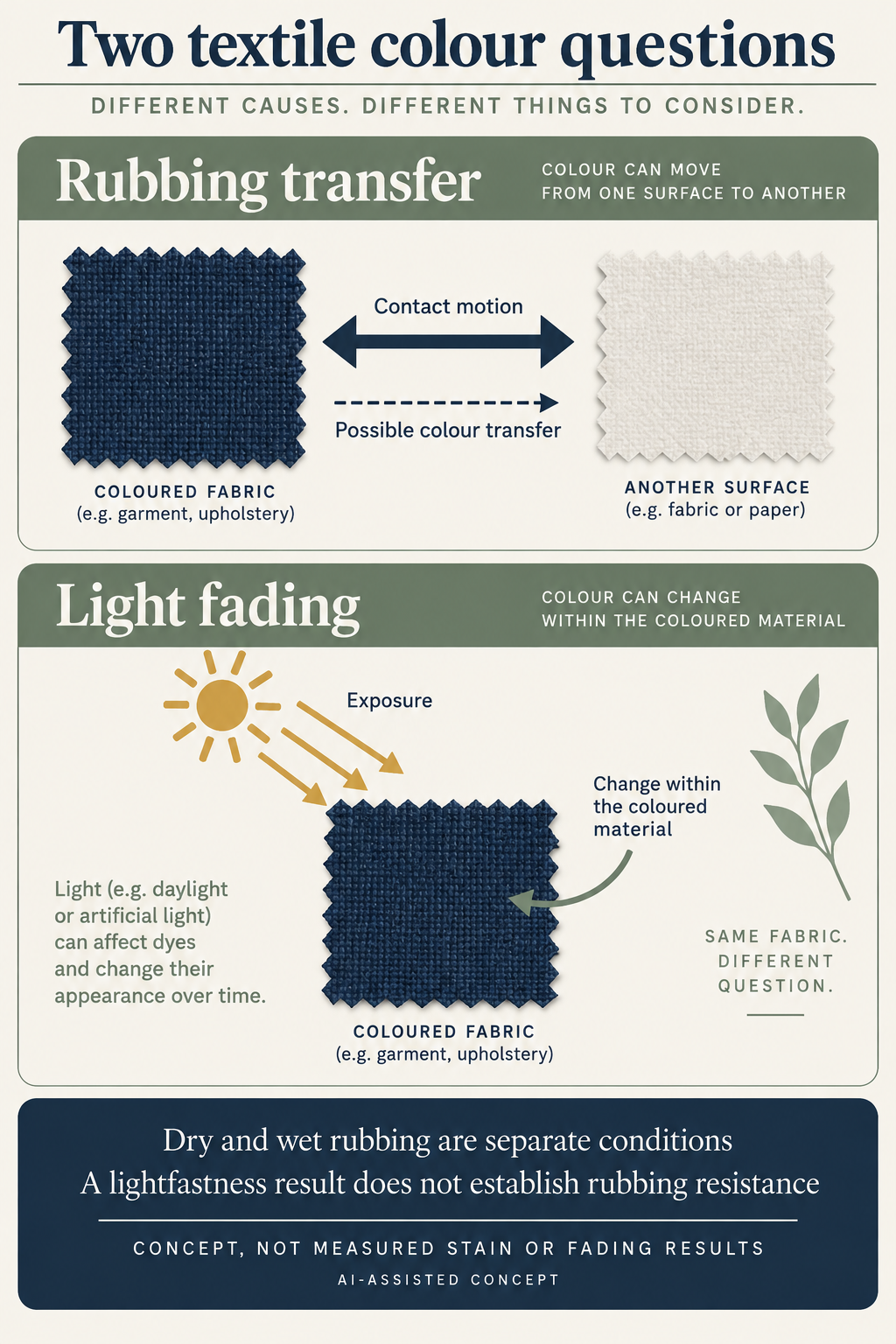
In a transfer question, the receiving surface matters. A pale card, a fabric lining and a jewelry finish are different contact partners. A mark on one shouldn't be silently treated as evidence for all three.
In a fading question, the comparison concerns the coloured material after exposure. A paler appearance may need investigation of the material and viewing conditions. It doesn't, by itself, show that colour moved onto a neighbouring surface.
Both mechanisms could be relevant during a product's life. Distinguishing them helps the brand decide whether the next comparison should address contact, exposure or both, instead of asking for one universal colourfastness score.
Rubbing evidence names a contact condition
The public abstract of ISO 105-X12:2016 concerns resistance of textile colour to rubbing off and staining other materials. It distinguishes dry and wet rubbing-cloth conditions. The full paid method wasn't obtained here.
AATCC Test Method 8 likewise identifies colourfastness to crocking, or rubbing transfer. A specified cloth-based result belongs to its method and test conditions; it doesn't automatically represent a finished pouch touching the brand's paper card or jewelry.
Wet and dry conditions should remain separately identified. One result cannot be relabelled as covering the other. Nothing in these public descriptions supplies a customer rubbing recipe or an acceptable grade for every gift presentation.
Follow a hypothetical pouch and pale card
Imagine a brand considering a navy textile pouch that will sit beside a pale printed card inside a gift box. The supplier offers a lightfastness document, but the brand's current concern is colour transfer where the two surfaces may contact during handling. This is a hypothetical proposal, not an observed staining incident.
The document can remain relevant to the stated exposure property. It leaves the contact-transfer question unresolved. The brand needs relevant evidence for the offered textile and the conditions that matter to that pairing.
If the pouch is revised to another dyeing or finishing construction, keep the change identified. A result associated with the earlier textile doesn't automatically transfer to the new one merely because both look navy.
Adding an intervening layer changes the contact arrangement too. The new layer has its own surface and role; it shouldn't be described as preventing transfer before that configuration is evaluated.
A pale mark still needs an identified cause
An actual visible mark could involve colour transfer, loose fibres, abrasion, another material or an existing print feature. Its appearance and location help frame the investigation, but they don't identify a cause on their own.
Packrivo's product-contact observation guide keeps the surfaces, handling and visible outcome together. The uncoated-paper proof guide serves a different appearance question when the receiving card's print is being compared.
For an investigation involving the textile, retain its identity and the contact partner. If light exposure is also suspected, keep that history separate from the rubbing action. Combining unlike histories would make the observed difference harder to interpret.
Select the property needed for the actual use
A pouch intended for repeated handling may raise a prominent rubbing-transfer question. A pouch displayed under light can also raise exposure durability. The relevant priorities depend on the complete intended presentation, not a generic premium-fabric description.
Request evidence for the property and conditions that need to be decided. Keep the result within its specimen and method scope, and assess the actual presentation where a finished-pack claim is intended. No rubbing grade, fading lifetime or jewelry-surface safety guarantee follows from a general textile colourfastness label.
Separate the source textile from the receiving surface
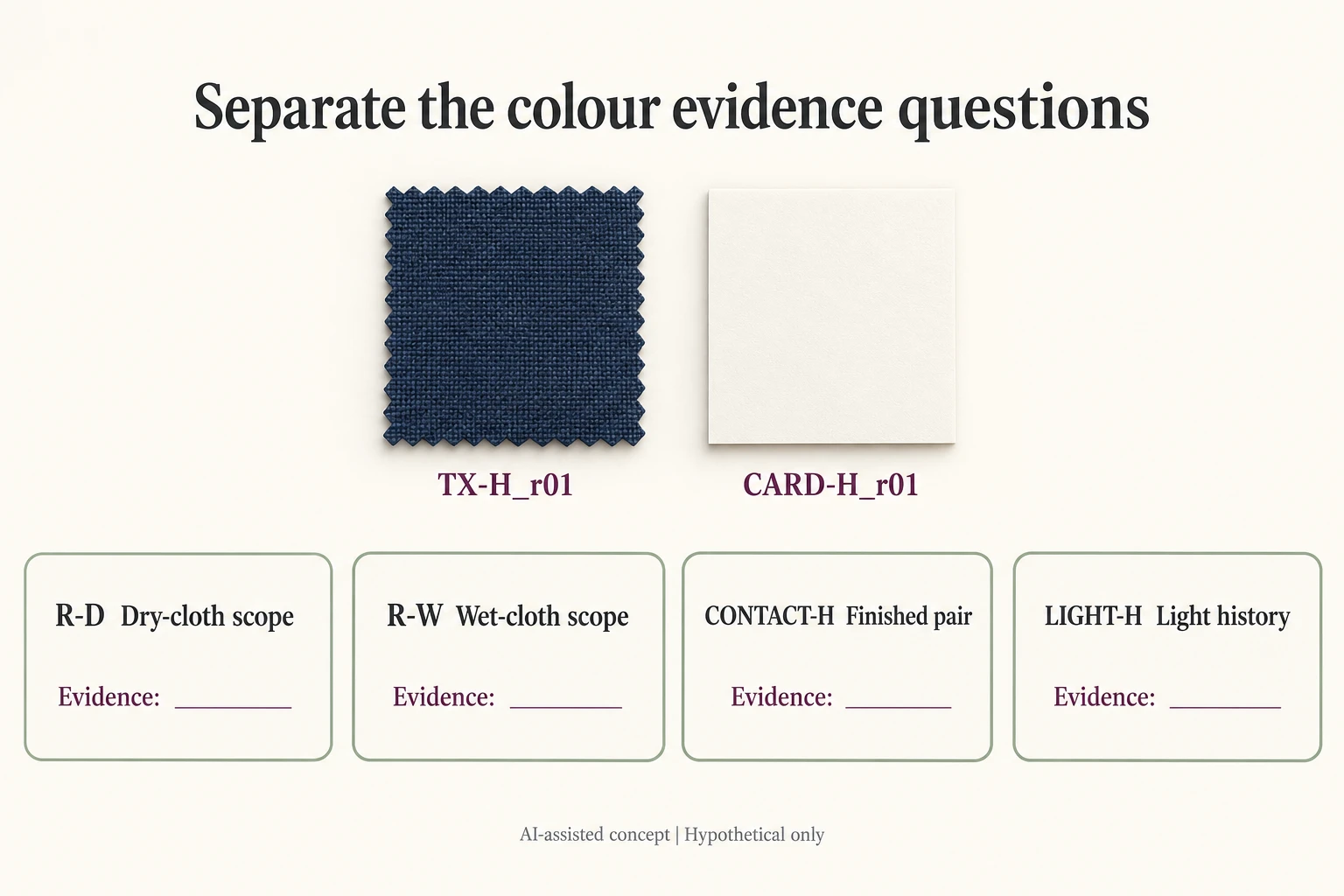
This new hypothetical map names textile TX-H_r01, pale card CARD-H_r01 and optional interlayer SEP-H_r01. It compares evidence questions without inventing a staining or fading observation.
Scroll horizontally if columns extend beyond the view.
| Question | Configuration | Unknown result |
|---|---|---|
| R-D | TX-H_r01 with a dry-cloth method scope | Actual method applicability and rubbing result |
| R-W | TX-H_r01 with a wet-cloth method scope | Separate conditions and result |
| CONTACT-H | TX-H_r01 beside CARD-H_r01 | Actual finished-pair interaction |
| LIGHT-H | TX-H_r01 with identified light history | Exposure-specific appearance evidence |
A cloth-based result and a finished card-contact observation belong in separate cells. Keep the textile dye/finish construction tied to TX-H_r01; a similarly coloured replacement needs a new exact revision.
If SEP-H_r01 is introduced, record TX-H_r01/SEP-H_r01 and SEP-H_r01/CARD-H_r01 as new interfaces. Its presence does not establish that colour transfer is prevented, nor that the jewelry surface is protected.
Describe any later visible mark before assigning a cause. The register leaves actual contact, motion, light history and observations blank. It gives no rubbing recipe, water treatment, acceptable grade, lightfastness lifetime or product-safety finding.
Download the fabric pouch dye transfer record (.csv). HYPOTHETICAL rows are invented examples. Use ACTUAL_BLANK for permitted project inputs; replace that row label only when recording actual facts. Empty evidence, observation and date fields mean unknown or not performed, never acceptance. Keep checkpoints and revisions separate.
Bring the textile revision, receiving surface and unresolved contact or exposure question through the packaging enquiry; one colourfastness description cannot close every property. Packrivo coordinates independent suppliers. These records establish no supplier offer, service availability or MOQ exception; its published baseline is 500 pieces per product/design.