
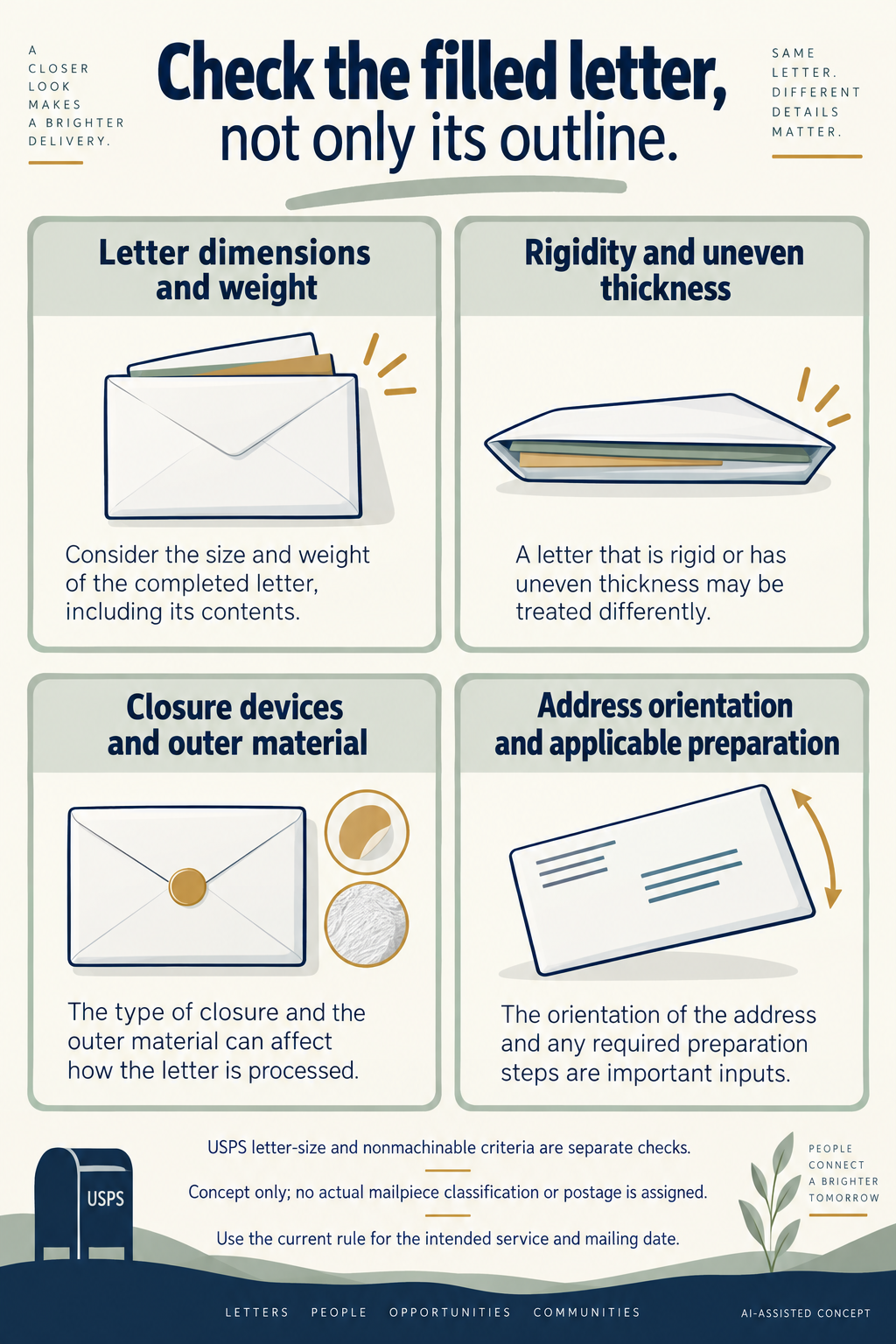
A filled envelope can meet the dimensions of a USPS letter and still have a characteristic that makes it nonmachinable. Rigidity, uneven thickness, certain closure devices, outside material and address orientation are separate from the length and height of its outline.
For a gift brand mailing a card or small presentation, assess the completed item under the current rule for the intended service. A supplier's empty-envelope dimensions don't establish the classification or postage of the finished mailing.
Letter-size shape and machinability are separate checks
USPS Domestic Mail Manual 101 separates letter dimensional standards in section 1.1 from nonmachinable criteria in section 1.2. Letter classification also involves weight, thickness and shape; length and height alone are incomplete inputs.
Section 1.2 identifies characteristics including excess rigidity, certain clasps or strings, uneven contents and address orientation. A compliant outline doesn't cancel those criteria. The exact applicable preparation and mailing category still matter.
Nonmachinable also isn't permission to mail every object in a paper envelope. Some contents or preparations may raise a mailability question. Don't treat paying a possible surcharge as automatic acceptance.
Contents can change the finished physical behaviour
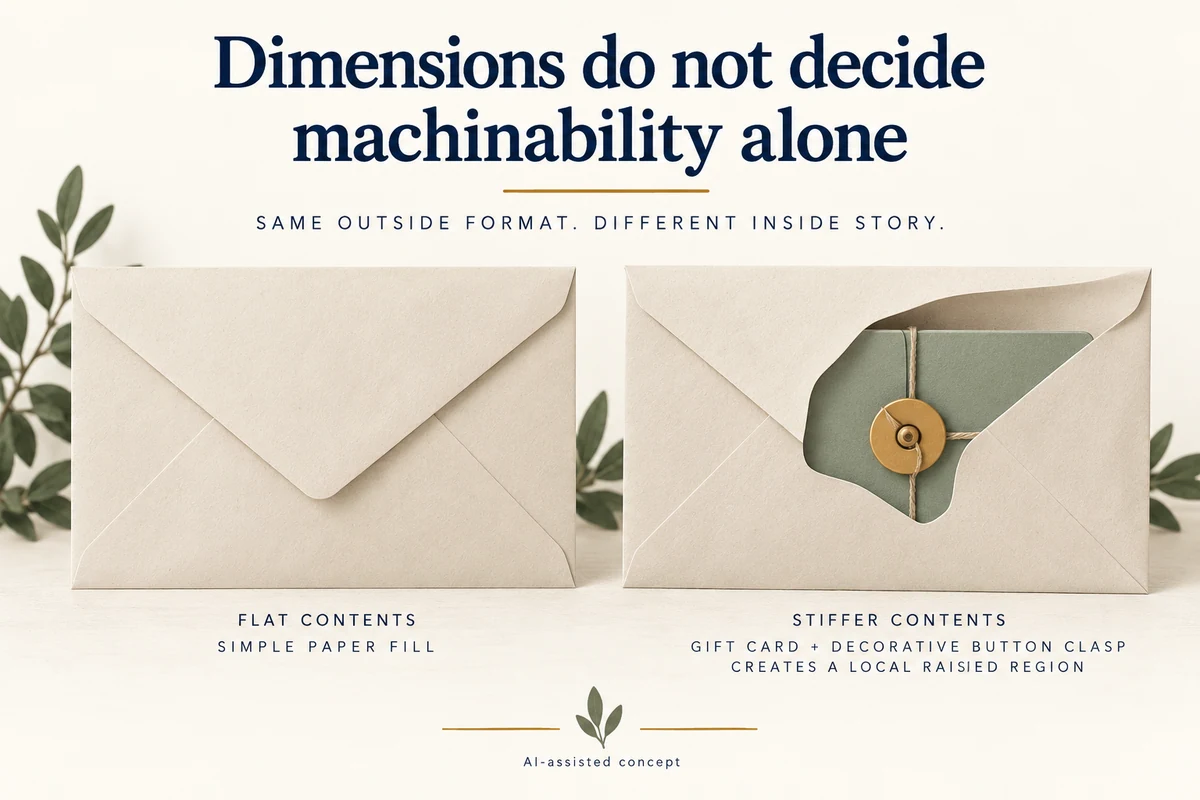
A blank paper envelope and one holding a stiff card aren't the same physical item. A rigid addition can affect flexibility; a local decoration can affect thickness distribution. The filled construction is the object to evaluate.
The location of the addition matters too. A uniform flat card and a small projecting object create different thickness questions even when both fit inside the same outside envelope format. Holding the flap closed doesn't establish machinability.
This distinction also explains why a photograph from the front is insufficient. The view can show the outline while hiding rigidity, a raised area or a closure device on the other side.
Follow a hypothetical gift-card mailing
Imagine a brand considering a paper envelope with a stiff gift card and a decorative closure. Its proposed length and height fall within the letter outline, but no complete weight, thickness or USPS evaluation has been supplied. This is a teaching example, not an accepted mailpiece.
The brand should first determine whether the filled item belongs in the relevant letter-size category at all. If it does, the decorative closure and rigidity still need consideration under the nonmachinable criteria. Meeting the first step doesn't automatically pass the second.
A revision could remove the decorative closure, alter the contents or use another mailing format. Each changes the physical item. The revised proposal needs its own applicable classification rather than retaining the earlier empty-envelope assumption.
No rate, surcharge amount or acceptance outcome is assigned to these proposals. The example identifies why the next comparison must involve more than the outline.
Address orientation is part of the final presentation
The DMM lists a delivery address parallel to the mailpiece's shorter dimension among the nonmachinable criteria. The final mailing artwork should therefore be considered with the filled construction, rather than approved only as an attractive gift graphic. Changing address direction alone doesn't resolve every other criterion.
Keep labels, attached decorations and the outside material in that review too. A change made after the initial physical comparison can alter the relevant item. Identify the current version before obtaining a classification response.
USPS's parcel size, weight and fee overview distinguishes several price and handling categories. Use the actual letter rule for the letter question instead of carrying a parcel dimensional-weight calculation into it.
Choose a suitable format from the actual mailing job
Packrivo's carrier-classification guide helps keep service, country and effective date attached to a comparison. The filled-envelope flap guide checks a separate closing relationship.
For the mailing decision, retain the filled item's measurements, contents, closure, outside material and address presentation. Have the responsible shipping party resolve the applicable USPS category and preparation before selecting postage.
Sources accessed 11 October 2026. This article identifies selected retail letter-size and nonmachinable distinctions, not every USPS eligibility or mailability rule. It provides no improvised rigidity test, physical acceptance finding, price or guarantee that a particular gift can travel as a letter.
An outline revision can reopen one flag while leaving others unknown
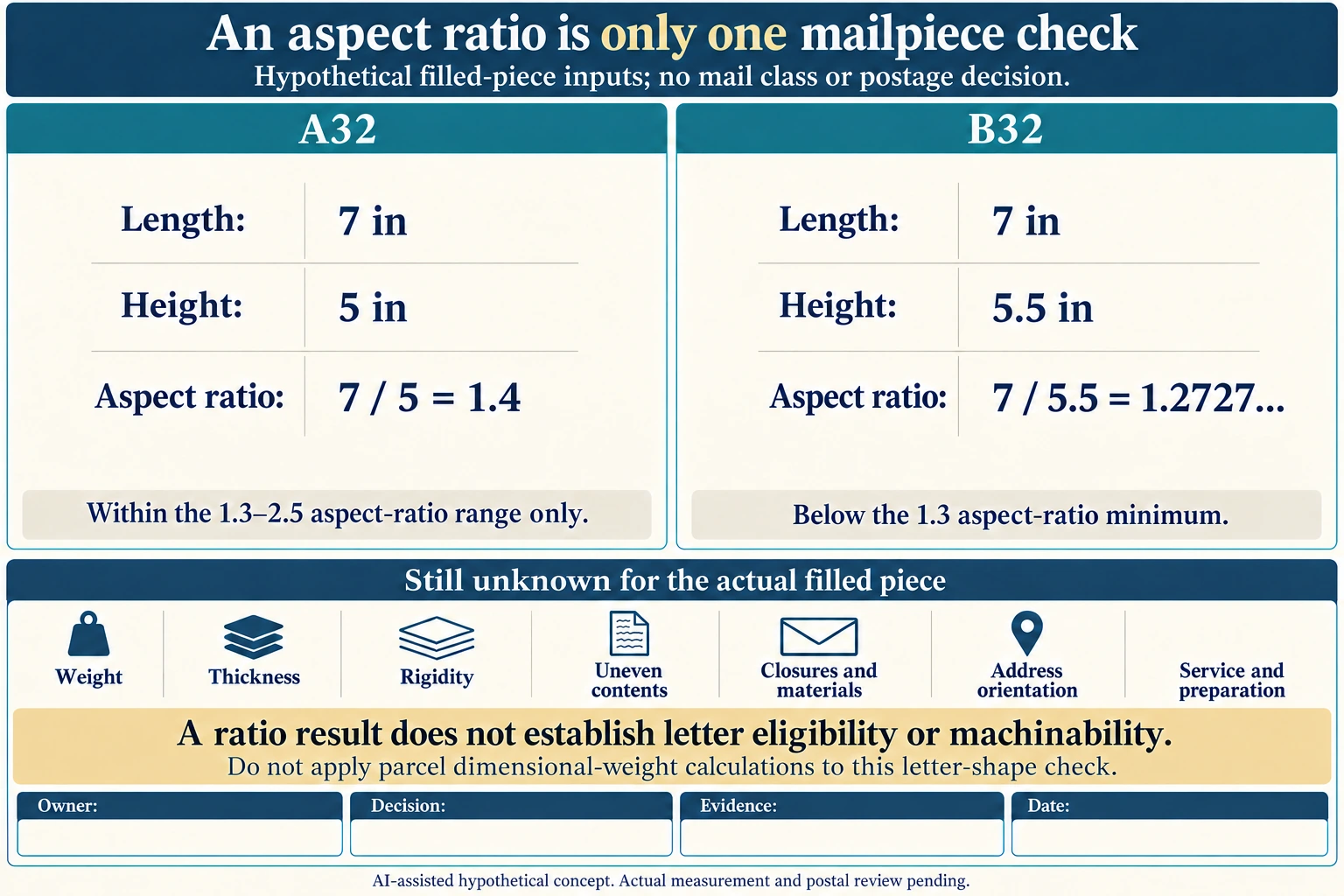
Consider two invented filled-piece outlines, each 7 in long. LETTER_A32 is 5 in high; LETTER_B32 is 5.5 in high. Their length-to-height ratios are 7÷5=1.4 and 7÷5.5≈1.2727. Under the applicable DMM letter nonmachinable aspect-ratio criterion, the latter is below 1.3 while the former is within the 1.3-to-2.5 interval. This narrow comparison does not classify either finished piece.
Weight, complete thickness, stiffness, uneven contents, closure devices, outside material, address orientation and relevant preparation remain unknown for both. A within-range aspect ratio supplies no evidence about those other characteristics. First establish whether the actual piece belongs in the relevant letter-size category, then resolve every applicable machinability and mailability question for its service.
A proposed removal of a decorative closure changes that feature, not automatically the rigidity of the remaining gift card. Turning the delivery address can close an orientation question without resolving a raised attachment. Keep the revised filled-item identity attached to each response. No dimensional-weight divisor, postage rate, surcharge amount or acceptance decision belongs to this outline arithmetic.
| Hypothetical scope | Object and relationship | Input, formula or open question |
|---|---|---|
| LETTER32_LENGTH | OUTSIDE_LENGTH — ASSUMED_INPUT | 7 in |
| LETTER_A32_HEIGHT | OUTSIDE_HEIGHT — ASSUMED_INPUT | 5 in |
| LETTER_A32_RATIO | ASPECT_RATIO — CALCULATED_FROM | LETTER32_LENGTH/LETTER_A32_HEIGHT; 1.4 dimensionless |
| LETTER_B32_HEIGHT | OUTSIDE_HEIGHT — ASSUMED_INPUT | 5.5 in |
| LETTER_B32_RATIO | ASPECT_RATIO — CALCULATED_FROM | LETTER32_LENGTH/LETTER_B32_HEIGHT; 1.2727272727272727 dimensionless |
| RATIO32_MIN | DMM_APPLICABLE_LETTER_ASPECT_RATIO_BOUND — SOURCE_REFERENCE | 1.3 dimensionless; Narrow criterion, not complete classification |
| RATIO32_MAX | DMM_APPLICABLE_LETTER_ASPECT_RATIO_BOUND — SOURCE_REFERENCE | 2.5 dimensionless; Narrow criterion, not complete classification |
| LETTER_A32_FLAG | ASPECT_RATIO — CONDITIONAL_COMPARISON | WITHIN_ASPECT_INTERVAL_ONLY |
| LETTER_B32_FLAG | ASPECT_RATIO — CONDITIONAL_COMPARISON | BELOW_ASPECT_INTERVAL |
| LETTER32_WEIGHT | WEIGHT — REMAINS_UNKNOWN | Neither example is an accepted mailpiece |
| LETTER32_THICKNESS | THICKNESS — REMAINS_UNKNOWN | Neither example is an accepted mailpiece |
| LETTER32_RIGIDITY | RIGIDITY — REMAINS_UNKNOWN | Neither example is an accepted mailpiece |
| LETTER32_UNEVENNESS | UNEVENNESS — REMAINS_UNKNOWN | Neither example is an accepted mailpiece |
| LETTER32_CLOSURE | CLOSURE — REMAINS_UNKNOWN | Neither example is an accepted mailpiece |
| LETTER32_OUTSIDE_MATERIAL | OUTSIDE_MATERIAL — REMAINS_UNKNOWN | Neither example is an accepted mailpiece |
| LETTER32_ADDRESS_ORIENTATION | ADDRESS_ORIENTATION — REMAINS_UNKNOWN | Neither example is an accepted mailpiece |
| LETTER32_SERVICE_PREPARATION | SERVICE_PREPARATION — REMAINS_UNKNOWN | Neither example is an accepted mailpiece |
A32 and B32 are the short image labels for LETTER_A32 and LETTER_B32 respectively. The image compares numerical inputs, not scale drawings.
Download the comparison and project record (.csv). It preserves the original passages, model branches and table fields alongside the added hypothetical scopes. Relationship rows are not business cases, tests or completed records. Every actual identity, quantity, material, process, specification, observation, owner, decision, evidence and date field is blank. ACTUAL_BLANK is an empty starting row; unknown fields require permitted project evidence.
For the separate question, read USPS Rectangular Parcel DIM Weight Needs the Complete Rounding Sequence.
For the separate question, read Check Flap Reach With the Envelope Filled.
Source scope checked 17 October 2026: Current public USPS DMM 101 selected 1.1/1.2/6.3.1 distinguish dimensions, weight and nonmachinability; conditional 0.009 in thickness and First-Class treatment above 3.5 oz must retain their conditions. The parcel fee page is not a letter rule. No physical USPS evaluation or postage determination was performed.
Public references for that scope: USPS DMM 101 selected letter standards.
Discuss this packaging specification with Packrivo. We coordinate independent suppliers. MOQ: 500 pieces per product/design; illustrative quantities are not production offers. Confirm materials, samples, price and timing for your project.