

Possessing an editable packaging file does not, by itself, establish permission to reprint or adapt its protected artwork. For a supplier transfer, identify the work, permission holder and proposed use before handing it onward. This article concerns general U.S. copyright guidance, not a determination of a particular agreement.

Distinguish the artwork from the delivered file
A native design file, a reference PDF and a final print output have different technical roles. The print-file manifest helps ensure the printer receives the accepted assets. That manifest cannot settle the rights behind a graphic simply by listing its filename.
The U.S. Copyright Office explains that original protected visual artwork generally starts with its creator as author and initial owner, subject to applicable exceptions. Permission questions concern copying, distributing, adapting or displaying the protected work. Simple marks, typography and other elements can have different protection boundaries.
Don’t assume that a paid commission automatically grants every future use. Determine the actual permission or ownership basis with the responsible parties. Work-made-for-hire treatment has specific requirements that this article does not decide.
Compare two hypothetical permission scopes
Suppose a brand receives both a PDF and a native file containing an illustration. These fictional permissions illustrate separate proposed uses; they are not legal interpretations of real terms.
Scroll horizontally if columns extend beyond the view.
| Assumed permission | Proposed next job | Unresolved question |
|---|---|---|
| 500 prints for one named campaign | 2,000 prints for a later campaign | Whether the later quantity and campaign are permitted |
| Further print runs of the unchanged illustration, but no adaptation | Repeat printing with a new supplier | Whether the actual permission covers the proposed recipient and print use |
| Same no-adaptation scope | Change the illustration for another product | Whether the requested change is permitted |
The editable file makes a change technically possible. It does not answer the last column. The brand should retain the actual terms and obtain clarification before the printer treats the new instruction as authorised.
Keep other asset rights separate
Linked photographs, fonts and decorative assets can carry their own permissions. A licence for the principal illustration need not include every linked item. Font-file sharing and embedding are especially distinct from merely seeing text in a PDF.
Trademark, privacy and rights outside U.S. copyright are also separate questions. A graphic’s lack of copyright protection does not mean every use of the mark is unrestricted.
Handoff the permitted scope with the assets
Create a concise asset record naming the protected work, actual rights evidence, proposed print or adaptation use and any unresolved limit. Keep it separate from file completeness and physical tool ownership. The practical next step is responsible permission review, followed by a technical transfer only within the confirmed scope.
Sources and scope
U.S. Copyright Office supports the stated general concepts within this scope: US general copyright ownership/permission scope for protected visual art. Access checked 14 October 2026.
The worked scenario is original editorial analysis with assumed inputs, not a supplier offer, customer record or measured Packrivo result. Commercial feasibility and physical suitability remain project-specific.
File completeness and permission coverage need different comparisons
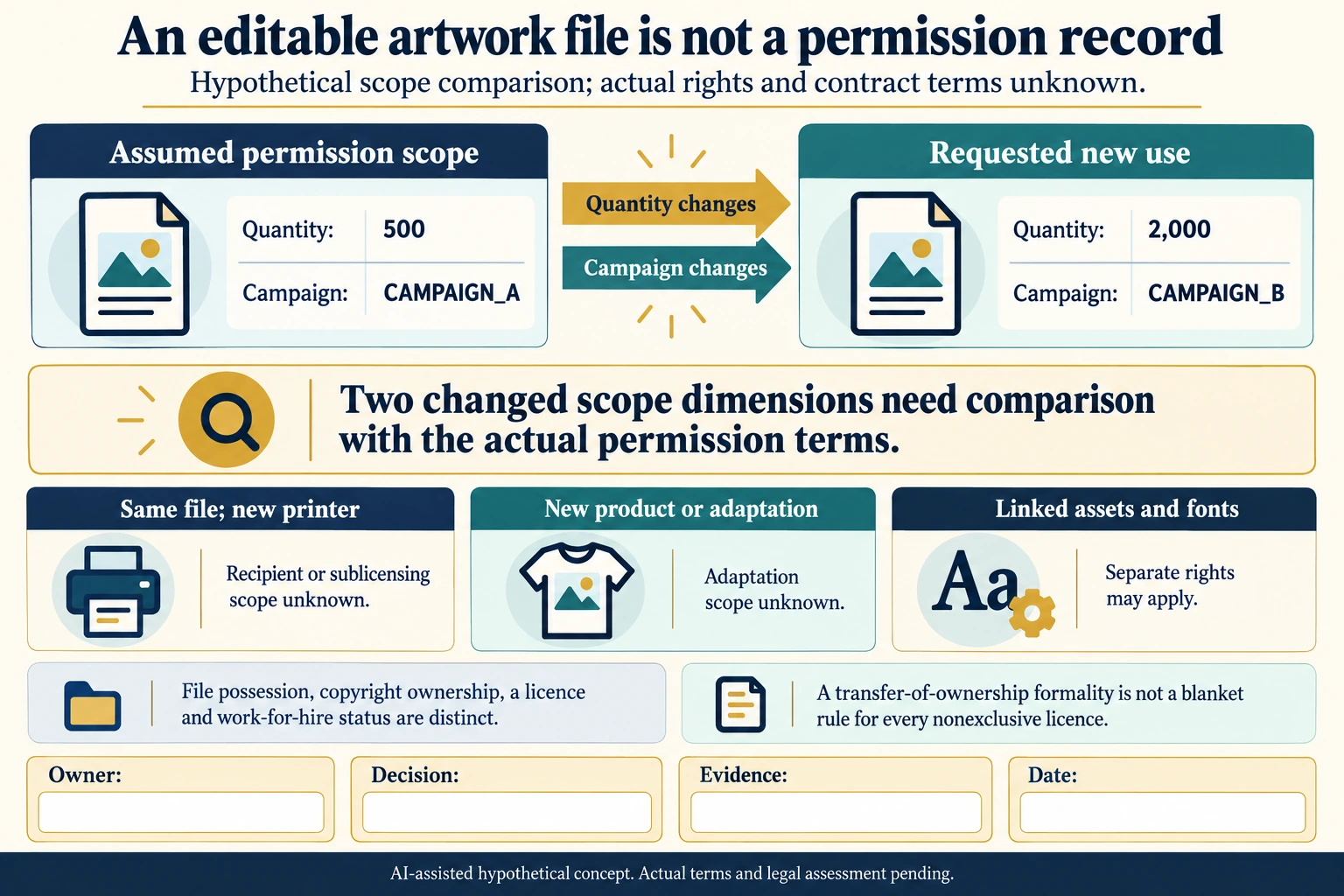
Keep the original three fictional permission branches and add an explicit dimension comparison. For the first, an assumed permission for 500 prints in CAMPAIGN_A is placed beside a proposed 2000 prints in CAMPAIGN_B. The request changes both quantity and campaign. An editable native file or a matching PDF cannot supply either missing permission dimension.
For unchanged repeat printing, compare the actual reproduction scope with the proposed receiving supplier. A no-adaptation condition addresses changes to the illustration; it does not, by itself, answer every recipient or delivery question. For an adapted illustration on another product, keep the requested change distinct from a technically successful export. These records locate questions, not conclusions about an actual contract.
A complete technical file package can therefore coexist with unresolved rights. Linked photographs, fonts and decorative assets each need their applicable scope; permission to view a PDF is not automatically permission to share a font file. Distinguish an ownership transfer, a licence and any work-made-for-hire or other applicable exception. The example approves neither reproduction, adaptation nor disclosure of any real asset.
| Hypothetical scope | Object and relationship | Input, formula or open question |
|---|---|---|
| PERMIT32_QUANTITY | ASSUMED_PERMISSION — ASSUMED_LIMIT | 500 print |
| REQUEST32_QUANTITY | PROPOSED_USE — ASSUMED_REQUEST | 2000 print |
| PERMIT32_CAMPAIGN | ASSUMED_PERMISSION — ASSUMED_CAMPAIGN | CAMPAIGN_A |
| REQUEST32_CAMPAIGN | PROPOSED_USE — ASSUMED_CAMPAIGN | CAMPAIGN_B |
| RIGHTS32_QUANTITY | REQUESTED_QUANTITY — EXCEEDS_ASSUMED_PERMISSION_ONLY | No actual licence interpretation |
| RIGHTS32_CAMPAIGN | REQUESTED_CAMPAIGN — DIFFERS_FROM_ASSUMED_PERMISSION | |
| RIGHTS32_NEW_PRINTER_RECIPIENT | NEW_PRINTER_RECIPIENT — REQUIRES_SEPARATE_SCOPE | Actual rights/terms unknown; no transfer performed |
| RIGHTS32_UNCHANGED_REPRODUCTION | UNCHANGED_REPRODUCTION — REQUIRES_SEPARATE_SCOPE | Actual rights/terms unknown; no transfer performed |
| RIGHTS32_ADAPTED_ILLUSTRATION | ADAPTED_ILLUSTRATION — REQUIRES_SEPARATE_SCOPE | Actual rights/terms unknown; no transfer performed |
| RIGHTS32_LINKED_PHOTO | LINKED_PHOTO — REQUIRES_SEPARATE_SCOPE | Actual rights/terms unknown; no transfer performed |
| RIGHTS32_FONT_FILE_SHARING | FONT_FILE_SHARING — REQUIRES_SEPARATE_SCOPE | Actual rights/terms unknown; no transfer performed |
| RIGHTS32_OWNERSHIP_OR_LICENCE_BASIS | OWNERSHIP_OR_LICENCE_BASIS — REQUIRES_SEPARATE_SCOPE | Actual rights/terms unknown; no transfer performed |
Download the comparison and project record (.csv). It preserves the original passages, model branches and table fields alongside the added hypothetical scopes. Relationship rows are not business cases, tests or completed records. Every actual identity, quantity, material, process, specification, observation, owner, decision, evidence and date field is blank. ACTUAL_BLANK is an empty starting row; unknown fields require permitted project evidence.
For the separate question, read A Print File Manifest Keeps Fonts, Links and Output Ownership Visible.
Source scope checked 17 October 2026: US Copyright Office public guidance and 17 USC 202 distinguish the work from its material carrier. 17 USC 204 ownership-transfer requirements are not a blanket rule that every nonexclusive permission needs a signed writing. Actual terms, protection, work-made-for-hire status and other exceptions remain unknown.
Public references for that scope: 17 USC 202, 17 USC 204.
Discuss this packaging specification with Packrivo. We coordinate independent suppliers. MOQ: 500 pieces per product/design; illustrative quantities are not production offers. Confirm materials, samples, price and timing for your project.