

Sending buyer-owned cards or labels to an assembler can reduce new component spending, but it introduces transport, receiving and matching work. Compare the costs that actually change between the two routes. Keep earlier purchases visible without counting them twice as new cash.
If the buyer-supplied part is an Informational insert card, identify its finished version, available quantity and receiving condition before comparing assembly offers. Buying fewer new cards does not remove transport, receiving or matching work.

Define the same completed pack
Describe the box, insert, cards and other components required for one finished gift. Identify the buyer-supplied component by its accepted version and quantity. A similar-looking card with an earlier size or message does not automatically belong in the current arrangement.
The complete-set quote comparison establishes the common requirement. Ask the assembler to quote one route using its own supplied component and another using the buyer’s material. Any changed work should remain itemised.
Confirm whether the assembler accepts that material, how it will receive and identify it, and who responds if quantity or condition is wrong. Possession of a card does not settle custody, ownership transfer or responsibility for damage.
Separate historical spending from the new decision
Assume a brand needs 500 sets and already owns enough compatible cards. Its earlier card purchase is historical cash. The following fictional amounts compare the next spending only.
Scroll horizontally if columns extend beyond the view.
| Incremental item | Assembler supplies cards | Buyer sends existing cards |
|---|---|---|
| New card purchase | $150 | $0 |
| Extra inbound transport | $0 in this scope | $35 |
| Receiving and identification | Included in assumed quote | $25 |
| Additional sorting | Included in assumed quote | $40 |
| Incremental total | $150 | $100 |
The buyer-supplied route needs $50 less new cash in this example. That result depends on the existing cards being suitable and the three added charges covering the actual interface.
For a full historical project-cost record, retain what the brand previously paid for the cards. Don’t add that same past amount only to the buyer-supplied route when deciding which new expenditure to authorise.
Make a shortage visible before assembly
Count usable cards at the receiving point. An assumed 500 shipped cards do not establish 500 accepted cards available at the bench. If only 480 are usable and each set needs one, twenty sets remain incomplete until an authorised solution exists.
Keep replacement transport, another receiving task and delayed assembly as separate scenario fields. Don’t use an unsupported waste percentage to make every interface appear complete.
The delivered state also matters. Individual cards, bundles and already matched kits can require different handling. Ask which arrangement the quoted receiving and sorting work actually covers.
Choose the route with its responsibilities attached
The practical output is a two-route cost comparison and a named material handover. It should identify the component, usable quantity, delivery point, receiving owner and shortage response. A lower component purchase alone isn’t enough to show that the complete assembly route costs less.
Sources and scope
Australian Government supports the stated general concepts within this scope: General inventory categories, reorder points and stocktake. Access checked 14 October 2026.
Australian Government supports the stated general concepts within this scope: Cash inflows/outflows and clear labeling of estimated figures. Access checked 14 October 2026.
The worked scenario is original editorial analysis with assumed inputs, not a supplier offer, customer record or measured Packrivo result. Commercial feasibility and physical suitability remain project-specific.
Trace the card at both ends of the handover
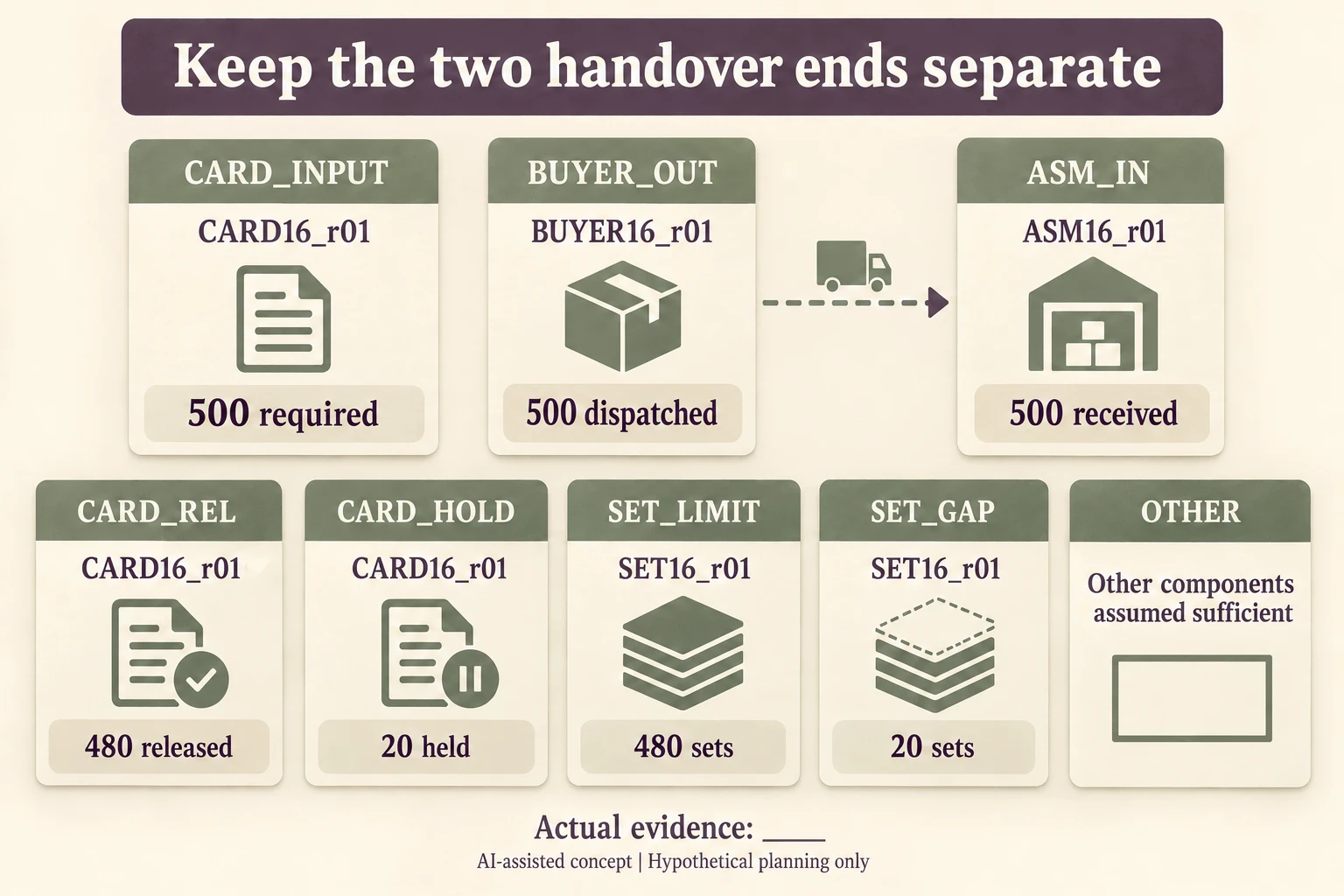
Use the original 500-set/480-usable-card idea with new explicit identities. This fictional register assumes 500 CARD16_r01 cards are dispatched and received, then separately places 480 in release and 20 on hold. Each set needs one matching card; other components are assumed sufficient.
Scroll horizontally if columns extend beyond the view.
| Scope ID | Exact entity | Stage / role | Hypothetical basis |
|---|---|---|---|
| OTHER | OTHER16_r01 | ASSUMED_INPUT | Other components assumed sufficient; no actual release confirmed |
| CARD_INPUT | CARD16_r01 | REQUIRED | One matching card required per planned set |
| BUYER_OUT | BUYER16_r01 | DISPATCH | Hypothetical buyer sends CARD16_r01 |
| ASM_IN | ASM16_r01 | RECEIPT | Hypothetical receiving count before disposition |
| CARD_REL | CARD16_r01 | RELEASED | Declared suitable subset at assembler |
| CARD_HOLD | CARD16_r01 | HELD | Declared unresolved subset; not usable |
| SET_LIMIT | SET16_r01 | CAPACITY | min(500 required,480 released cards); other components assumed sufficient |
| SET_GAP | SET16_r01 | UNRESOLVED_DEMAND | 500 – 480; no authorised shortage solution assigned |
BUYER_OUT and ASM_IN identify different interface ends. A dispatched quantity is not evidence of receipt, and receipt is not evidence of release. Their actual fields stay separate and blank; CARD_REL and CARD_HOLD record the distinct assumed dispositions.
The resulting modeled limit is 480 complete SET16_r01 sets with a 20-set demand gap. SET_GAP is an unresolved planning boundary, not a rejected order or a replacement commitment. No historical card purchase is added to new cash, and no credit, replacement or extra shipment is assumed in this focused register.
Download the buyer supplied packaging components record (.csv). HYPOTHETICAL rows are invented examples. Use ACTUAL_BLANK for permitted project inputs; replace that row label only when recording actual facts. Empty evidence, observation and date fields mean unknown or not performed, never acceptance. Keep checkpoints and revisions separate.
Use the named scope rows and unresolved evidence to prepare a project enquiry. Replace planning assumptions with actual authorised records before a commercial or use decision. Packrivo coordinates independent suppliers. These records establish no supplier offer, service availability or MOQ exception; its published baseline is 500 pieces per product/design.