

Choose direct packaging delivery or central redistribution by comparing the actual freight legs and handling work for the same destination demand. Direct receipts may avoid a central transfer while costing more in split freight. Centralisation only helps if the receiving and redistribution route can meet each site’s needs.
Use Split Packaging Deliveries: Storage and Handoffs if a direct or central route is also offered in several releases. Keep delivery frequency and timing separate from the route itself, so fewer kilometres do not conceal extra receiving or storage work.

Hold the destination requirement constant
Name the component version and quantity each packing location needs. Keep transport suitability and receiving restrictions separate from the cost comparison. The same box design can travel in different shipping-carton arrangements when the quantities split.
Use the carton freight record to describe each shipment leg. A central quote for 1,000 units does not establish the cost of shipping 600 to one site and 400 to another.
Record who receives, checks and transfers the central stock. Include the intermediate handling only once. If central receiving already appears inside a quoted service charge, avoid adding it again as a separate labor estimate.
A two-site example
Assume two sites need 600 and 400 suitable packs. The following invented USD costs omit tax and use the same total component purchase in both routes.
Scroll horizontally if columns extend beyond the view.
| Route | Included modeled movements and work | Total |
|---|---|---|
| Central receipt then redistribution | $180 inbound freight + $90 onward freight + $60 extra central handling | $330 |
| Direct receipts | $210 freight to A + $170 freight to B | $380 |
Direct receipt requires $50 more in this example, although it removes the extra central handling step. There is no assumed saving simply because the route has fewer handovers.
Now suppose the central route requires an additional unquoted $80 receiving appointment. Its total becomes $410 and the modeled difference reverses. Add that charge only if it actually belongs to this shipment and isn’t already included.
Check readiness by location
A complete central quantity can still leave one site short. Keep site allocations attached to dispatch quantities, and confirm when each can receive and release its goods. Don’t promise the remote site’s gifts using boxes that are still held centrally.
Direct delivery may also split components differently. If site A receives boxes while its cards go to the central warehouse, the apparent shortcut still needs an onward route for the cards. Compare complete required components at each destination.
Request the two feasible transport arrangements with actual carton data and receiving scope. Your output should show total comparable cost, named handovers and ready-to-use quantities by site. It does not determine legal title or guarantee arrival dates.
Sources and scope
Australian Government supports the stated general concepts within this scope: General inventory categories, reorder points and stocktake. Access checked 14 October 2026.
Australian Government supports the stated general concepts within this scope: Cash inflows/outflows and clear labeling of estimated figures. Access checked 14 October 2026.
The worked scenario is original editorial analysis with assumed inputs, not a supplier offer, customer record or measured Packrivo result. Commercial feasibility and physical suitability remain project-specific.
Check complete readiness at each destination
Keep the original assumed demand of 600 sets at site A and 400 at site B. This focused new register defines one suitable SET-S16_r01 as one BOX-S16_r01 plus one CARD-S16_r01; other needs are assumed sufficient. It evaluates destination release scope, not another freight price.
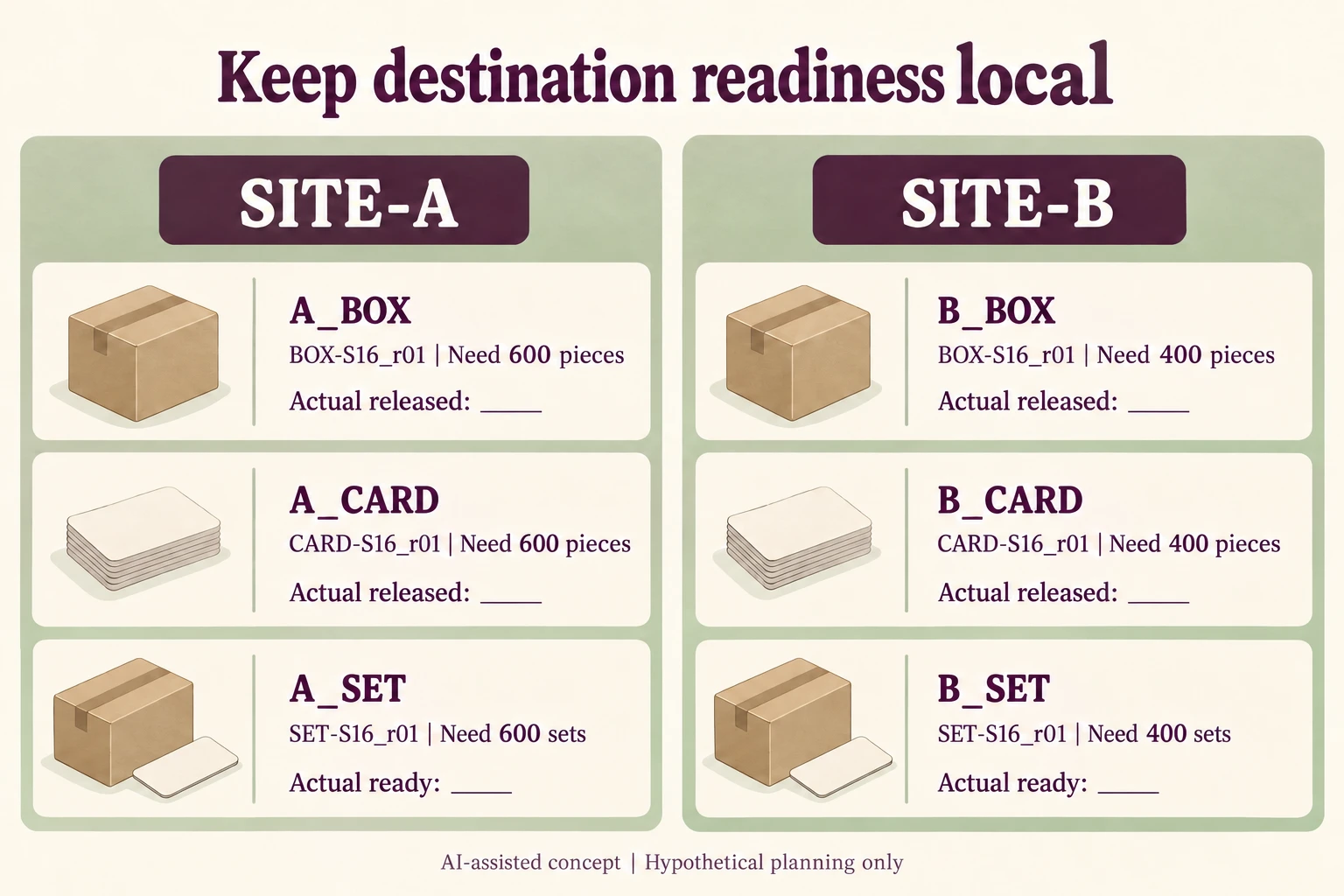
Scroll horizontally if columns extend beyond the view.
| Scope ID | Exact entity | Stage / role | Hypothetical basis |
|---|---|---|---|
| A_BOX | BOX-S16_r01 | RELEASE_FOR_PACKING_REQUIREMENT | Site A needs 600; actual released quantity remains unknown |
| A_CARD | CARD-S16_r01 | RELEASE_FOR_PACKING_REQUIREMENT | Site A needs 600; actual released quantity remains unknown |
| A_SET | SET-S16_r01 | READY_QUANTITY_REQUIREMENT | Site A: one BOX-S16_r01 plus one CARD-S16_r01 per set; actual ready quantity unknown |
| B_BOX | BOX-S16_r01 | RELEASE_FOR_PACKING_REQUIREMENT | Site B needs 400; actual released quantity remains unknown |
| B_CARD | CARD-S16_r01 | RELEASE_FOR_PACKING_REQUIREMENT | Site B needs 400; actual released quantity remains unknown |
| B_SET | SET-S16_r01 | READY_QUANTITY_REQUIREMENT | Site B: one BOX-S16_r01 plus one CARD-S16_r01 per set; actual ready quantity unknown |
A_BOX/A_CARD and B_BOX/B_CARD identify component requirements separately. A_SET and B_SET retain the complete-set level at each site. A quantity released at another location cannot populate these actual local-release fields. The two sites are independent destination scopes, not interchangeable stock.
The current worksheet records no shipment, receipt or transfer event; actual release and ready quantities are unknown. It therefore establishes no site is ready. Use the original transport comparison for route costs, while requesting evidence for each named local component and complete-set row.
Download the direct packaging delivery record (.csv). HYPOTHETICAL rows are invented examples. Use ACTUAL_BLANK for permitted project inputs; replace that row label only when recording actual facts. Empty evidence, observation and date fields mean unknown or not performed, never acceptance. Keep checkpoints and revisions separate.
Use the named scope rows and unresolved evidence to prepare a project enquiry. Replace planning assumptions with actual authorised records before a commercial or use decision. Packrivo coordinates independent suppliers. These records establish no supplier offer, service availability or MOQ exception; its published baseline is 500 pieces per product/design.