

Compare decorative packaging finishes with the fulfilment work their actual instructions require. A visually suitable finish can change staging, transfers or protective material at the bench. Keep those operations visible instead of choosing solely from the appearance of a finished sample.

Begin with the intended effect
Decide which visual or tactile job the finish must do. The foil, embossing and UV comparison separates those effects and the relevant sample questions.
Once two proposals meet the intended appearance, request their actual supplied state and handling instructions. Don’t assume every finish needs a separator sheet, special gloves or extra waiting. Material-specific requirements should come from the identified proposal.
Map the operation changed by the finish
Consider hypothetical proposals A and B for the same gift presentation. Suppose A’s actual offered instructions require a divider and two additional transfers before final assembly, while B’s instructions do not. No physical result or damage rate is verified here.
Scroll horizontally if columns extend beyond the view.
| Operational field | Proposal A scenario | Proposal B scenario |
|---|---|---|
| Extra protective piece | One named divider | None specified |
| Additional transfers | Two identified movements | None specified |
| Staging footprint | Measure the actual supplied arrangement | Measure its arrangement separately |
| Evidence still needed | Trial full operation under its instructions | Trial under its own instructions |
The matrix locates differences; it doesn’t calculate a saving before the operations are observed. Keep the underlying visual requirement steady so less handling isn’t achieved by abandoning the intended result unnoticed.
Record marks without assigning their cause
If a surface mark appears, retain its location, starting condition and preceding action. A scuff photograph does not prove that the finish caused it or that a different coating will solve it.
A change to stacking, divider position or movement can alter the result independently of the finish. Record those controls in a comparison trial rather than changing several at once and assigning the outcome to one treatment.
Actual operator time and consumable use can later populate the cost model. Until then, leave those fields open instead of adding a universal finish surcharge or damage percentage.
Handoff an appearance and operation proposal
Keep the representative appearance evidence with its required handling route. Ask which steps are construction-specific and which are local packing choices. The next decision can then evaluate a finish that meets the design goal and a feasible fulfilment operation, with the cost and performance limits retained.
Sources and scope
Australian Government supports the stated general concepts within this scope: General inventory categories, reorder points and stocktake. Access checked 14 October 2026.
OSHA supports the stated general concepts within this scope: US warehousing ergonomic hazards. Access checked 14 October 2026.
The worked scenario is original editorial analysis with assumed inputs, not a supplier offer, customer record or measured Packrivo result. Commercial feasibility and physical suitability remain project-specific.
Keep each transfer and its receiving state visible
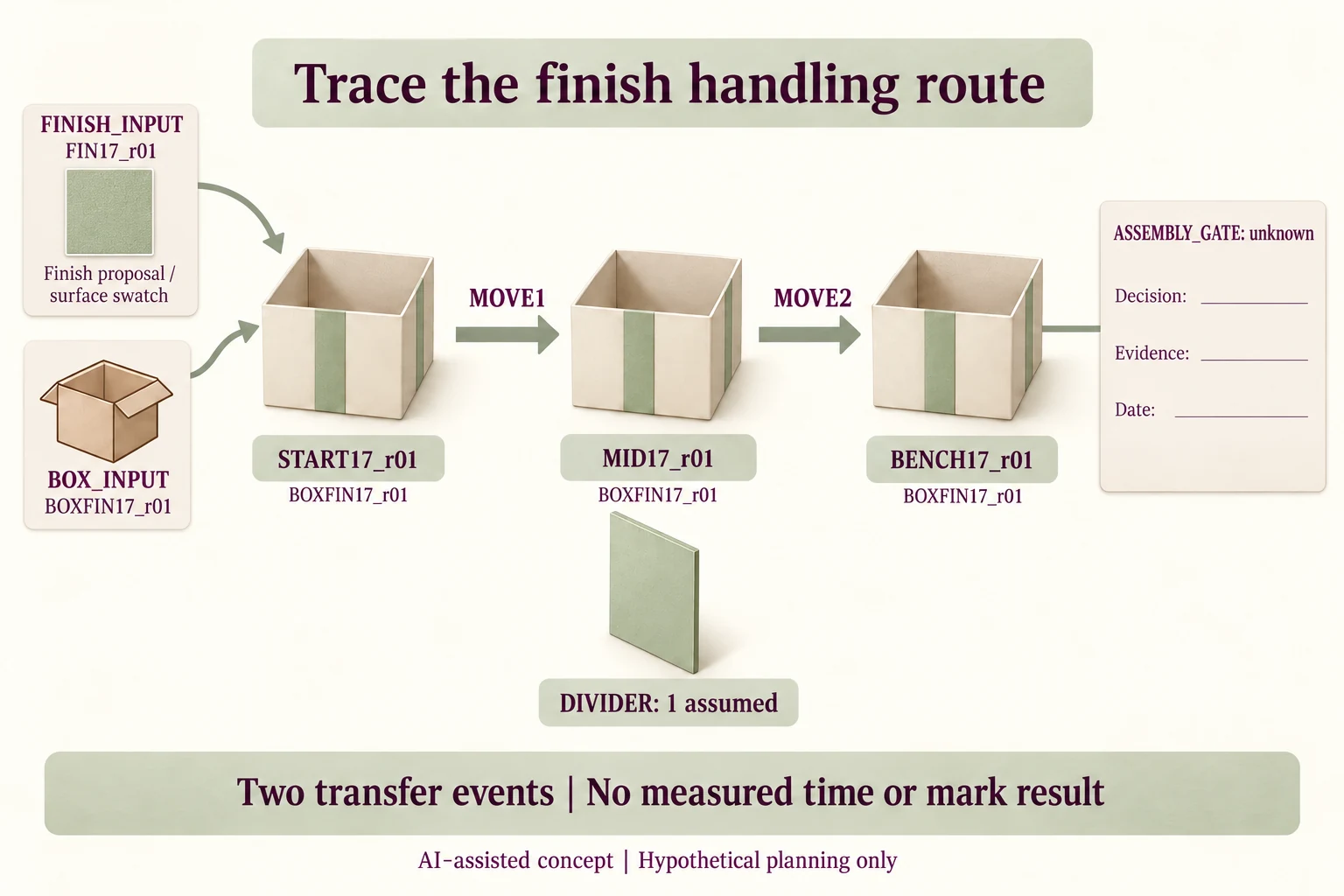
This new hypothetical route follows only the original A-type handling premise: FIN17_r01 on BOXFIN17_r01, one DIV17_r01 protective piece and two proposed transfers. The premise establishes no actual finish instruction or universal extra-work requirement.
Scroll horizontally if columns extend beyond the view.
| Scope ID | Exact entity | Stage / role | Hypothetical basis |
|---|---|---|---|
| FINISH_INPUT | FIN17_r01 | INPUT_SCOPE | Selected hypothetical handling route, not a universal finish requirement |
| BOX_INPUT | BOXFIN17_r01 | INPUT_SCOPE | Component carrying FIN17_r01; actual instructions unknown |
| DIVIDER | DIV17_r01 | HANDLING_INPUT | Assumed route-specific protective piece |
| START_STATE | START17_r01 | BEFORE_TRANSFER1 | Actual starting state unknown |
| MOVE1 | MOVE117_r01 | FIRST_MOVEMENT | Proposed first transfer; no time/result |
| MID_STATE | MID17_r01 | BETWEEN_TRANSFERS | Actual intermediate state unknown |
| MOVE2 | MOVE217_r01 | SECOND_MOVEMENT | Proposed second transfer; no time/result |
| BENCH_STATE | BENCH17_r01 | AFTER_TRANSFER2 | Actual bench state unknown |
| ASSEMBLY_GATE | ASSEMBLY17_r01 | BEFORE_FINAL_ASSEMBLY | Actual feasibility and appearance remain unknown |
MOVE1 connects START17_r01 to MID17_r01; MOVE2 connects MID17_r01 to BENCH17_r01. Each endpoint state is separately recorded so a movement instruction does not become evidence of its received condition. DIVIDER remains a distinct handling component, not an assumed finish property.
ASSEMBLY_GATE leaves actual feasibility and appearance unknown. Time, marks, damage and evidence are not filled from the diagram. No extra fee, damage cause, waiting duration or handling improvement is calculated; the relevant construction-specific instructions still need confirmation.
Download the packaging finish handling costs record (.csv). HYPOTHETICAL rows are invented examples. Use ACTUAL_BLANK for permitted project inputs; replace that row label only when recording actual facts. Empty evidence, observation and date fields mean unknown or not performed, never acceptance. Keep checkpoints and revisions separate.
Bring the exact scope rows and unresolved evidence in a Packrivo enquiry. Replace planning inputs with actual authorised records before treating the scenario as an available arrangement. Prepare a Packrivo packaging enquiry. Packrivo coordinates independent suppliers. These records establish no supplier offer, service availability or MOQ exception; its published baseline is 500 pieces per product/design.