

Compare integrated and specialist packaging procurement by holding the completed gift requirement steady and identifying the interfaces each route creates. Separate suppliers may offer useful capabilities, but their components still need to meet at a defined assembly point. Include that coordination and handling in the comparison.

Identify the physical merge points
List the box, insert, cards and any decoration required. State which parts arrive together, which arrive separately and who verifies the complete configuration. An integrated proposal can still leave final assembly with the buyer.
The flat and assembled delivery scope assigns those operations. Use it under both routes so “one supplier” doesn’t silently imply a finished product pack-out.
For separate sources, retain the same drawing and component identities. A fit decision needs the relevant pieces together; approving each supplier’s isolated photograph doesn’t establish the complete arrangement.
A small coordination difference can reverse the total
Assume the underlying acceptable components have equal purchase costs under two hypothetical routes. The only modeled differences below are extra integration charges. Amounts are invented USD inputs.
Scroll horizontally if columns extend beyond the view.
| Route | Extra scope in the example | Incremental amount |
|---|---|---|
| Integrated route | Defined coordination and merge work | $90 |
| Separate specialists | $40 additional transport plus $80 receiving and merge work | $120 |
The integrated route requires $30 less for this scoped work. That result doesn’t rank actual suppliers or imply that integrated procurement always costs less.
If the specialist route offers a necessary capability absent from the integrated proposal, cost alone cannot make the proposals equivalent. Keep that difference visible rather than pricing a technically unavailable route.
Join the schedule as well as the components
A box can arrive before its dedicated insert. Determine whether the receiving party holds it and who bears any additional work. A complete gift is ready only when every required approved component and assembly operation is available.
Identify who reviews changed dimensions or artwork across supplier boundaries. A new insert revision can affect another maker’s drawing, so the interface needs a current shared reference.
Don’t count coordination both inside a service quotation and again as a separate estimated fee. Equally, do not assume the buyer’s time is free while comparing it with a quoted coordination charge.
Request two complete delivery scopes
Ask for included component versions, assembly state, actual merge work, receiving point and change responsibility under each route. You can then compare a defined integration workload with its costs, while preserving capability differences and unconfirmed timing.
Sources and scope
Australian Government supports the stated general concepts within this scope: General inventory categories, reorder points and stocktake. Access checked 14 October 2026.
Australian Government supports the stated general concepts within this scope: Cash inflows/outflows and clear labeling of estimated figures. Access checked 14 October 2026.
The worked scenario is original editorial analysis with assumed inputs, not a supplier offer, customer record or measured Packrivo result. Commercial feasibility and physical suitability remain project-specific.
Record the two ends of each merge interface
Use one new hypothetical specialist-route merge: BOX17_r01 and INS17_r01 come from BOXSRC17_r01 and INSSRC17_r01 to MERGE17_r01. Each component has separate source and destination records; no supplier, shipment or assembly has been verified.
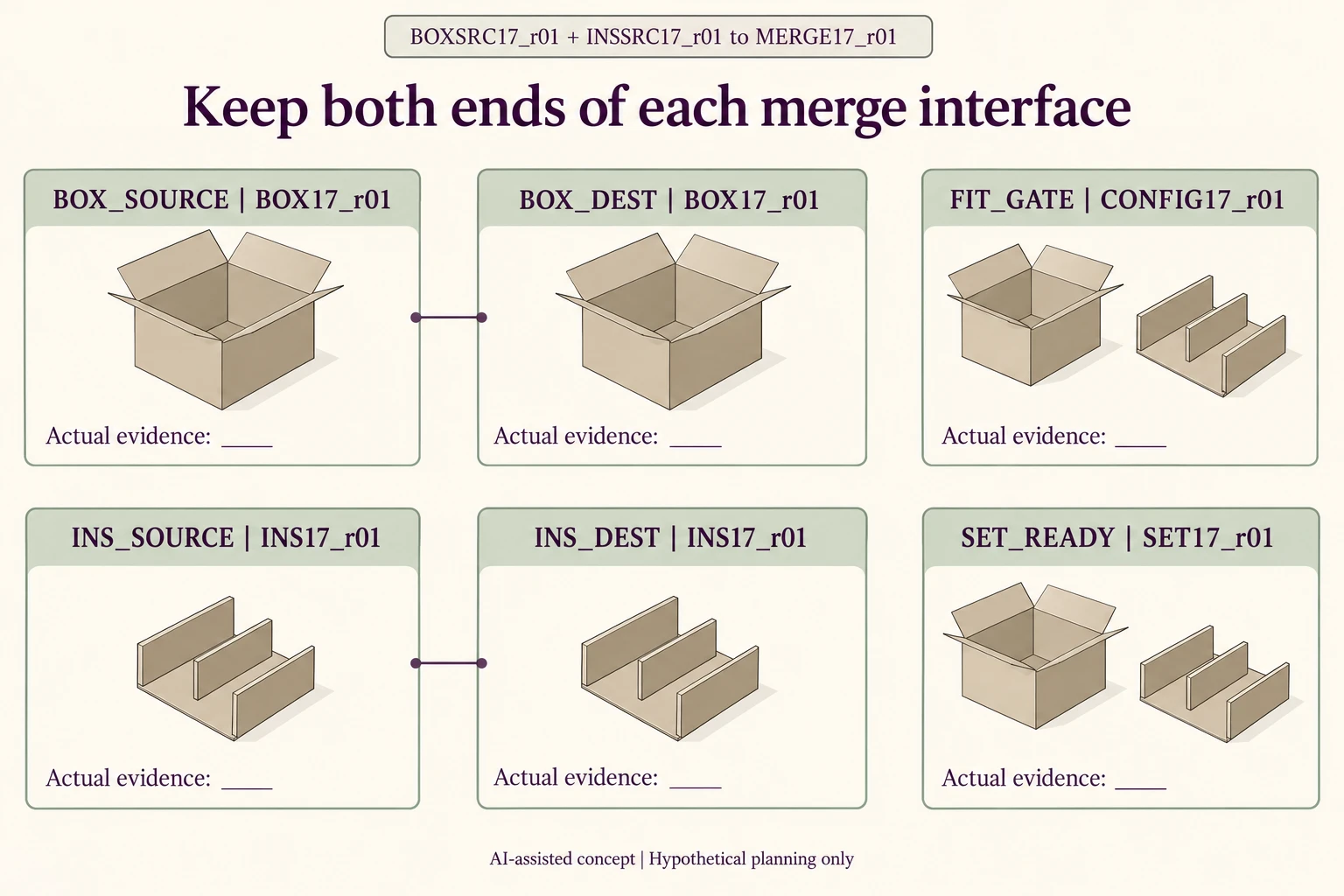
Scroll horizontally if columns extend beyond the view.
| Scope ID | Exact entity | Stage / role | Hypothetical basis |
|---|---|---|---|
| BOX_SOURCE | BOX17_r01 | DISPATCH_SCOPE | Box source end; actual dispatch unverified |
| BOX_DEST | BOX17_r01 | RECEIPT_SCOPE | Box destination end; actual receipt unverified |
| INS_SOURCE | INS17_r01 | DISPATCH_SCOPE | Insert source end; actual dispatch unverified |
| INS_DEST | INS17_r01 | RECEIPT_SCOPE | Insert destination end; actual receipt unverified |
| FIT_GATE | CONFIG17_r01 | FIT_DECISION | One BOX17_r01 plus one INS17_r01 together; no fit decision recorded |
| SET_READY | SET17_r01 | READINESS_DECISION | Required assembly and contents readiness remain unknown |
BOX_SOURCE is not BOX_DEST, and INS_SOURCE is not INS_DEST. A source instruction does not prove receipt at the merge point. Keep their actual quantities, evidence and dates empty until the relevant permitted records exist.
FIT_GATE concerns the two packaging components together as CONFIG17_r01. SET_READY concerns the complete presentation and required assembly, rather than the sum of two isolated component photographs. Both decisions remain unknown. This focused map adds no integration fee or capability claim to the original cost comparison.
Download the single versus multiple packaging suppliers record (.csv). HYPOTHETICAL rows are invented examples. Use ACTUAL_BLANK for permitted project inputs; replace that row label only when recording actual facts. Empty evidence, observation and date fields mean unknown or not performed, never acceptance. Keep checkpoints and revisions separate.
Bring the exact scope rows and unresolved evidence in a Packrivo enquiry. Replace planning inputs with actual authorised records before treating the scenario as an available arrangement. Prepare a Packrivo packaging enquiry. Packrivo coordinates independent suppliers. These records establish no supplier offer, service availability or MOQ exception; its published baseline is 500 pieces per product/design.