
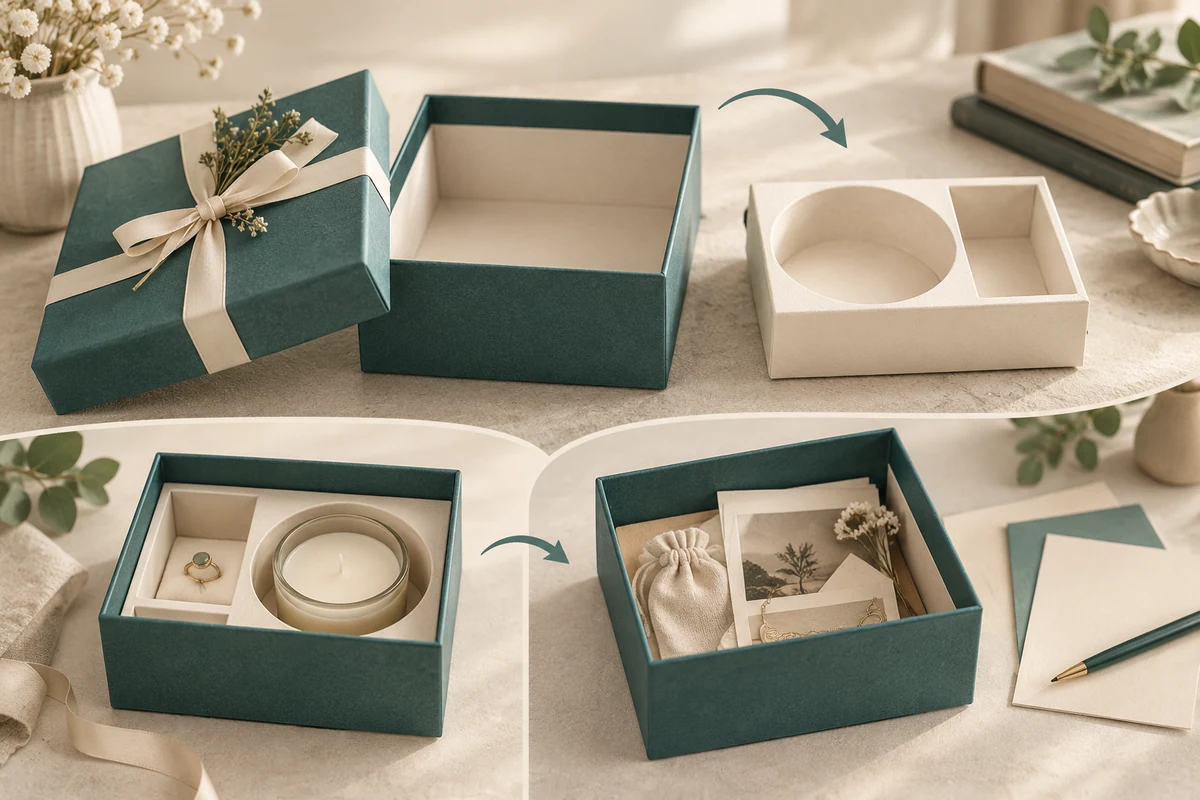
Define the second storage job before calling a gift box useful after the original product is removed. A shaped jewelry holder may be excellent for its first contents but obstruct a different household use. Compare the retained box, removable holder and resulting usable space against one stated task.
Customer retention is a possible use, not evidence of durability or an operating business return system. It also does not establish an environmental benefit or suitability for every object someone might store.
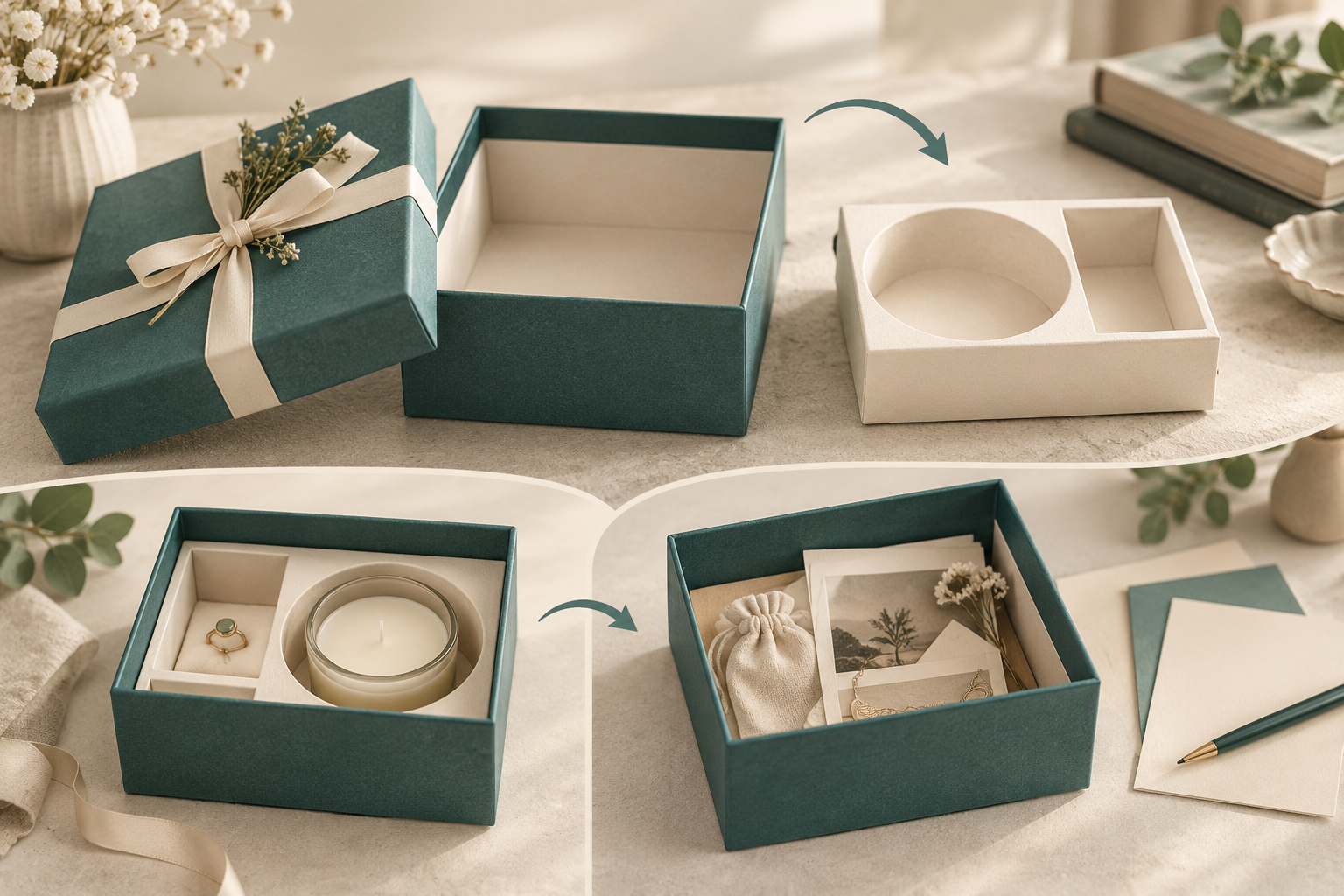
Write two separate functional descriptions
For the original gift, name the product, presentation position, loading, removal and closure requirements. For the second use, describe the objects, how they enter, where they rest and how they are retrieved.
Keep the descriptions specific enough to compare a structure. “Store anything later” leaves dimensions, contacts and operations undefined. It can encourage a design claim wider than the evidence supports.
The business return-system explanation distinguishes keeping a box at home from an organized collection, preparation and next-use service. This article concerns a proposed household conversion only.
Compare a removable holder with a fixed one
Consider a hypothetical necklace gift box. Its original holder creates small product-shaped compartments. The proposed second job is storing three blank stationery packets after the necklace is removed. Neither use has been physically reviewed for this example.
Scroll horizontally if columns extend beyond the view.
| Construction proposal | Original gift job | Second storage job to review |
|---|---|---|
| Holder permanently fixed | Maintains its defined presentation position | Existing shaped compartments remain in the storage space |
| Holder intended to be removed | Needs an identified retention and removal proposal | Interior becomes available in the actual holder-out state |
| Separate retained wall liner | Defines the enclosure’s inner surfaces | May reduce usable space or introduce folds and overlaps |
Removing the holder does not automatically create the nominal box dimensions as usable storage. Lining, corner folds, closure parts and projections can remain. Record the actual interior in that state.
The folded-liner specification distinguishes lining a surface from locating the product. Use that distinction when deciding which part remains after conversion.
Review the conversion action itself
Ask how the holder is detached or lifted, what remains attached and whether the intended recipient can perform the action. Do not instruct people to scrape, heat or cut unknown attachments merely to make a proposed second use possible.
Where the holder is designed to leave as a separate component, describe its intended destination or use only when the product owner has an approved instruction. The box and removed holder can need different decisions.
Microsoft’s packaging design guidance supports considering the complete interaction and intended users. Its examples do not validate the hypothetical conversion or supply contact limits for household objects.
Keep the second-use promise narrow
Return a brief naming the original configuration, the conversion parts and the second-use objects. Request a sample representing both states and identify which observations are still missing. A visual concept can show the intended change but cannot establish its physical success.
Packrivo can coordinate those structural and supplier questions through a packaging project inquiry. Public design guidance was checked on 14 October 2026. This proposal proves no lifetime, food-contact suitability, safe storage category or environmental advantage.
Track both the converted box and the removed holder
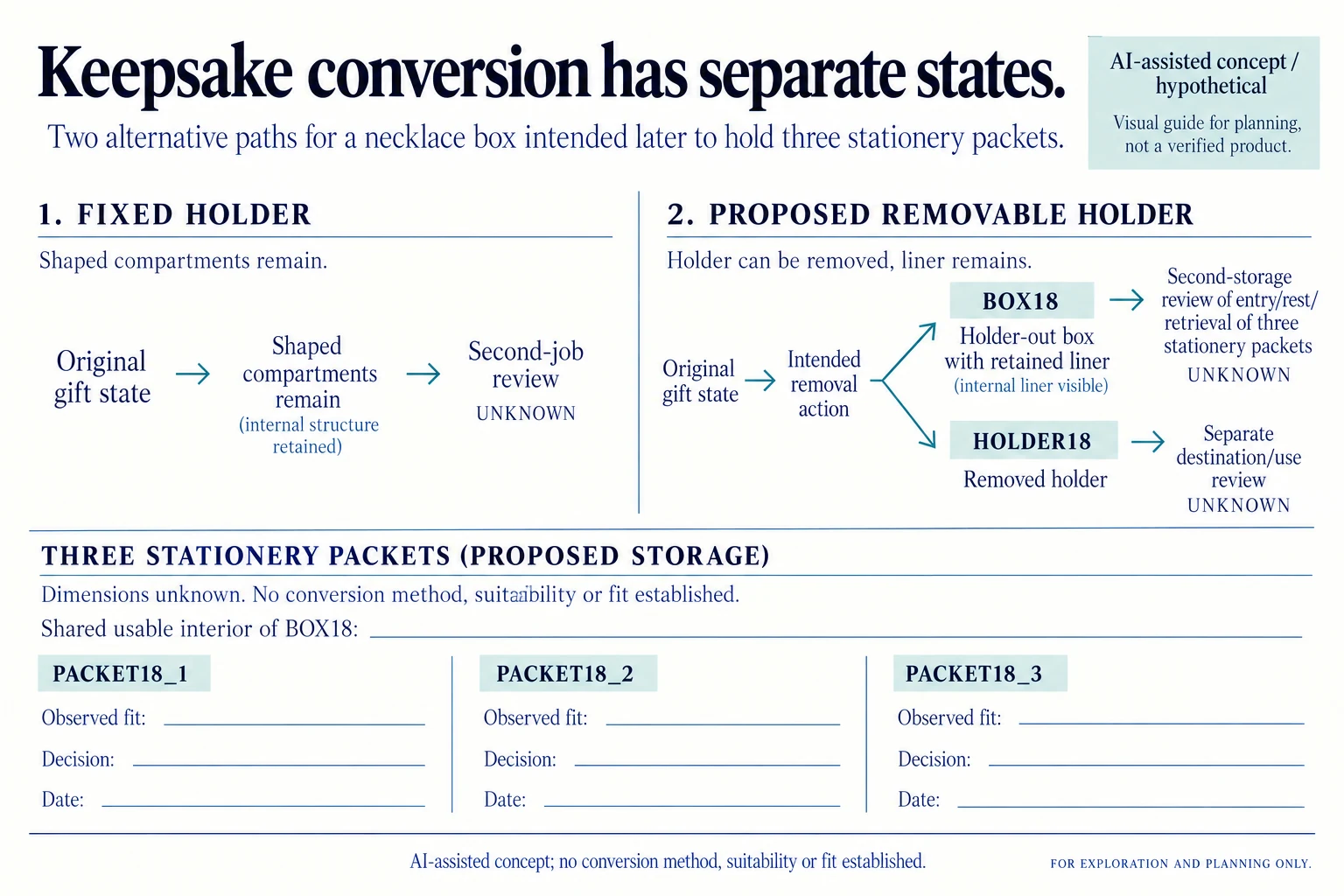
Use separate references for the retained box, removable holder and wall liner in the original hypothetical necklace-to-stationery proposal. Each of the three blank packets also gets a reference. No packet dimensions or usable interior have been measured.
Scroll horizontally if columns extend beyond the view.
| Scenario scope | Exact object or route | Hypothetical input or output | Calculation or record boundary |
|---|---|---|---|
| Second action | BOX18 | Unobserved; actual fields blank | Three packets entry into actual holder-out state |
| Second position | BOX18 | Unobserved; actual fields blank | Resting relationship of all three packets |
| Second action | BOX18 | Unobserved; actual fields blank | Retrieve packets without assumed fit |
| Open decision | BOX18 | Unobserved; actual fields blank | Original and converted functions reviewed separately; lifetime food contact safe use environment unestablished |
A holder-out photo should show the retained liner, corner folds, closure parts and projections. Record entry, resting positions and retrieval for the three packets against that actual state. The nominal outside box size does not answer whether the proposed second job fits.
The removed holder needs its own destination or approved use instruction; it does not disappear from the conversion merely because the box interior is photographed. Keep the permanently fixed holder as a separate alternative and leave its second-job review open. No scraping, heating, cutting or other removal method is prescribed.
Download the keepsake box design record (.csv). It covers the original scenarios and this added comparison. HYPOTHETICAL rows are invented planning examples. Actual quantity, value, configuration, method, owner, observation, condition, decision, evidence and dates are blank because no actual project record has been obtained. Copy a relevant row and replace its type with ACTUAL only when entering permitted project evidence; keep the example and actual record separate. ACTUAL_BLANK is an empty starting row. A blank is unknown, never approval.
Returning jewelry after wear is a different job in the daily jewelry repacking task. Customer retention is separate from the organized packaging-return distinction.
Source scope checked 16 October 2026: the original public references remain within their stated general guidance or manufacturer-example scope. The new numbers and task records are original hypothetical analysis, not observed supply, trials, inventory, prices or performance.
What this changes in a packaging enquiry
State the intended second storage contents before specifying a removable insert, durable closure or open interior. Ask for the first-use and second-use arrangements separately in the sample scope. A keepsake concept is not evidence of service life, environmental benefit or suitability for an unspecified later use. A relevant configuration to compare is the Rigid Magnetic Jewelry Box; it is a concept reference, not confirmed suitability.
Discuss this packaging specification with Packrivo. We coordinate independent suppliers. MOQ: 500 pieces per product/design; illustrative quantities are not production offers. Confirm materials, samples, price and timing for your project.