

A packing-capacity scenario divides available productive time by a clearly defined per-pack interval. Deduct the setup, replenishment and other work outside that interval first. Retain trial limitations so the calculated number doesn’t become an unsupported production promise.

Match the trial to the planned shift
The packing-trial record names the observed operation, contents, operator and interruptions. Use that scope when translating an interval into capacity. A prepared-bench trial cannot silently represent a shift that includes fetching every insert from storage.
List additional work in minutes. Keep any task already included in the per-pack interval out of the deduction column, or it will reduce the model twice.
Read the shortfall before accepting the order
Assume a fictional 360-minute shift. Setup needs 30 minutes, breaks 30, and replenishment outside the per-pack cycle another 20. Productive time is therefore 280 minutes. Suppose the defined cycle is an assumed 90 seconds.
Scroll horizontally if columns extend beyond the view.
| Calculation | Scenario result |
|---|---|
| Productive seconds | 280 x 60 = 16,800 |
| Complete packs at 90 seconds | Floor of 16,800 / 90 = 186 |
| Productive time required for 220 packs | 220 x 90 / 60 = 330 minutes |
| Gap against 280 productive minutes | 50 minutes |
The precise gap is 50 minutes under these assumptions. Rounding the capacity down to 186 should not make the gap 51 minutes by comparing only rounded output counts.
No actual shift or Packrivo performance is measured here. The model omits variable delays and any further requirements that the stated trial didn’t include.
Test the slower cycle too
If the same operation takes 110 seconds rather than 90, the productive time supports 152 complete packs after rounding down. That scenario can identify how sensitive a commitment is to the original observation.
Additional operators may need a separate task-balance model. Two people do not necessarily double output when they share equipment, space or a bottleneck operation.
Remember finished-unit boundaries. A box formed during the shift isn’t a completed gift if loading, card matching or closure remain outside the clock. Product and component availability also remain independent constraints.
Close the workload with actual evidence
Record the order count, productive-time deductions and cycle scope together. Trial the intended setup and update the interval with appropriate evidence before relying on capacity. Your output should identify the modeled gap and the additional feasible time or process change needed, rather than quietly removing breaks or replenishment to make the order fit.
Sources and scope
Australian Government supports the stated general concepts within this scope: General inventory categories, reorder points and stocktake. Access checked 14 October 2026.
OSHA supports the stated general concepts within this scope: US warehousing ergonomic hazards. Access checked 14 October 2026.
The worked scenario is original editorial analysis with assumed inputs, not a supplier offer, customer record or measured Packrivo result. Commercial feasibility and physical suitability remain project-specific.
Keep the seconds behind the rounded complete-pack count
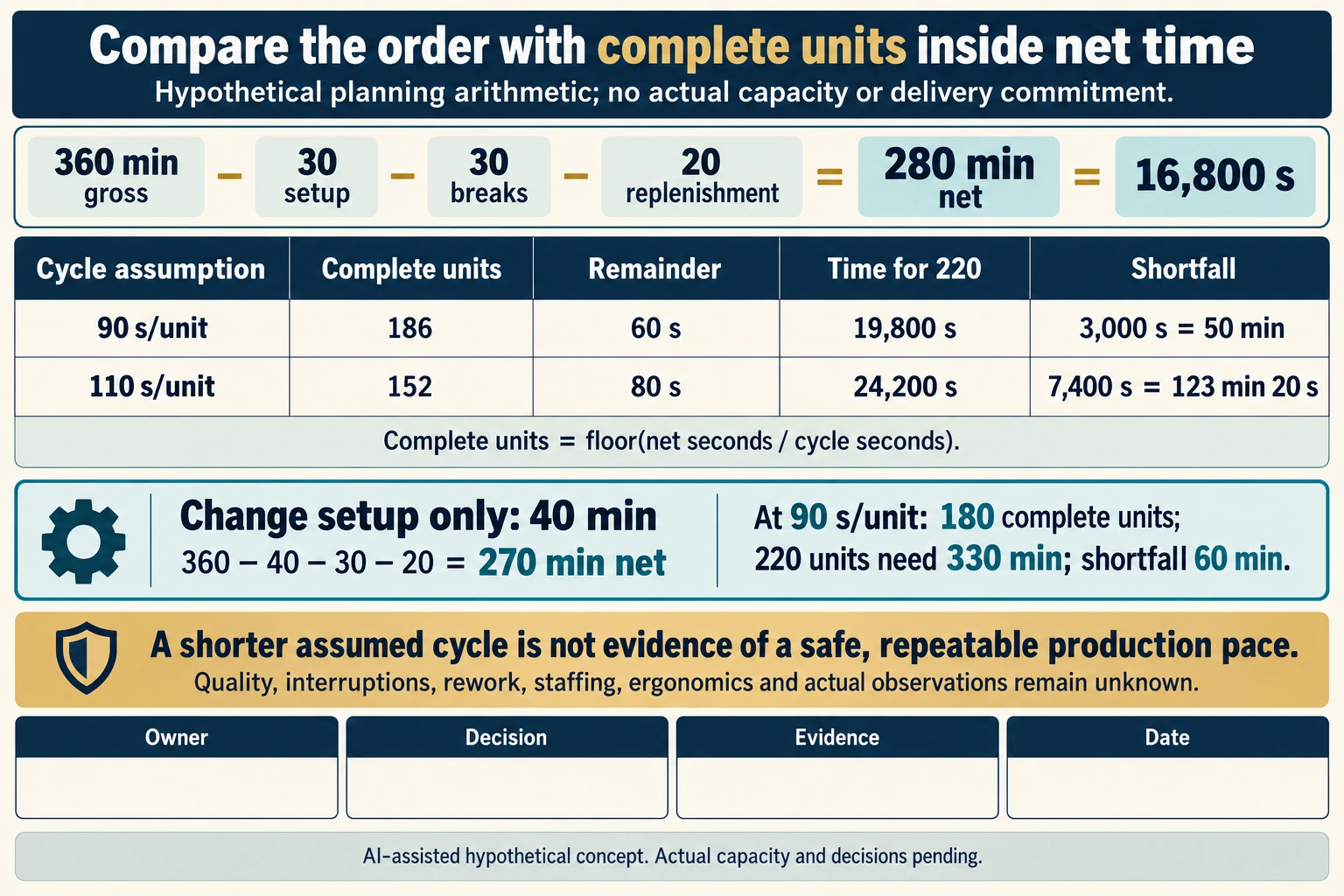
Retain the original 360-minute shift, 30-minute setup, 30-minute breaks and 20-minute replenishment outside the cycle. They leave 280 productive minutes or 16800 seconds. At the assumed 90 seconds per finished pack, 186 complete packs consume 16740 seconds and leave 60 seconds. That remainder is not another complete gift.
For the separate 110-second cycle scenario, 152 complete packs use 16720 seconds and leave 80 seconds. The 220-pack request needs 24200 productive seconds, exceeding 16800 by 7400 seconds: 123 minutes 20 seconds. This exact continuous-time shortfall is a different output from subtracting 152 rounded packs from 220 and multiplying a rounded count. The original 90-second scenario still has its correct 50-minute gap.
As another stated change, increasing setup from 30 to 40 minutes leaves 270 productive minutes. At the same assumed 90-second cycle, that yields 180 complete packs and a 60-minute productive-time gap against the 220-pack requirement. Breaks and replenishment were retained. These sensitivities identify which time or scope premise requires evidence; they do not justify removing safe breaks or assigning a real completion date.
Material availability, accepted finished-unit definition, quality losses, unexpected delays and feasible staffing remain independent constraints. Actual observations must replace the fictional inputs before a commitment. An apparently precise floor result is still a planning model, not a demonstrated stable Packrivo capacity.
| Hypothetical scope | Object and relationship | Input, formula or open question |
|---|---|---|
| TIME32_SHIFT | SHIFT — ASSUMED_TIME | 360 min |
| TIME32_SETUP | SETUP — ASSUMED_TIME | 30 min |
| TIME32_BREAKS | BREAKS — ASSUMED_TIME | 30 min |
| TIME32_REPLENISH | REPLENISH — ASSUMED_TIME | 20 min |
| TIME32_NET | PRODUCTIVE_TIME — CALCULATED_FROM | TIME32_SHIFT-TIME32_SETUP-TIME32_BREAKS-TIME32_REPLENISH; 280 min |
| UNIT32_SECONDS_PER_MINUTE | UNIT_CONVERSION — DEFINITION | 60 s/min |
| TIME32_SECONDS | PRODUCTIVE_SECONDS — CALCULATED_FROM | TIME32_NET*UNIT32_SECONDS_PER_MINUTE; 16800 s |
| ORDER32_COUNT | REQUESTED_FINISHED_PACKS — ASSUMED_QUANTITY | 220 pack |
| CYCLE90_32_INTERVAL | DEFINED_FINISHED_PACK_INTERVAL — ASSUMED_INPUT | 90 s/pack |
| CYCLE90_32_COMPLETE | COMPLETE_PACK_COUNT — CALCULATED_FROM | floor(TIME32_SECONDS/CYCLE90_32_INTERVAL); 186 pack |
| CYCLE90_32_REMAINDER | UNUSED_PRODUCTIVE_SECONDS — CALCULATED_FROM | TIME32_SECONDS-CYCLE90_32_COMPLETE*CYCLE90_32_INTERVAL; 60 s |
| CYCLE90_32_REQUIRED | PRODUCTIVE_TIME_FOR_ORDER — CALCULATED_FROM | ORDER32_COUNT*CYCLE90_32_INTERVAL; 19800 s |
| CYCLE90_32_GAP | PRODUCTIVE_TIME_SHORTFALL — CALCULATED_FROM | CYCLE90_32_REQUIRED-TIME32_SECONDS; 3000 s |
| CYCLE110_32_INTERVAL | DEFINED_FINISHED_PACK_INTERVAL — ASSUMED_INPUT | 110 s/pack |
| CYCLE110_32_COMPLETE | COMPLETE_PACK_COUNT — CALCULATED_FROM | floor(TIME32_SECONDS/CYCLE110_32_INTERVAL); 152 pack |
| CYCLE110_32_REMAINDER | UNUSED_PRODUCTIVE_SECONDS — CALCULATED_FROM | TIME32_SECONDS-CYCLE110_32_COMPLETE*CYCLE110_32_INTERVAL; 80 s |
| CYCLE110_32_REQUIRED | PRODUCTIVE_TIME_FOR_ORDER — CALCULATED_FROM | ORDER32_COUNT*CYCLE110_32_INTERVAL; 24200 s |
| CYCLE110_32_GAP | PRODUCTIVE_TIME_SHORTFALL — CALCULATED_FROM | CYCLE110_32_REQUIRED-TIME32_SECONDS; 7400 s |
| SETUP40_32_INPUT | REVISED_SETUP_TIME — ASSUMED_INPUT | 40 min |
| SETUP40_32_NET | REVISED_PRODUCTIVE_TIME — CALCULATED_FROM | TIME32_SHIFT-SETUP40_32_INPUT-TIME32_BREAKS-TIME32_REPLENISH; 270 min |
| SETUP40_32_CAPACITY | REVISED_COMPLETE_PACKS — CALCULATED_FROM | floor(SETUP40_32_NET*UNIT32_SECONDS_PER_MINUTE/CYCLE90_32_INTERVAL); 180 pack |
| SETUP40_32_GAP | REVISED_PRODUCTIVE_GAP — CALCULATED_FROM | CYCLE90_32_REQUIRED/UNIT32_SECONDS_PER_MINUTE-SETUP40_32_NET; 60 min |
Download the comparison and project record (.csv). It preserves the original passages, model branches and table fields alongside the added hypothetical scopes. Relationship rows are not business cases, tests or completed records. Every actual identity, quantity, material, process, specification, observation, owner, decision, evidence and date field is blank. ACTUAL_BLANK is an empty starting row; unknown fields require permitted project evidence.
For the separate question, read Record a Packing Trial Without Promising a Universal Speed.
Source scope checked 17 October 2026: These capacity calculations are original hypothetical editorial analysis. General inventory and OSHA hazard guidance do not prescribe this formula or verify trial performance, safe pace, quality, staffing or delivery. No actual shift or production commitment is established.
What this changes in a packaging enquiry
If the modeled packing capacity misses the launch requirement, compare supplier proposals that move a defined task out of your packing operation, such as delivered box forming or component kitting. Obtain the actual included work and arrival state; do not convert the example cycle time into a supplier capacity or promised launch date.
Discuss this packaging specification with Packrivo. We coordinate independent suppliers. MOQ: 500 pieces per product/design; illustrative quantities are not production offers. Confirm materials, samples, price and timing for your project.