

Adding operators increases gift-packing output only if tasks can be assigned across feasible stations without leaving one station as the dominant bottleneck. Preserve task order, handovers and actual handling requirements. Dividing a one-person time by the number of people can overstate the capacity of a serial line.

Break the observed operation into tasks
Use the actual delivered packaging and full contents. The packing-trial timing record keeps the observation’s start, stop, operator and interruptions visible.
Record which tasks must follow others. Forming the box may precede loading, and loading may precede closing. Some tasks require the same person or a stable temporary state, so they cannot be reassigned solely to balance a spreadsheet.
Compare station loads for one assumed gift
Suppose the fictional task times are 30 seconds to form, 40 seconds to load the insert and product, and 20 seconds to add the card and close. One sequential operator uses 90 seconds per gift before interruptions.
Scroll horizontally if columns extend beyond the view.
| Assumed assignment | Station workloads | Ideal serial-line bottleneck |
|---|---|---|
| One operator | 90 seconds | 90 seconds |
| Two stations: form, then load and close | 30 and 60 seconds | 60 seconds |
| Three stations: one task group each | 30, 40 and 20 seconds | 40 seconds |
Two operators do not yield a 45-second bottleneck in the stated assignment. The second station still needs 60 seconds for every gift. The three-station case has a 40-second limiting stage under its ideal assumptions.
These are mathematical scenarios, not demonstrated production rates. Startup, transfers, pauses, replenishment and variability remain excluded. A finite job also takes time to fill and empty the line.
Check the handover that creates the apparent gain
Specify how an open gift moves between stations and stays identified. A personal card or fragile item may make a proposed transfer unsuitable. Retain that constraint rather than moving a task into another column to improve the calculated balance.
Provide an appropriate work area and qualified review of actual ergonomic or safety questions. The task model does not certify a layout or recommend machinery modifications.
If one station falls behind, locate the work waiting between stages. A faster preceding station can simply create more unfinished gifts. Output should follow completed units rather than the number formed at the first station.
Trial the feasible assignment
Choose a candidate task split and observe the full route with the intended people and materials. Retain transfers and interruption work, then revise the station loads from actual evidence. The next decision is which assignment can support the workload, with its limiting stage visible.
Sources and scope
Australian Government supports the stated general concepts within this scope: General inventory categories, reorder points and stocktake. Access checked 14 October 2026.
OSHA supports the stated general concepts within this scope: US warehousing ergonomic hazards. Access checked 14 October 2026.
The worked scenario is original editorial analysis with assumed inputs, not a supplier offer, customer record or measured Packrivo result. Commercial feasibility and physical suitability remain project-specific.
A ten-gift job must fill the line before the steady rhythm appears
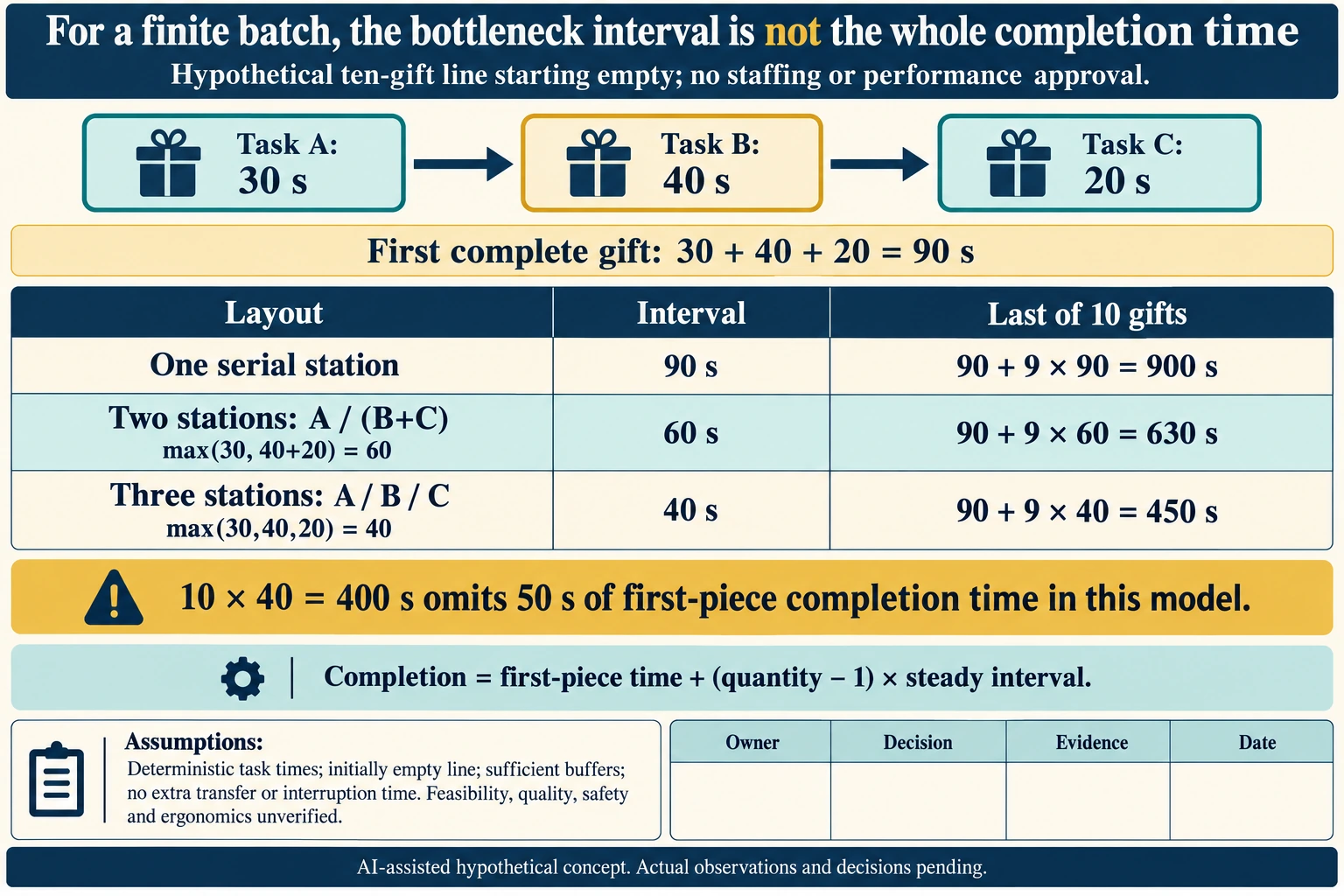
Keep the original fictional 30-second forming, 40-second loading and 20-second card-and-close task groups. Add a finite job of 10 gifts on an initially empty deterministic serial line. In the formulas, JOB32_COUNT is the dimensionless integer cardinal count N=10: gifts are the counted objects, not an algebraic unit. N-1 counts nine subsequent completion gaps; multiplying this dimensionless gap count by an interval in seconds gives seconds. The first completion is added separately. Assume feasible assignments, adequate intermediate buffers, one gift at each stage at a time, no extra transfer/setup/replenishment time and no interruptions or variation. These assumptions are not an approved layout or safe handling method.
One sequential operator needs 10×90=900 seconds. With stations of 30 and 60 seconds, the first completed gift takes 90 seconds and the following nine emerge 60 seconds apart: 90+9×60=630 seconds. With three stations of 30, 40 and 20 seconds, the first again takes 90 seconds and the following nine emerge 40 seconds apart: 90+9×40=450 seconds.
Multiplying the 10-gift job only by the three-station 40-second bottleneck gives 400 seconds and omits 50 seconds of finite-line timing. It is not a demonstrated faster method. The mathematical comparison now distinguishes first completion, subsequent spacing and last completion. Actual handovers, fragile/personalized contents, safe work areas, quality and variable delays still determine whether an assignment is feasible; this model does not assign staff or promise production output.
| Hypothetical scope | Object and relationship | Input, formula or open question |
|---|---|---|
| TASK32_FORM | FORM — ASSUMED_TASK_DURATION | 30 s |
| TASK32_LOAD | LOAD — ASSUMED_TASK_DURATION | 40 s |
| TASK32_CARD_CLOSE | CARD_CLOSE — ASSUMED_TASK_DURATION | 20 s |
| JOB32_COUNT | FINITE_JOB — ASSUMED_QUANTITY | 10 gifts; integer cardinal count N=10 is dimensionless in the formulas |
| LINE32_FIRST | FIRST_COMPLETION — CALCULATED_FROM | TASK32_FORM+TASK32_LOAD+TASK32_CARD_CLOSE; 90 s |
| ONE32_INTERVAL | SUBSEQUENT_COMPLETION_INTERVAL — CALCULATED_FROM | TASK32_FORM+TASK32_LOAD+TASK32_CARD_CLOSE; 90 s; Original feasible serial station assignment assumed; not observed rate |
| ONE32_LAST | TENTH_GIFT_COMPLETION — CALCULATED_FROM | LINE32_FIRST+(JOB32_COUNT-1)*ONE32_INTERVAL; 900 s |
| TWO32_INTERVAL | SUBSEQUENT_COMPLETION_INTERVAL — CALCULATED_FROM | max(TASK32_FORM,TASK32_LOAD+TASK32_CARD_CLOSE); 60 s; Original feasible serial station assignment assumed; not observed rate |
| TWO32_LAST | TENTH_GIFT_COMPLETION — CALCULATED_FROM | LINE32_FIRST+(JOB32_COUNT-1)*TWO32_INTERVAL; 630 s |
| THREE32_INTERVAL | SUBSEQUENT_COMPLETION_INTERVAL — CALCULATED_FROM | max(TASK32_FORM,TASK32_LOAD,TASK32_CARD_CLOSE); 40 s; Original feasible serial station assignment assumed; not observed rate |
| THREE32_LAST | TENTH_GIFT_COMPLETION — CALCULATED_FROM | LINE32_FIRST+(JOB32_COUNT-1)*THREE32_INTERVAL; 450 s |
| THREE32_NAIVE | OMITTED_LINE_TIMING_COMPARISON — CALCULATED_FROM | JOB32_COUNT*THREE32_INTERVAL; 400 s; Incomplete model, not actual capacity |
| THREE32_OMITTED | FINITE_LINE_TIME_OMITTED — CALCULATED_FROM | THREE32_LAST-THREE32_NAIVE; 50 s |
Download the comparison and project record (.csv). It preserves the original passages, model branches and table fields alongside the added hypothetical scopes. Relationship rows are not business cases, tests or completed records. Every actual identity, quantity, material, process, specification, observation, owner, decision, evidence and date field is blank. ACTUAL_BLANK is an empty starting row; unknown fields require permitted project evidence.
For the separate question, read Record a Packing Trial Without Promising a Universal Speed.
Source scope checked 17 October 2026: The scheduling calculation is original hypothetical analysis. Business.gov.au inventory guidance and OSHA warehouse hazard guidance do not establish station times, staffing ratios or capacity gains. No ergonomic assessment, actual trial or safe layout approval is supplied.
What this changes in a packaging enquiry
When assembly work affects the packaging choice, ask whether the supplier delivers formed boxes, flat components or a partly assembled kit. Use the same task breakdown to compare those arrival states. More operators cannot compensate for an unreviewed assembly sequence or an insert that prevents the tasks from being divided.
Discuss this packaging specification with Packrivo. We coordinate independent suppliers. MOQ: 500 pieces per product/design; illustrative quantities are not production offers. Confirm materials, samples, price and timing for your project.