

Size a pop-up packaging kit around the services customers are expected to use, then separate what travels initially from what can be refilled during the event. Product sales, shopping-bag requests and gift-wrapping requests need different component counts. A single estimate of “120 customers” cannot define all three.
Label a new event’s demand assumptions clearly. The starting plan can guide preparation, but actual issues and remaining supplies should be recorded so the next event uses evidence rather than copied percentages.

Translate the service mix into materials
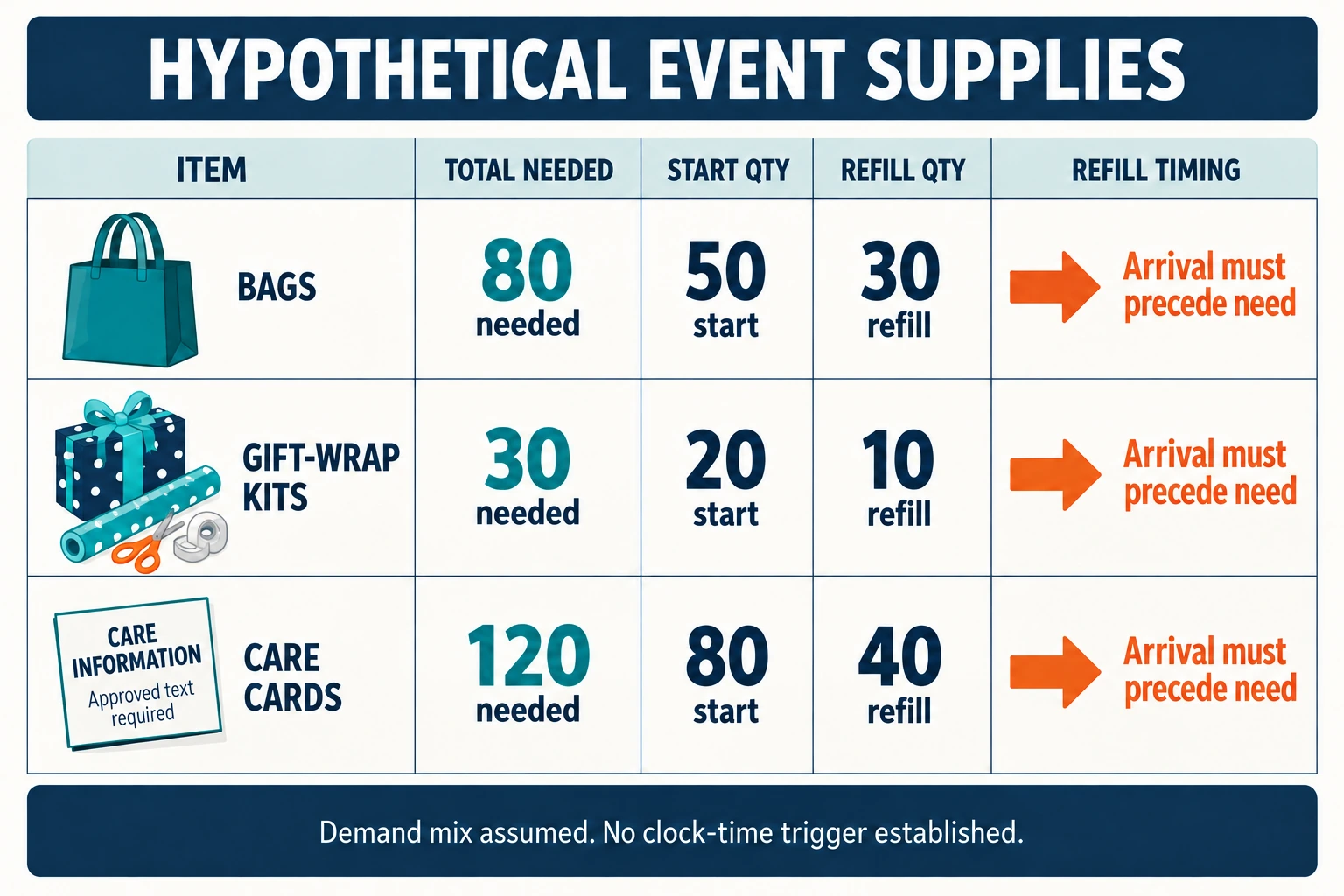
This hypothetical event expects 120 sales, 80 bag requests and 30 gift-wrapping requests. Each sale includes one care card. All quantities are invented; no Packrivo event or observed customer behavior supports them.
Scroll horizontally if columns extend beyond the view.
| Supply | Assumed event demand | Initial carry quantity | Refill required to cover the assumption |
|---|---|---|---|
| Shopping bags | 80 | 50 | 30 |
| Gift-wrap kits | 30 | 20 | 10 |
| Care cards | 120 | 80 | 40 |
The table assumes every gift-wrap kit is complete and suitable for the intended gift. If a kit contains two seals or a separate envelope, convert the kit count into those component quantities before preparing the refill.
Avoid treating every purchase as a bag request unless that is the actual service. Conversely, a bag might carry more than one purchased product. Define the service unit so the quantity sheet reflects what staff hand over.
A refill quantity also needs a usable arrival time
Thirty spare bags in another location do not solve a shortage at the stall unless someone can deliver them before they are needed. Name the refill stock location, transport arrangement and person responsible. Confirm when that route can operate during the event.
Set a practical trigger based on remaining supplies and the time needed for replenishment. The example provides no observed consumption rate, so it cannot establish a reliable clock time for the trigger.
Include the space required for unopened refill supplies and the material currently used at the station. Retailer or venue rules may restrict where that stock waits. The channel packaging comparison provides the broader pop-up context; this kit follows the event’s consumables through its own refill route.
Count the unused materials back in
At close, separate intact unused supplies, used materials and items whose condition or version needs review. Record materials issued from a refill location even when they arrived too late to be used. Otherwise, the event’s apparent consumption can include stock simply moved between locations.
A useful closing balance is opening supplies plus actual refills, less recorded issues, compared with the quantity counted at the stall. An unexplained difference remains a reconciliation question. It should not automatically become a future waste allowance.
The Australian Government inventory guidance supports recording inventory, sales and returns. The service-mix conversion and refill table are original planning examples, not an event forecast or prescribed stock level. Source checked 14 October 2026.
Keep the next event’s buying decision separate
Actual bag and gift-kit demand can inform the next plan, but one short event may not represent a different venue or audience. Preserve its context and avoid assuming an identical service mix.
Packrivo can coordinate a materials brief through a packaging project inquiry. Component quantities, packing form and supplier conditions need confirmation; an initial carry limit does not create an exception to a custom component’s order requirements.
Reconcile a refill that arrives after part of the demand
A pop up shop packaging supplies record needs both a quantity balance and a location/time boundary. Extend the invented 80-bag, 30-kit and 120-card demand with a checkpoint immediately before a planned refill. Assume 45 bags, 18 complete kits and 70 cards have been issued; these are teaching inputs, not observed event rates.
Scroll horizontally if columns extend beyond the view.
| Supply | Start | Issued before checkpoint | Remaining before refill | Hypothetical refill received | Balance after refill |
|---|---|---|---|---|---|
| Bags | 50 | 45 | 5 | 30 | 35 |
| Complete gift-wrap kits | 20 | 18 | 2 | 10 | 12 |
| Care cards | 80 | 70 | 10 | 40 | 50 |
Remaining assumed event demand is 35 bags, 12 kits and 50 cards, exactly the post-refill balance in this example. There is no buffer in those numbers. If another six bag requests arrive before the refill, five can be served from the five remaining bags and one cannot be served at that moment. A later arrival does not retroactively avoid that shortage. Record the actual arrival and a real exception response rather than inserting an invented reliable clock-time trigger. At close, reconcile each location separately before combining stock transfers with issues.
Download the pop up shop packaging supplies record (.csv). Example rows are explicitly hypothetical. Use ACTUAL_BLANK for your own permitted project entries; replace that row label only when recording actual inputs. Blank evidence or observation fields mean unknown or not performed, never approval. Keep revisions and checkpoints separate.
For a scoped packaging inquiry, provide the event service mix, complete-kit recipe, carrying limits and actual refill route/arrival responsibility. Send the identified configuration and open questions to Packrivo. Quantities in this record are planning demand, not quoted purchase quantities, MOQ exceptions or confirmed service availability.
What this changes in a packaging enquiry
Build the event packaging order from the services actually planned, such as boxed gifts, carrier bags or gift messages. Separate the initial carry quantity from the replenishment quantity and its usable arrival time. An event attendance assumption is not a confirmed order forecast or a supplier stock commitment. A relevant configuration to compare is the Gift Bag and Tissue Set; it is a concept reference, not confirmed suitability.