

Preassembling empty gift boxes moves forming work before the packing peak, but creates a physical buffer that needs space and current-version control. Choose the buffer from the actual forming task, expected peak and available storage. Preformed boxes are not completed gifts.

Keep internal preparation separate from delivery format
A supplier’s assembled-delivery proposal and your team’s early forming plan are different decisions. The delivery-state comparison establishes which work arrives finished and which remains local.
For local preparation, identify the state counted as preassembled. A formed outer box might still need an insert, fastening or another operation. Include only the work actually moved earlier.
Move 40 minutes out of an assumed peak
Suppose a fictional peak requires 120 gifts per hour for two hours, or 240 gifts. Forming each empty box takes an assumed 30 seconds. The full forming work is 120 minutes.
Scroll horizontally if columns extend beyond the view.
| Buffer before peak | Forming work moved earlier | Boxes still formed during peak |
|---|---|---|
| 0 | 0 minutes | 240 |
| 80 | 40 minutes | 160 |
| 160 | 80 minutes | 80 |
An 80-box buffer moves 40 minutes. It doesn’t establish that the whole peak now fits; product loading, message matching and closure still need their own capacity.
The buffer should have actual measured storage arrangements. Multiplying closed-box geometric volume can start a proposal, but delivered cartons, stacking limits, access and safe handling can change the usable space.
Test demand and configuration changes
If the peak uses only 60 gifts, twenty of the preformed 80 boxes remain. Record their component version and whether they can return to an approved later use. Don’t describe all early work as waste or assume every remaining box stays usable.
If the configuration changes after forming, determine what preparation can be reversed and which work must be repeated. A removable sleeve and a permanent fastening may have different consequences under the actual construction.
Keep the buffer distinct from ordinary bulk stock. Its purpose is to supply a named operation during a specific window, so the refill or draw-down plan needs a responsible owner.
Choose the smallest feasible buffer scenario
Compare several buffer quantities against the actual peak-work gap and ready-stock space. Trial the supplied construction before using a forming time. The output should state how much work moves earlier, how much stays inside the peak, and where the prepared boxes will remain identified until used.
Sources and scope
Australian Government supports the stated general concepts within this scope: General inventory categories, reorder points and stocktake. Access checked 14 October 2026.
OSHA supports the stated general concepts within this scope: US warehousing ergonomic hazards. Access checked 14 October 2026.
The worked scenario is original editorial analysis with assumed inputs, not a supplier offer, customer record or measured Packrivo result. Commercial feasibility and physical suitability remain project-specific.
Keep the prepared-box residual separate from finished gifts
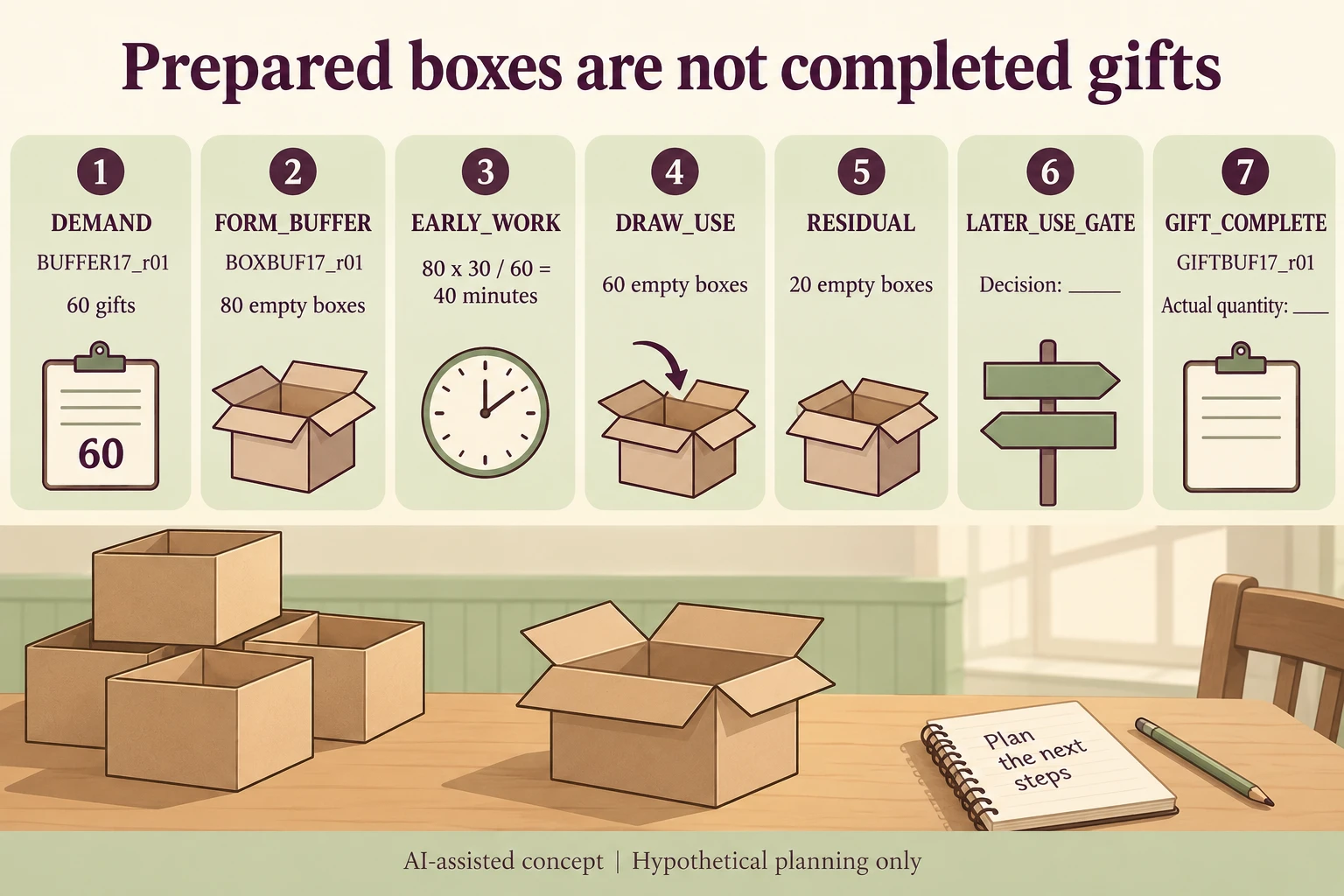
Select only the original fictional lower-use case: 80 BOXBUF17_r01 empty boxes are prepared at an assumed 30 seconds each, then demand calls for 60 gifts. BUFFER17_r01 names the planning scenario, not actual ready stock.
Scroll horizontally if columns extend beyond the view.
| Scope ID | Exact entity | Stage / role | Hypothetical basis |
|---|---|---|---|
| DEMAND | BUFFER17_r01 | LOW_USE_SCENARIO | Selected fictional lower-use case |
| FORM_BUFFER | BOXBUF17_r01 | PREPEAK_FORMING | Empty outer boxes only |
| EARLY_WORK | BOXBUF17_r01 | MOVED_EARLIER | 80 x 30 / 60 |
| DRAW_USE | BOXBUF17_r01 | DRAWN_FOR_PACKING | Hypothetical draw against60 gift demand; not finished gifts |
| RESIDUAL | BOXBUF17_r01 | AFTER_DRAW | 80 – 60 |
| LATER_USE_GATE | BOXBUF17_r01 | RESIDUAL_REVIEW | Later suitability and version decision unknown |
| GIFT_COMPLETE | GIFTBUF17_r01 | COMPLETION_SCOPE | Actual product/message/closure completion unknown |
EARLY_WORK is 80×30/60=40 minutes. DRAW_USE is 60 empty boxes issued for packing; RESIDUAL is 20 boxes. Neither is a count of completed gifts. GIFT_COMPLETE therefore has its own unknown result rather than inheriting the draw quantity.
LATER_USE_GATE records whether the 20 remaining boxes still suit a supported later use. They are not automatically waste or usable stock. Actual forming time, use, disposition, evidence and dates stay empty; no actual storage allowance or peak capacity is established.
Download the preassembling gift boxes record (.csv). HYPOTHETICAL rows are invented examples. Use ACTUAL_BLANK for permitted project inputs; replace that row label only when recording actual facts. Empty evidence, observation and date fields mean unknown or not performed, never acceptance. Keep checkpoints and revisions separate.
Bring the exact scope rows and unresolved evidence in a Packrivo enquiry. Replace planning inputs with actual authorised records before treating the scenario as an available arrangement. Prepare a Packrivo packaging enquiry. Packrivo coordinates independent suppliers. These records establish no supplier offer, service availability or MOQ exception; its published baseline is 500 pieces per product/design.
What this changes in a packaging enquiry
Compare supplier-assembled boxes with your own preassembly using both delivery volume and storage space for the formed boxes. State who forms the box, where that work occurs and how many formed units are needed before the peak. Moving work earlier does not establish that the formed boxes remain suitable in storage. A relevant configuration to compare is the Folding gift box; it is a concept reference, not confirmed suitability.