

Usable packaging cost depends on which received units are actually released for packing. Calculate cash per released unit with that scope visible, then show how unresolved goods could change the denominator. A hold is a pending decision, so it shouldn’t silently become either good stock or scrap.

Begin with the disposition record
Keep received, released, held and rejected quantities in separate fields. Their identities and counting bases should agree with the incoming packaging inspection record. A photograph of damaged boxes cannot establish the status of the rest of a delivery.
For operational planning, divide a clearly defined outlay by the released count. State what the outlay contains: component purchases, freight, sorting or another actual scope. Use the same scope when comparing alternatives.
This ratio measures cash committed relative to currently released units. It isn’t an accounting inventory valuation, an estimate of the lot’s defect rate or permission to use held goods.
A pending release changes the denominator
Assume a fictional outlay of $900 for 1,000 received units. An authorised decision releases 850, leaves 100 on hold and rejects 50. No actual delivery or inspection result is represented.
Scroll horizontally if columns extend beyond the view.
| Stated outcome | Released quantity | Cash per released unit |
|---|---|---|
| Current decision | 850 | $900 / 850 = about $1.059 |
| All 100 held units later released | 950 | $900 / 950 = about $0.947 |
| Held units remain unreleased | 850 | About $1.059 before extra costs |
The second row is a scenario, not an available-stock promise. The packing team must continue to use the current decision until the responsible owner changes it.
If additional sorting costs an assumed $50, add it only to the relevant scenario. The ratio becomes $950 divided by its final released count. Keep that added work separate from the original purchase so readers can see why the numerator changed.
Keep credits and replacements traceable
A supplier’s proposed credit or replacement can alter the comparison, but a message announcing it is not the completed outcome. Identify the actual amount received or the replacement lot released before updating the corresponding scenario.
Replacement pieces need their own identity and disposition. Adding their count to usable stock while leaving the original held pieces in the same denominator would double count availability.
Even a high released count can leave the wrong component scarce. A usable box does not create a complete gift set if its insert is missing. Apply this ratio to one defined component or to a released complete-set unit, and retain that definition.
Return a bounded cost range
Show the current ratio, the pending decision and the alternative scenario supported by it. List any additional work needed to reach the alternative. A buyer can then compare economic exposure without inventing a rejection result or asking the packing team to treat unresolved goods as usable.
Sources and scope
Australian Government supports the stated general concepts within this scope: General inventory categories, reorder points and stocktake. Access checked 14 October 2026.
Shopify Help Center supports the stated general concepts within this scope: Shopify state definitions only. Access checked 14 October 2026.
The worked scenario is original editorial analysis with assumed inputs, not a supplier offer, customer record or measured Packrivo result. Commercial feasibility and physical suitability remain project-specific.
Reconcile the current cohort before using its denominator
This register expands the original fictional 1,000-piece grouping into explicit current-state rows. LOT16_r01 identifies one component cohort; it is not an inspected delivery. The declared subsets are 850 released, 100 held and 50 rejected.
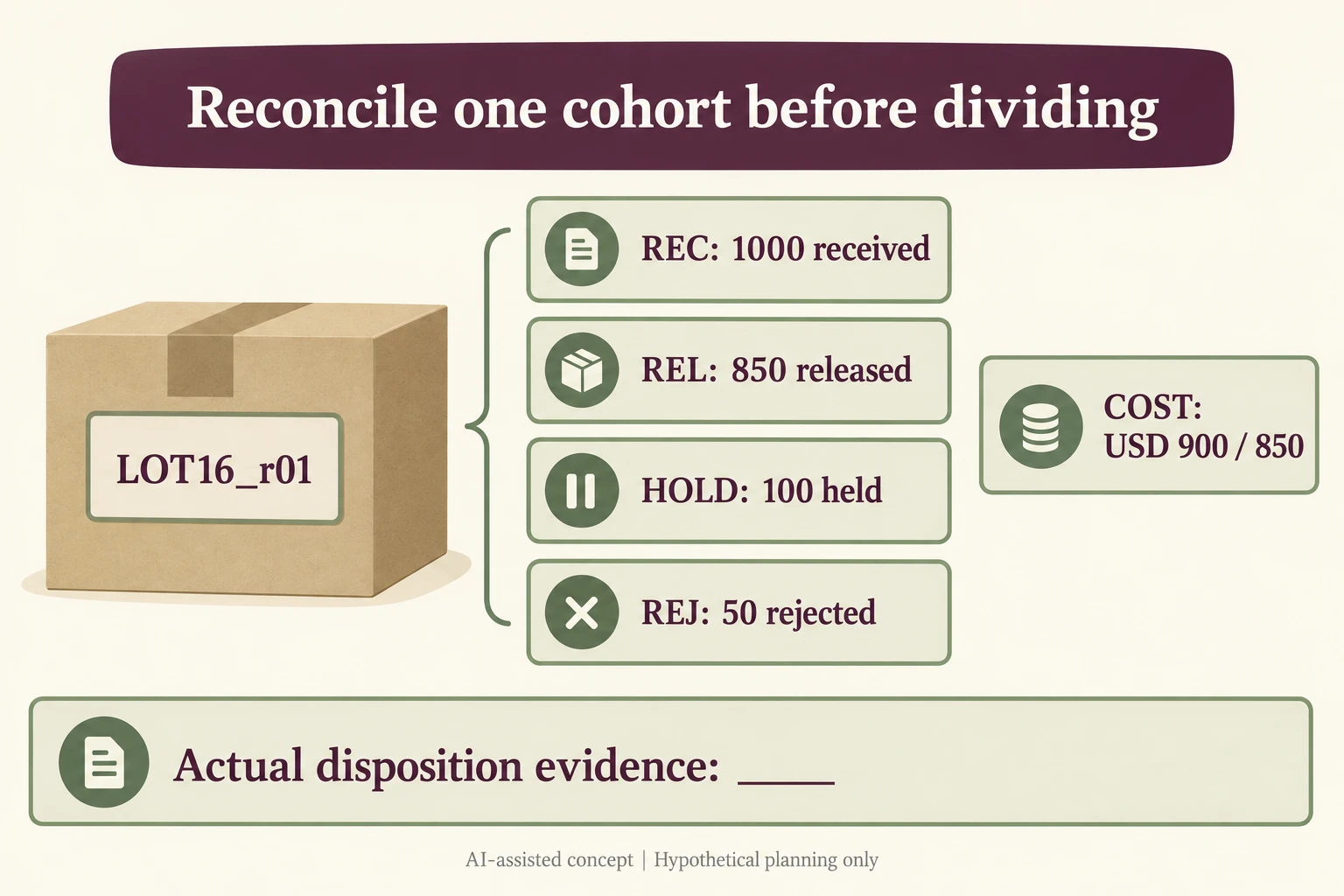
Scroll horizontally if columns extend beyond the view.
| Scope ID | Exact entity | Stage / role | Hypothetical basis |
|---|---|---|---|
| REC | LOT16_r01 | RECEIVED | Declared received grouping |
| REL | LOT16_r01 | RELEASED | Declared hypothetical release subset |
| HOLD | LOT16_r01 | HELD | Pending subset; not released or rejected |
| REJ | LOT16_r01 | REJECTED | Declared hypothetical rejection subset |
| COST | LOT16_r01 | CASH_PER_RELEASED | 900 / 850; denominator REL only |
The subsets reconcile as 850+100+50=1,000. COST uses only REL: $900/850, approximately $1.059 per released piece. REC is the received total, not the released denominator. HOLD remains a pending category rather than being silently added to REL or REJ.
Actual quantity, decision, evidence and date fields remain empty across all five rows. The worksheet supplies no acceptance rule or defect-rate estimate. Its component unit must remain unchanged when the ratio is used; it does not describe complete gifts.
Download the usable packaging unit cost record (.csv). HYPOTHETICAL rows are invented examples. Use ACTUAL_BLANK for permitted project inputs; replace that row label only when recording actual facts. Empty evidence, observation and date fields mean unknown or not performed, never acceptance. Keep checkpoints and revisions separate.
Use the named scope rows and unresolved evidence to prepare a project enquiry. Replace planning assumptions with actual authorised records before a commercial or use decision. Packrivo coordinates independent suppliers. These records establish no supplier offer, service availability or MOQ exception; its published baseline is 500 pieces per product/design.