

Model a stopped packaging project by separating money already spent, obligations already committed under the actual terms, and future work not yet authorised. Treat credits or recoverable materials as separate evidence. This calculation does not establish a right to cancel or a supplier’s refund policy.
Use Packaging Payment Schedule and Cash Calendar to locate the actual payment events before modelling a project stop. Keep cash already paid separate from remaining contractual obligations; a cash-calendar entry does not establish a right to cancel.

Define the stopping point
Record the exact stage and the scope already instructed. A sample payment, authorised tooling and a proposed production run can have different commitment states. An unpaid invoice is not automatically avoidable, and a deposit is not automatically the full cost of stopping.
Keep commercial interpretation with the responsible parties or advisers. The changed-scope quotation record preserves the original offer and current request; the cost scenario should retain those references rather than rewrite their terms.
Compare two assumed commitment states
The following invented USD scenario assumes specific written terms solely for explaining the arithmetic. It is not an actual contract, quotation or cancellation rule.
Scroll horizontally if columns extend beyond the view.
| Cost line | Stop before production authorisation | Stop after production is assumed committed |
|---|---|---|
| Sample already spent | $100 | $100 |
| Setup assumed committed | $250 | $250 |
| Production | $600 not authorised | $600 assumed committed |
| Freight | $80 not booked | $80 not booked |
| Modeled committed exposure | $350 | $950 |
The earlier stop leaves $350 of spent or committed cost in this example. The later state adds $600, giving $950. Both exclude the $80 unbooked freight under the stated assumption.
Payment timing stays separate. If only $100 has actually been paid, the remaining assumed obligation can still be part of modeled exposure. Conversely, an amount already paid may have a documented credit or refund path, which needs its own conditions.
Separate recoverable receipts from optimistic values
If a specific material can be used for another approved project, identify the configuration and expected use before assigning a recovery amount. Generic blank boxes and dated printed sleeves may have different possibilities.
A proposed supplier credit is a conditional scenario until the actual entitlement and receipt are established. Don’t subtract it from every stopping outcome just because it appears in an email.
Preserve further work such as return transport or storage when it belongs to the chosen outcome. Recovering an item can itself require spending that the original total omitted.
Request a written stop-work scope
The next useful response identifies what has been completed, what remains committed, what can stop and which amounts or materials may be recovered. Use that evidence to revise the scenario. The article’s categories organise a decision; they do not resolve contract rights, accounting treatment or a dispute.
Sources and scope
Australian Government supports the stated general concepts within this scope: Cash inflows/outflows and clear labeling of estimated figures. Access checked 14 October 2026.
The worked scenario is original editorial analysis with assumed inputs, not a supplier offer, customer record or measured Packrivo result. Commercial feasibility and physical suitability remain project-specific.
Attach the exposure to its stopping boundary
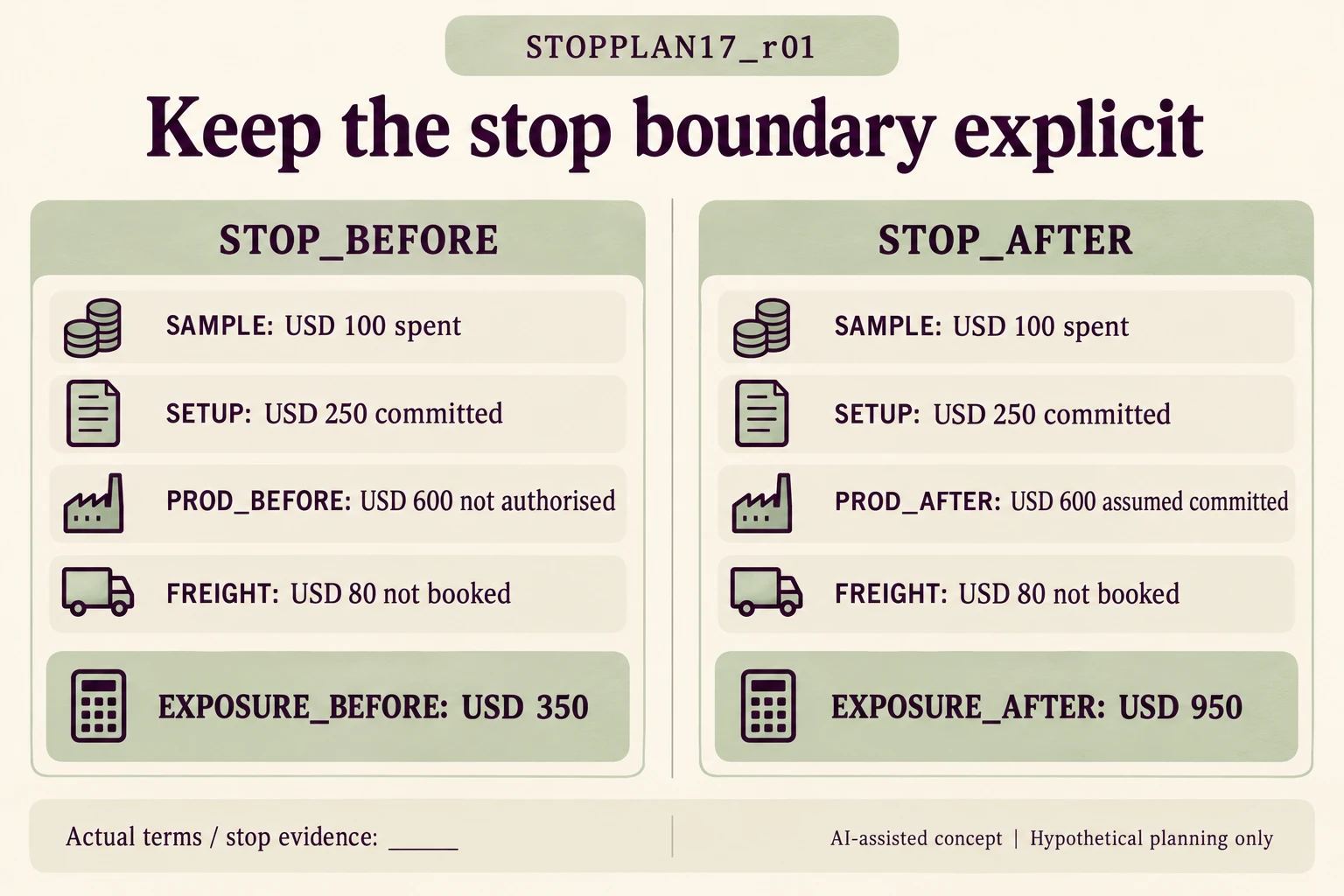
STOPPLAN17_r01 is a new fictional record using the original $100 sample, $250 setup, $600 production and $80 freight inputs. STOP_BEFORE and STOP_AFTER are alternative assumed commitment states, not two real stop instructions.
Scroll horizontally if columns extend beyond the view.
| Scope ID | Exact entity | Stage / role | Hypothetical basis |
|---|---|---|---|
| SAMPLE | STOPPLAN17_r01 | SPENT_INPUT | Assumed sample money already spent in both cases |
| SETUP | STOPPLAN17_r01 | COMMITTED_INPUT | Assumed setup obligation in both cases |
| PROD_BEFORE | STOPPLAN17_r01 | NOT_AUTHORISED | Before-state production not authorised; excluded from exposure |
| PROD_AFTER | STOPPLAN17_r01 | ASSUMED_COMMITTED | After-state production assumed committed under fictional terms |
| FREIGHT | STOPPLAN17_r01 | NOT_BOOKED | Unbooked in both cases; excluded from exposure |
| STOP_BEFORE | STOPPLAN17_r01 | BEFORE_PRODUCTION | Hypothetical stopping position; actual authority and date unknown |
| STOP_AFTER | STOPPLAN17_r01 | AFTER_PRODUCTION_COMMITMENT | Alternative stopping position, not a second actual stop |
| EXPOSURE_BEFORE | STOPPLAN17_r01 | BEFORE_STATE | 100 spent + 250 committed |
| EXPOSURE_AFTER | STOPPLAN17_r01 | AFTER_STATE | 100 spent + 250 committed + 600 production |
SAMPLE and SETUP are shared inputs. PROD_BEFORE is not authorised, while PROD_AFTER is assumed committed solely under the invented terms. FREIGHT is not booked in either case. The exposure rows therefore give $350 and $950 without treating unpaid money as automatically avoidable.
The actual stop authority, commercial interpretation, evidence and date remain empty. This register assigns no refund, cancellation entitlement or recovery value. A cost category is not permission to issue a stop instruction or a determination of anyone’s contractual rights.
Download the packaging project cancellation costs record (.csv). HYPOTHETICAL rows are invented examples. Use ACTUAL_BLANK for permitted project inputs; replace that row label only when recording actual facts. Empty evidence, observation and date fields mean unknown or not performed, never acceptance. Keep checkpoints and revisions separate.
Bring the exact scope rows and unresolved evidence in a Packrivo enquiry. Replace planning inputs with actual authorised records before treating the scenario as an available arrangement. Prepare a Packrivo packaging enquiry. Packrivo coordinates independent suppliers. These records establish no supplier offer, service availability or MOQ exception; its published baseline is 500 pieces per product/design.