

Assess returned wholesale gifts at the retail-unit level before counting the stock available for another order. Separate units accepted unchanged, units requiring presentation repacking and units held for product review. Damage to a shipping case alone cannot decide the status of every gift it contains.
The responsible product and stock owners must decide whether returned goods can re-enter sale. This article calculates quantities after those decisions are defined; it supplies no legal, safety or hygiene basis for resale.

Record what came back before rebuilding it
Keep the retailer return reference, known product and packaging versions, quantities and received condition. Photograph the arrangement before replacing outer cartons or tidying the gifts. That preserves the evidence behind later disposition.
The transit-damage location record shows how to retain observed condition without assigning a cause. A returned carton and its retail units may have different visible conditions, which should remain separate observations.
Determine which presentation components are affected. A bent sleeve, missing care card and damaged product are different issues. Replacing all components can conceal the actual need; replacing only the visible sleeve can leave an unresolved product issue.
Follow forty hypothetical returned units
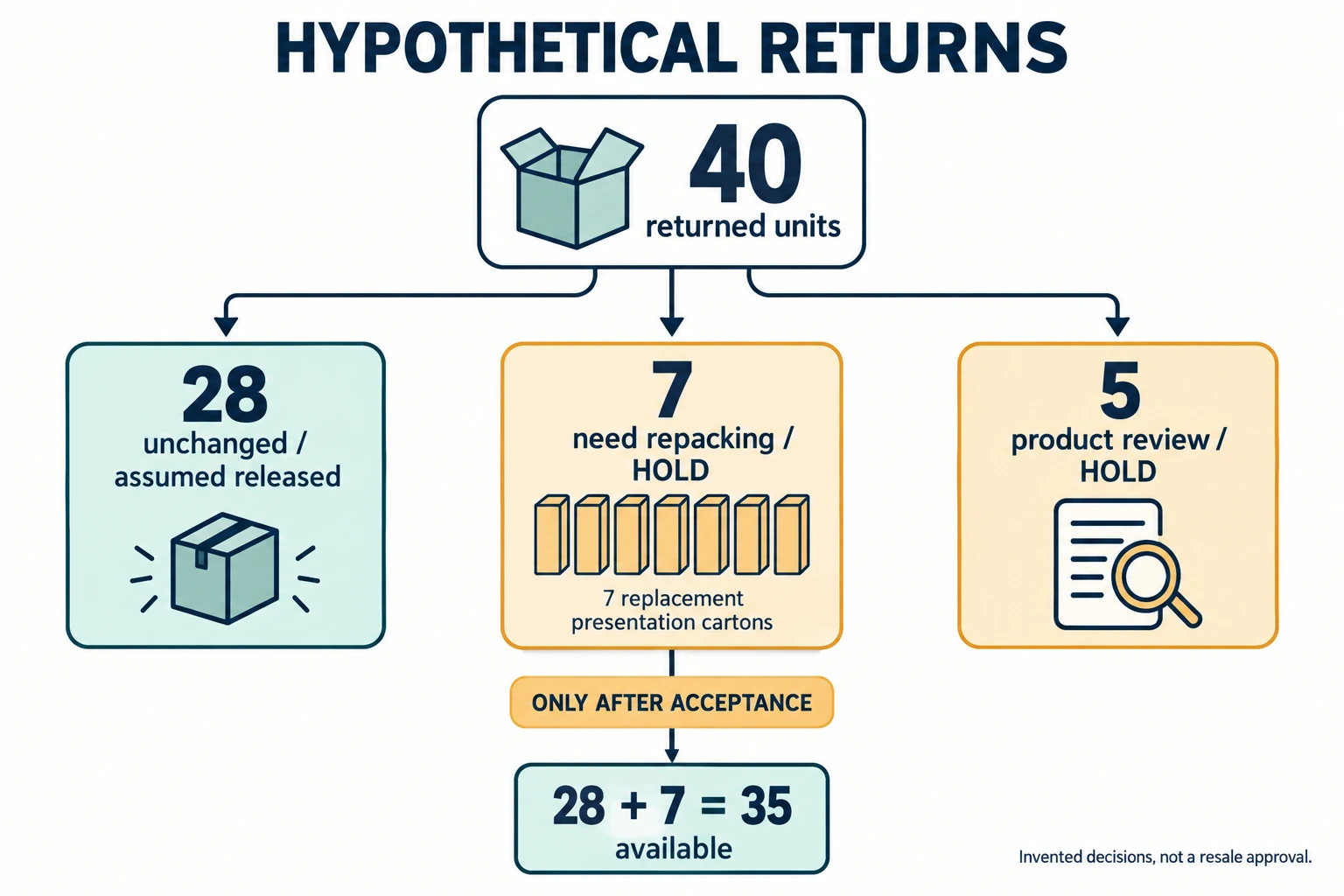
Assume the stock owner has approved 28 units unchanged, identified seven that require a new presentation carton before another decision, and held five for product review. These are invented classifications, not actual inspection results.
Scroll horizontally if columns extend beyond the view.
| Returned group | Units | Presentation-material demand | Availability in the scenario |
|---|---|---|---|
| Approved unchanged | 28 | None identified | 28 available under the stated decision |
| Presentation repack required | 7 | Seven matched replacement cartons | Held until repacking and acceptance |
| Product review pending | 5 | Unresolved | Excluded from available stock |
| Total physically returned | 40 | Determined by group | Not automatically 40 available |
If all seven repacked units receive the required acceptance, 35 units become available in this scenario. The five held units remain separate. Ordering seven replacement cartons is different from purchasing forty full packaging sets.
A further finding can change the requirement. If two of the seven units also need inserts, add two correctly identified inserts rather than silently changing the entire group to complete-set replacements.
Reconcile receipt, repacking and release
Use the same unit identity through each state. Record what entered the repack operation, what was replaced and what decision permits the completed unit’s next use. Keep discarded or withdrawn presentation pieces outside usable material stock.
Shopify’s inventory-state documentation distinguishes stock on hand from available, committed and unavailable quantities. Those are platform-specific product states, not an automatic packaging-rework system. They illustrate why a physical count and an available quantity need separate records.
A courier or shipping-case review has its own scope. The return’s transport packaging and a subsequent outward shipment may differ, even if some retail units remain unchanged.
Request only the confirmed replacement scope
The supplier brief should name the affected presentation version, approved replacement quantities and unknown component needs. Actual ability to supply isolated cartons, cards or inserts remains a supplier question.
Packrivo can help organize that scope through a packaging project inquiry. The hypothetical table demonstrates reconciliation, not a returns policy, accepted resale result or promised spare-parts service. Public platform documentation was checked on 14 October 2026.
Carry each return through a dated material and release record
For wholesale return repacking, record the replacement demand separately from the unit’s permission to return to stock. Continue the forty-unit example with return reference RET-H and individual identities U01–U40. These identities, decisions and quantities are fictional; no real resale decision is recorded.
Scroll horizontally if columns extend beyond the view.
| Fictional unit group | Current condition decision | Material request | Next availability decision |
|---|---|---|---|
| U01–U28 / 28 | Assumed accepted unchanged | None identified | 28 available only under the assumed decision |
| U29–U35 / 7 | Presentation repack pending | 7 cartons B1; 2 inserts I1 for U29/U30 | Hold all seven until actual repack acceptance |
| U36–U40 / 5 | Product review pending | Unknown; exclude from confirmed request | Hold; product owner decides |
Seven cartons plus two inserts are nine component pieces for seven units, not nine extra gifts. If only six of the seven repacks receive acceptance at the later checkpoint, the available total is 28+6=34, with one repack hold and five product holds: 34+1+5=40 returned units. Keep that later checkpoint distinct from the earlier conditional total of 35 when all seven are accepted. Do not order replacements for the five product holds until their actual disposition establishes a need.
Download the wholesale return repacking record (.csv). Example rows are explicitly hypothetical. Use ACTUAL_BLANK for your own permitted project entries; replace that row label only when recording actual inputs. Blank evidence or observation fields mean unknown or not performed, never approval. Keep revisions and checkpoints separate.
For a scoped packaging inquiry, include the returned-unit identities, the actual decision owner, the seven-carton/two-insert scope if confirmed, and the release questions still open. Send the identified configuration and open questions to Packrivo. Quantities in this record are planning demand, not quoted purchase quantities, MOQ exceptions or confirmed service availability.
What this changes in a packaging enquiry
Identify the replacement presentation components needed by each returned-unit condition before placing a rework purchase. Match the parts to the accepted packaging version and intended resale route. An available new box cannot, by itself, authorize resale or restore an unreviewed product or insert.