

Wordless packaging directions need evidence that recipients understand the intended action on the actual pack. An arrow can be visible yet mean “lift” to one person and “slide” to another. Compare the action people infer before describing an instruction as useful across languages.
Removing English text changes the information available. Keep the structure, starting state and intended task fixed while comparing an icon-only direction with an appropriate language-assisted reference. That makes the communication decision visible.

Define the action the symbol must explain
Name one physical action: slide a sleeve off, pull a drawer, lift a lid or remove a named restraint. Show what stays still and what moves. A floating arrow beside a perspective rendering may leave both the object and direction unclear.
Do not borrow a plausible symbol and assume it has universal meaning. Decorative motifs can resemble working cues. Where a ribbon is printed on the lid and another ribbon physically pulls a tray, the recipient may need to distinguish their different jobs.
Microsoft’s accessible-packaging guidance discusses identifiable elements, iconography and clear physical cues in its own product context. Those examples support investigating the communication, not declaring a particular gift-box symbol understood.
Test interpretation before the opening attempt
Assume a hypothetical drawer gift box has a pull feature beside a printed arrow. The intended action is to hold the sleeve and pull the drawer horizontally. No instruction artwork or physical trial has been approved.
Ask a participant from the intended audience to indicate the next action they believe the illustration requests. Then, where an appropriate representative pack and safe review arrangement exist, observe the action performed without coaching.
Scroll horizontally if columns extend beyond the view.
| Proposed observation | Decision it can inform |
|---|---|
| Participant points to the working pull | Whether the cue identifies the intended object |
| Participant expects the lid to lift | Whether the direction or depicted relationship is ambiguous |
| Participant understands the action but cannot grip the feature | A physical-access problem beyond symbol meaning |
| Participant succeeds after an explanation | Assisted understanding, not an unassisted instruction result |
Keep those findings separate. A successful opening after coaching cannot establish that the icon alone communicated the action. Likewise, an understandable icon does not prove a difficult closure is accessible.
Choose a deliberate response to ambiguity
The designer can change the viewpoint, identify the moving part more clearly, add a second frame or retain short approved wording in the required languages. Compare the revised direction from the same closed starting state.
An extra frame may explain an action better than a more elaborate symbol. Avoid drawing hidden mechanisms the customer cannot see or a hand passing through an unopened panel.
If wording is retained, use the multilingual proof review for meaning, typography and exported output. That process checks actual language; this article concerns whether a pictorial direction conveys the intended physical action.
Describe the supported audience and conditions
Record the pack revision, instruction version, participant task, any assistance and the observed interpretation. Do not turn a small exploratory comparison into a universal language-independence claim.
The UK communication guidance also recommends involving the audience and considering accessible formats. Neither cited source supplies approval for these hypothetical icons. Both were checked on 14 October 2026.
Bring the action, starting-state images and unresolved interpretations to a packaging project inquiry. Packrivo can coordinate the structural and printing questions; actual recipient understanding needs its own relevant evaluation.
Earlier wording can contaminate an icon-only interpretation check
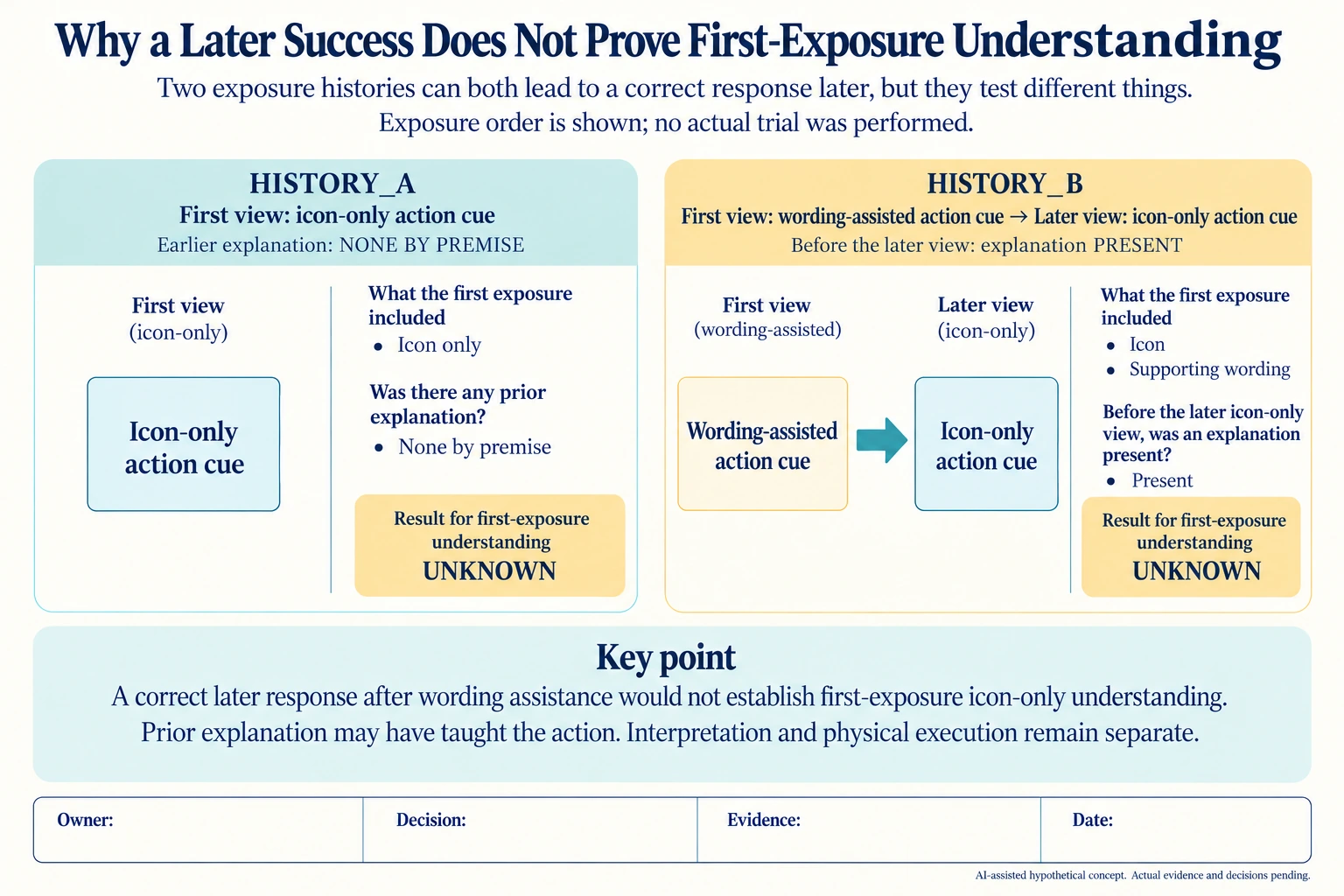
Compare two hypothetical exposure histories for the same proposed instruction. HISTORY_A presents the icon-only version first, with no earlier explanation in the scenario. HISTORY_B presents wording that explains the action, then later shows the icon without that wording. These are study-design examples, not recruited participants or results.
Scroll horizontally if columns extend beyond the view.
| Hypothetical configuration | Named object | Relationship | Input or next scope |
|---|---|---|---|
| HISTORY_A | FIRST_VIEW | presents | ICON_ONLY_ACTION_CUE |
| HISTORY_A | EARLIER_EXPLANATION | assumed | NONE_BY_PREMISE |
| HISTORY_B | FIRST_VIEW | presents | WORDING_ASSISTED_ACTION_CUE |
| HISTORY_B | LATER_VIEW | presents | ICON_ONLY_ACTION_CUE |
| HISTORY_B | EARLIER_EXPLANATION_BEFORE_LATER | assumed | PRESENT |
| HISTORY_B | LATER_CORRECT_RESPONSE_IF_ANY | does not establish | FIRST_EXPOSURE_ICON_ONLY_UNDERSTANDING |
A correct action after HISTORY_B cannot be labelled first-time icon-only understanding. The earlier wording may have taught the intended movement. Removing the words from the second view does not remove that prior exposure. Keep the history with the interpretation rather than pooling both histories under one icon-only heading.
An appropriate reviewer can plan how first exposure, assistance and later learning will be distinguished for the intended audience. This article selects no sample size, randomization procedure or acceptable success rate. Do not ask someone to perform an unsafe action merely to complete a comparison.
The original distinction between understanding an action and physically executing it remains necessary in either history. Microsoft supports clear physical and visual cues and audience involvement; GOV.UK discusses accessible communication formats. Neither establishes that this proposed icon is universal, accessible or independently understood.
Download the wordless packaging instruction prior exposure learning record (.csv). It includes the original table fields and scenarios alongside the added relationships. HYPOTHETICAL rows are editorial examples or required review scopes, not actual records. Actual quantity, configuration, component and file identities, materials, process, specification, copy, method, condition, observation, owner, decision, evidence and dates are blank. ACTUAL_BLANK is a separate empty starting row; enter permitted project evidence before using an actual record. A blank means unknown.
Use the Multilingual Packaging Proofs: Meaning, Type and Output for its separate question. Use the Accessible Gift Packaging for Limited Dexterity for its separate question.
Source scope checked 17 October 2026: Microsoft accessible-packaging HTML and GOV.UK accessible formats (updated 17 June 2026) support audience and interaction questions. Neither prescribes this exposure comparison or approves icons. No actual participants, comprehension rate or physical trial. The added configurations and calculations are hypothetical, with actual evidence and decisions pending.
What this changes in a packaging enquiry
A wordless instruction brief should name the starting state, intended action and point where the recipient can see the symbol. Keep the graphic artwork and comprehension-trial scope separate. A supplier can reproduce a symbol without establishing that users understand it on the actual pack. A relevant configuration to compare is the Informational insert card; it is a concept reference, not confirmed suitability.
Discuss this packaging specification with Packrivo. We coordinate independent suppliers. MOQ: 500 pieces per product/design; illustrative quantities are not production offers. Confirm materials, samples, price and timing for your project.