

Check a packaging supplier’s certificate against the organization taking your order, the site doing the work and the activities covered. Then verify its current status through the relevant register or issuer. A certificate can be genuine while covering a different site or operation, so a familiar logo alone cannot settle your supplier decision.
For a small jewelry or gift brand, this check belongs before relying on a certification claim in supplier selection. The useful result is a short record of what matches, what differs and who can resolve each difference. Keep product specifications and sample approval on their own tracks.
Begin with the supplier and the work you are buying
Ask for the complete certificate, including any pages listing additional sites or scope. Keep the original file rather than a cropped image from a sales presentation. Record when you received it and which quotation or supplier proposal it accompanied.
Next, describe the actual purchasing arrangement. The company issuing your invoice may be a trading business, while a separate factory prints and assembles the boxes. That arrangement calls for a clear explanation of each organization’s role. It does not automatically establish wrongdoing or make the factory’s certificate cover the trader.
Write down the proposed manufacturing address, including the building or unit where available. Ask which operations occur there and which are subcontracted. Printing, lamination, cutting and final assembly can involve different locations. Your check should identify the operation relevant to the claim you intend to rely on.
A broader material-claim evidence review asks whether a statement fits a supplied component. Here the question is narrower: does this supplier certificate describe the organization and work behind this proposal?
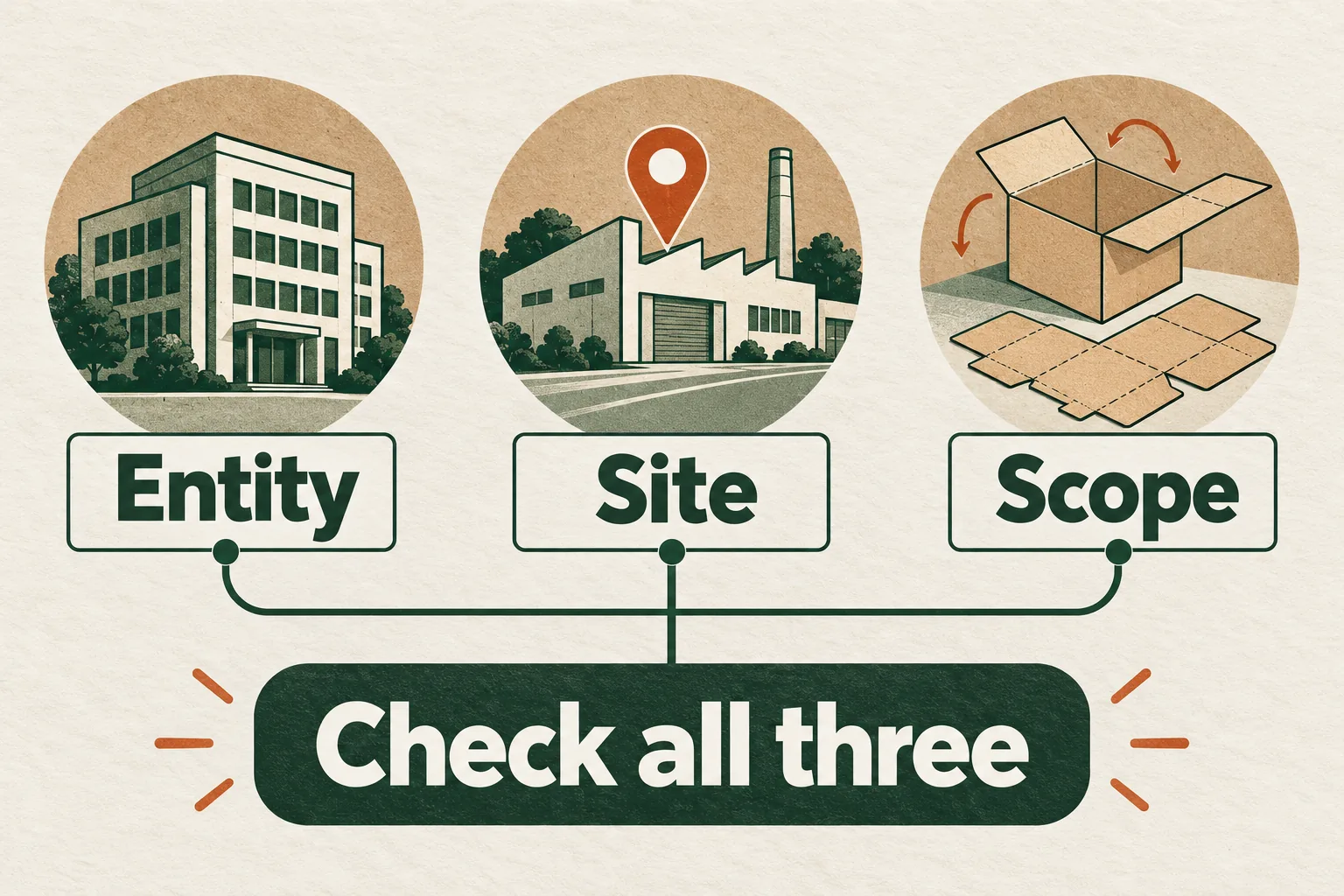
Use six fields to make certificate verification repeatable
Copy the six fields below into your supplier comparison. A status such as “awaiting clarification” is useful when it names the missing fact. An empty checkbox provides little help to the next person reviewing the order.
Scroll horizontally if columns extend beyond the view.
| Field | Record from the certificate | Compare or confirm |
|---|---|---|
| Certified entity | Full holder name and identifying details | Manufacturing entity, contracting entity and their stated relationship |
| Covered site | Address and any multi-site annex | Location proposed for the relevant work |
| Activities and scope | Exact scope wording | Printing, converting or assembly actually proposed |
| Issuer and accreditation | Certification body and claimed accreditation body | Issuer identity and relevant accreditation scope where claimed |
| Standard and edition | Standard number and stated edition | Applicable transition position confirmed with the issuer |
| Current certificate status | Certificate number, dates and verification result | Current status, checked date and unresolved discrepancy |
The ISO certification guidance explains that external certification bodies issue certificates; ISO itself does not certify companies. It also distinguishes accreditation from certification. Record which body did which job instead of treating several marks as interchangeable evidence.
Read the edition printed on the document and ask the issuer about any transition affecting that certificate. A newly published standard and a particular holder’s transition position are separate facts. Avoid rejecting or accepting a document solely because its year differs from a search result.
Look up the record and preserve the result
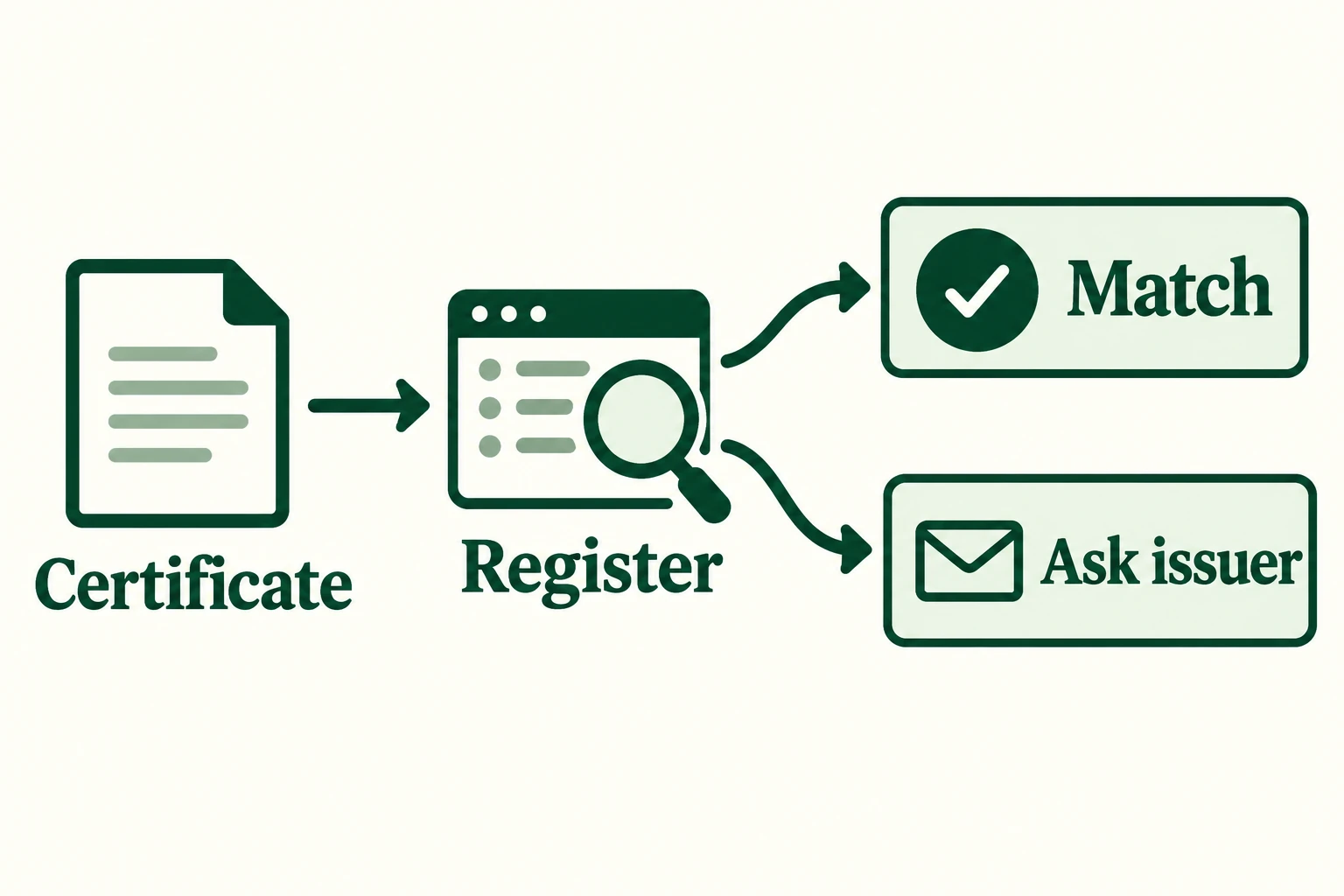
Use the relevant official register or contact the issuer through independently obtained contact details. A link supplied in an email can help locate a record, but it should not be your only check of who operates the destination.
For accredited management-system certificates, IAF CertSearch’s own documentation describes records covering the standard, scope, certified locations, issuing body and accreditation body. Compare those fields with the received document and proposed factory. Save the record reference, access date and any issuer response with your review.
Check status as well as identity. The published status definitions distinguish active, suspended, withdrawn and expired records. A correct holder name does not resolve a status discrepancy.
If a search produces no matching record, describe what you searched and ask the relevant issuer or accreditation body to clarify. Do not turn a failed search, spelling difference or unavailable interface into a public accusation of fraud. We reviewed the documentation for this guide; we did not verify an actual supplier through the CertSearch interface.
Separate a site mismatch from a product approval
Consider a hypothetical order for 500 drawer jewelry boxes. Supplier A sends a quality-management certificate naming Factory B at Site 1. Its quotation identifies Site 2 as the place where the boxes will be printed and assembled. The certificate number is readable, but the supplied file contains no site annex.
The immediate decision is to hold reliance on that certificate for Site 2. It would be premature to reject Factory B entirely, and equally premature to mark the proposal “certified” without resolving the address. Ask whether Site 2 appears in a valid annex and request issuer confirmation of the relevant activities.
Suppose the issuer subsequently confirms that Site 2 is covered for the stated converting activities. The record can close that particular site-and-scope question. It still cannot approve the proposed board grade, insert fit, color match or production capacity. Those purchasing questions need their own evidence.
The distinction also matters for intended uses. Our food-contact document checklist explains why a quality-management certificate is not a product-specific food-contact authorization. This guide does not establish that Packrivo supplies or certifies food-contact packaging.
Finish with a decision the buyer can act on
Use a filled record rather than a general “certificate checked” note. The following entries continue the invented Site 2 example. They are a decision exercise, not a real certificate review or evidence of a Packrivo supplier relationship.
Scroll horizontally if columns extend beyond the view.
| Question | Hypothetical entry | Next action or limit |
|---|---|---|
| Order and proposed operation | 500 drawer boxes; printing and assembly at Site 2 | Keep quotation revision with the review |
| Document received | Factory B certificate identifies Site 1; no annex supplied | Request complete site annex and relevant scope |
| Current status | Unresolved pending issuer response | Do not describe Site 2 as covered yet |
| Decision if coverage is confirmed | Close only the specified site-and-activity discrepancy | Continue separate sample and specification checks |
| Decision if it remains unresolved | Certificate reliance held for this proposal | Compare another documented route or supplier |
Keep the confirmation attached to the exact proposal. If the production location or subcontracting arrangement changes, reopen the affected fields. A previous check should remain understandable without becoming blanket approval for every later order.
For FSC-related packaging, use the separate FSC permission guide. Supplier certification, product claims and permission to reproduce a mark require different questions.
Discuss a packaging project with Packrivo using the proposed format, quantity, production arrangement and the specific document gap. Packrivo coordinates independent suppliers; a certificate check does not promise an order, price, lead time or product approval.