
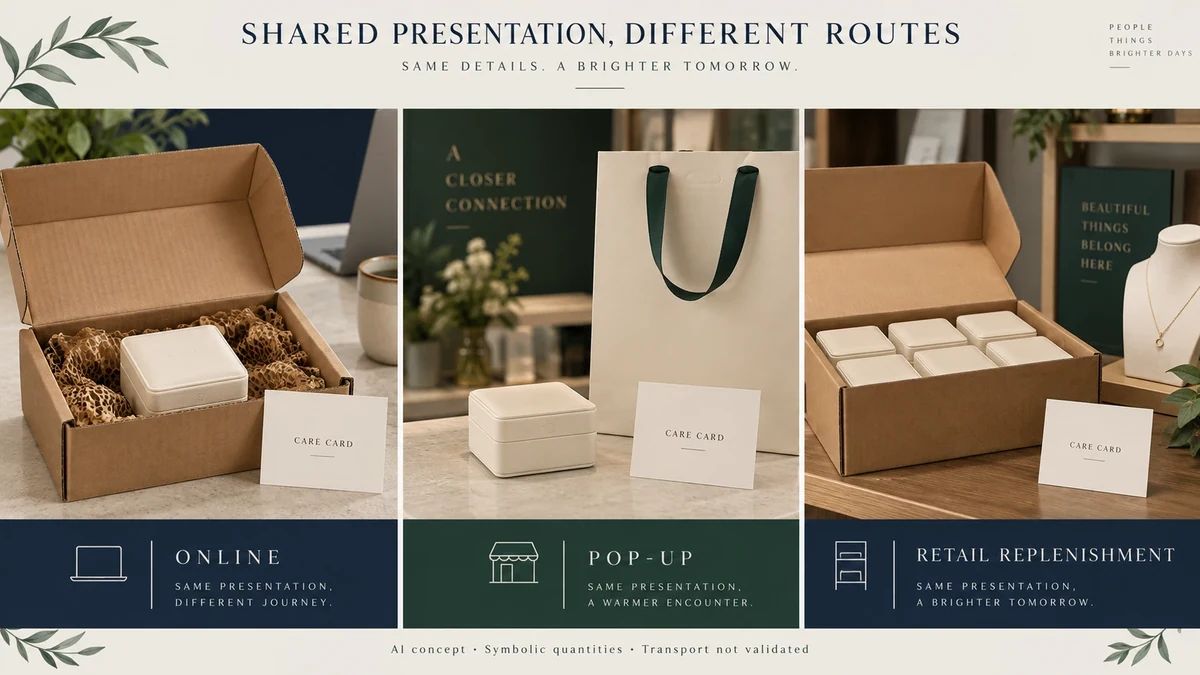
AI-assisted concept cover. Open the cover at full size.
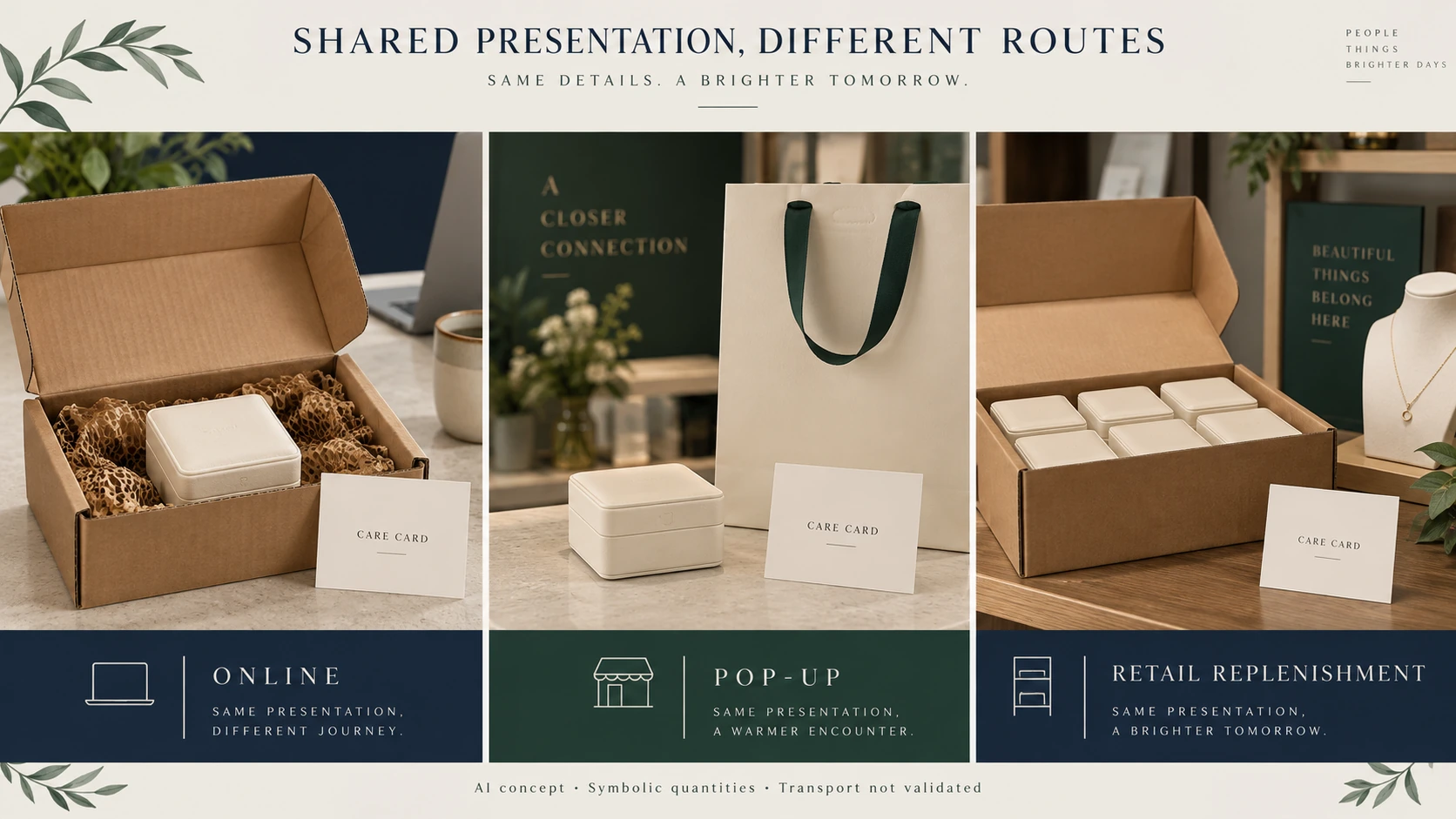
Ecommerce packaging must support the complete parcel journey, while retail packaging must support browsing, stock identification and handover. Compare those channel tasks first, then decide which brand elements and customer-facing components can be shared. Parcel protection, retail presentation, gift carrying and store replenishment should be planned around their actual uses.
This gives a small brand a practical way to grow from online orders into a shop, pop-up or wholesale account. The customer can encounter a coherent range while the people packing, displaying and receiving it have components suited to their work. The first decision is which part of the experience genuinely needs to be common.
Choose the shared customer-facing layer
Begin with the product the customer takes home. For jewelry, that might be an individual box or pouch with a care card. For candles, it might be the product label and retail carton. Define the product name, variant naming, logo treatment and essential information that should remain consistent wherever the item is sold.
A recognizable visual language can extend across several components. Jo Malone London’s official gift-wrap page describes its cream-and-black boxes, black ribbon and tissue. This is a useful public example of several packaging elements contributing to one gift presentation; it is not evidence about that brand’s shipping performance or a specification to copy. Jo Malone London gift wrap.
For your own range, decide which details are essential to recognition. A clear name system and consistent graphic placement may matter more than repeating an expensive finish on every layer. Keep the shared artwork manageable enough that a new product or channel does not require a completely separate visual system.
Give the parcel its own job
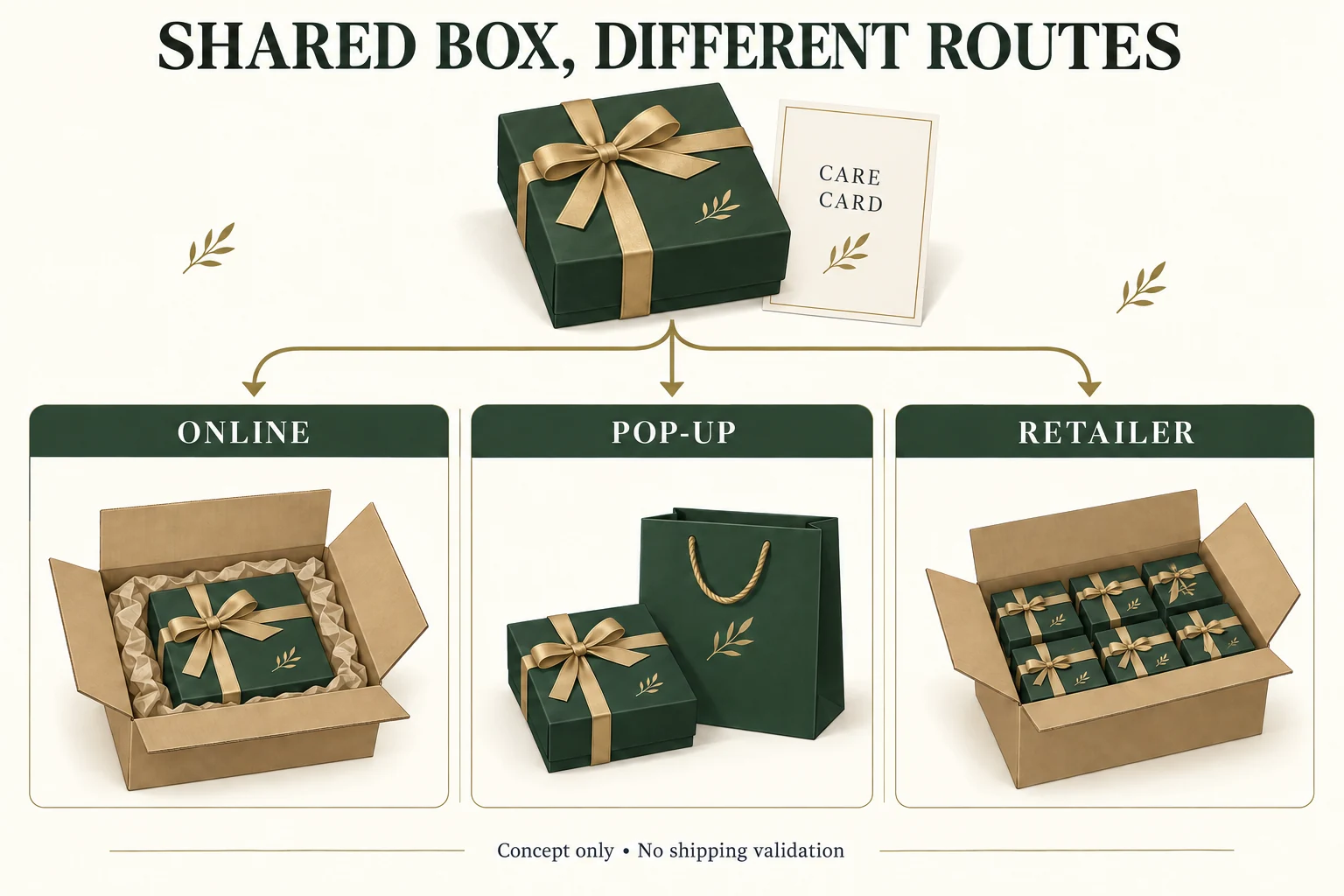
An online order needs a complete dispatch configuration. The customer-facing pack may sit inside a mailer or outer carton with support appropriate to the contents. Review the actual product, inner packaging, inserts, closure and shipping label together.
UPS distinguishes packaging approaches according to the goods being shipped and provides guidance on securing contents and cushioning. Its advice underlines the need to consider the shipment as a complete arrangement. A gift box’s appearance or stiffness does not establish that it is suitable for a parcel route. UPS packaging guidance.
Plan the outside appearance deliberately too. Some brands want a simple shipping exterior and a more expressive customer-facing pack inside. Others want a branded mailer. Either direction can be explored, but printing and presentation choices should follow the parcel’s functional requirements. Confirm the appropriate performance review for the actual configuration and distribution route rather than assuming that a retail-ready pack has already passed it.
Map the retail journey beyond the shelf
A retail channel includes more than the moment of purchase. Someone receives the stock, opens the shipping carton, checks the units, stores spare inventory and replenishes the fixture. The packaging plan should explain which components arrive assembled, which remain with the product and which the store removes.
Then consider how customers browse. A self-service shelf may need information visible on a closed pack. A staffed jewelry counter may display a product separately while keeping its box nearby. A pop-up may have limited back-stock space and require a compact presentation. Ask the specific retailer about its receiving, barcode, display and replenishment requirements before committing to a shared arrangement.
Gift carrying is another distinct task. A bag that looks coordinated still needs to accommodate the selected box and intended load. Packrivo’s tissue and gift-bag checklist provides a related starting point when that handover layer belongs in the brief.
Scroll horizontally if columns extend beyond the view.
| Component | What may be shared | What needs a channel decision |
|---|---|---|
| Product label or retail pack | Product identity and core artwork | Required information, visibility and handling |
| Care or product-information card | Current approved product content | Placement and whether the customer receives it |
| Gift presentation | Brand colors and selected finishing details | Optional wrapping, gift message and bag use |
| Shipping outer | Graphic language where appropriate | Contents, support, closure and delivery route |
| Retail display | Brand assets and product naming | Fixture, browsing method and replenishment |
| Store replenishment pack | Product references | Unit count, receiving information and packing arrangement |
A hypothetical jewelry brand across three channels
Imagine a jewelry brand selling one necklace collection through its website, its own pop-up and a small independent retailer. It proposes one customer-facing necklace box and care card for all three routes, subject to review with the actual jewelry.
For website orders, the box sits in a separately developed parcel pack. A gift message is included only when ordered. For the pop-up, staff display a demonstration piece and hand over the boxed purchase in a suitable gift bag when needed. The retailer receives agreed quantities in a replenishment carton and uses its own display arrangement.
The common box still has to work for each route. The retailer may need to identify a variant without opening every box. Pop-up staff may need an easy way to match display pieces with stock. Website fulfillment needs to distinguish standard orders from gifts. The brand therefore checks whether one consistent product-identity system supports all three workflows before producing separate channel artwork.
Nothing in this hypothetical example establishes cost savings or a tested shipping result. Its purpose is to show how common components and channel-specific arrangements can be evaluated together.
Allocate components across the three channels
Turn that scenario into a quantity plan. The example below assumes 600 necklace units in one planning period: 360 single-unit online orders, 140 pop-up purchases and 100 units sent to one retailer. It assumes one shared necklace-box design and one shared care-card design. These quantities and packing arrangements are hypothetical and unvalidated.
Scroll horizontally if columns extend beyond the view.
| Component | Online | Pop-up | Wholesale retailer | Total demand |
|---|---|---|---|---|
| Shared necklace box | 360 | 140 | 100 | 600 |
| Shared care card | 360 | 140 | 100 | 600 |
| Online dispatch pack | 360 | 0 | 0 | 360 |
| Optional personal message | 90 | 0 | 0 | 90 |
| Store handover bag | 0 | 100 | 0 | 100 |
| Replenishment carton containing 10 units | 0 | 0 | 10 | 10 |
The message line assumes 90 of the 360 online buyers select that service; the bag line assumes 100 of 140 store buyers use a bag. Neither rate is a forecast for your business. The ten-unit replenishment configuration must be developed around the actual products and receiving requirements, not selected merely to make the arithmetic convenient.
This table shows why shared demand and purchase quantities are different. Six hundred uses of one unchanged box design can be considered together. Demand for 100 bags does not automatically permit an order of 100 custom bags. Packrivo’s published starting MOQ is 500 pieces per product/design, with the actual component and project terms to be confirmed. Identify that mismatch before committing to a fully customized channel layer; compare authorized project options rather than assuming a low-quantity exception.
Suppose the retailer requires variant identification visible without opening the necklace box. The brand must decide whether the shared box can carry a stable external variant label acceptable in all three channels, or whether the retailer needs a separately applied identifier. Record who supplies the information, where it is applied and whether it changes the artwork or packing line. That receiving requirement can alter component consumption even while the main brand design stays common.
Test the awkward combinations
Review the orders that complicate a simple channel diagram. What happens when an online customer buys two items, requests gift wrapping or chooses collection from the pop-up? What happens when a retailer wants mixed variants in one replenishment carton? Is a gift bag supposed to arrive folded inside a parcel, or is it only part of in-store handover?
Walk through those combinations with actual contents. Extra tissue, a folded bag or a gift message can change the packing arrangement. Record which options are included, optional or channel-specific, so staff do not have to interpret the brand concept during a busy shift.
Assign a version to each channel configuration
The 600-unit example shares a necklace box and care card, not one complete dispatch pack. Give the three routes distinct configuration IDs even if the same two components appear in every route. This prevents a retailer carton instruction from being used for a single online order.
Scroll horizontally if columns extend beyond the view.
| Hypothetical configuration | Shared pieces | Route-specific layer | Release question |
|---|---|---|---|
| WEB-01 | 1 necklace box + 1 care card | Named parcel outer and support; optional message only when ordered | Which complete parcel arrangement was actually reviewed? |
| POP-01 | 1 necklace box + 1 care card | Carry bag when requested | Which box-and-bag combination and load were checked? |
| RET-01 | 10 necklace boxes + 10 care cards per model carton | Retailer-agreed replenishment carton | Are case contents and visible variant references accepted by the retailer? |
Use the 10-unit retailer carton only as the example’s counting convention. One hundred retailer units then require 10 such cartons; a change to eight units per carton needs a different packing plan and reconciliation. A customer order containing two necklace gifts is also a different online arrangement from WEB-01. Review its support and parcel size before carrying over the single-unit decision.
Write one plan with channel-specific configurations
A useful range plan lists the shared components once, then defines the complete configuration for each channel and major order type. Include current quantities by component, storage assumptions and who packs or assembles each version. This makes it possible to compare genuinely shared demand without pretending that all channels consume every component equally.
Bring your sales channels, product range and current packing methods to Packrivo’s packaging brief form. Packrivo can help organize the sourcing brief and supplier questions around a coordinated system. Materials, structures, sample scope and commercial terms remain subject to confirmation for the agreed project.
Keep the current record with the project brief
Download the channel configuration allocation CSV. It contains field definitions, clearly hypothetical examples and a blank actual-project row. Replace invented values with your own supported records; keep unknown fields open.
Packrivo coordinates packaging sourcing and project questions with independent suppliers. The worksheet is a discussion aid, not a confirmed quotation, manufacturing promise or sample approval. The published starting MOQ is 500 pieces per product/design; actual component, design and commercial scope require confirmation.
Source scope: Brand presentation example and general US carrier packing context only; no channel configuration or shipment validated. Public references checked 16 October 2026. All new illustrations are AI-assisted concepts. No real customer, test, shipment, stock, savings or production outcome is represented.