
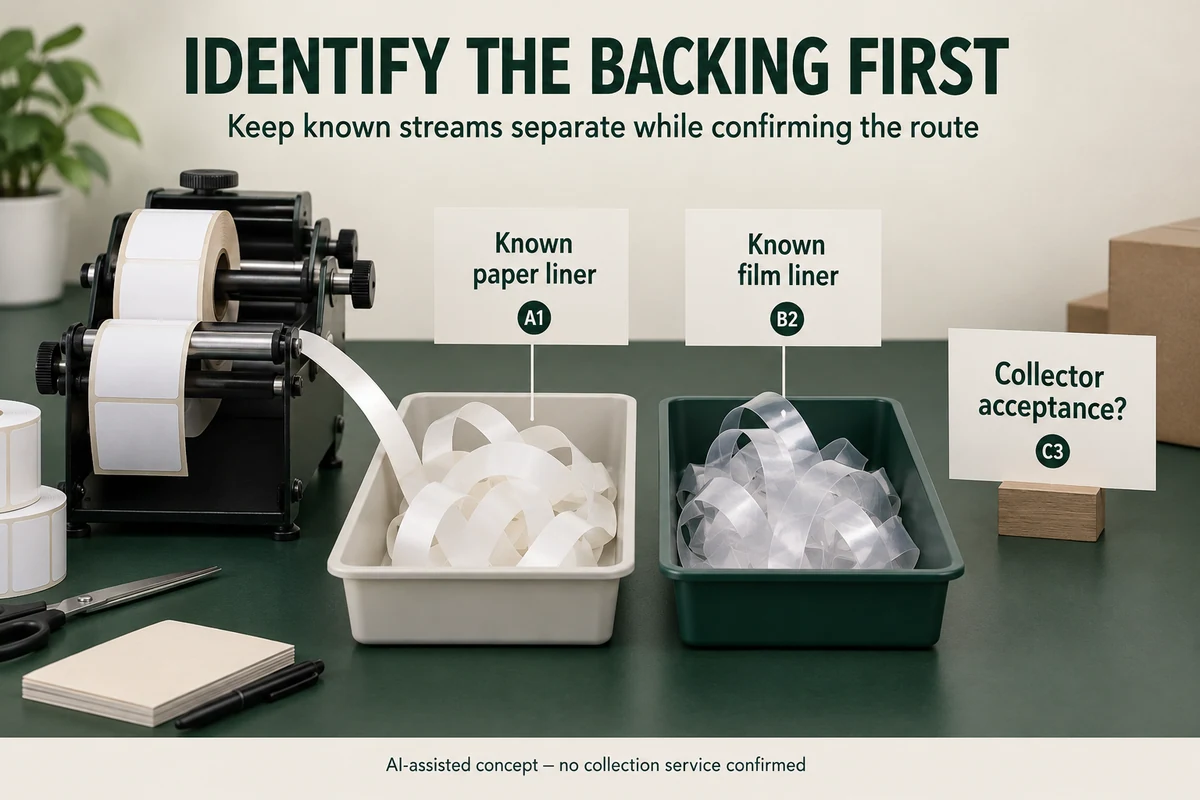
Identify the backing left after labels are applied, then keep known paper and film liner streams distinct while a collection provider confirms its accepted materials. Check the packing location, actual quantity and preparation requirements before choosing a route. A label’s face material does not tell you which backing will remain at the bench.
This is a business waste-stream decision. It is separate from deciding how a customer disposes of the labeled box or jar after use.
Identify the spent backing from the supplied construction
Ask the label converter to name the actual liner in each offered construction. Keep that reference with the roll or sheet identity so the packing operator can distinguish the waste streams without judging them only by color or appearance.
For example, a paper-looking label face does not settle whether its backing is paper or film. The liner-release method already handles peeling and application observations. Carry the confirmed liner identity from that work into the separate collection decision.
If the backing is still unknown, retain it as an unidentified stream until the converter or collection provider resolves it. Do not add uncertain material to a batch the provider has accepted as a named construction.
Compare the actual collection route for each material
Avery Dennison’s AD Circular Europe page describes a glassine collection process involving subscription, supplied collection boxes and requested pickup. Its PET section describes connecting users with recovery partners. Those descriptions are different routes, not proof that one collection arrangement accepts every liner in every location.
Use the current provider information to ask a specific question about your stream. Confirm the service area and proposed quantity before applying an old leaflet’s country list or minimum-volume figure. A programme’s public description is a lead for checking eligibility, not a confirmed offer to your brand.
UPM Adhesive Materials’ RafCycle service page is another provider lead. Ask the proposed collector to confirm the accepted amount and how it handles remaining labels, adhesives, foreign plastics, cardboard and cores. Those are questions for the actual stream, not a statement that the current public page approves or excludes each item. Follow the requirements confirmed for that provider and material.
Keep collection material separate from packing accessories
Decide where each identified liner stream goes as the labels are used. A clearly marked collection container at the relevant packing step can help operators avoid combining backing with tape, damaged labels, box offcuts or roll cores. Agree the container and handling arrangement with the provider rather than assuming any bag or box is acceptable.
Record actual quantities using the agreed basis. A count of labels does not, on its own, establish the weight or collection-ready volume of their backing. Keep an estimated figure marked as an estimate until the collection decision has the information it needs.
The comparison below shows questions to resolve, not approval of either stream.
| Packing-bench stream | Identify first | Resolve before collection |
|---|---|---|
| Confirmed paper liner | Converter’s backing reference | Provider acceptance, location, preparation and quantity basis |
| Confirmed PET liner | Actual film-liner reference | The applicable partner/route and its own requirements |
| Mixed or unidentified backing | Which constructions entered the batch | Whether the provider accepts it or requires a different disposition |
| Labels, cores and other packing waste | The actual separate materials | Their own handling route, rather than silently adding them to accepted liner |
Work through a hypothetical two-label packing bench
Imagine a gift brand uses one confirmed glassine-backed seal on its outer boxes and a PET-backed label on its jars. Operators currently put all spent backing and cores in one container. These are hypothetical materials and working conditions, not a Packrivo customer report.
The useful first change is to identify the two liner sources and separate their collection questions. The brand asks the proposed provider about its packing location, current quantities and both constructions. It also identifies the already mixed batch instead of representing it as clean paper liner.
If only one stream has a confirmed route, record that limited result. Keep the other route unresolved or use the disposition agreed with the appropriate local provider. Do not advertise all label waste as recycled because one proposal has reached the collection stage.
Send one stream-specific question before changing materials
Ask the provider: "For this identified liner at our packing location, please confirm accepted preparation, quantity basis, collection arrangement and commercial terms. Explain how to handle the mixed or contaminated material we have already identified."
Retain that answer before changing a label construction just to suit a programme. Dispensing, final adhesion, print requirements and supply conditions still need their own reviews. Nor does a collection record for packing-bench backing establish the recyclability of the customer’s finished package.
Sources accessed 9 October 2026. The provider pages describe their own programmes; no local eligibility, cost saving, carbon result, collection agreement or Packrivo recycling service is established here. The UPM source changed destination during review. This draft links the current page observed by the independent reviewer and treats material-preparation details as questions to confirm, rather than importing conditions from an earlier cached version.
Subtract the container before comparing identified liner quantities
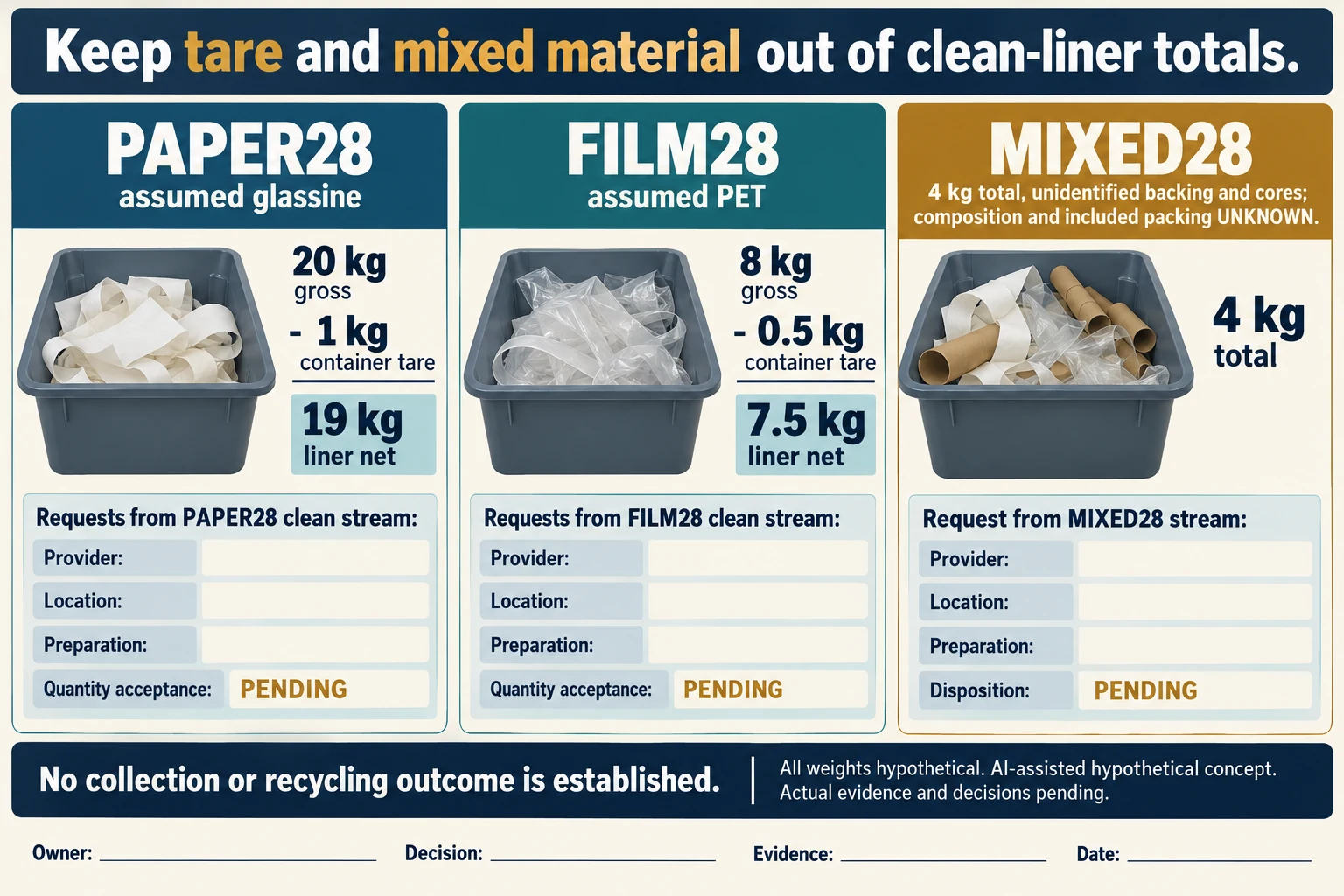
Use invented weights to define what a collection inquiry would describe. PAPER28 is assumed to contain glassine backing in a collection container: 20 kg gross less a 1 kg container tare gives 19 kg of the stated liner stream. FILM28 separately contains PET backing: 8 kg gross less a 0.5 kg tare gives 7.5 kg. These are arithmetic inputs, not measured packing waste or a collector’s accepted shipment.
Scroll horizontally if columns extend beyond the view.
| Hypothetical configuration | Named object | Relationship | Input or next scope |
|---|---|---|---|
| PAPER28 | PAPER28 | assumed material | GLASSINE_LINER |
| PAPER28 | PAPER28 | assumed gross weight | 20 kg |
| PAPER28 | COLLECTION_CONTAINER | assumed tare weight | 1 kg |
| PAPER28 | GLASSINE_LINER | calculated from | PAPER28_GROSS-PAPER28_TARE; 19 kg |
| PAPER28 | GLASSINE_LINER | requires | OWN_PROVIDER_LOCATION_PREPARATION_AND_QUANTITY_ACCEPTANCE |
| FILM28 | FILM28 | assumed material | PET_LINER |
| FILM28 | FILM28 | assumed gross weight | 8 kg |
| FILM28 | COLLECTION_CONTAINER | assumed tare weight | 0.5 kg |
| FILM28 | PET_LINER | calculated from | FILM28_GROSS-FILM28_TARE; 7.5 kg |
| FILM28 | PET_LINER | requires | OWN_PROVIDER_LOCATION_PREPARATION_AND_QUANTITY_ACCEPTANCE |
| MIXED28 | UNIDENTIFIED_BACKING_WITH_CORES | assumed total weight | Composition and included packing unknown; not clean-liner net weight; 4 kg |
| MIXED28 | MIXED_MASS | must not add to | PAPER28_NET_AS_CLEAN_GLASSINE |
| BENCH28 | LABEL_COUNT | does not determine | LINER_NET_MASS |
| BENCH28 | ARITHMETIC | does not establish | COLLECTION_OR_RECYCLING_OUTCOME |
The subtraction is meaningful only if gross and tare describe the same container and the net scope excludes the items the collector asks to keep separate. Record whether a core, label remnant or other waste is present instead of silently assigning its mass to clean liner. A label count cannot determine backing weight without a supported conversion basis.
MIXED28 is another invented batch, weighing 4 kg in total, with unidentified backing and cores. Its composition and included packing are unresolved. Do not add those four kilograms to PAPER28 and call the sum clean glassine, or allocate them between paper and PET by appearance. Give the provider the mixed-state description and obtain its preparation or alternative-disposition instructions.
Ask about each material and packing location under its actual route. AD Circular’s Europe glassine collection description and PET partner connection are different leads, and RafCycle’s public service description is not a confirmed offer for this bench. No universal minimum weight, price or coverage area is assumed here. Even correct net-weight arithmetic does not prove pickup, acceptance, recycling or a carbon result; retain those outcomes separately if they are later documented.
Download the label liner waste net weight separate streams record (.csv). It includes the original table fields and scenarios alongside the added relationships. HYPOTHETICAL rows are editorial examples or required review scopes, not actual records. Actual quantity, configuration, component and file identities, materials, process, specification, copy, method, condition, observation, owner, decision, evidence and dates are blank. ACTUAL_BLANK is a separate empty starting row; enter permitted project evidence before using an actual record. A blank means unknown.
Use the Label Liner Release vs Adhesion: Review Both Interfaces for its separate question.
Source scope checked 17 October 2026: The cited AD Circular Europe and RafCycle provider pages are collection-service leads. Glassine collection and PET partner routes, actual site coverage, preparation, quantities and acceptance require provider confirmation; no pickup or recycling occurred. The added configurations and calculations are hypothetical, with actual evidence and decisions pending.
Discuss this packaging specification with Packrivo. We coordinate independent suppliers. MOQ: 500 pieces per product/design; illustrative quantities are not production offers. Confirm materials, samples, price and timing for your project.