
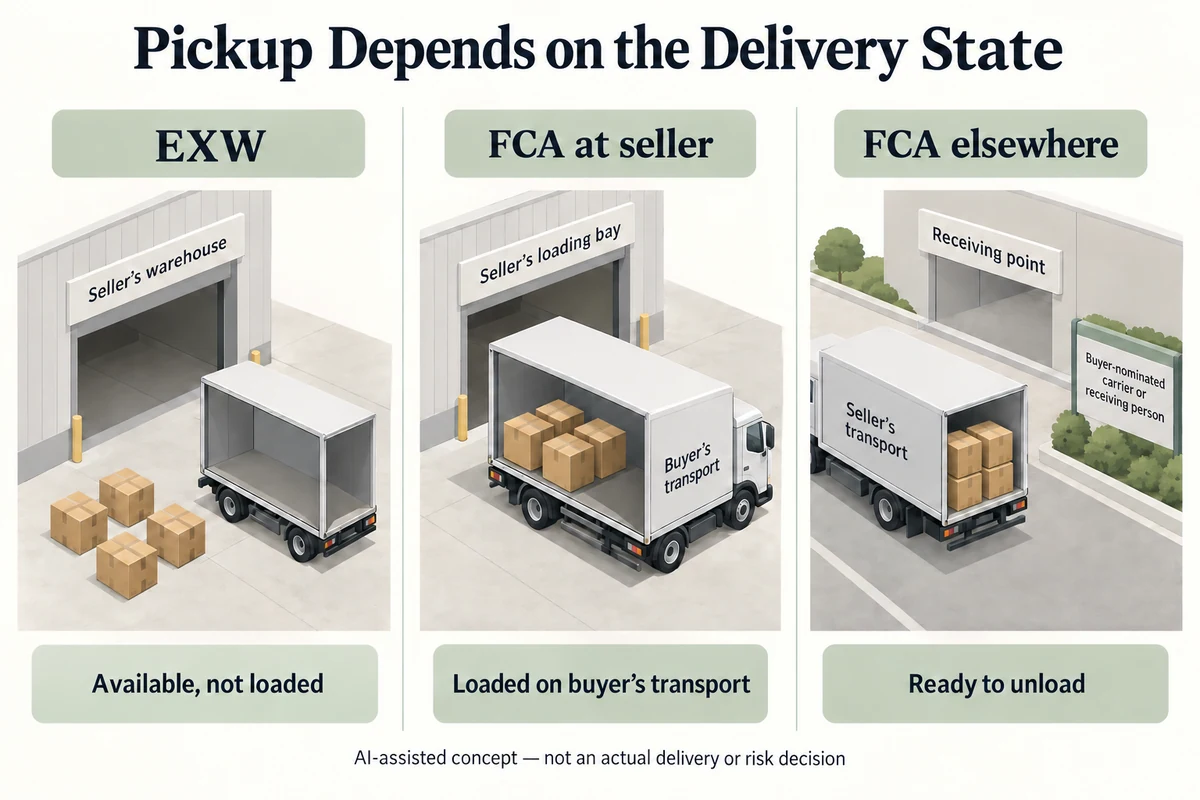
For an overseas order of empty gift boxes, choose the intended pickup state before booking transport. Cartons available beside a vehicle, cartons loaded onto it and cartons arriving at a depot ready to unload describe different handovers. A freight quotation or a three-letter trade term does not show which operation the parties have arranged.
This guide uses hypothetical cartons and locations. It does not establish Packrivo’s contract terms, export capability or a completed shipment.
Compare the three delivery states
The ICC’s Incoterms 2020 rule text distinguishes these ordinary delivery conditions:
| Arrangement | Delivery condition | Applicable export clearance |
|---|---|---|
| EXW at the agreed point | Identified goods at the buyer’s disposal, not loaded | Buyer, with the seller’s specified assistance |
| FCA at the seller’s premises | Goods loaded onto buyer-provided transport | Seller |
| FCA at another named place | Goods on seller-provided transport, at the disposal of the buyer-nominated carrier or receiving person, ready to unload | Seller |
Risk normally follows the rule’s delivery event, subject to the contract and its exceptions. Buyer notice, nomination or collection failures can matter. Seller-assisted loading under EXW does not automatically change the agreed risk allocation; address that operation expressly. Under FCA elsewhere, seller unloading is not ordinarily required for delivery.
These are limited rule summaries. Read the applicable clauses with the responsible contracting and transport parties rather than treating the table as a complete Incoterms manual.
Describe the operation missing from the pickup instruction
Imagine four shipping cartons of empty jewelry boxes at a hypothetical warehouse. Their count, size and contents are unchanged in each proposal below.
For an EXW proposal, the dispatch contact identifies a release area where the cartons will be available. The buyer’s instruction says only that a driver will collect them. It has not explained who may enter the area, operate the equipment or put the cartons on the vehicle. Ask the site and transport contacts to resolve that work before confirming collection. A helpful warehouse worker and a driver with equipment are different operational proposals; neither should remain an undocumented assumption.
For an FCA seller-premises proposal, ask the dispatch contact to identify the loading bay and the vehicle the buyer will provide. A photograph of cartons waiting beside the bay locates the goods but leaves the loading event unanswered. Ask what record will show the intended handover state, including the cartons and collecting vehicle involved.
For an FCA depot proposal, identify the buyer-nominated carrier or receiving person as well as the destination point. The cartons arrive there on the seller’s vehicle. Ask the receiving contact how that arrival will be handled and who provides unloading. An appointment booking, an arrival photograph and a storage receipt issued later record different things; do not silently substitute one for another.
No warehouse, equipment, driver or depot has been verified for these examples. Their purpose is to expose the unanswered operation in each proposed collection plan.
Keep the event separate from its evidence
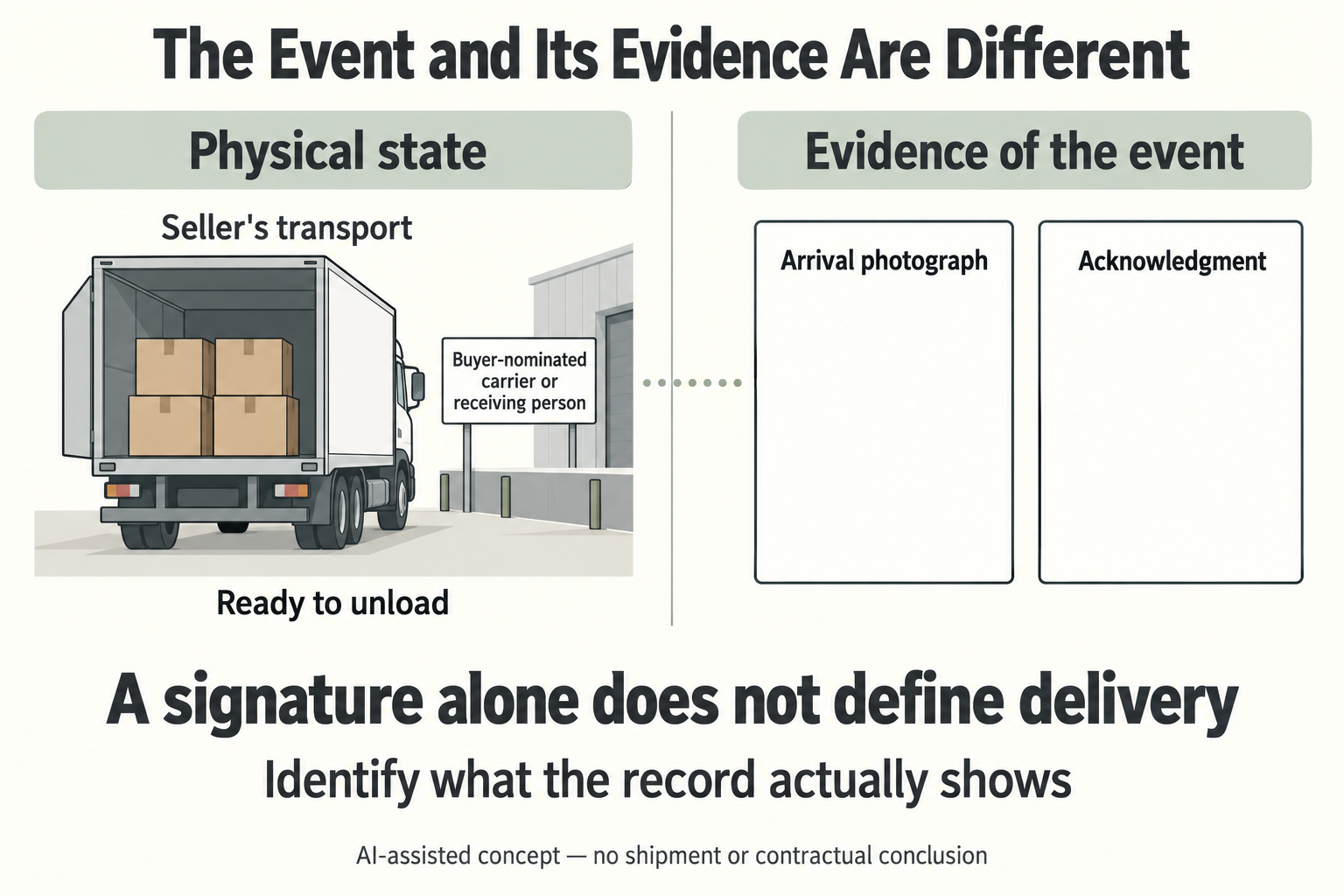
Give each retained photograph, notice or acknowledgment a factual description: cartons available at the release point, loading completed on the collecting vehicle, or arriving goods presented to the buyer-nominated carrier or receiving person ready for unloading. Record what the evidence actually shows and retain any missing fact.
A timestamp can help establish when an action occurred. A signature can identify an acknowledgment. Neither alone explains which contractual delivery condition was met. If the evidence and the agreed condition disagree, return the question to the responsible parties instead of renaming the record as delivered.
The carton freight-data guide supplies the separate count, dimensions and weight record. Those numbers help identify what travels; this review identifies the physical handover expected.
Resolve export capability and the wider agreement
Transport booking and lawful export arrangements need separate confirmation. Ask the party assigned the applicable formalities to explain its actual arrangement before committing to a pickup that depends on it. An unconfirmed contracting seller, exporter role or broker arrangement remains an open issue; writing a term on an invoice does not supply that authority.
The ICC’s contract-scope explanation distinguishes the rules from the wider sale contract. They do not determine ownership, payment terms, the legal imposition of tariffs or the law governing the contract. Local legal requirements and any specifically agreed variations still need review.
Use the quote comparison checklist for commercial scope. Attach a short pickup instruction that names the point, intended vehicle-related state, handling arrangement, applicable export responsibility and unresolved facts. The seller, buyer and receiving party should be able to recognize the same event from that instruction.
Sources checked 9 October 2026. The ICC pages identify the 2020 rules without a separate webpage revision date. This is packaging planning education, not a customs or contractual determination. Packrivo coordinates sourcing and project questions; actual delivery and export decisions remain with the contracting parties and their appropriate advisers. Any illustration is an AI-assisted concept.
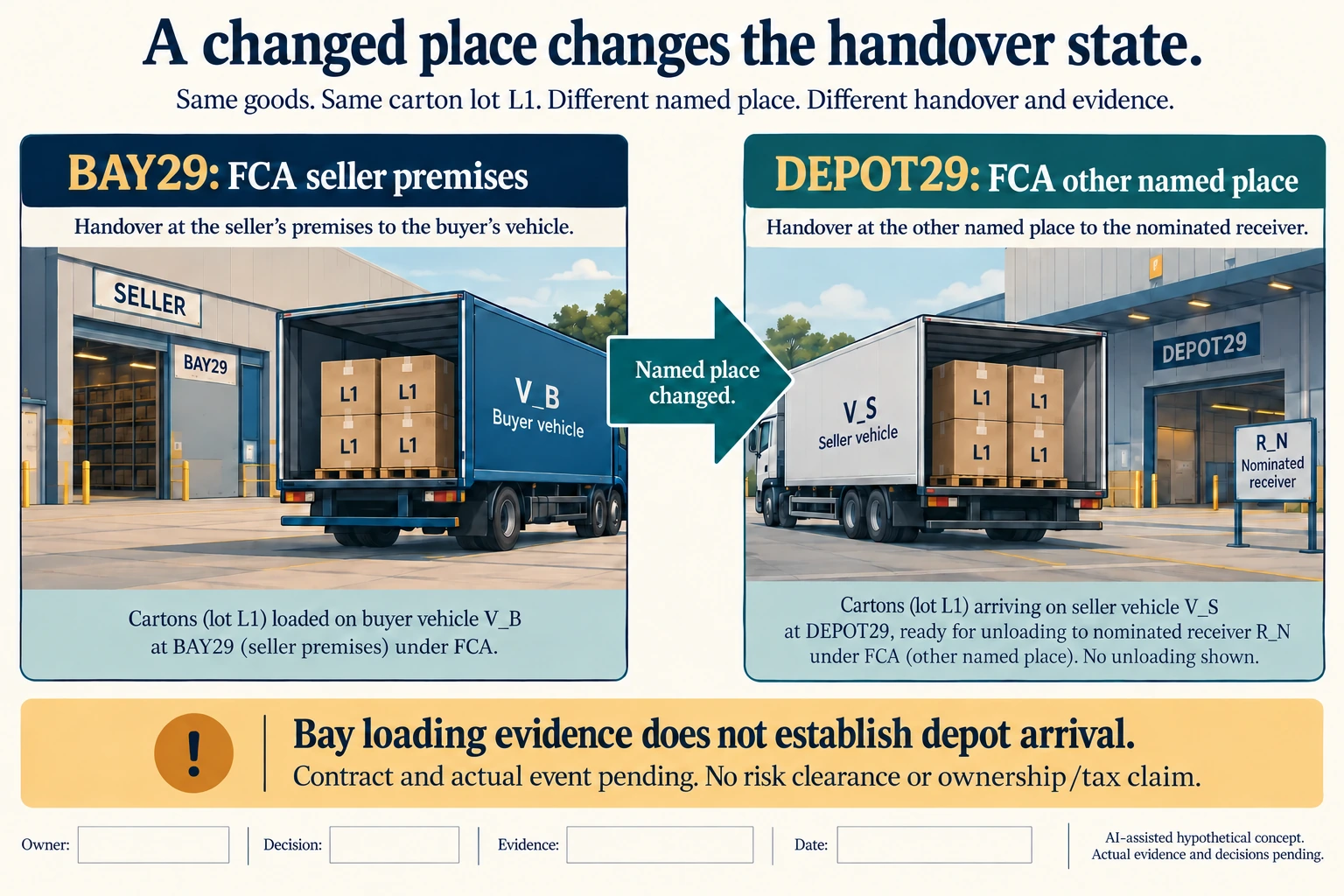
Changing the named place changes which vehicle state matters
Keep the same invented carton lot L 1 while changing the proposed FCA place. BAY29 names the seller’s bay and buyer-provided vehicle V_B. DEPOT29 names a different receiving depot, seller-provided vehicle V_S and buyer-nominated receiver R_N. The carton identity can remain the same while the required vehicle-related delivery state changes. These tokens describe proposed roles, not dispatched goods or a completed handover.
Scroll horizontally if columns extend beyond the view.
| Hypothetical configuration | Named object | Relationship | Input or next scope |
|---|---|---|---|
| BAY29 | BAY29 | proposed place | SELLER_BAY |
| BAY29 | BAY29 | proposed vehicle role | BUYER_V_B |
| BAY29 | BAY29 | proposed delivery state | LOADED_ON_BUYER_TRANSPORT |
| DEPOT29 | DEPOT29 | proposed place | OTHER_NAMED_DEPOT |
| DEPOT29 | DEPOT29 | proposed vehicle role | SELLER_V_S |
| DEPOT29 | DEPOT29 | proposed delivery state | ARRIVED_READY_FOR_UNLOADING |
| DEPOT29 | R_N | is | BUYER_NOMINATED_RECEIVER |
| PLACE_CHANGE29 | BAY_LOADING_RECORD | does not establish | DEPOT_ARRIVAL |
| DEPOT29 | ORDINARY_FCA_DELIVERY | does not generally require | SELLER_UNLOADING |
For BAY29, a record showing L 1 loaded onto V_B addresses the ordinary seller-premises loading state. A photograph of L 1 beside that vehicle does not. For DEPOT29, the relevant ordinary state is L 1 arriving at the named depot on V_S, at the nominated receiver’s disposal, ready for unloading. A record that L 1 was loaded at the original warehouse does not establish arrival at the new named point. Seller unloading at the other place is not generally a condition of that ordinary FCA delivery event.
This prevents a document shortcut when the booking changes. Keep an existing bay-loading record under its original factual scope; do not rename it depot delivery. Identify the new destination point, nominated receiving person, arriving vehicle role and receiving arrangement. A later unloaded-storage receipt may be useful evidence of a different state, but it does not replace a factual account of the contractual event. No acknowledgment, actual appointment or risk transfer is invented in the download.
EXW remains another rule: goods at the agreed point available to the buyer, not ordinarily seller-loaded. Any proposed loading help needs its own arrangement. The ICC Incoterms 2020 rules also retain ordinary transport-packaging responsibilities under their stated conditions. A changed named place does not settle ownership, payment, tax responsibility or every contract variation. Use the carton-data record for what travels and this comparison for which operation the revised instruction must describe.
Download the FCA named place change vehicle handover comparison record (.csv). It includes the original table fields and scenarios alongside the added relationships. HYPOTHETICAL rows are editorial examples or required review scopes, not actual records. Actual quantity, configuration, component and file identities, materials, process, specification, copy, method, condition, observation, owner, decision, evidence and dates are blank. ACTUAL_BLANK is a separate empty starting row; enter permitted project evidence before using an actual record. A blank means unknown.
Use the Packaging Freight Quotes: Carton Data to Prepare for its separate question.
Source scope checked 17 October 2026: ICC Incoterms 2020 EXW/FCA and packaging provisions depend on the named point and actual contract. FCA at another place ordinarily concerns arriving seller transport ready for unloading. No contract, export authority, completed delivery or risk outcome is established. The added configurations and calculations are hypothetical, with actual evidence and decisions pending.
Discuss this packaging specification with Packrivo. We coordinate independent suppliers. MOQ: 500 pieces per product/design; illustrative quantities are not production offers. Confirm materials, samples, price and timing for your project.