
A sealed air cushion does not necessarily keep the same pressure, shape or contact with the packed product throughout shipping. Its response depends partly on which conditions are constrained.
When a trapped gas warms, its absolute pressure increases if its volume is fixed. If its absolute pressure stays constant and it can expand freely, its volume increases instead. A flexible air pillow inside a shipping carton may follow neither limiting case exactly.
For a jewellery, candle or gift brand, the important distinction is that an air pillow looking fully inflated at pack-out does not establish how it will support the contents under different transport conditions.
The gas relationship depends on what remains fixed
NASA’s public educational explanation of the equation of state describes the ideal-gas relationship:
P × V = n × R × T
Here:
-
P is the gas’s absolute pressure.
-
V is the volume occupied by the gas.
-
n is the amount of gas.
-
R is the universal gas constant.
-
T is absolute temperature in kelvin (K).
If the amount of gas remains constant, the relationship between two states can be written:
P₂V₂ / P₁V₁ = T₂ / T₁
This does not mean pressure and volume each change by the temperature ratio. Their product changes according to that ratio.
One more distinction matters for inflatable packaging: the pressure in this equation is absolute internal pressure, not simply the pressure above the surrounding atmosphere.
The difference between internal and surrounding pressure matters to the forces acting on a flexible film. It is not interchangeable with the absolute pressure used in the gas equation.
The relationship is an idealized model. It does not describe the mechanical behavior of the bag film, its seals or its contact with surrounding packaging.
The same temperature change produces two different limiting results
Consider a completely hypothetical quantity of gas initially at 300 K and later at 330 K.
Assume the gas amount does not change and ideal-gas behavior applies. These temperatures are mathematical inputs, not measurements or predicted shipping conditions.
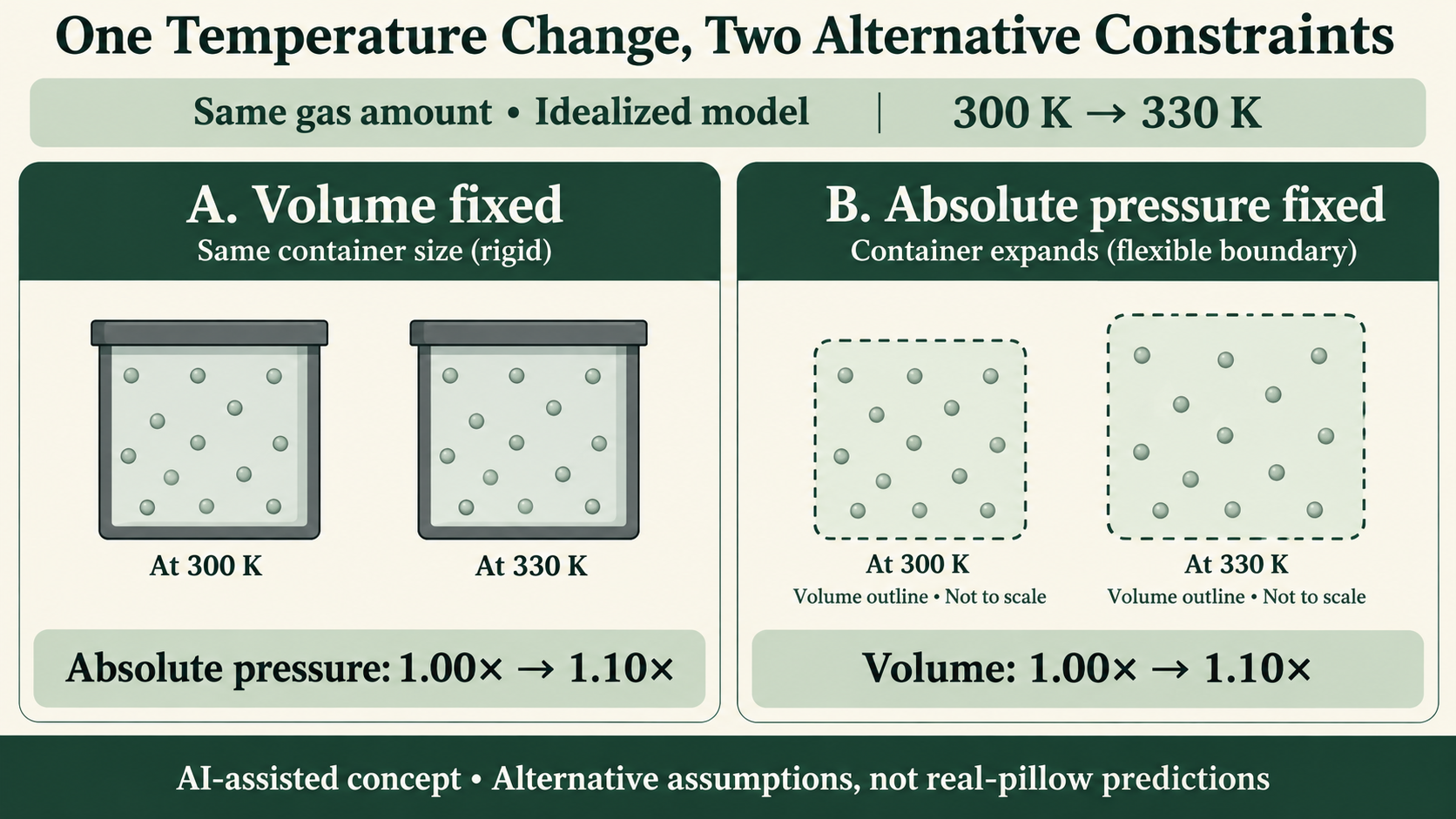
A sealed rigid volume changes pressure
First, suppose the gas is enclosed in a perfectly rigid chamber whose volume cannot change.
Because volume and gas amount stay fixed:
P₂ / P₁ = T₂ / T₁ = 330 / 300 = 1.10
The final absolute pressure is 1.10 times the initial absolute pressure, an increase of 10%.
The calculation does not say the gauge pressure increases by 10%, and it does not supply a pressure in psi or kPa. Those results would require additional information.
A rigid chamber is a limiting illustration, not a description of an ordinary flexible packaging pillow.
Gas at fixed absolute pressure changes volume
Now suppose the same idealized amount of gas can expand while its absolute internal pressure is held constant.
Then:
V₂ / V₁ = T₂ / T₁ = 330 / 300 = 1.10
The final gas volume is 1.10 times the initial volume.
This is a 10% increase in gas volume under the stated assumptions. It is not necessarily a 10% increase in pillow length, height or thickness.
The two results describe alternative constraints, not simultaneous predictions for the same package.
In the rigid case, volume remains unchanged. In the fixed-pressure case, pressure remains unchanged. When both pressure and volume can change, the gas equation alone cannot determine either final value.
A flexible pillow responds to its film and surrounding carton
A shipping air pillow is neither a rigid container nor an imaginary gas chamber that expands without resistance.
Its response involves the flexibility of the film, the seams, the initial inflated shape and the space available inside the closed carton.
Imagine a flexible pillow warming while sealed.
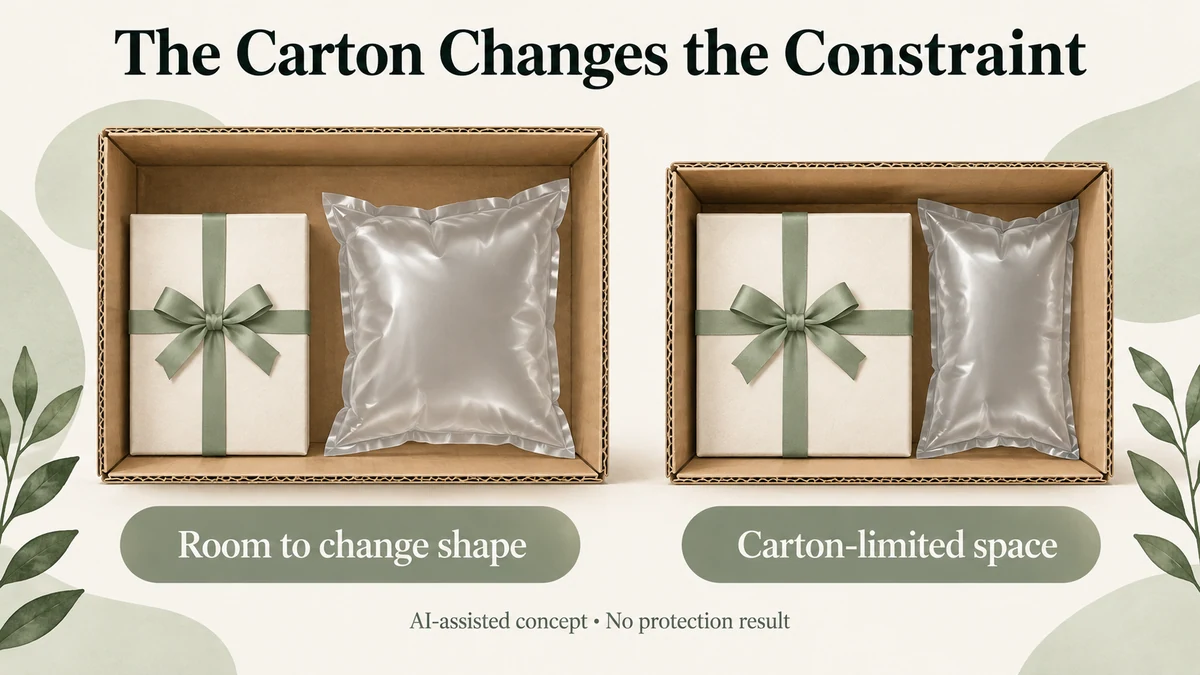
If it has room to change shape, some of the gas-state change may appear as increased volume. If the carton restricts expansion, the pillow cannot follow the freely expanding illustration.
Its internal pressure and the forces acting on its film and contact surfaces may change instead.
Neither result can be quantified from the ideal-gas relationship without knowing the relevant mechanical constraints.
Surrounding air pressure introduces another distinction.
If surrounding pressure decreases, the difference between the pillow’s internal pressure and its surroundings may increase. A flexible pillow may expand if its film and available space permit.
If its volume is rigidly fixed and temperature and gas amount remain unchanged, a change in surrounding pressure alone would not change its calculated internal absolute pressure. It would change the pressure difference across the enclosure.
A real pillow can change volume, so its internal pressure may also change as the system responds.
Similarly, an increase in surrounding pressure may encourage a flexible pillow to occupy less volume, depending on its internal state and mechanical constraints.
None of these possibilities establishes a particular change in size, seal loading or protection during an actual shipment.
Gas loss creates a further limitation. If air escapes through a seal or film, the trapped gas amount is no longer constant. The simple fixed-gas-amount comparison no longer describes the complete change.
Two similar-looking gift packs can have different constraints
Consider a hypothetical small gift brand using a sealed air pillow to fill space beside a smooth-sided gift box inside an outer shipping carton.
The brand considers two layouts.
In the first layout, the pillow occupies part of a relatively open void. It has some room to change shape without immediately pressing against every surrounding surface.
In the second layout, a visually similar pillow is confined between the gift box and the outer carton’s closed wall. Its available expansion space is much more restricted.
Both pillows might look similarly inflated before final closure.
That appearance does not mean their pressure and volume would respond identically if the environmental conditions changed.
The first pillow may have greater freedom to change its shape and contact position. The second has a stronger geometric constraint, so it cannot be represented by the same free-expansion assumption.
But this comparison does not establish which pack is safer.
The more restrained pillow might exert different contact forces. The less restrained pillow might move or lose a useful contact position. The actual responses depend on the package, bag construction and conditions.
No hypothetical gas calculation demonstrates whether either layout will adequately protect the gift.
The example explains why the closed-carton geometry matters to the gas-state interpretation, rather than merely whether the pillow initially looks full.
Inflatable void fill is not automatically verified impact cushioning
UPS’s public US packaging guidance describes inflatable air bags as void-fill material for lightweight items without sharp corners or edges.
It also warns that extreme hot or cold temperatures can affect their ability to provide adequate product protection.
That guidance does not specify a universal inflation pressure, permitted temperature range, safe product weight or performance result for a particular air-pillow construction.
An air pillow used to occupy empty space is not automatically a verified shock-cushioning system.
For a glass candle container, delicate jewellery component or other fragile product, the distinction remains especially important. Preventing obvious movement is not equivalent to establishing resistance to the impacts that may occur during transport.
Nor can the gas equation determine whether a visibly smaller or softer pillow necessarily provides worse protection.
The complete packaging arrangement matters. Packrivo’s mailer-box protection guide addresses the separate question of reviewing the outer carton, inserts, cushioning, contents and closure as one system.
Identify the actual constraint before interpreting the air cushion
A buyer reviewing an inflatable-packaging proposal can make a more useful decision by distinguishing three situations.
If the claimed behavior assumes fixed volume, establish what physically prevents the pillow from changing volume in the fully closed package. A close-fitting carton is not automatically a perfectly rigid gas chamber.
If the claimed behavior assumes constant absolute pressure, establish whether the pillow actually has freedom to expand and what film resistance, contact or surrounding-pressure conditions might prevent that assumption.
If neither condition is established, the ideal-gas equation identifies a relationship between possible gas states, not a unique final pressure or volume.
A proposal also needs to distinguish an effectively sealed gas quantity from a product whose gas retention is unknown. Actual leakage would change the amount of gas available.
For a relevant shipping proposal, the missing physical information may include the pillow construction, remaining space after carton closure, surrounding contact surfaces and anticipated environmental conditions along the intended route.
If the proposed benefit is protection from transport impacts rather than simply occupying a void, appropriate evidence for the actual packed system remains a separate question.
Packrivo can coordinate these sourcing and project questions, but an equation, supplier photograph or nominal inflated appearance cannot substitute for package-specific performance evidence.
The useful conclusion is therefore not a universal inflation setting. It is knowing which pressure–volume assumptions the proposed package permits, which remain unverified and why its initial appearance cannot settle the transport-protection decision.
Source/access note — Sources were checked on 10 October 2026. NASA provides a public general ideal-gas explanation; the undated UPS US guidance concerns inflatable void fill. Neither supplies actual pillow pressure, dimensions or protection results for these hypothetical arrangements.
A small starting pressure difference changes the percentage comparison
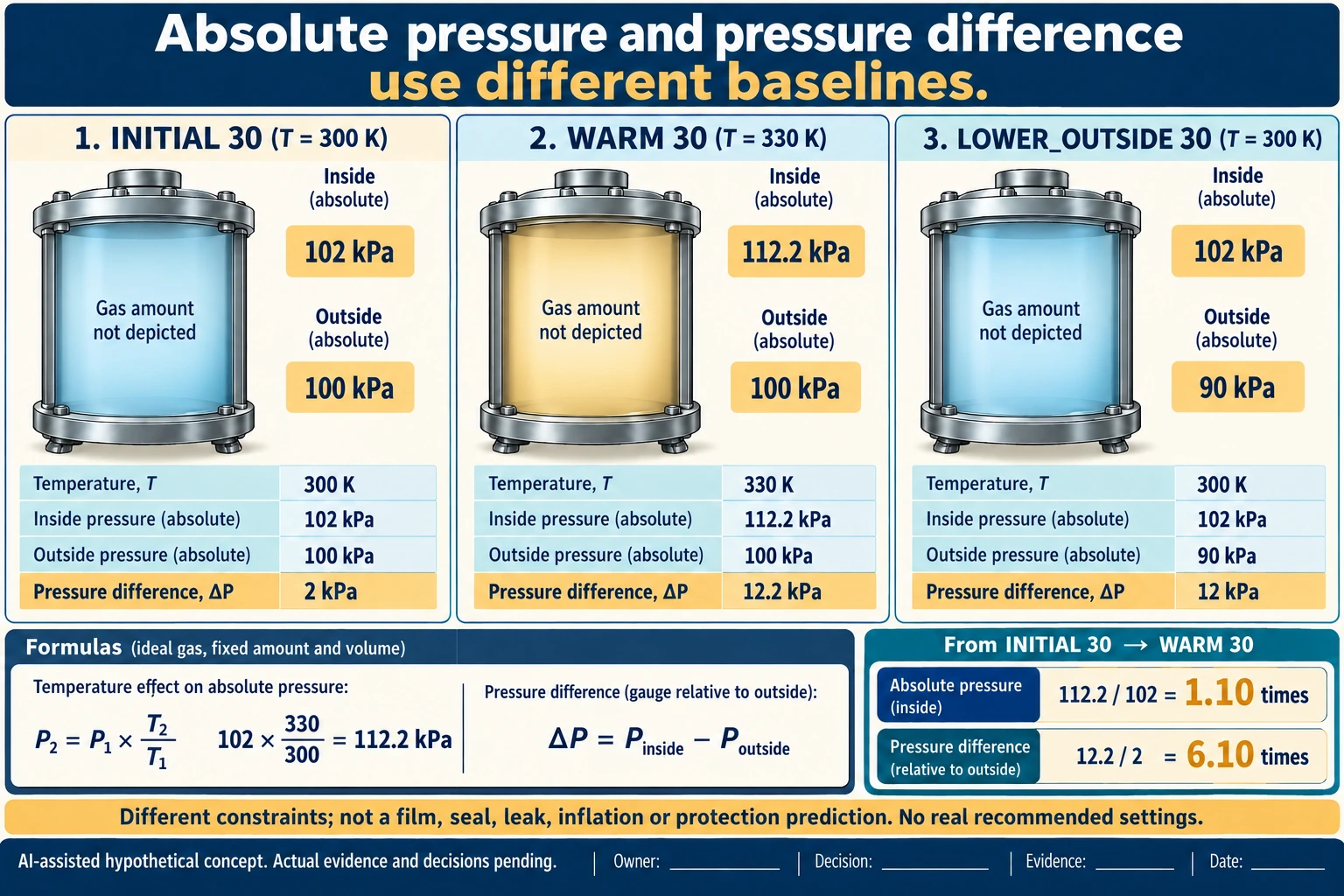
Extend the original ideal-gas explanation with explicit, invented pressure baselines. INITIAL30 is a perfectly rigid chamber at 300 K, holding a fixed amount of ideal gas at 102 kPa absolute while its surroundings are 100 kPa absolute. The pressure difference is 102 − 100 = 2 kPa. This is a limiting calculation, not an inflation instruction or a flexible-pillow specification.
Scroll horizontally if columns extend beyond the view.
| Hypothetical configuration | Named object | Relationship | Input or next scope |
|---|---|---|---|
| INITIAL30 | ABSOLUTE_TEMPERATURE | assumed input | 300 K |
| INITIAL30 | OUTSIDE_ABSOLUTE_PRESSURE | assumed input | 100 kPa |
| INITIAL30 | INSIDE_ABSOLUTE_PRESSURE | assumed input | 102 kPa |
| INITIAL30 | INSIDE_MINUS_OUTSIDE | calculated from | INITIAL30_IN-INITIAL30_OUT; 2 kPa |
| INITIAL30 | INITIAL30 | assumes | IDEAL_RIGID_FIXED_GAS_AMOUNT_AND_VOLUME |
| WARM30 | ABSOLUTE_TEMPERATURE | assumed input | 330 K |
| WARM30 | OUTSIDE_ABSOLUTE_PRESSURE | assumed input | 100 kPa |
| WARM30 | INSIDE_ABSOLUTE_PRESSURE | calculated from | INITIAL30_IN*WARM30_T/INITIAL30_T; 112.2 kPa |
| WARM30 | INSIDE_MINUS_OUTSIDE | calculated from | WARM30_IN-WARM30_OUT; 12.2 kPa |
| WARM30 | WARM30 | assumes | IDEAL_RIGID_FIXED_GAS_AMOUNT_AND_VOLUME |
| LOWER_OUTSIDE30 | ABSOLUTE_TEMPERATURE | assumed input | 300 K |
| LOWER_OUTSIDE30 | OUTSIDE_ABSOLUTE_PRESSURE | assumed input | 90 kPa |
| LOWER_OUTSIDE30 | INSIDE_ABSOLUTE_PRESSURE | assumed input | 102 kPa |
| LOWER_OUTSIDE30 | INSIDE_MINUS_OUTSIDE | calculated from | LOWER_OUTSIDE30_IN-LOWER_OUTSIDE30_OUT; 12 kPa |
| LOWER_OUTSIDE30 | LOWER_OUTSIDE30 | assumes | IDEAL_RIGID_FIXED_GAS_AMOUNT_AND_VOLUME |
| WARM30 | PRESSURE_RATIO | calculated from | WARM30_IN/INITIAL30_IN; 1.1 ratio |
| WARM30 | DIFFERENCE_RATIO | calculated from | WARM30_DIFF/INITIAL30_DIFF; 6.1 ratio |
| GAS30 | WARM30_VS_LOWER_OUTSIDE30 | are | DIFFERENT_CHANGED_VARIABLE_BRANCHES |
| GAS30 | IDEAL_GAS_ARITHMETIC | does not establish | FILM_SEAL_LEAK_STRESS_OR_PROTECTION |
WARM30 holds gas amount and volume unchanged and raises the assumed temperature to 330 K. Its absolute internal pressure becomes 102 × 330 ÷ 300 = 112.2 kPa. If outside pressure remains 100 kPa, the difference becomes 12.2 kPa. Absolute pressure has a 1.10 ratio, but the pressure difference has a 6.10 ratio against its small initial 2 kPa baseline. Applying the 10% absolute increase to that difference would give the wrong answer.
A different branch, LOWER_OUTSIDE30, keeps the initial 300 K gas state and rigid volume but changes outside pressure to 90 kPa absolute. Internal absolute pressure stays 102 kPa under those assumptions; the difference becomes 12 kPa. Do not combine this branch with WARM30 silently. Each row states which variable changed and which remained constrained.
A real film, seam, contact arrangement or gas loss can make neither rigid branch representative. The arithmetic calculates no membrane stress, leak, burst, contact load or protection. Keep absolute pressure for the gas relation and the inside-minus-outside difference for its separate role, then ask the responsible source which actual mechanical constraints are known. UPS void-fill guidance does not validate these invented states for shipping.
Download the air cushion absolute pressure gauge difference baseline record (.csv). It includes the original table fields and scenarios alongside the added relationships. HYPOTHETICAL rows are editorial examples or required review scopes, not actual records. Actual quantity, configuration, component and file identities, materials, process, specification, copy, method, condition, observation, owner, decision, evidence and dates are blank. ACTUAL_BLANK is a separate empty starting row; enter permitted project evidence before using an actual record. A blank means unknown.
Use the Mailer Box Shipping Protection: Review the Packed System for its separate question.
Source scope checked 17 October 2026: NASA’s ideal-gas equation is conditional on gas amount, absolute temperature/pressure and stated constraints. UPS US void-fill advice for lightweight items without sharp edges and its temperature cautions are not actual air-pillow performance, inflation limits or transport approval. The added configurations and calculations are hypothetical, with actual evidence and decisions pending.
Discuss this packaging specification with Packrivo. We coordinate independent suppliers. MOQ: 500 pieces per product/design; illustrative quantities are not production offers. Confirm materials, samples, price and timing for your project.