
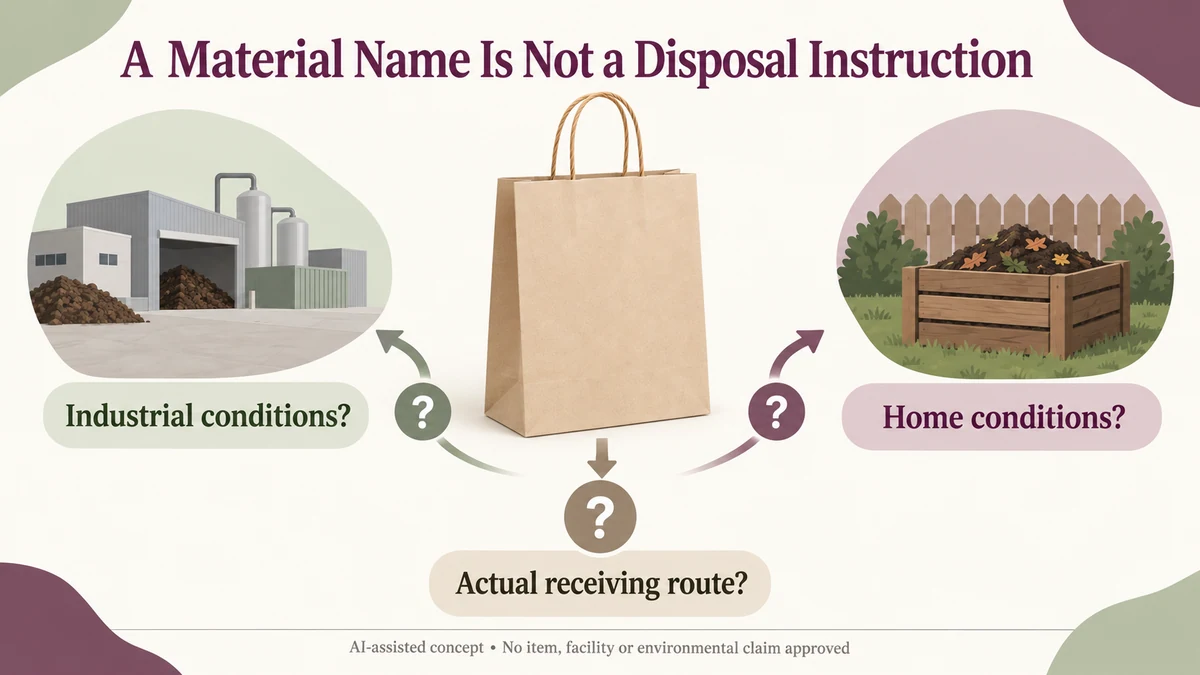
A material described as compostable under a particular industrial process is not automatically suitable for a home compost pile or available to a consumer’s local collection programme. The material behavior, processing conditions and actual disposal route are separate parts of the decision.
For a gift brand considering an environmental statement, define the component and conditions the evidence covers before choosing wording. A supplier’s material name does not approve the finished pack or an unqualified consumer claim.
This is general packaging education with a US marketing-guidance example, not legal advice or a compostability finding for a real product.
Composting Is a Biological Process With Conditions
Composting involves microbial activity under appropriate conditions, rather than an object simply disappearing whenever it is thrown away. The US EPA’s home-composting explanation describes a managed aerobic process involving organic materials, moisture and air.
The conditions and materials of a home system are not automatically those of a municipal or industrial operation. A result produced in one processing context cannot silently become a finding for every other context.
Nor is the visual breaking apart of a package enough to establish usable compost. Fragmentation, biological conversion and the suitability of the resulting material are different aspects of the question.
A claim about a specific material must retain the evidence and processing basis rather than relying on how natural, paper-like or thin it appears.
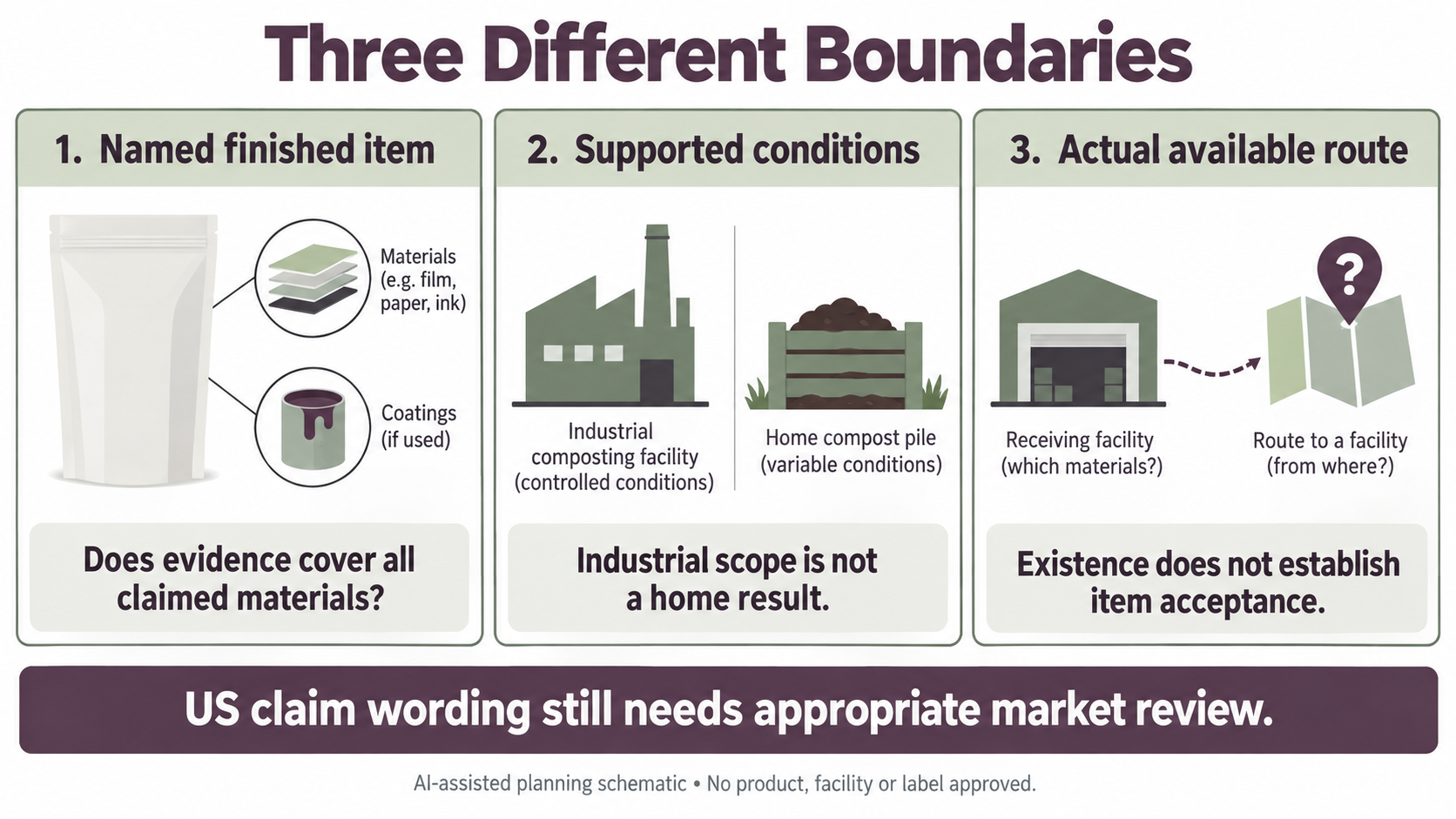
An Industrial Scope Does Not Establish a Home-Composting Result
The public scope of ASTM D6400-26 concerns applicable plastics and products designed for aerobic municipal or industrial composting where thermophilic conditions are achieved. That is a defined processing scope, not a home-composting approval for any film with a similar name.
The catalogue also makes clear that the relevant end item can involve polymers used as coatings or binders. Knowing only the base polymer or fibre does not establish that the supplied finished construction has the required evidence.
This article does not reproduce performance criteria from the paid specification, assign a breakdown period or infer certification from citing its title.
If the offered record concerns an industrial processing condition, the home-use question remains separate unless appropriately supported. An image of a backyard compost bin cannot supply that support.
The Claimed Item Must Match the Evidence
A gift pack can combine a bag, print, adhesive, label, coating and other components. Evidence about one constituent material is not automatically evidence about the complete item named in a consumer statement.
The existing material-claim scope guide helps identify the component and supplied construction. The present additional question is how that construction relates to the specific composting conditions and disposal route.
Changing an ink, label or layer can change what the supporting record covers. The responsible reviewer needs to determine the relevance of the current evidence rather than treating a previously seen certificate or specification name as a permanent blanket approval.
This is not an assertion that any named accessory prevents composting. It is a boundary on the conclusion that can be drawn without evidence for the claimed item.
US Guidance Retains Home Conditions and Facility Availability
The current public text of FTC Green Guides section 260.7 addresses compostable claims in the US. It calls for scientific substantiation covering the materials in the claimed item and the relevant safe, timely conversion to usable compost.
The guidance also addresses qualifying statements when home composting is not appropriate and when relevant municipal or institutional facilities are not available to a substantial majority of the consumers or communities where the item is sold.
These are different qualifications. Establishing a facility-related material behavior does not establish that customers actually have access to that route. Conversely, a local composting facility’s existence does not prove that it accepts this particular packaging item.
Actual wording and market compliance need appropriate review. This article does not select approved label language for a brand or apply the guidance to a real legal case.
A Hypothetical Gift Bag Shows the Two Unanswered Questions
Imagine an outer gift bag for which the offered material record concerns a defined industrial composting context. The brand wants to print a broad compostable statement, but the record’s coverage of the finished printed bag and the customers’ available route are not established.
The material information could be relevant within its actual scope. It does not resolve whether every part of the supplied bag is covered, whether home processing is supported or whether the intended sales area has a suitable receiving programme.
Those gaps should remain open rather than being filled with a generic leaf logo or a statement that the bag can go into any organic-waste bin.
The appropriate next decision is to establish the current item, conditions and route that can genuinely be supported, then have the responsible market reviewer consider the wording and necessary qualifications.
No actual customer area, facility, bag construction or certification is assigned to this hypothetical example.
Keep Composting Distinct From Other End-of-Life Routes
Composting evidence is not recycled-content evidence, paper-repulping evidence or proof of local plastic recyclability. Each refers to another attribute or processing question.
It also should not be turned into a claim about ordinary landfill breakdown, litter or overall environmental superiority. A condition-specific material property does not establish every outcome after disposal.
Packrivo can coordinate the proposed materials and documentation questions. It does not certify compostability, verify an actual facility’s acceptance or approve consumer environmental wording through project coordination.
Connect the named item to the supported processing conditions and available route. “Compostable” is not a complete disposal instruction supplied by a material name alone.
Source scope: Public official material accessed 11 October 2026. The eCFR interface shows Title 16 current through 7 October 2026; that title-level date is not presented as a new amendment to section 260.7. ASTM’s official listing identifies D6400-26 as active, updated 15 June 2026; D6400-23 is historical. The exact new page later timed out while its official indexed public scope remained available. The paid specification was not obtained. EPA home guidance describes its own context; no product, facility availability, label authorization or legal compliance conclusion is established.
Availability and item acceptance must meet at the same route
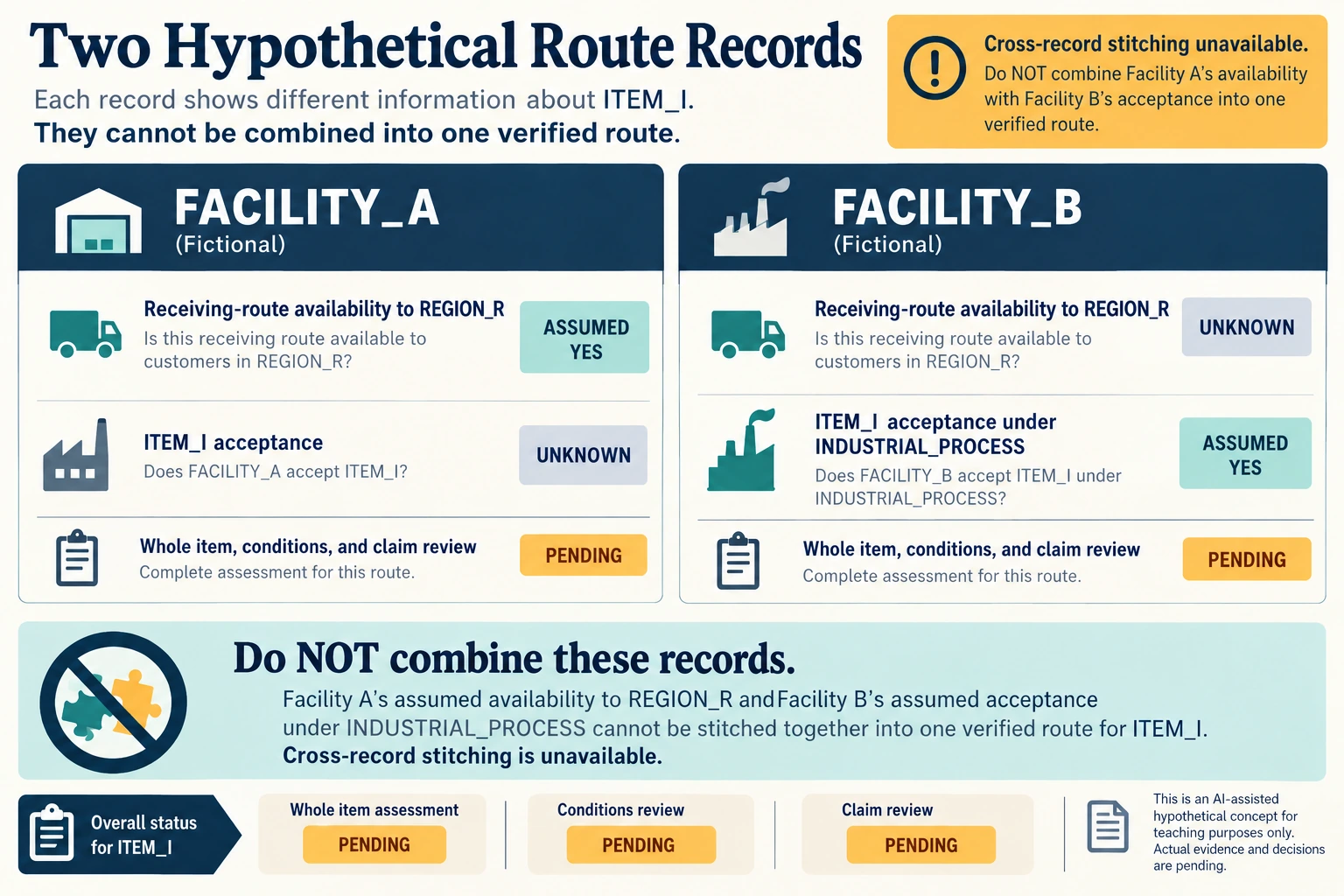
Use two entirely fictional route records. FACILITY_A is assumed available to CUSTOMER_REGION_R, but acceptance of ITEM_I is unknown. FACILITY_B is assumed to accept ITEM_I under its named industrial process, but availability to that customer region is unknown. These premises describe logic only, not real facilities, services or certificates.
Scroll horizontally if columns extend beyond the view.
| Hypothetical configuration | Named object | Relationship | Input or next scope |
|---|---|---|---|
| FACILITY_A | FACILITY_A | receiving route availability to | CUSTOMER_REGION_R |
| FACILITY_A | REGION_R_RECEIVING_ROUTE | hypothetical status | ASSUMED_YES |
| FACILITY_A | ITEM_I_ACCEPTANCE | hypothetical status | UNKNOWN |
| FACILITY_A | WHOLE_ITEM | remains | PENDING |
| FACILITY_A | CONDITIONS | remains | PENDING |
| FACILITY_A | CLAIM_REVIEW | remains | PENDING |
| FACILITY_B | FACILITY_B | receiving route availability to | CUSTOMER_REGION_R |
| FACILITY_B | REGION_R_RECEIVING_ROUTE | hypothetical status | UNKNOWN |
| FACILITY_B | ITEM_I_ACCEPTANCE | hypothetical status | ASSUMED_YES_UNDER_NAMED_INDUSTRIAL_PROCESS |
| FACILITY_B | WHOLE_ITEM | remains | PENDING |
| FACILITY_B | CONDITIONS | remains | PENDING |
| FACILITY_B | CLAIM_REVIEW | remains | PENDING |
| ROUTE_LOGIC | A_AVAILABILITY_PLUS_B_ACCEPTANCE | does not establish | ONE_VERIFIED_ACCEPTING_AVAILABLE_ROUTE |
| ROUTE_LOGIC | INDUSTRIAL_SCOPE | does not approve | HOME_COMPOST_OR_COMPLETE_ITEM_CLAIM |
| SOURCE_SCOPE | FTC260_7_SUBSTANTIAL_MAJORITY | no explicit | PERCENTAGE_OR_RECYCLABLE60_RULE |
Taking the availability answer from A and the acceptance answer from B would create a complete-looking route that neither record establishes. Keep facility identity, exact item, processing conditions and customer access on one supported association. A material record or a generic organics-bin instruction cannot fill the missing fields.
This route check is still separate from evidence for all materials in the claimed finished item, home-versus-industrial scope and the exact marketing presentation. D6400-26 concerns its public municipal/industrial thermophilic aerobic scope; it does not establish household composting or complete-pack evidence from a base-material name.
FTC section 260.7’s substantial-majority wording supplies no explicit percentage to import from recyclability. Section 260.1 explains the interpretive guidance rather than granting an independent certification right. Have the responsible reviewer address actual substantiation, qualifications and local acceptance; neither fictional route approves a claim, legal case or disposal instruction.
Download the compostable packaging facility acceptance availability route record (.csv). It includes the original table fields and scenarios alongside the added relationships. HYPOTHETICAL rows are editorial examples or required review scopes, not actual records. Actual quantity, configuration, component and file identities, materials, process, specification, copy, method, condition, observation, owner, decision, evidence and dates are blank. ACTUAL_BLANK is a separate empty starting row; enter permitted project evidence before using an actual record. A blank means unknown.
Use the Packaging Material Claims: Match the Evidence Scope for its separate question.
Source scope checked 17 October 2026: EPA home-compost context, ASTM D6400-26 public industrial/municipal thermophilic aerobic scope, and FTC sections 260.7 and 260.1 address separate boundaries. The Green Guides are interpretive guidance. Substantial-majority compostability wording supplies no explicit percentage; the recyclability 60% rule is not imported. No full paid standard, whole-item evidence, actual facility acceptance, home approval or claim permission was established. The added configurations and calculations are hypothetical, with actual evidence and decisions pending.
Discuss this packaging specification with Packrivo. We coordinate independent suppliers. MOQ: 500 pieces per product/design; illustrative quantities are not production offers. Confirm materials, samples, price and timing for your project.