

A packaging cash calendar places each payment at its actual trigger and shows the cumulative money required before sales receipts arrive. Record deposits as part of the order total, keep conditional payments distinct, and leave unconfirmed timing visible. An affordable total can still create an earlier cash gap.
Use Packaging Sample Fee Credits and Production Payments when an offer deducts a sample payment from later production. Place the actual credit trigger in this cash calendar instead of treating a possible future credit as cash already received.

Turn the quotation into payment events
Read the offer’s sample, setup, production and delivery lines before assigning dates. Some are separate charges; others are portions of the same production amount. Label that relationship explicitly so a deposit isn’t added twice.
Each event needs an amount, currency, trigger and timing status. A requested dispatch date and a contractual payment trigger are different fields. Keep expected dates as estimates until the responsible party confirms them.
The set-quote component record identifies the quoted scope. The calendar adds when its payments occur. It does not determine whether an invoice is legally due or provide financing advice.
Read the largest cumulative outflow
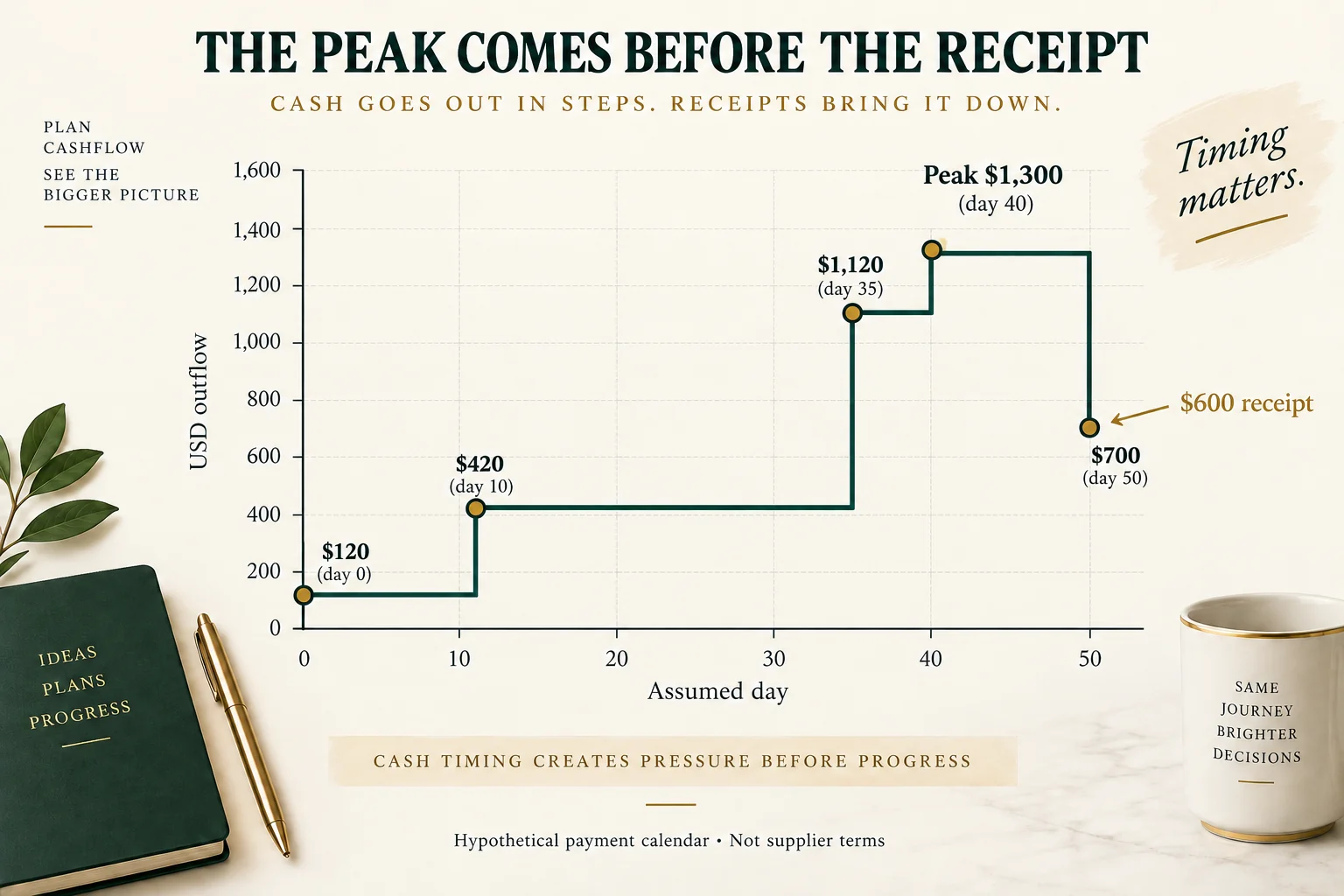
The following assumed USD amounts concern a fictional purchase. The $300 deposit and $700 balance together make a $1,000 production payment. The sample and freight charges are separate.
Scroll horizontally if columns extend beyond the view.
| Assumed day | Event | Cash leaving | Cash arriving | Cumulative net outflow |
|---|---|---|---|---|
| 0 | Sample payment | $120 | $0 | $120 |
| 10 | Production deposit | $300 | $0 | $420 |
| 35 | Production balance | $700 | $0 | $1,120 |
| 40 | Freight payment | $180 | $0 | $1,300 |
| 50 | Product sales receipt | $0 | $600 | $700 |
The modeled maximum net outflow is $1,300 before the sales receipt. The final $700 net position does not remove the need to cover that earlier amount. Nor does it include other business spending.
If your opening available cash for this purchase were an assumed $1,000, the example would have a $300 shortfall at day 40. That arithmetic identifies a planning gap; it does not recommend borrowing or imply that a supplier will change its terms.
Preserve conditions and timing uncertainty
A payment due after sample approval needs that trigger beside its estimated date. If approval moves, preserve the original calendar and revise the affected event. A freight estimate also needs its shipment scope and quotation validity rather than a number borrowed from a different route.
For a possible sample credit, show when it reduces a later balance. Don’t insert a cash receipt unless the actual terms promise a refund. The credit may affect the total without returning any earlier payment to your bank account.
Use one currency for a simple scenario. A real multi-currency purchase needs explicit conversion assumptions and dates, with the original amounts retained. This calendar does not predict exchange rates.
Send an event list rather than a guessed schedule
Return the draft calendar to the commercial contact with the payment triggers that remain unclear. Your next usable output is a dated list of confirmed obligations and estimated receipts, plus the highest modeled funding requirement. Update it when an amount, trigger or shipment changes.
Carry payment triggers into the cash-calendar worksheet
For the fictional five-event calendar, preserve the 120 sample,300 deposit,700 balance and 180 freight as outgoing rows, then 600 as a later incoming row. The 300 and 700 together are the 1,000 production amount; the worksheet never adds a separate 1,000 charge on top.
Keep each real payment trigger beside its estimated date. If approval delays the balance, revise that event without quietly moving an already-paid deposit. For a possible sample credit, use a separate eligibility record and reduce only the affected later obligation when the actual terms support it. An assumed receipt atday 50 does not fund an earlier payment atday 40.
Download this article’s project record (CSV). It includes field definitions, clearly hypothetical teaching rows and a blank actual-project row. Keep actual source evidence and unresolved fields with the record.
For a sourcing discussion, send the component quote references and payment triggers still awaiting confirmation. Packrivo coordinates supplier questions; the responsible technical or commercial parties confirm the actual method, configuration and terms.
Sources and scope
Australian Government supports the stated general concepts within this scope: Cash inflows/outflows and clear labeling of estimated figures. Access checked 14 October 2026.
The worked scenario is original editorial analysis with assumed inputs, not a supplier offer, customer record or measured Packrivo result. Commercial feasibility and physical suitability remain project-specific.