
A sample-fee credit changes a packaging comparison only under the conditions stated in the offer. Separate the sample payment, the production price and the later balance reduction. A credit against production does not automatically mean the earlier sample payment will be refunded.
Use Packaging Payment Schedule and Cash Calendar to place any confirmed sample credit at its actual payment event. Keep the total project-cost comparison separate from the amount and date of cash that must leave before production.
Identify the amount the credit changes
Ask whether the quoted production figure is before or after credit. Record the eligible design, order quantity, timing and any other stated condition. An offer saying “credited on order” leaves those questions open if it doesn’t define the order.
Retain the paid sample amount beside its reference. If production is later purchased, link the actual credited amount to the invoice or balance it reduces. That keeps one benefit from appearing twice, once as a deduction and again as a supposed refund.
The sample-version quote record helps determine what the original sample represents. Eligibility may depend on that configuration, so a revised structure or different sample scope should stay visible.
Compare three mutually exclusive paths
Assume a sample costs $100 and the intended production order costs $1,000 before any credit. Suppose the fictional offer permits the whole $100 as a credit only for its named, unchanged production configuration.
Scroll horizontally if columns extend beyond the view.
| Scenario | Sample cash already paid | Later production payment | Total cash |
|---|---|---|---|
| No production order | $100 | $0 | $100 |
| Eligible unchanged order | $100 | $900 | $1,000 |
| Changed design without eligible credit | $100 | $1,000 | $1,100 |
The eligible path totals $1,000. Subtracting the sample fee again would incorrectly show $900 total cash. The no-order path also provides no assumed refund.
These are invented terms and amounts. A real comparison must use the actual offer; the example establishes neither Packrivo sample prices nor a supplier’s cancellation or refund obligations.
Compare the sample work as well as its fee
Two credited samples can answer different questions. One may be a structural model while another represents intended print and finishing. Keep fit, appearance and complete-pack evidence separate so a larger credit does not become a reason to accept inadequate sample scope.
Where a credit covers only part of a fee, enter the eligible portion directly. For example, an assumed $60 credit against the same $1,000 production amount leaves $940 later to pay and $1,040 total including the earlier $100 sample.
A deposit and a sample credit also need separate rows. A deposit is already-paid production money; the credit reduces the agreed amount under its conditions. Their combined effect on the final balance should be traceable to the offer rather than inferred from their names.
Keep the conditional result with the comparison
Write the comparison as an eligible path and an ineligible path until the relevant condition is settled. The useful next answer identifies the sample reference, production scope, actual credit amount and the balance it reduces. Keep that evidence with the quotation so later scope changes don’t silently retain an obsolete benefit.
Sources and scope
Australian Government supports the stated general concepts within this scope: Cash inflows/outflows and clear labeling of estimated figures. Access checked 14 October 2026.
The worked scenario is original editorial analysis with assumed inputs, not a supplier offer, customer record or measured Packrivo result. Commercial feasibility and physical suitability remain project-specific.
Reconcile sample credit and a production deposit once
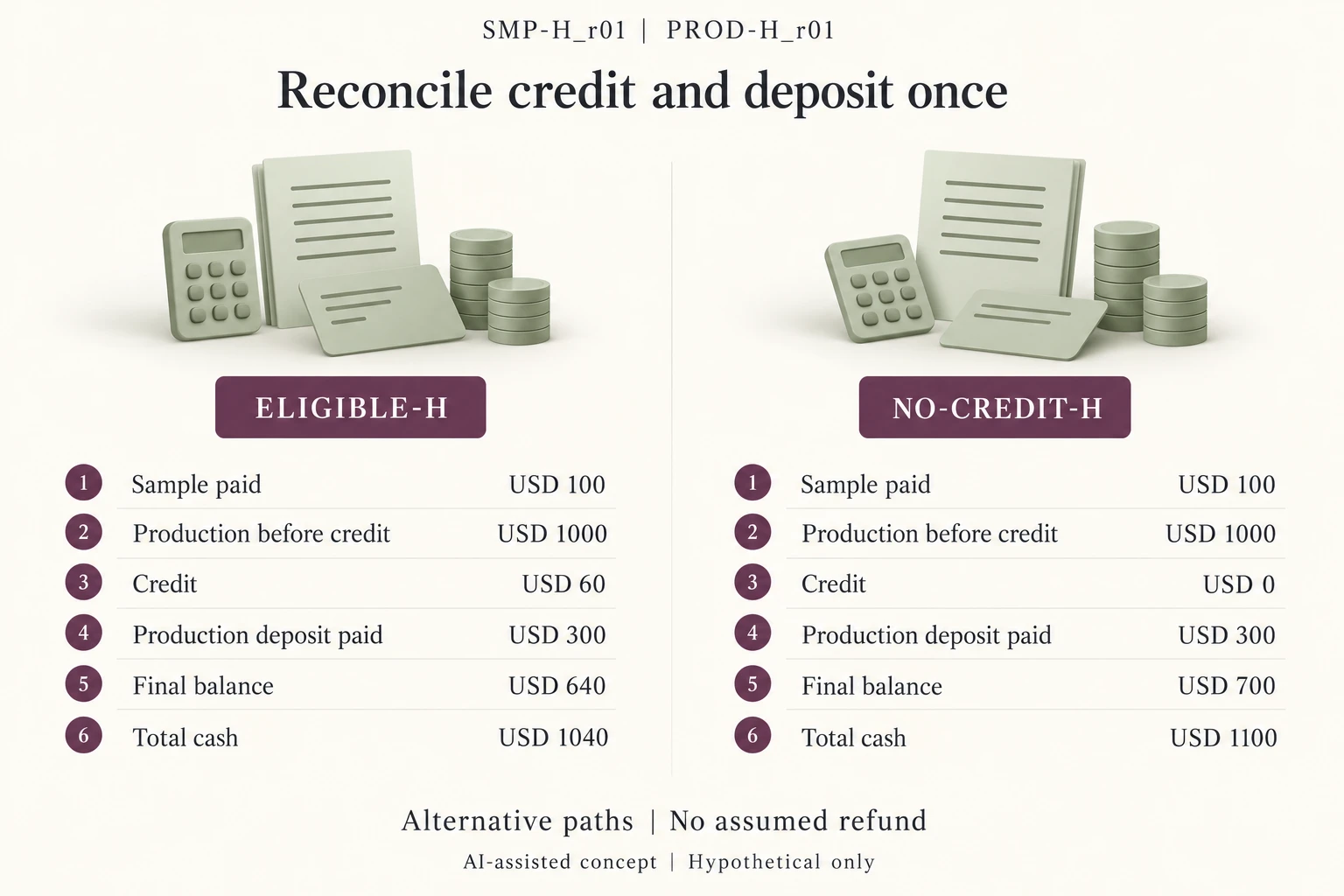
This new hypothetical continuation uses the original partial-credit inputs: $100 sample cash, $1,000 production before credit and a conditional $60 credit. It adds an assumed $300 production deposit. SMP-H_r01 and PROD-H_r01 are new exact scenario identities, not actual offers.
Scroll horizontally if columns extend beyond the view.
| Cash component | Eligible partial-credit path | Unsettled or ineligible-credit path |
|---|---|---|
| Sample already paid | USD 100 | USD 100 |
| Production before credit | USD 1,000 | USD 1,000 |
| Credit applied once | USD 60, only if conditions confirmed | USD 0 assumed for this separate no-credit case |
| Production deposit already paid | USD 300 | USD 300 |
| Final production balance | USD 640 | USD 700 |
| Total cash including earlier payments | USD 1,040 | USD 1,100 |
For the eligible scenario, production remaining is 1,000−60−300=$640. Total cash is the $100 sample plus $300 deposit plus $640 balance, or $1,040. The deposit is already-paid production money; it does not reduce that total a second time.
The no-credit scenario keeps the same assumed deposit but applies no credit: 1,000−0−300=$700, with total cash $1,100. These paths are mutually exclusive alternatives, not invoices to add together. An unresolved eligibility question is not a finding that an actual credit has been rejected.
Keep the actual credited invoice reference and eligibility confirmation blank until supported. No refund, extra fee, deposit schedule or Packrivo sample policy is established. If a real production quote already includes credit, do not subtract it again; identify that price basis before using this before-credit example.
Download the packaging sample fee credit record (.csv). HYPOTHETICAL rows are invented examples. Use ACTUAL_BLANK for permitted project inputs; replace that row label only when recording actual facts. Empty evidence, observation and date fields mean unknown or not performed, never acceptance. Keep checkpoints and revisions separate.
Bring the exact sample/production identities and before-credit price basis through the packaging enquiry so the deposit, credit and balance remain traceable. Packrivo coordinates independent suppliers. These records establish no supplier offer, service availability or MOQ exception; its published baseline is 500 pieces per product/design.