
Component purchase pack sizes can create different surpluses even when every gift uses one of each piece. Calculate each required quantity, round it up to the actual offered purchase multiple, and keep the residual by component. A neat finished-set target does not guarantee matching purchase counts.
Identify the offered unit
A bundle of 100 boxes and a carton containing 100 boxes may look similar on a quote, but they need not be the same purchasing restriction. Ask which quantity must be bought together and distinguish it from shipping pack-out.
The complete-set unit method defines the component requirement. This worksheet adds the indivisible purchase multiple. Commercial minimums and per-design requirements remain separate constraints; the example does not create a low-quantity exception.
Round 620 sets component by component
Assume 620 gifts require one box, one card and one insert each. The fictional supplier offers boxes in multiples of 100, cards in 250 and inserts in 200, with no additional minimums in this isolated example.
Scroll horizontally if columns extend beyond the view.
| Component | Need | Offered multiple | Rounded purchase | Remaining after 620 uses |
|---|---|---|---|---|
| Box | 620 | 100 | 700 | 80 |
| Card | 620 | 250 | 750 | 130 |
| Insert | 620 | 200 | 800 | 180 |
For each line, divide need by the multiple, round upward to a whole purchase unit, then multiply back. The insert calculation is 620 divided by 200, rounded from 3.1 to four packs, giving 800 pieces.
The three residual counts should remain separate. Adding 80, 130 and 180 does not produce 390 complete spare gifts. These residuals can form only 80 more sets, assuming every component remains suitable.
Compare alternatives without forcing equal totals
You could ask about another permitted multiple or a different overall purchase plan. Keep each response as an actual offered scenario; don’t invent loose-piece purchasing to remove a surplus mathematically.
Buying 800 of everything would yield equal residual counts but might require more money and stock than needed. Equal totals are useful only if they support the intended consumption and actual offer.
For a gift needing two cards, calculate 1,240 card pieces before rounding. Under the assumed 250-card multiple, the purchase becomes 1,250, leaving ten cards rather than 130. Per-set use therefore changes the purchase boundary.
Send the required count, offered multiple and rounded quantity together. The next comparison should show actual cost and storage implications of each feasible plan, with future residual use kept provisional.
Sources and scope
Australian Government supports the stated general concepts within this scope: General inventory categories, reorder points and stocktake. Access checked 14 October 2026.
The worked scenario is original editorial analysis with assumed inputs, not a supplier offer, customer record or measured Packrivo result. Commercial feasibility and physical suitability remain project-specific.
Convert each residual into its own set capacity
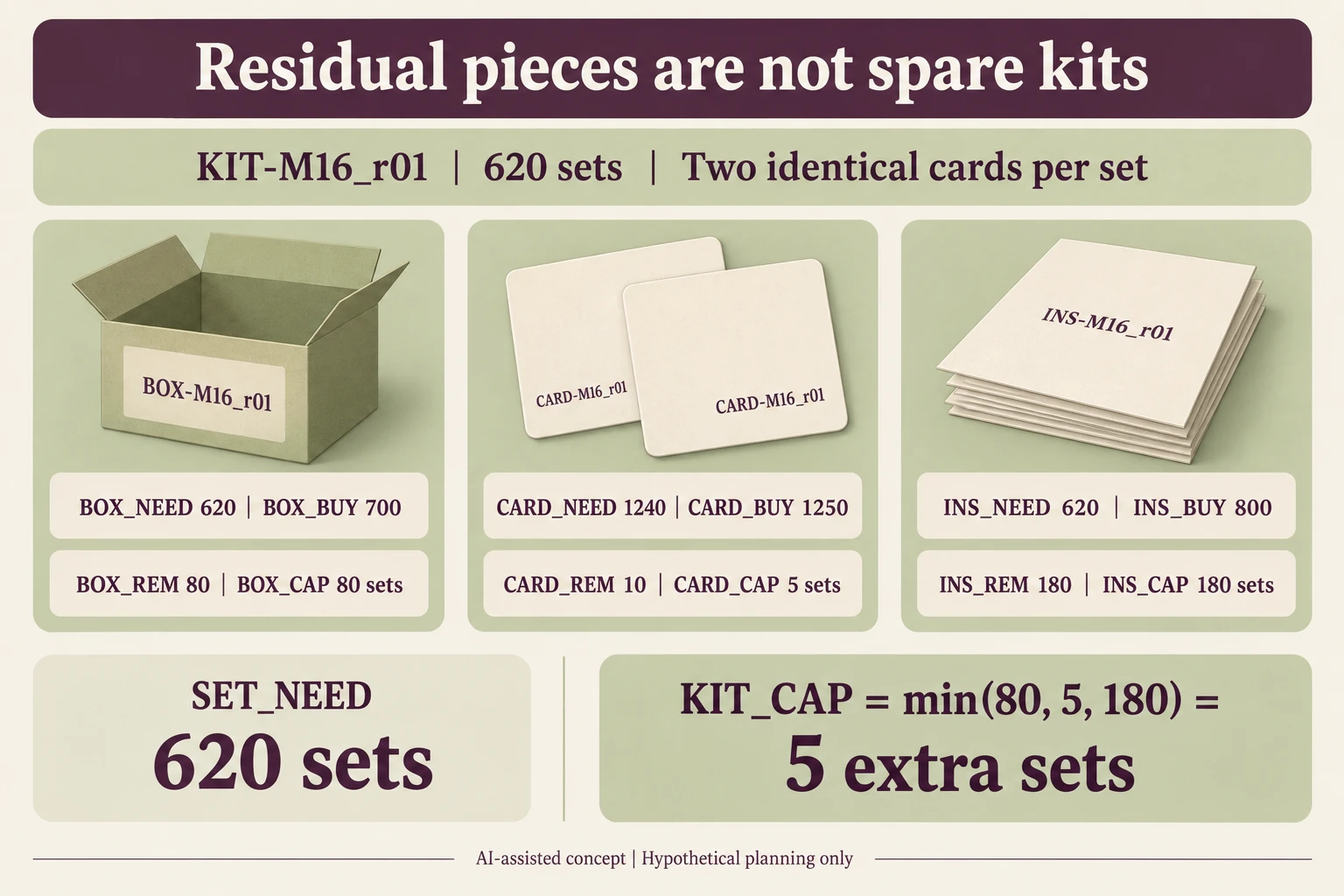
Use the original two-card variation as one explicit hypothetical KIT-M16_r01: one box, two copies of the same CARD-M16_r01 and one insert. The 620-set requirement uses fictional purchase multiples of 100 boxes, 250 cards and 200 inserts.
Scroll horizontally if columns extend beyond the view.
| Scope ID | Exact entity | Stage / role | Hypothetical basis |
|---|---|---|---|
| SET_NEED | KIT-M16_r01 | REQUIREMENT | One box, two identical CARD-M16_r01 copies, one insert per set |
| BOX_NEED | BOX-M16_r01 | REQUIREMENT | 620 x 1 per set |
| BOX_BUY | BOX-M16_r01 | PURCHASE_PLAN | ceil(620/100) x 100 |
| BOX_REM | BOX-M16_r01 | RESIDUAL | 700 – 620 |
| BOX_CAP | BOX-M16_r01 | RESIDUAL_SET_CAPACITY | floor(80/1) |
| CARD_NEED | CARD-M16_r01 | REQUIREMENT | 620 x 2 per set |
| CARD_BUY | CARD-M16_r01 | PURCHASE_PLAN | ceil(1240/250) x 250 |
| CARD_REM | CARD-M16_r01 | RESIDUAL | 1250 – 1240 |
| CARD_CAP | CARD-M16_r01 | RESIDUAL_SET_CAPACITY | floor(10/2) |
| INS_NEED | INS-M16_r01 | REQUIREMENT | 620 x 1 per set |
| INS_BUY | INS-M16_r01 | PURCHASE_PLAN | ceil(620/200) x 200 |
| INS_REM | INS-M16_r01 | RESIDUAL | 800 – 620 |
| INS_CAP | INS-M16_r01 | RESIDUAL_SET_CAPACITY | floor(180/1) |
| KIT_CAP | KIT-M16_r01 | RESIDUAL_CAPACITY | min(80 boxes, floor(10 cards/2),180 inserts) |
The component needs are 620 boxes, 1,240 cards and 620 inserts. Planned purchases are 700, 1,250 and 800; residuals are 80, 10 and 180 pieces. Each requirement, purchase, residual and residual-set capacity has its own row rather than combining stages in a stock count.
Ten card pieces support only five more two-card sets. KIT_CAP is therefore min(80,5,180)=5 additional sets, conditional on the assumed suitable components. This is not ten spare gifts. Actual purchasing terms, availability and future use remain unconfirmed; no loose-piece buying or MOQ exception is inferred.
Download the packaging purchase pack multiples record (.csv). HYPOTHETICAL rows are invented examples. Use ACTUAL_BLANK for permitted project inputs; replace that row label only when recording actual facts. Empty evidence, observation and date fields mean unknown or not performed, never acceptance. Keep checkpoints and revisions separate.
Use the named scope rows and unresolved evidence to prepare a project enquiry. Replace planning assumptions with actual authorised records before a commercial or use decision. Packrivo coordinates independent suppliers. These records establish no supplier offer, service availability or MOQ exception; its published baseline is 500 pieces per product/design.
What this changes in a packaging enquiry
Ask each supplier to state the selling unit and purchase multiple for every component. Use the rounded quantities in the comparison, including the surplus boxes, cards or labels they create. Keep those purchasing multiples separate from Packrivo's project MOQ and from the number of complete gifts you expect to sell.