

An agreed delivery quantity range can change the number of complete packaging sets available. Apply each component’s explicit lower and upper quantity to its per-set requirement, then calculate the limiting complete-set count. Keep the actual received quantity and payment basis separate from this planning range.

Use stated terms rather than a customary percentage
Record whether the offer specifies an exact quantity or a defined permitted range. The range may differ between components. Its commercial meaning needs the actual agreement; this article supplies no standard overrun or underrun allowance.
Begin with the complete-set component definition. One gift may require two different cards, two identical cards or another combination. Keep design-specific counts separate where one version cannot replace another.
The combined lower bound can be smaller
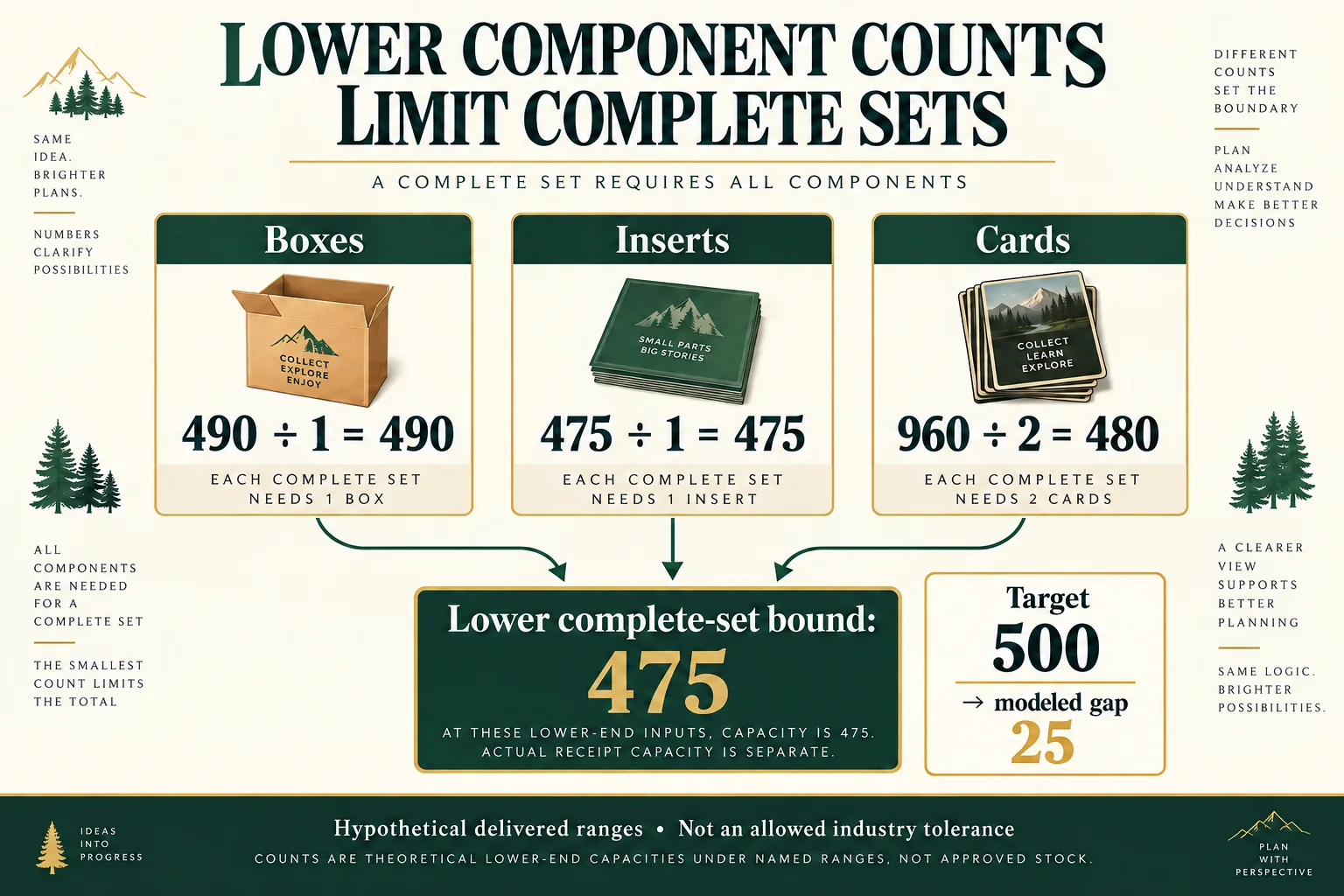
Assume the following hypothetical delivered ranges. Every gift uses one box, one insert and two identical cards. No other component constrains the example.
Scroll horizontally if columns extend beyond the view.
| Component | Assumed delivered range | Complete sets supported at lower end | At upper end |
|---|---|---|---|
| Boxes | 490 to 510 | 490 | 510 |
| Inserts | 475 to 525 | 475 | 525 |
| Cards | 960 to 1,040 | 480 | 520 |
The lower complete-set bound is the smallest lower-end capacity: 475. The upper bound is the smallest upper-end capacity: 510. These are theoretical bounds under the named ranges, not a promise of a realised combination.
If the actual receipt contains 500 boxes, 490 inserts and 980 cards, it supports 490 complete sets. The actual count should replace the planning range once its usable status is established.
Distinguish quantity from usability
A delivered count inside the commercial range does not establish that every unit is approved for packing. Identity, condition and relevant acceptance decisions still affect usable quantity.
Conversely, a shortage against an exact agreed quantity is a commercial response question. Don’t silently label it an allowed tolerance because a different supplier’s offer permits variation.
Show payment questions separately. Whether invoicing uses ordered, delivered or another defined quantity is not determined by the complete-set calculation. Ask for that basis before converting a range into cash exposure.
Return the finished-set consequence
Place the required finished-set target beside the modeled lower bound. If you need 500 complete gifts and the assumed lower bound is 475, identify the 25-set gap before relying on the order plan. The responsible parties can then discuss exact component requirements or another feasible arrangement with the underlying terms visible.
Keep the receipt example separate from the delivery-range model
The range model and the conditional receipt example answer different questions. The lower-bound model yields 475 sets and the upper-bound model 510. The separate example of 500 boxes,490 inserts and 980 cards yields 490 sets, assuming those pieces are usable and each gift needs two identical cards.
Record an actual receipt against its agreed quantity basis and acceptance status before replacing the planning assumptions. The 25-setgap to a 500 target is a consequence of the invented lower bounds, not proof that a supplier may lawfully under-deliver by that amount. Do not turn the calculated set range into an invoice total or a customary overrun/underrun percentage.
Download this article’s project record (CSV). It includes field definitions, clearly hypothetical teaching rows and a blank actual-project row. Keep actual source evidence and unresolved fields with the record.
For a sourcing discussion, send the component quantity ranges, finished-set target and payment basis still to confirm. Packrivo coordinates supplier questions; the responsible technical or commercial parties confirm the actual method, configuration and terms.
Sources and scope
Australian Government supports the stated general concepts within this scope: General inventory categories, reorder points and stocktake. Access checked 14 October 2026.
The worked scenario is original editorial analysis with assumed inputs, not a supplier offer, customer record or measured Packrivo result. Commercial feasibility and physical suitability remain project-specific.
What this changes in a packaging enquiry
Before relying on a delivery tolerance, obtain the actual supplier term for each component and identify which lower-bound combination would constrain complete sets. Ask how shortages, excess pieces and invoiced quantities are handled. The hypothetical ranges in this article are not Packrivo or supplier delivery terms.