

Consolidating repeated packaging print runs can reduce setup repetition while bringing inventory forward. Compare the same period demand and artwork under both schedules, then include holding and change exposure. A cheaper production total does not establish that early stock will remain useful.
When consolidating an Informational insert card print run, identify the artwork version and dates through which that wording remains usable. Compare repeated setup with early stock commitment; a common card size does not make different artwork one production run.

Hold the artwork horizon steady
Identify which printed component stays unchanged across the periods. A future campaign, legal text update or different product can make a later quantity a separate design rather than part of today’s run.
The tooling and reuse scope identifies preparation that might repeat. Use actual offer terms for each run; owning an earlier tool doesn’t make every setup free.
Keep purchasing dates and material-use dates together. Three short runs and one consolidated run may satisfy identical demand while tying up cash and space at different times.
Three short runs versus one earlier run
Assume three consecutive periods each require 300 identical cards. In this fictional USD scenario, every run has $80 setup and a $0.40 per-card charge.
Scroll horizontally if columns extend beyond the view.
| Schedule | Setup charges | Card charges | Production total |
|---|---|---|---|
| Three runs of 300 | 3 x $80 = $240 | 900 x $0.40 = $360 | $600 |
| One run of 900 | $80 | $360 | $440 |
The consolidated run reduces the modeled production total by $160. If its additional holding cost over the comparison period is an assumed $30, that modeled difference becomes $130.
The holding amount needs its own basis. Include only additional charges or consistently calculated work; don’t insert an arbitrary monthly percentage and present it as an industry rule.
Make the changed-artwork case visible
Suppose the design changes after the first period, leaving 600 early-printed cards incompatible with the later need. The original $160 setup difference no longer describes the complete outcome. Record the unusable quantity and the actual replacement scope rather than inventing a guaranteed salvage value.
Repeated smaller runs can retain later decisions, but they need feasible production timing and actual permitted quantities. They may introduce freight, receiving or setup charges missing from the simple example.
Unlike a comparison of two print processes for one quantity, this decision changes when quantities are purchased. The control variables are run count, release timing and the period for which artwork remains current.
Choose a schedule tied to confirmed uses
Place each consumption period beside the latest feasible order date and relevant artwork decision. Request both schedules on that basis. A usable comparison shows setup repetition, early stock and the impact of a later change, with unconfirmed demand and commercial flexibility clearly identified.
Sources and scope
Australian Government supports the stated general concepts within this scope: General inventory categories, reorder points and stocktake. Access checked 14 October 2026.
Australian Government supports the stated general concepts within this scope: Cash inflows/outflows and clear labeling of estimated figures. Access checked 14 October 2026.
The worked scenario is original editorial analysis with assumed inputs, not a supplier offer, customer record or measured Packrivo result. Commercial feasibility and physical suitability remain project-specific.
Keep superseded cards outside the replacement release
The original changed-artwork case becomes a revision-boundary ledger. ART16_r01 is the fictional early-printed cohort of 900 cards; 300 are used in period one. CHANGE-E16_r01 then introduces the later ART16_r02 requirement.
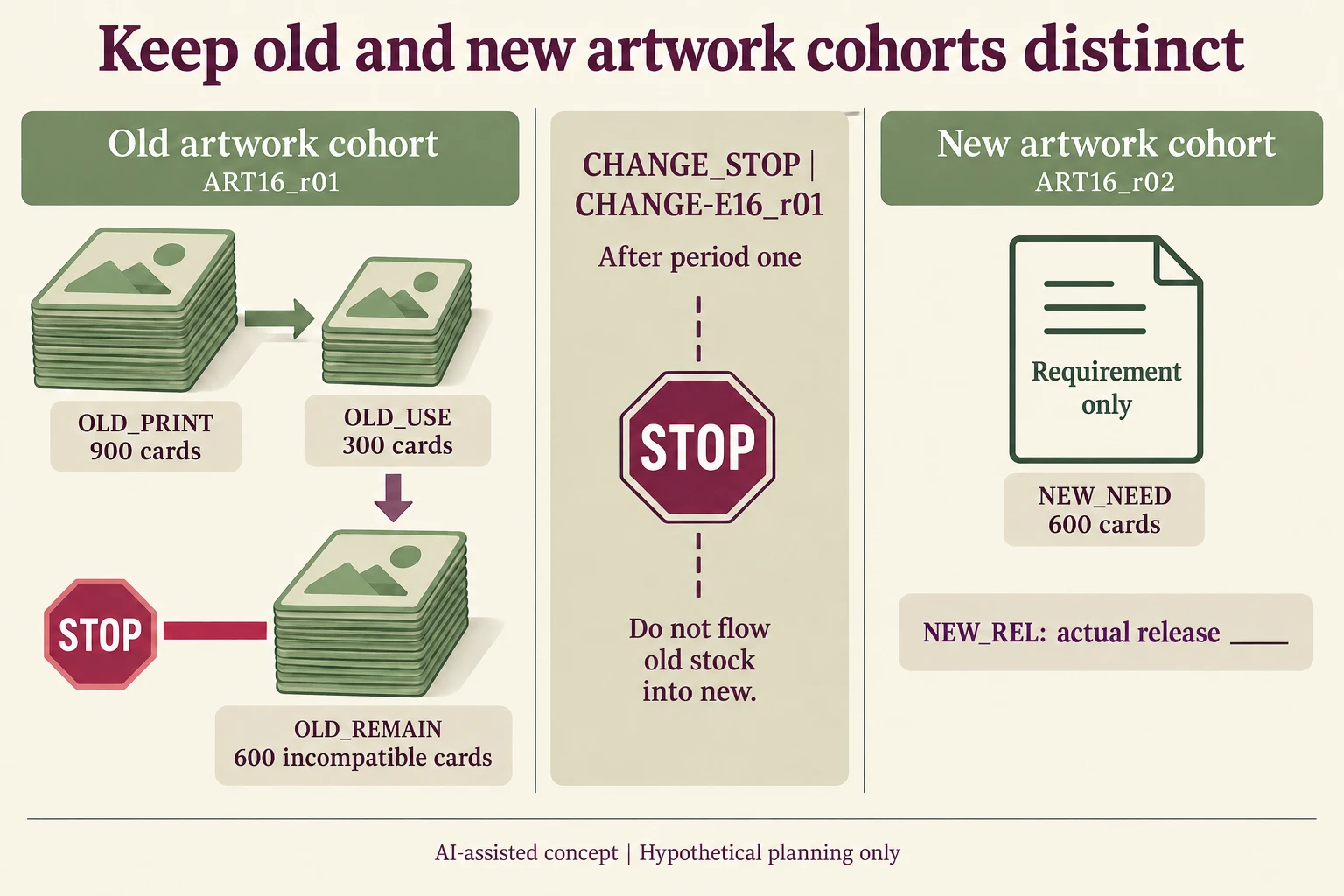
Scroll horizontally if columns extend beyond the view.
| Scope ID | Exact entity | Stage / role | Hypothetical basis |
|---|---|---|---|
| OLD_PRINT | ART16_r01 | EARLY_PRINT_PLAN | Original artwork cohort |
| OLD_USE | ART16_r01 | PERIOD_ONE_USE | Assumed first-period consumption |
| CHANGE_STOP | CHANGE-E16_r01 | AFTER_PERIOD_ONE | Hypothetical artwork change stops ART16_r01 for later requirement |
| OLD_REMAIN | ART16_r01 | INCOMPATIBLE_RESIDUAL | 900 – 300; not assigned to new revision |
| NEW_NEED | ART16_r02 | LATER_PERIOD_REQUIREMENT | New artwork requirement, not an actual purchase |
| NEW_REL | ART16_r02 | RELEASE_FOR_USE | Actual new-revision release remains unknown |
OLD_REMAIN records 600 ART16_r01 cards incompatible with the later requirement. NEW_NEED records 600 ART16_r02 cards required, while NEW_REL leaves actual released replacements unknown. The residual is not relabelled as ART16_r02 and the requirement is not treated as a receipt.
This ledger assigns no replacement cost, supplier commitment, salvage value or credit. The original production-cost comparison remains attached to its unchanged-artwork assumptions; a later revision needs actual scope before another total can be supported. Actual quantities, release decisions, evidence and dates stay blank.
Download the consolidating packaging print runs record (.csv). HYPOTHETICAL rows are invented examples. Use ACTUAL_BLANK for permitted project inputs; replace that row label only when recording actual facts. Empty evidence, observation and date fields mean unknown or not performed, never acceptance. Keep checkpoints and revisions separate.
Use the named scope rows and unresolved evidence to prepare a project enquiry. Replace planning assumptions with actual authorised records before a commercial or use decision. Packrivo coordinates independent suppliers. These records establish no supplier offer, service availability or MOQ exception; its published baseline is 500 pieces per product/design.