

Compare foreign-currency packaging quotes across more than one explicitly assumed conversion rate before relying on their home-currency ranking. Keep the quantity and scope fixed, include the stated fee once, and calculate where the two totals cross. The result is a sensitivity model, not a prediction of exchange rates.

Preserve the original offers and conversion direction
First align the finished packaging requirement, supplied state, included components and delivery scope. A currency calculation cannot make a box-only offer equivalent to a complete gift set.
Keep the original currency and amount unchanged in the record. The quote-currency comparison guide explains that provenance. This model adds a different question: whether changing the assumed rate changes which offer has the lower comparable home-currency total.
Define r as U.S. dollars per one British pound. Converting a dollar total into pounds under that convention requires dividing by r. A rate written as pounds per dollar would need a different operation.
Test two entirely hypothetical 500-unit routes
Assume both fictional routes cover the same suitable 500-unit packaging requirement. Offer A is USD 915 for the defined scope, plus a separately assumed GBP 5 conversion charge. Offer B is GBP 750 for the same scope. Every amount, fee and rate is invented; none is a supplier price or actual bank quotation.
The modeled pound total for A is 915 / r + 5. B remains 750 in this comparison.
Scroll horizontally if columns extend beyond the view.
| Assumed USD per GBP | A in GBP including assumed fee | B in GBP | Lower modeled amount |
|---|---|---|---|
| 1.25 | 915 / 1.25 + 5 = 737.00 | 750.00 | A by 13.00 |
| 1.20 | 915 / 1.20 + 5 = 767.50 | 750.00 | B by 17.50 |
Under the lower assumed dollar-per-pound rate, more pounds are needed to meet the unchanged dollar total. The two original offers have not changed; only the comparison assumption has.
Find the crossing before choosing a preferred scenario
Set the totals equal: 915 / r + 5 = 750. Subtract the five-pound fee, leaving 915 / r = 745. Therefore r = 915 / 745, approximately 1.228187919 dollars per pound.
Above that modeled rate, A has the lower pound amount. Below it, B does, provided the quantities, included scope and fixed fee remain unchanged. The decimal crossing is algebraic precision, not confidence about a future or obtainable rate.
If the fee is percentage-based or contains other charges, write its actual calculation rather than continuing to use a fixed five pounds. Likewise, changing a delivery inclusion or price validity creates a new offer scenario, not just another rate row.
Distinguish a reference from the payment quotation
The European Central Bank publishes its reference rates for information and strongly discourages transaction use. Its displayed currencies are quoted against the euro. This article does not lift those numbers into the fictional dollar-per-pound scenarios.
Ask the responsible payment provider for the actual conversion amount and charges applicable to the intended payment. Retain that evidence separately from a public reference. This sensitivity model does not recommend when to exchange money, hedging, financing or a currency transaction.
Return the original offers, rate convention, comparable fee scope and two-sided threshold to the buyer. That shows whether the ranking depends on an assumption that remains unsettled, while keeping the real payment decision with its actual terms.
Sources and scope
ECB reference exchange rates supports the stated general concepts within this scope: ECB reference-rate information purpose. Access checked 15 October 2026.
The worked scenario is original editorial analysis with assumed inputs, not a supplier offer, customer record or measured Packrivo result. Commercial feasibility and physical suitability remain project-specific.
Keep the rate assumption outside the original offer
This register assigns exact hypothetical identities to the original USD 915 offer, GBP 750 offer, GBP 5 fixed fee and two USD-per-GBP rate assumptions. None is a live quotation or an ECB transaction rate.
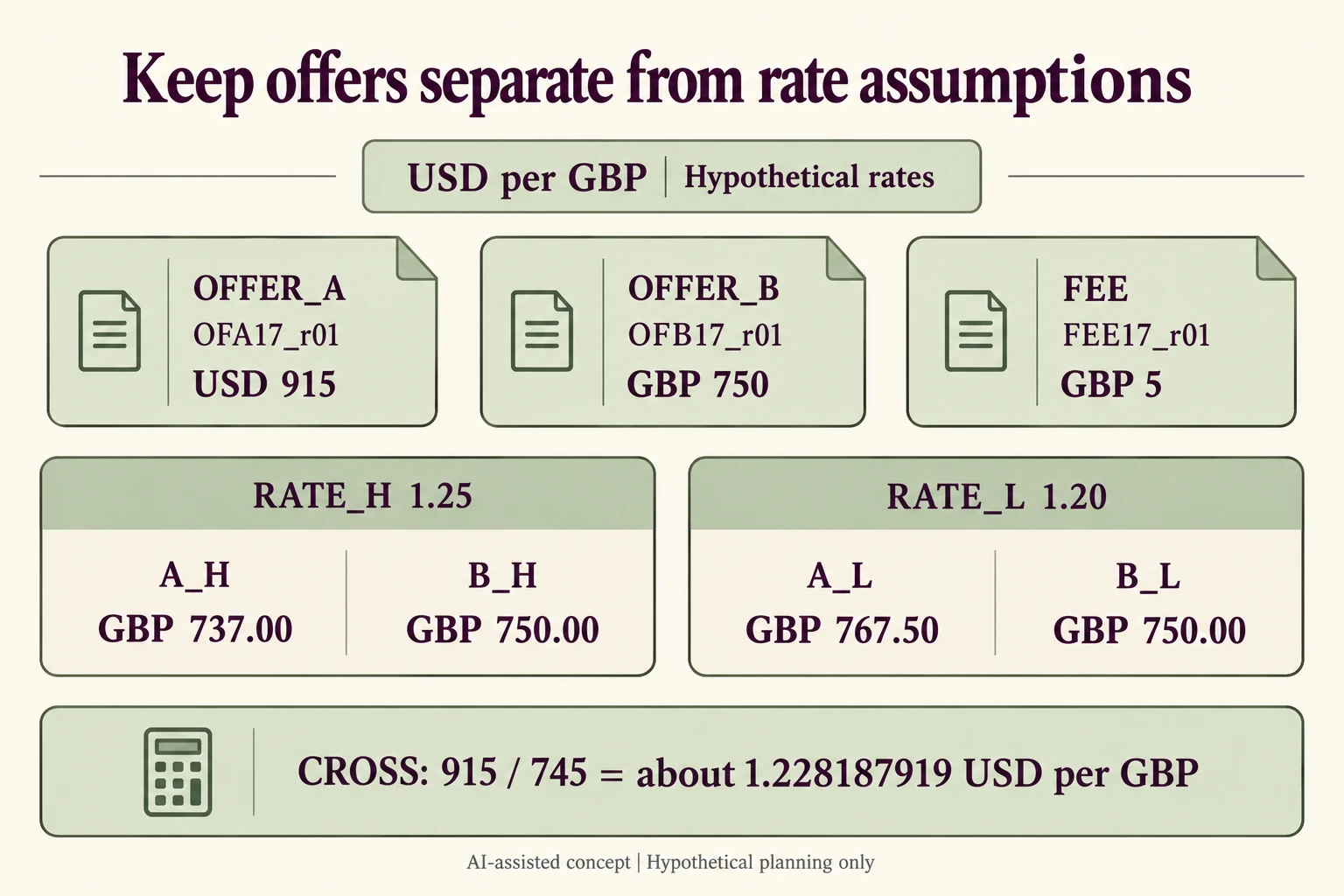
Scroll horizontally if columns extend beyond the view.
| Scope ID | Exact entity | Stage / role | Hypothetical basis |
|---|---|---|---|
| OFFER_A | OFA17_r01 | INPUT | Fictional original amount, unchanged |
| OFFER_B | OFB17_r01 | INPUT | Fictional original amount, unchanged |
| FEE | FEE17_r01 | INPUT | Assumed fixed fee once |
| RATE_H | RATEH17_r01 | INPUT | Invented rate, no source/payment date |
| RATE_L | RATEL17_r01 | INPUT | Invented rate, no source/payment date |
| A_H | OFA17_r01 | HIGH_RATE | 915 / 1.25 + 5 |
| B_H | OFB17_r01 | HIGH_RATE | 750 unchanged |
| A_L | OFA17_r01 | LOW_RATE | 915 / 1.20 + 5 |
| B_L | OFB17_r01 | LOW_RATE | 750 unchanged |
| CROSS | FXCOMPARE17_r01 | CALCULATION | 915 / (750 – 5) |
OFFER_A/OFFER_B remain original-currency inputs. RATE_H/RATE_L are independent assumptions, while A_H/B_H and A_L/B_L are separate converted comparisons. Divide the USD amount by USD per GBP and add the fixed GBP fee once: £737.00 at 1.25 and £767.50 at 1.20.
CROSS separately retains 915/(750−5), about 1.228187919 USD per GBP. It is algebra, not a forecast. All actual rate/payment evidence and dates stay empty. A later actual rate or offer needs its own evidence; this model gives no payment-timing or exchange recommendation.
Download the foreign currency packaging quotes record (.csv). HYPOTHETICAL rows are invented examples. Use ACTUAL_BLANK for permitted project inputs; replace that row label only when recording actual facts. Empty evidence, observation and date fields mean unknown or not performed, never acceptance. Keep checkpoints and revisions separate.
Bring the exact scope rows and unresolved evidence in a Packrivo enquiry. Replace planning inputs with actual authorised records before treating the scenario as an available arrangement. Prepare a Packrivo packaging enquiry. Packrivo coordinates independent suppliers. These records establish no supplier offer, service availability or MOQ exception; its published baseline is 500 pieces per product/design.