

Reconcile a numbered gift edition by number status as well as printed-piece count. A spoiled card and its replacement can carry the same intended number, but only the accepted current piece should enter the released gift. Counting all printed cards as completed gifts can hide duplicate numbers or gaps.
Numbering alone proves no real scarcity, authenticity or protection against copying. The brand must define the actual edition and its offered contents before using limited-edition wording.

Give the sequence an owner and a release event
Define the intended number range and the finished gift that receives each number. Record when a number becomes allocated and what evidence identifies its physical carrier. A number in an artwork file has not yet been released with a gift.
Distinguish an unprinted allocation from a printed card, a spoiled piece, an approved replacement and a completed released gift. Keep withdrawn pieces outside the current packing stock so their status remains visible.
The second-pass print review addresses adding variable information to a preprinted label. Its surface and device evidence does not decide which number a finished gift should receive.
Follow a hypothetical 100-number run
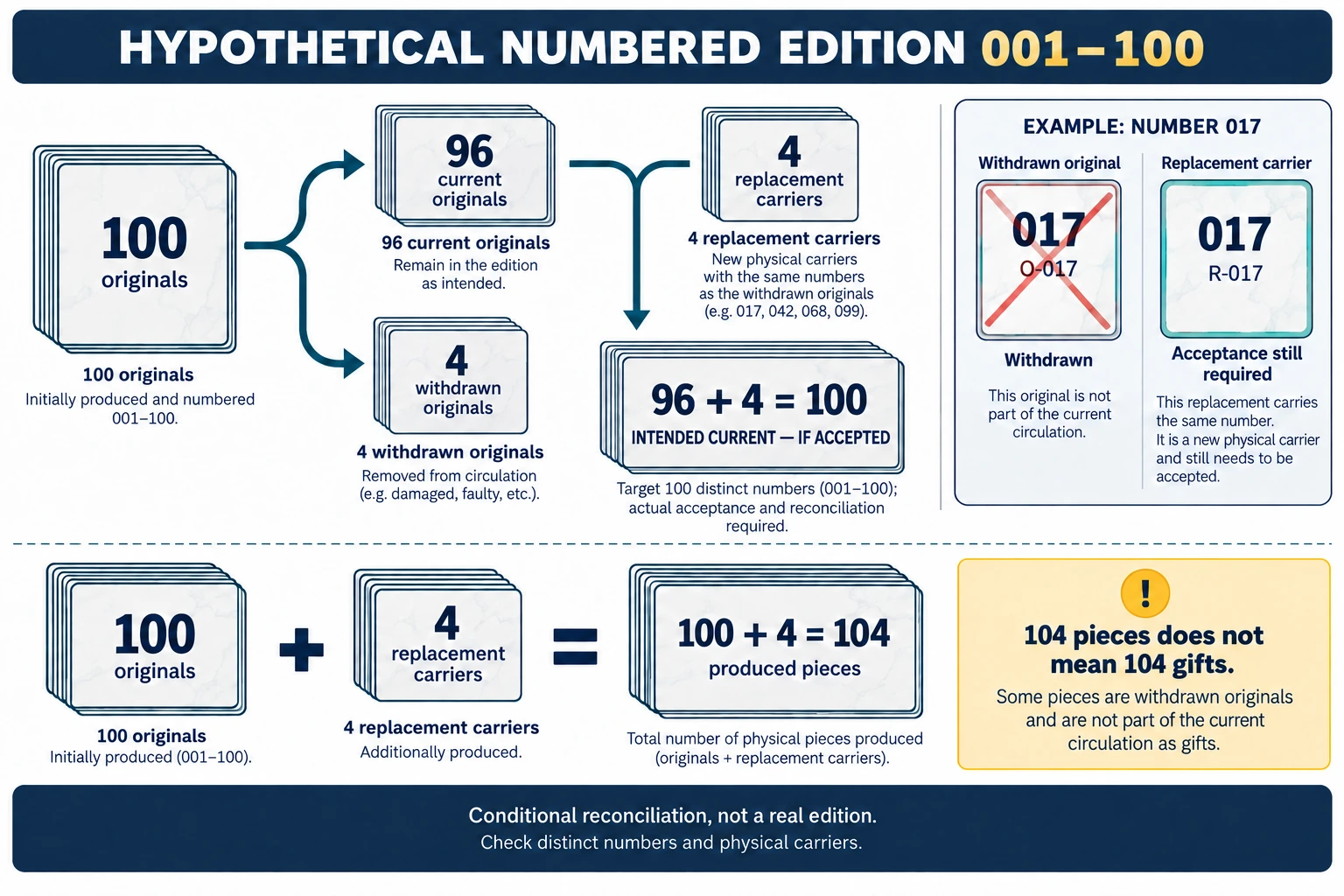
Assume a fictional edition intends numbers 001 through 100. Four cards are spoiled before release and need authorized replacements. No actual edition, print result or numbering system has been created.
Scroll horizontally if columns extend beyond the view.
| Sequence event | Physical pieces | Number-status consequence |
|---|---|---|
| Initial print | 100 cards | One intended carrier for each number |
| Four spoiled cards withdrawn | 4 pieces | Those carriers cannot enter current gifts |
| Same four numbers reprinted | 4 new cards | Replacement carriers need their own acceptance |
| Accepted current carriers | 96 originals plus 4 replacements | 100 distinct intended numbers, if reconciliation succeeds |
The history includes 104 produced pieces, but the intended released edition still contains 100 distinct numbers. Issuing new numbers 101 through 104 instead would change the declared sequence and leave a different decision for the brand.
Retain each spoiled number’s connection to its replacement. A general note saying “four cards reprinted” cannot show whether 017 was printed twice or 018 remained missing.
Match the number to the finished physical unit
At the release step, connect the accepted number carrier to its actual gift reference. Confirm that the number is readable in the intended position and that the associated contents match the offered edition.
If a gift is reopened or its card is replaced later, record the current carrier rather than silently creating another released example of the same number. A replacement is a controlled history event, not proof that the earlier piece has disappeared.
Official inventory guidance recommends accurate records of stock and its movements. The sequence states here are an original editorial method. They do not provide a GS1 allocation rule, a security specification or an automatic software feature.
Close both the count and the uniqueness question
Before release, reconcile the intended range, current accepted carriers, withdrawn pieces and any unassigned numbers. A correct total of 100 is insufficient if two carriers share a number and another number is missing.
Packrivo can help organize the print and component questions through a packaging project inquiry. Public business guidance was checked on 14 October 2026. This example establishes no real limited edition, print acceptance or anti-counterfeit outcome.
Find a duplicate even when the carrier count balances
For numbered gift packaging, reconcile identities as well as the 104-piece print history. In a wholly invented 001–100 edition, let the spoiled numbers be 017, 042, 068 and 099. Assign separate physical carrier identities to the originals and replacements so the same printed number cannot hide two current pieces.
Scroll horizontally if columns extend beyond the view.
| Intended number | Withdrawn original carrier | Proposed replacement carrier | Required current identity decision |
|---|---|---|---|
| 017 | O-017 | R-017 | One accepted current carrier only |
| 042 | O-042 | R-042 | One accepted current carrier only |
| 068 | O-068 | R-068 | One accepted current carrier only |
| 099 | O-099 | R-099 | One accepted current carrier only |
Assuming all four replacements receive acceptance, 96 originals+4 replacements=100 current carriers, while four withdrawn originals remain outside packing stock. A separate counterexample shows why the count is insufficient: a list containing 001–100 except 018, plus an extra 017, still has 100 entries but only 99 distinct numbers. It has a duplicate 017 and a gap 018 and must remain unresolved. Do not renumber a replacement as 101 simply to make a total agree. Retain the offered range, gift reference and physical carrier history together; this record is not a GS1 rule or anti-counterfeit system.
Download the numbered gift packaging record (.csv). Example rows are explicitly hypothetical. Use ACTUAL_BLANK for your own permitted project entries; replace that row label only when recording actual inputs. Blank evidence or observation fields mean unknown or not performed, never approval. Keep revisions and checkpoints separate.
Import the intended-number and carrier fields as text in a spreadsheet so identifiers such as 017 retain their leading zeros. Formatting a number does not check its uniqueness or establish a current physical carrier.
For a scoped packaging inquiry, send the intended number range, spoiled-to-replacement carrier log and the actual finished-gift matching step. Send the identified configuration and open questions to Packrivo. Quantities in this record are planning demand, not quoted purchase quantities, MOQ exceptions or confirmed service availability.
What this changes in a packaging enquiry
Separate the number of common packaging components from the controlled numbering on cards, labels or sleeves. Agree who issues replacements and withdraws spoiled numbered pieces before sending final artwork. A physical replacement count does not authorize a duplicate edition number. A relevant configuration to compare is the Informational insert card; it is a concept reference, not confirmed suitability.