

Plan packaging delivery appointments against the staff time and staging space available during the receiving window. Two shipments can each be manageable on their own yet create an unworkable overlap. Confirm the actual appointment arrangement rather than assuming a carrier will wait while the team finishes another receipt.
In this guide
Define the work covered by the receiving estimate: unloading, quantity identification, initial checks and movement to a stated location. Later batch acceptance can be a separate operation, but it still needs time and a suitable place in the actual process.

Use the same time window for work and availability
Record the receiving staff allocated to the proposed window and what other tasks they must perform. An employee scheduled to pack customer orders cannot simultaneously contribute all of those minutes to receiving.
The packaging delivery-state comparison identifies what arrives and who performs the remaining work. This receiving-day plan uses those facts to evaluate overlapping deliveries, not to choose flat or assembled supply again.
Keep estimated time distinct from an observed interval or confirmed capacity. A supplier’s carton count does not establish how quickly the buyer’s staff can unload or identify it.
Compare two hypothetical deliveries
Assume two incoming packaging shipments each need 45 employee minutes of defined receiving work. Both are proposed within one sixty-minute window, which has one available receiving employee. Each shipment also occupies ten cartons in staging, while the assumed area can accommodate only one such shipment. These are invented planning inputs.
Scroll horizontally if columns extend beyond the view.
| Constraint | Work or space requested | Available in the example | Unresolved gap |
|---|---|---|---|
| Employee time | 45 + 45 = 90 minutes | 60 minutes | 30 minutes before other work |
| Concurrent staging | 10 + 10 = 20 cartons | One ten-carton shipment | Another shipment’s stated envelope |
The staffing gap cannot be removed by relabeling both appointments “morning.” The staging gap also remains if the first shipment has not moved before the second arrives.
Adding another receiver might address nominal employee minutes while leaving the space problem unresolved. Separating confirmed appointment windows can change both constraints, but only if the first receipt’s required work and movement actually fit between them.
Preserve the handling and acceptance requirements
A receiving schedule must not remove needed checks simply to meet the slot. Keep unidentified or held material distinct and give the acceptance operation a named later point where necessary.
OSHA’s US warehousing guidance addresses clear handling routes, suitable storage and physical handling constraints. It does not supply a universal carton capacity, unloading time or approval for the hypothetical staging area.
Use the actual site, equipment and responsible safety assessment for handling arrangements. The time table supplies no load limit or lifting instruction.
Confirm an appointment the operation can execute
Return the shipment state, carton envelope, defined receiving work, available staff minutes and staging requirement. Name who confirms the delivery slot and what happens when arrival timing changes. Keep a requested appointment separate from an agreed commitment.
Where the provider cannot offer the preferred timing, compare a genuinely available alternative rather than assuming storage or labor can expand without limit.
Packrivo can help coordinate supplier shipment information through a packaging project inquiry. Actual appointments and warehouse operations remain with the responsible parties. Public guidance was checked on 14 October 2026; no real receipt or delivery capacity is reported.
Check labour and staging as separate release conditions
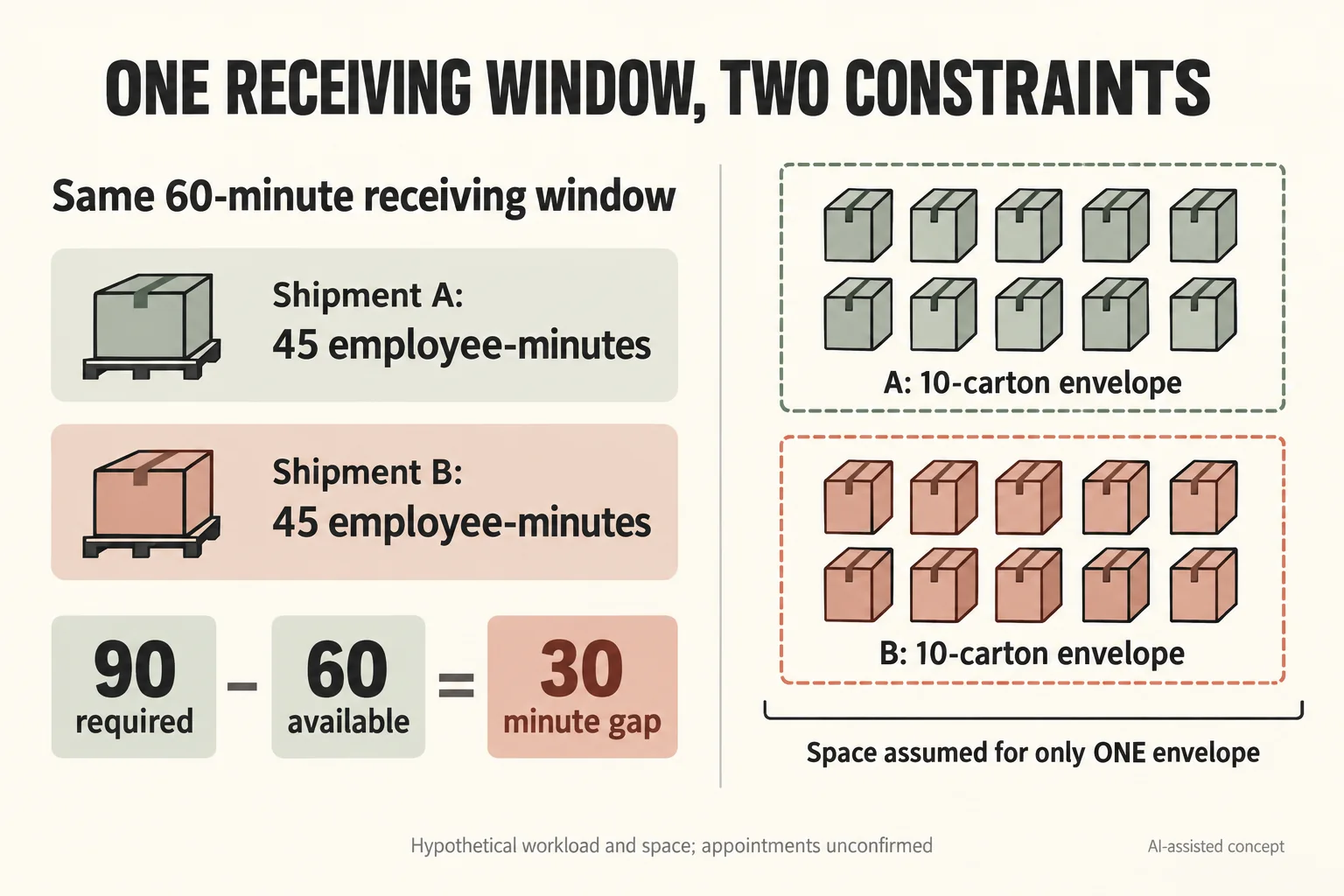
Keep the ninety employee-minutes in the same sixty-minute window as the staffing assumption. Moving one task to another person changes available labour, but does not move either shipment out of the staging area. A ten-carton envelope also needs actual dimensions and handling conditions before it can become a space record.
Scroll horizontally if columns extend beyond the view.
| Separate hypothetical option | Nominal employee-minutes in the window | Staging question | Decision boundary |
|---|---|---|---|
| Original overlap; one allocated employee | 90 required versus 60 allocated | Two envelopes versus space for one | Both gaps unresolved |
| Two genuinely allocated employees | 90 required versus 120 allocated | Still two envelopes versus one | Nominal labour arithmetic alone does not release the plan |
| Separate agreed windows | 45 required within each 60-minute window | First shipment moved before the second arrives | Confirm movement and appointments; do not assume carrier waiting |
These options are invented comparisons, not staffing instructions or confirmed appointments. A second employee must actually be allocated and able to perform the relevant tasks. For separate windows, record where the first shipment goes after staging and who completes that move; simply changing a calendar entry does not establish free space.
Send the delivered state, carton envelope, task boundary and appointment request together. Ask the receiving owner which assumptions are accepted, which are estimated and who confirms a changed arrival. Retain a requested slot as a request until the actual arrangement is agreed.
The flat or assembled handover comparison determines remaining work; the receiving acceptance record determines the later goods disposition. This capacity sheet assigns time and space to those operations without reducing their required scope.
Download the packaging delivery scheduling record (.csv). This file contains field definitions, clearly fictional teaching entries and a blank actual-project row. Keep unknown evidence open rather than copying the example as an approval.
Bring the specific open question to the project brief
For a delivery-capacity question, include the same arrival window, task-time basis, actual staffing allocation and measured staging envelope; identify who can confirm the slot. Send the current configuration, actual records available, quantity by design, destination and the unresolved question through Packrivo’s packaging inquiry. Packrivo coordinates sourcing and project questions with independent suppliers; the responsible parties confirm materials, service, methods and commercial terms.
What this changes in a packaging enquiry
Request the delivery format, carton count and handling scope before comparing packaging delivery appointments. Use the actual staff and staging limits to decide whether a split delivery is useful. An assumed labour-minute total does not establish unloading capability or a feasible appointment.