

Agree the units and common-cost allocation before combining an identical packaging purchase for two independent buyers. Separate each party’s stock, variable cost, fixed charges and brand-specific extras. The total order may remain unchanged while a different allocation rule materially changes what each party pays.
The arrangement needs actual supplier and contracting approval. This calculation does not create a joint-buying service, permission to pool custom designs or an exception to any supplier’s quantity requirements.

Keep the shared component genuinely identical
Name the exact blank or otherwise identical component proposed for the joint purchase. Different logos, print files, dimensions, inserts or finishes may create distinct supply lines even if the two brands call them the same box.
The same-scope quotation comparison helps establish the offered component and included work. Agree that scope before splitting charges; an allocation of an incomplete total remains incomplete.
Identify the contracting buyer, payment responsibility and actual stock handover. Cost shares alone cannot establish legal ownership, rights to artwork or an entitlement to supplier remedies. Those come from the real agreement and relevant advice.
Compare two hypothetical fixed-cost rules
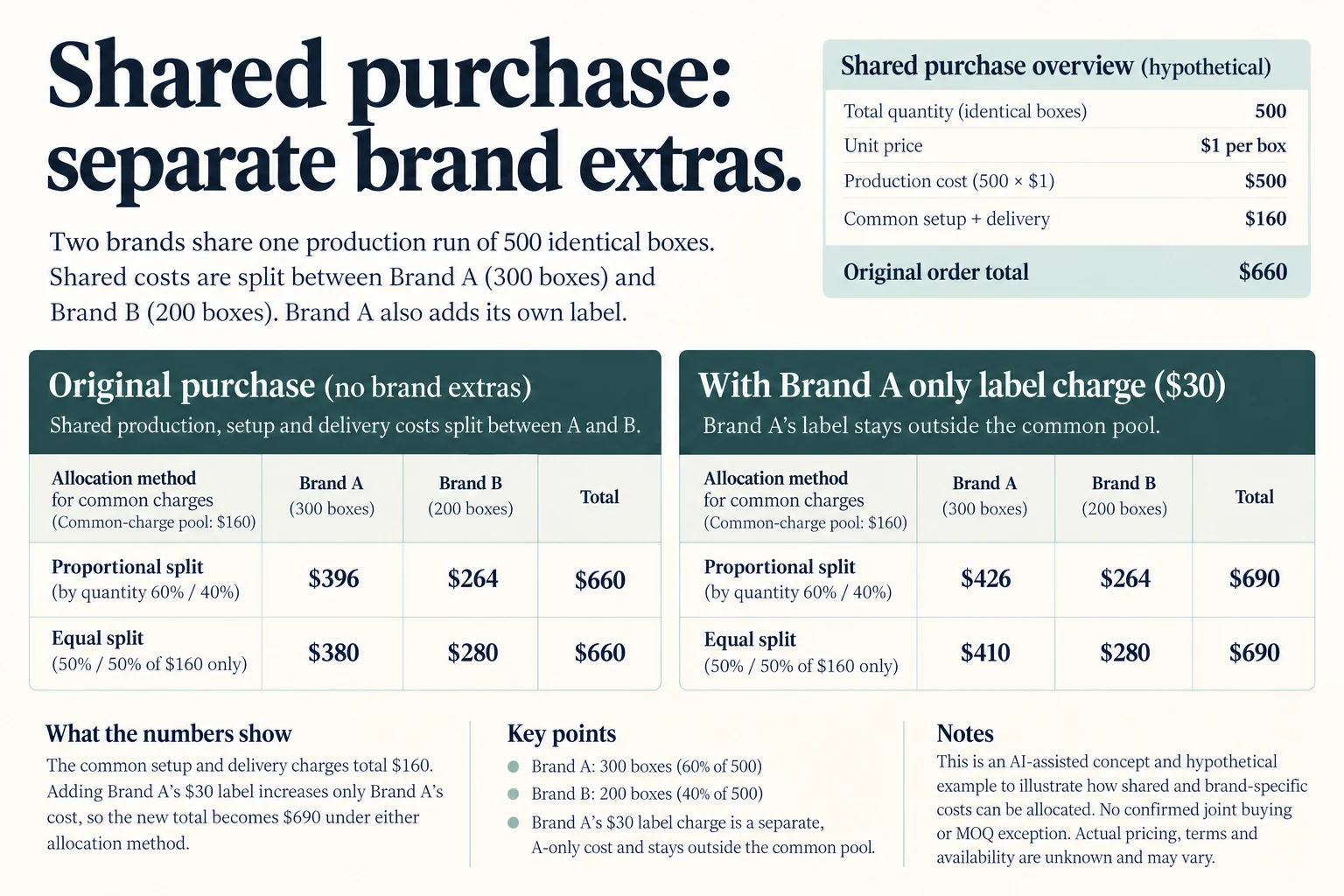
Assume an authorized joint proposal contains 500 identical blank boxes at an invented $1 each, plus $100 common setup and $60 common delivery. Buyer A receives 300 boxes; Buyer B receives 200. The order total is $660.
Scroll horizontally if columns extend beyond the view.
| Allocation method | Buyer A: boxes plus common charges | Buyer B: boxes plus common charges | Combined total |
|---|---|---|---|
| Common charges split 60/40 with unit quantities | $300 + $96 = $396 | $200 + $64 = $264 | $660 |
| Common charges split equally | $300 + $80 = $380 | $200 + $80 = $280 | $660 |
The total does not change, but A pays $16 less and B pays $16 more under the equal fixed-charge split. Neither rule is inherently the agreement. The parties must decide which basis matches their actual arrangement before relying on the shares.
If a brand-specific label or special packing step is added for A, identify that charge separately. It should not quietly enter the shared setup line unless both parties have actually accepted that allocation.
Reconcile cost, units and payment timing
Confirm that the two unit shares sum to 500 and that their allocated charges sum to the actual offer total. Keep taxes, payment fees, split delivery or other unresolved inclusions outside a confirmed comparison until their scope is known.
Record when each party owes its share and who pays the supplier. An earlier payment by one buyer can create another reimbursement or cash-timing question even where the final cost allocation is equal.
Official cash-flow guidance supports separating actual and estimated money movements. It does not determine joint-purchase accounting or ownership. All prices and allocation terms in this example are invented.
Return one order record and separate buyer shares
Retain the supplier proposal unchanged, then attach the agreed unit, cost and handover allocation. Record each amendment so a changed delivery or quantity does not leave old shares attached to a new order.
Packrivo can coordinate the component and supplier questions through a packaging project inquiry. Public business guidance was checked on 14 October 2026. No pooled order, commercial permission, legal arrangement or actual saving is established here.
Keep a buyer-specific extra outside the common charge
Add an invented $30 label line for Buyer A only to the original 500-box scenario. The component shares remain 300 for A and 200 for B, with $160 common setup and delivery. This new line changes the order total, not the agreed unit ownership.
Scroll horizontally if columns extend beyond the view.
| Scenario scope | Exact object or route | Hypothetical input or output | Calculation or record boundary |
|---|---|---|---|
| A only extra | BUYER_A19 | 30 USD | New fictional extra charged only to A |
| Proportional plus a extra | BUYER_A19 | 426 USD | 396+30 |
| Proportional unchanged | BUYER_B19 | 264 USD | 264 unchanged |
| Equal plus a extra | BUYER_A19 | 410 USD | 380+30 |
| Equal unchanged | BUYER_B19 | 280 USD | 280 unchanged |
| With a only extra | ORDER19 | 690 USD | 660+30; both methods sum to690 |
With proportional common charges, A becomes $426 and B stays $264. With equal common charges, A becomes $410 and B stays $280. Both add to $690. Mixing the A-only $30 into the common pool would charge part of that extra to B and answer a different allocation question.
The worksheet keeps each buyer’s due amount, supplier payment and stock handover separate. Neither the arithmetic nor an assumed supplier authorization creates a joint-buying service, contractual right, permission to pool designs or a minimum-quantity exception. Keep the original supplier offer and add amendments as new versions.
Download the shared packaging purchase costs record (.csv). It covers the original scenarios and this added comparison. HYPOTHETICAL rows are invented planning examples. Actual quantity, value, configuration, method, owner, observation, condition, decision, evidence and dates are blank because no actual project record has been obtained. Copy a relevant row and replace its type with ACTUAL only when entering permitted project evidence; keep the example and actual record separate. ACTUAL_BLANK is an empty starting row. A blank is unknown, never approval.
The related Custom Packaging Quote Comparison Checklist guide concerns a separate requirement. Use this record for the specific comparison above rather than treating that guide as evidence of a completed result.
Keep amendments attached to their own supplier response with the changed-scope quote record. Keep physical ownership separate from uncommitted availability using the shared-stock reservation distinction.
Source scope checked 16 October 2026: the original public references remain within their stated general guidance or manufacturer-example scope. The new numbers and task records are original hypothetical analysis, not observed supply, trials, inventory, prices or performance.
What this changes in a packaging enquiry
Before combining a packaging purchase, confirm that the component, artwork, material and accepted configuration are genuinely identical for both buyers. Obtain the actual common charges and allocation agreement separately. Sharing a nominal size or a total quantity does not establish one production design or a lower combined MOQ.
Discuss this packaging specification with Packrivo. We coordinate independent suppliers. MOQ: 500 pieces per product/design; illustrative quantities are not production offers. Confirm materials, samples, price and timing for your project.