

Compare custom packaging quotations after aligning the complete configuration, priced unit, included work and delivery scope. Then calculate totals for the same requirement. A lower per-box figure can cover fewer components or leave assembly and freight outside the amount you're comparing.
View the full-size planning illustration
Start with the purchase you actually need, not the cheapest line on a proposal. A useful comparison shows what one completed set contains, which design quantities are required and what each supplier still needs to clarify.
Give every supplier one common requirement
Identify the selected structure, current drawing, material proposal, decoration and complete contents. Include the insert, sleeve, cards and wrap where required. Keep the original supplier wording beside any summary so a missing grade or unclear dimension remains visible.
Record the quantity per design and the finished unit you want. A supplier offering an alternative can still be considered, but the changed fields should be labeled. Different structures or different artwork versions should not disappear inside adjacent price columns.
A folding carton and a mailer with fitted insert can involve different components and packing work. Confirm which configuration each quotation describes before using either as a comparison baseline.
Australian Government quote guidance describes a written quotation in terms of goods or services, price and terms. Apply that scope discipline here without assuming the guidance determines the legal effect of your particular overseas purchase.
Build a component matrix before converting units
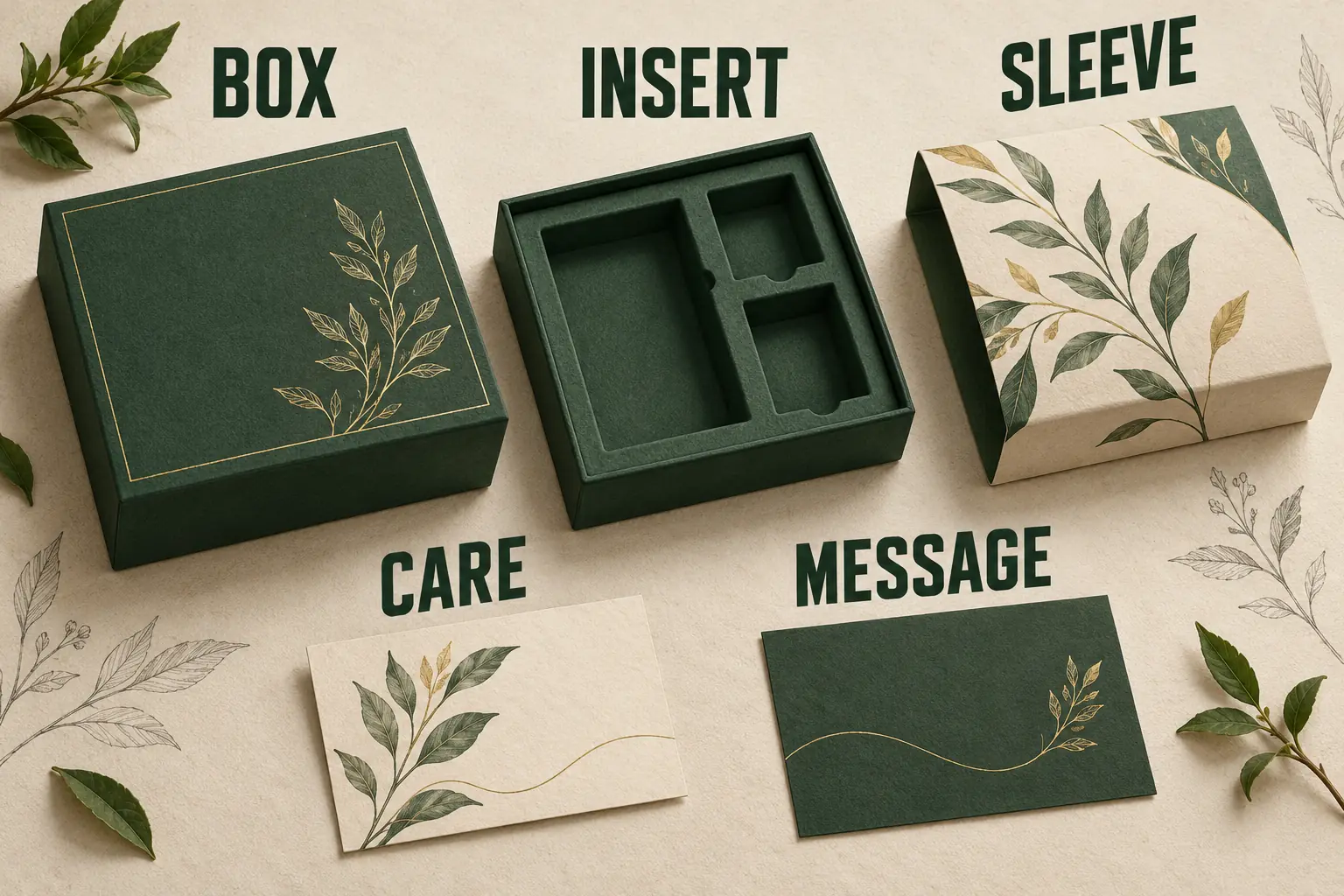
Write one sentence defining a completed set. Give each physical component its own line, version and units per set. Two different cards remain two designs even when a supplier combines their total piece count.
Scroll horizontally if columns extend beyond the view.
| Required line | Units per completed set | What each offer must state |
|---|---|---|
| Outer box | Defined box quantity | Structure, drawing, design and supplied state |
| Insert | Defined holder quantity | Included configuration and material proposal |
| Sleeve | Defined sleeve quantity | Finished size, artwork and delivery state |
| Care card | Its own per-set quantity | Copy/design revision and printed sides |
| Message card | Its own per-set quantity | Separate artwork and required quantity |
| Assembly | Defined operation | Included steps, owner and price basis |
Add columns for each offer and mark every line included, excluded or unanswered. Assembly is work, not another component piece. A price for separate pieces can be useful, but it isn't the same handover as a price for an assembled set.
Planning quantity example: 500 sets each containing one box, one insert, one sleeve and two different cards require 500 pieces of each of those five designs. The result is 2,500 component pieces for 500 sets. Combining the cards into a 1,000-piece total would hide their separate design quantities.
That arithmetic establishes a recipe only. It doesn't confirm stock, a supplier's accepted design grouping or an exception to Packrivo's MOQ policy of 500 pieces per design. Keep proposed purchasing quantities and actual supplier conditions separate from set consumption.
An offer containing only the box and insert covers two lines of the five-component requirement. An offer adding the sleeve covers three, while both card designs remain separate gaps. Their piece totals should not be presented as complete-set quantities. Ask each source to identify the missing designs and whether inserting them changes the assembly scope before calculating a revised total.
Attach each charge to what it includes
Record whether the quoted amount is per component, per set, per carton or for the whole order. State the currency and quantity beside it. Convert the offer to the defined requirement without replacing its original priced unit.
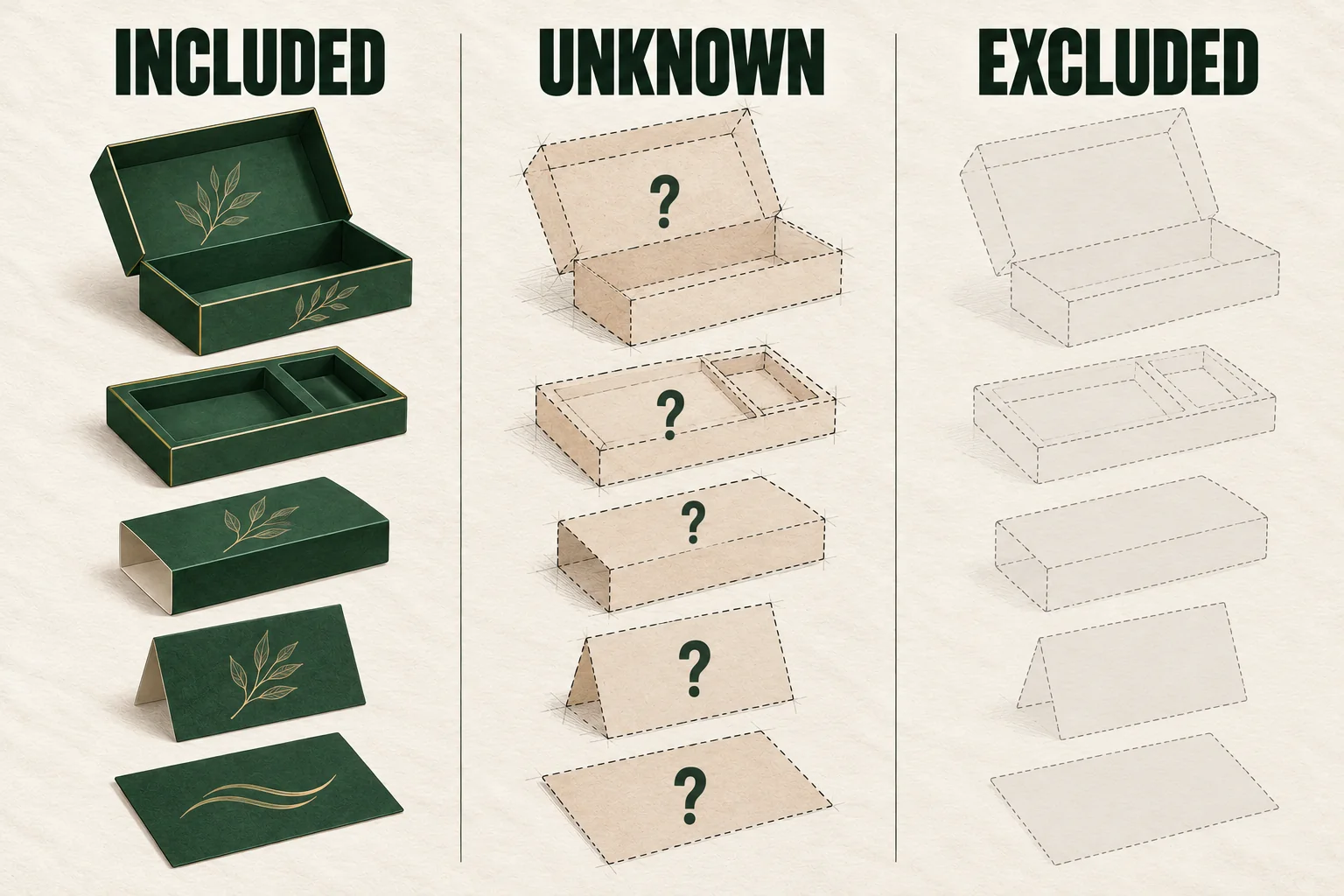
Keep sample, tooling, artwork preparation, print setup and assembly as separate questions. A line may already include one of them, so adding it again would double-count. An unanswered inclusion should remain unknown rather than becoming a zero charge.
Identify the assembly finish point. Forming the box, fitting an insert and loading the product are distinct tasks. If one supplier completes only the first, its assembly figure cannot be compared with a service that finishes all three without an adjustment in scope.
Mark each offer comparable, revision needed or scope unknown. A known missing sleeve calls for a revision. An unspecified insert inclusion calls for clarification. Those states tell the buyer which calculation can be trusted and which needs another answer.
Use a bounded cost example before ranking totals
Planning example: assume two arrangements meet the same five-component, 500-set requirement and include the same assembly. All values below are exercise inputs, not market prices, received quotations or a customer project. Freight, taxes and duties have no supplied amounts.
Scroll horizontally if columns extend beyond the view.
| Cost line | Planning arrangement A | Planning arrangement B |
|---|---|---|
| Recurring packaging | USD3.00 per complete assembled set | Box1.50 + insert0.50 + sleeve0.30 + care card0.10 + message card0.10 + assembly0.20, all USD per set |
| Quantity | 500 sets | 500 sets |
| Recurring subtotal | USD1,500 | USD1,350 |
| Separate setup | USD80 | USD130 |
| Known packaging subtotal | USD1,580 | USD1,480 |
| Outside this subtotal | Freight, taxes and duties unknown | Same fields unknown |
B's recurring sum is USD2.70 per set. Adding setup once gives USD1,480, which is USD100 below A's known packaging subtotal, or USD0.20 per set. That is a comparison of these stated inputs, not a saving observed in a purchase.
The calculation cannot identify the lower delivered cost while the excluded amounts remain unknown. It also cannot survive a hidden material change. Keep the configuration and inclusions attached to the arithmetic so a later reply changes the correct row.
Close delivery and commercial differences explicitly
Write the proposed trade rule, version and named place beside each offer. US International Trade Administration guidance explains that Incoterms allocate specified delivery tasks, costs and risks; they don't identify the goods or list the contract price. A three-letter term doesn't replace your component matrix.
Request the relevant carton count, packed dimensions, weights and supplied state for freight discussions. Flat and assembled deliveries can transfer work differently. Preserve those differences before comparing their delivery amounts or assuming either is cheaper.
Keep quoted currency separate from any planning conversion. If you convert for comparison, record the rate direction, source and date without rewriting the original offer. Payment conditions, validity and sample timing also need their own actual answers.
Return a comparison or a focused clarification request
Retain the dated offers and ask each source to resolve its own missing fields. Don't borrow an inclusion or material description from another supplier to complete a blank. A comparable result should show the same requirement with traceable differences and known exclusions.
Use the first supplier brief when the underlying contents or dimensions still need work. Once that baseline is defined, send the component matrix, original priced units and the few open cost questions through a packaging quote inquiry.