
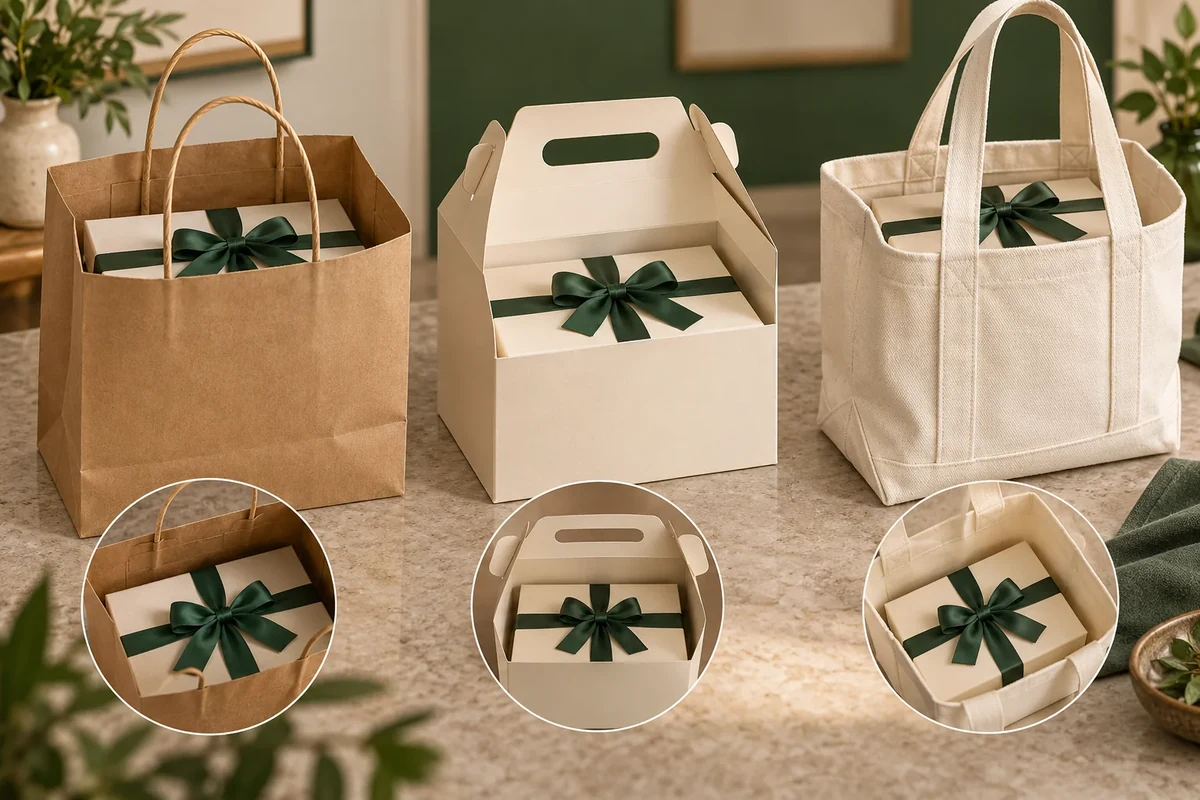
Compare a gift carrier through the same complete boxed gift and the handoff action, then record each structure’s different acceptance questions. A paper bag, integral-handle carton and box-bottom fabric tote need different opening, base and handle evidence. Keep those observations together instead of repeating a generic load-and-lift sequence.
Keep the contents fixed across carrier proposals
Name the actual gift box, tissue, card and decoration being handed to the customer. Record the finished envelope and complete packed mass as inputs. Use that same arrangement when comparing carrier forms so a changed ribbon or smaller box does not disappear into the result.
The original carton carrier reference identifies an integral-handle construction. It supports the structural category, while the offered gable or other integral-handle drawing defines its actual head folds and grip. The fabric-maker tote pattern illustrates boxed-corner base formation and handle attachment as a different construction.
The carrier label alone should not decide acceptance. Mark the actual bag anchor, integral handle panel or fabric seam that receives the relevant action. Keep any carrying suitability or loading limit as an offered project question requiring its own evidence.
Use structure-specific checks during handoff
For a paper bag, locate its usable mouth, base and attached handle anchors. For a gable or integral-handle carton, identify the formed head/handle panels and base setup. For a box-bottom tote, locate the boxed seams, lining and handle attachment relative to the gift.
Review how the complete box enters and rests in each form before the handoff. Then record the actual grip, lifting/set-down action and customer access under the agreed conditions. Keep an observed mouth snag or inaccessible handle linked to the structure and state where it occurs.
If the gift arrangement must change for a carrier, record that as a different packout rather than declaring the two proposals equivalent. The buyer should be able to see whether it is the carrier, contents or handoff sequence that changed.
Use a cross-carrier acceptance matrix
This original Packrivo comparison uses one hypothetical boxed gift. It does not assign carrying ratings.
| Same-gift check | Paper bag proposal | Gable/integral handle | Box-bottom tote |
|---|---|---|---|
| Loading opening | Usable mouth beside handle anchors | Head panels open before handle formation | Mouth and handle route around box corners |
| Base seating | Offered bag base and gift footprint | Offered carton base setup | Boxed seams and formed base envelope |
| Grip | Attached handle position | Integral aperture and panel overlap | Handle drop and attachment route |
| Filled handoff | Located anchor/base observations | Located handle/base observations | Located seam/lining observations |
| Customer access | Gift box removal from bag | Head/handle opening route | Box lift through usable mouth |
| Next evidence | Bag maker and packing owner | Carton converter and packing owner | Fabric converter and packing owner |
Make the comparison lead to a specific next sample
Imagine the same candle gift fits the base of all three carriers, but its ribbon catches at one loading mouth. Keep the base-fit observation and the mouth issue separate. Ask the relevant converter for a located opening proposal instead of changing every carrier dimension at once.
The next sample should retain the boxed gift and its decoration, or explicitly name the changed contents. The buyer can then choose which access route to develop and which interface needs more evidence. A broad impression that one carrier looks premium does not resolve a snag at a named corner.
Link the structures to the actual handoff record
Use the existing gift bag and tissue checklist for the shared contents and handoff brief. Compare the gable-top handle box and the box-bottom fabric tote through their own construction fields.
The buyer supplies the fixed contents and intended use. Each converter supplies its drawing and supplied state. The packing owner returns the actual loading/handoff evidence, and the buyer records the chosen route and remaining sample question.
Bring the completed comparison and located access questions to your packaging brief. MOQ is 500 pieces per design; materials, carrying review, samples and commercial terms are confirmed for the project.
Keep a changed gift separate from the carrier comparison
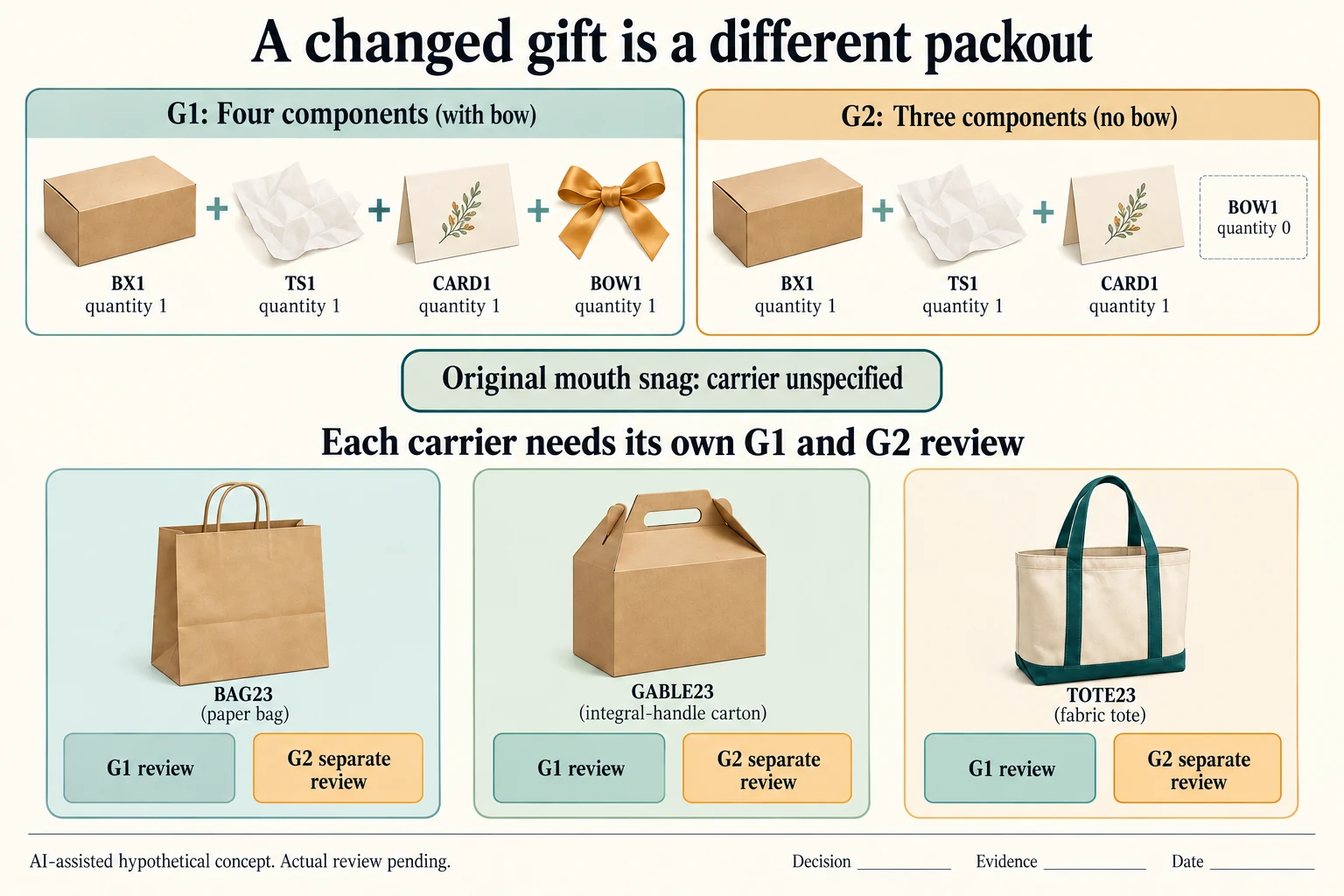
Create an invented G1 contents identity with one BX1 box, one TS1 tissue sheet, one CARD1 and one BOW1. Compare BAG23, GABLE23 and TOTE23 against that same G1. A separate G2 proposal contains the same box, tissue and card but zero bows. These are illustrative component quantities, not a bundle offer or a recommendation to omit decoration. The CSV gives G1 and G2 their own component rows and links each carrier configuration to the appropriate contents identity.
Scroll horizontally if columns extend beyond the view.
| Hypothetical configuration | Named object | Relationship | Input or next scope |
|---|---|---|---|
| G1 | BOW1 | required component | GIFT; 1 pieces |
| G2 | BOW1 | required component | GIFT; 0 pieces |
| G1_BAG23 | BAG23 | uses contents | G1 |
| G1_GABLE23 | GABLE23 | uses contents | G1 |
| G1_TOTE23 | TOTE23 | uses contents | G1 |
| G2_BAG23 | BAG23 | uses contents | G2 |
| G2_GABLE23 | GABLE23 | uses contents | G2 |
| G2_TOTE23 | TOTE23 | uses contents | G2 |
G2 is useful as a deliberately changed packout. If a bow omission makes an entry demonstration look easier, it cannot close the G1 loading question. Carry both identities into the next sample request and ask whether the project actually permits that contents change. The original hypothetical snag was at one unspecified carrier mouth; this extension does not assign that finding to the paper bag, carton or tote.
Each of the six carrier/contents combinations has independent entry, base, grip, handoff and customer-removal scopes. The same number of contents does not create the same carrier construction. Paper handle anchors, an integral carton head and a fabric boxed seam need their own offered drawing and supplied state. Actual packed mass, component identities, observed actions and acceptance remain blank.
The Henry Glass pattern (©2018 copyright notice; publication date unconfirmed) supplies a specific sewing example of boxed corners, lining and attached straps. It is not an industrial tote specification or carrying qualification. The carton catalogue supplies a carrier category, not the actual gable drawing. Use those references to locate questions; select the next sample only after the relevant converter and packing owner identify the actual complete configuration.
Download the gift carrier fixed contents comparison record (.csv). It includes the original table fields and scenarios alongside the added relationships. HYPOTHETICAL rows are editorial examples or required review scopes, not actual records. Actual quantity, configuration, component and file identities, materials, process, specification, copy, method, condition, observation, owner, decision, evidence and dates are blank. ACTUAL_BLANK is a separate empty starting row; enter permitted project evidence before using an actual record. A blank means unknown.
Use the Tissue and Gift Bag Set: A Buyer Specification Checklist for its separate question. Use the A Gift Bag’s Load Position Changes How It Hangs from Its Handles for its separate question. Use the Define Flat and Assembled Packaging Delivery Scope for its separate question.
References apply to the materials, processes or guidance named in each source. Worked configurations and dimensions are teaching examples, not tested specifications or production limits. Use the project’s material specification, drawing and formed sample for approval.
Discuss this packaging specification with Packrivo. We coordinate independent suppliers. MOQ: 500 pieces per product/design; illustrative quantities are not production offers. Confirm materials, samples, price and timing for your project.