

Review the path a gift-box corner takes through the bag opening, not only its final fit at the base. Record the usable mouth, handle route, box projections and loading orientation together. A transient snag during insertion should become a located opening question rather than another generic bag-size request.
Separate the loading envelope from the seated gift
The original boxed-base tote construction pattern illustrates a formed base and separate handle attachment. The fabric converter leaflet identifies fastening and handle options. These support construction vocabulary, not a universal clearance formula for loading a box.
Provide the finished gift box with ribbon, primary wrap and card projections included. Record its corners and widest local features, then identify the bag’s usable mouth and any handle, channel or seam that occupies that space.
Draw the intended entry orientation. The box may be inserted straight, rotated through a named action or loaded before another component is positioned. Keep that action separate from its final resting position so the converter can answer the actual mouth question.
Locate contact during the entry movement
Use the actual bag and complete boxed gift for the review. Pause at the point where a corner approaches the mouth, seam or handle. Photograph the contact location and record whether staff change the angle, move the handle or adjust a decoration.
Treat that adjustment as a proposal or observed packing action with an owner. The buyer may accept it as the intended sequence, or ask for another opening/handle arrangement. Keep it visible instead of hiding the change behind a photograph of the gift already seated at the base.
Review the removal route as well. A box that enters through one angle may need a different grip after the bag is fully packed. Record any inaccessible corner or handle obstruction at that stage without assuming the insertion observation settles customer access.
Use a corner-path loading record
This original Packrivo worksheet uses a hypothetical candle gift with a projecting bow.
| Loading field | Illustrative entry | Next question |
|---|---|---|
| Gift envelope | Finished box BX1 including bow R1 | Which local projection enters first? |
| Usable mouth | Actual opening and handle positions | Where is the narrow or obstructed area? |
| Entry orientation | Packing owner’s intended direction/rotation | Is this the agreed loading sequence? |
| Corner contact | Rear corner C1 beside seam S1 | Request a located opening or seam proposal |
| Seated result | Box and tissue at the formed base | Keep final base fit separate |
| Removal | Customer grip with handles in final position | Review actual access before acceptance |
Compare an illustrative base-fit and entry issue
Imagine a tote whose formed base accepts the box, while the bow catches at a handle during entry. Increasing the base dimensions alone would not describe the located issue. Send the mouth/handle view and the complete gift envelope to the converter.
The response might change the opening, handle location or agreed loading action. Retain the earlier sequence and compare the revised sample with the same box and bow. The buyer can then decide the next arrangement from visible evidence rather than inferring bag fit from a flat width.
Send the mouth question with the contents state
The existing gift bag and tissue method handles the broader static contents and carrier plan. Compare the box-bottom fabric tote through its formed base and handle fields when that structure is proposed.
The buyer supplies the finished gift. The converter identifies the opening and construction proposal. The packing owner records the actual entry action, and the buyer accepts that route or requests a specific change. Keep the final sample and decision tied to the same contents state.
Bring the corner-path record and unresolved mouth/handle question to the packaging brief. MOQ is 500 pieces per design; materials, sample scope and commercial details are confirmed for the project.
A new loading sequence needs its own complete-gift exit review
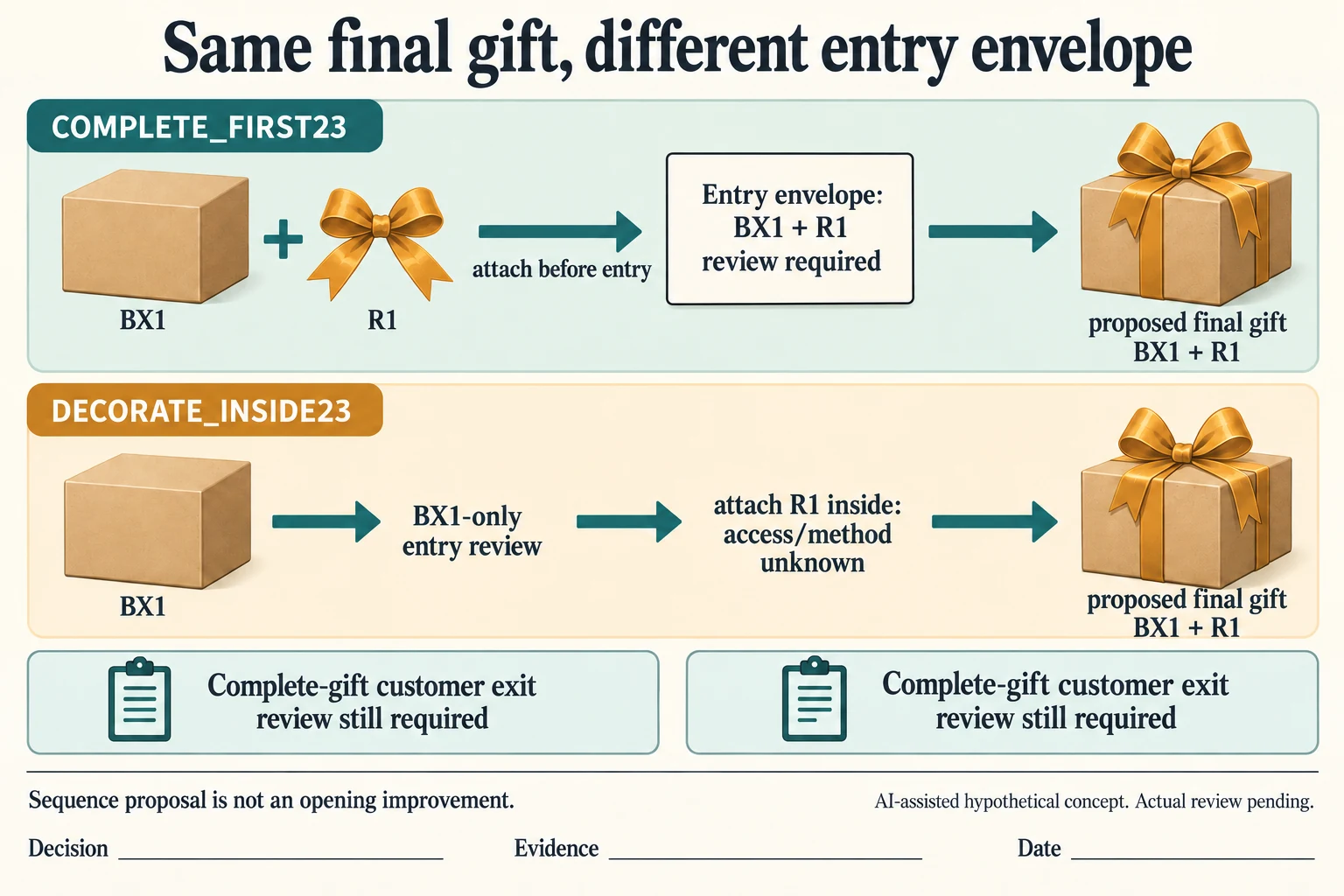
Keep final gift BX1 plus bow R1 fixed, then distinguish two invented sequence candidates. COMPLETE_FIRST23 proposes attaching the bow before the complete gift enters. DECORATE_INSIDE23 proposes entering BX1 alone and attaching R1 inside afterward. No attachment method, inside access or feasibility has been confirmed. The alternative is a question for the actual packing owner, not an instruction to reach into an unsuitable carrier.
Scroll horizontally if columns extend beyond the view.
| Hypothetical configuration | Named object | Relationship | Input or next scope |
|---|---|---|---|
| COMPLETE_FIRST23 | ENTRY_ENVELOPE | uses contents | BX1_PLUS_R1 |
| COMPLETE_FIRST23 | R1 | attachment stage | BEFORE_ENTRY |
| COMPLETE_FIRST23 | BX1_R1 | requires | COMPLETE_GIFT_EXIT |
| DECORATE_INSIDE23 | ENTRY_ENVELOPE | uses contents | BX1_ONLY |
| DECORATE_INSIDE23 | R1 | attachment stage | INSIDE_BAG_AFTER_ENTRY |
| DECORATE_INSIDE23 | BX1_R1 | requires | COMPLETE_GIFT_EXIT |
The CSV records one box and one bow in the final gift for both candidates, but different entry envelopes and bow-attachment stages. DECORATE_INSIDE23 also creates an inside-decoration access and method requirement. Its entry view cannot be used as evidence that the complete BX1/R1 envelope fits through the mouth. The proposed sequence has changed work rather than demonstrated an improved bag opening.
For both candidates, retain independent corner-path, handle-position, seated-state, final-bow-condition and complete-gift-exit scopes. The customer encounters the completed gift, even if staff inserted an undecorated box. A final bow can therefore reintroduce the original mouth or handle question during removal. Review the actual customer grip and final handle position rather than assuming loading and exit are interchangeable.
Use C1 and S1 to locate a corner/seam concern and record any rotation or temporary handle movement. If the converter instead proposes a new mouth or handle location, name the revised construction and compare it with the same contents and declared sequence. Actual geometry, conditions, observations and route acceptance remain blank; no clearance allowance follows from the tote pattern or fabric-options leaflet.
Download the gift bag loading sequence comparison record (.csv). It includes the original table fields and scenarios alongside the added relationships. HYPOTHETICAL rows are editorial examples or required review scopes, not actual records. Actual quantity, configuration, component and file identities, materials, process, specification, copy, method, condition, observation, owner, decision, evidence and dates are blank. ACTUAL_BLANK is a separate empty starting row; enter permitted project evidence before using an actual record. A blank means unknown.
Use the Tissue and Gift Bag Set: A Buyer Specification Checklist for its separate question. Use the A Gift Bag’s Load Position Changes How It Hangs from Its Handles for its separate question. Use the Packaging Sample Revisions: Compare Versions Before Approval for its separate question.
Source scope checked 16 October 2026. References cover only the named materials, processes or guidance. Added configurations and geometry are hypothetical, not supplier specifications, tests or production approval; they set no universal tolerances or machine limits. Confirm the actual material, process, drawing and formed sample for the project.
Discuss this packaging specification with Packrivo. We coordinate independent suppliers. MOQ: 500 pieces per product/design; illustrative quantities are not production offers. Confirm materials, samples, price and timing for your project.