
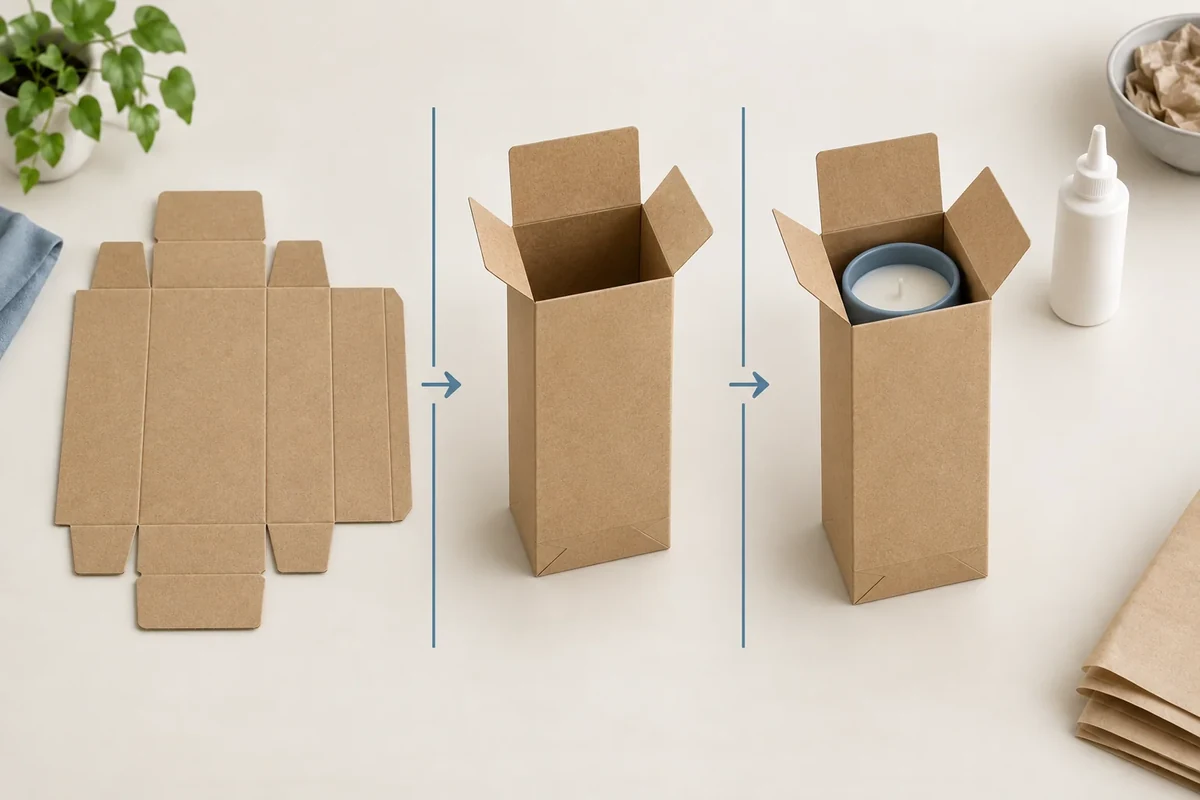
Match a seal-end carton to the actual packing process before comparing proposals. Name who loads the product, who completes each seal and which equipment and consumables are available. A quotation for an empty carton does not settle the joining work required to create the packed unit.
The useful output is an operation sheet with separate sample and production scopes. It keeps the technical sealing question visible before it becomes an assumed responsibility.
Assign work to the actual packing location
The seal-end reference warns about glue-equipment needs for large-volume assembly in its own proposal context. Use that warning to ask process questions. It doesn’t identify the machine, method or capability at your packing location.
Record the location and responsible role for forming, loading and sealing. If another party performs part of the work, keep that handoff explicit. Unknown equipment should remain a question rather than a guessed capacity.
For a full-overlap seal-end carton, keep flap coverage and sealing surfaces in the structural drawing. This sheet records who uses that proposal and how.
Separate appearance samples from process evidence
Ask what method creates the proposed sample. A hand-assembled appearance sample can answer some visual questions while leaving the actual production joining process unresolved.
Record tools and consumables by identified proposal, with any source instruction attached. Don’t prescribe a generic glue or pressure setting without responsible confirmation.
| Sealing-work field | Sample scope | Production/packing scope |
|---|---|---|
| Owner/location | Who prepares sample | Who seals actual packed units |
| Method | Sample joining proposal | Confirmed packing operation |
| Tool/equipment | What is actually used | Available identified equipment |
| Consumables | Named sample material | Proposed controlled material |
| Contents | Appearance or full configuration | Actual loaded configuration |
| Evidence gap | Decisions sample covers | Remaining process review |
Use the quote comparison method to make sure a proposal includes the same assembly scope. A unit label alone can hide joining or packing work.
Follow a hypothetical outsourced packing decision
Suppose a gift brand orders printed cartons but packs the products elsewhere. One supplier proposes a seal-end format. The buyer records that the packing site has not yet confirmed its sealing method or equipment.
The operation sheet leaves that field open and requests the actual process response. A neat sample seam is kept as appearance evidence, not proof that the packing site can reproduce it.
If the supplier instead proposes sealing the loaded units itself, the owner and contents scope change. The record shows that this is a different offer rather than comparing two empty-carton prices as if they included the same work.
Use a process-specific next question
Ask: ‘Please identify the operation required for end E2 after contents C1 are loaded at location PL1.’ It gives the source the actual handoff. A reply about board grade does not close the sealing owner or tool fields.
After a process proposal, review the sample or trial that represents that method as agreed. Record visible seam observations separately from any functional acceptance or evaluation requirement.
The sheet is an original planning aid. It does not establish seal integrity, machinery suitability, productivity or a security function; those require responsible evidence for the actual configuration.
Send the owner and method gaps
Bring the operation sheet, structural proposal and full contents through Packrivo’s enquiry. The next response should name what work is included, who performs it and which evidence is needed before the project can rely on that process.
Compare the actual included work in two sealing offers
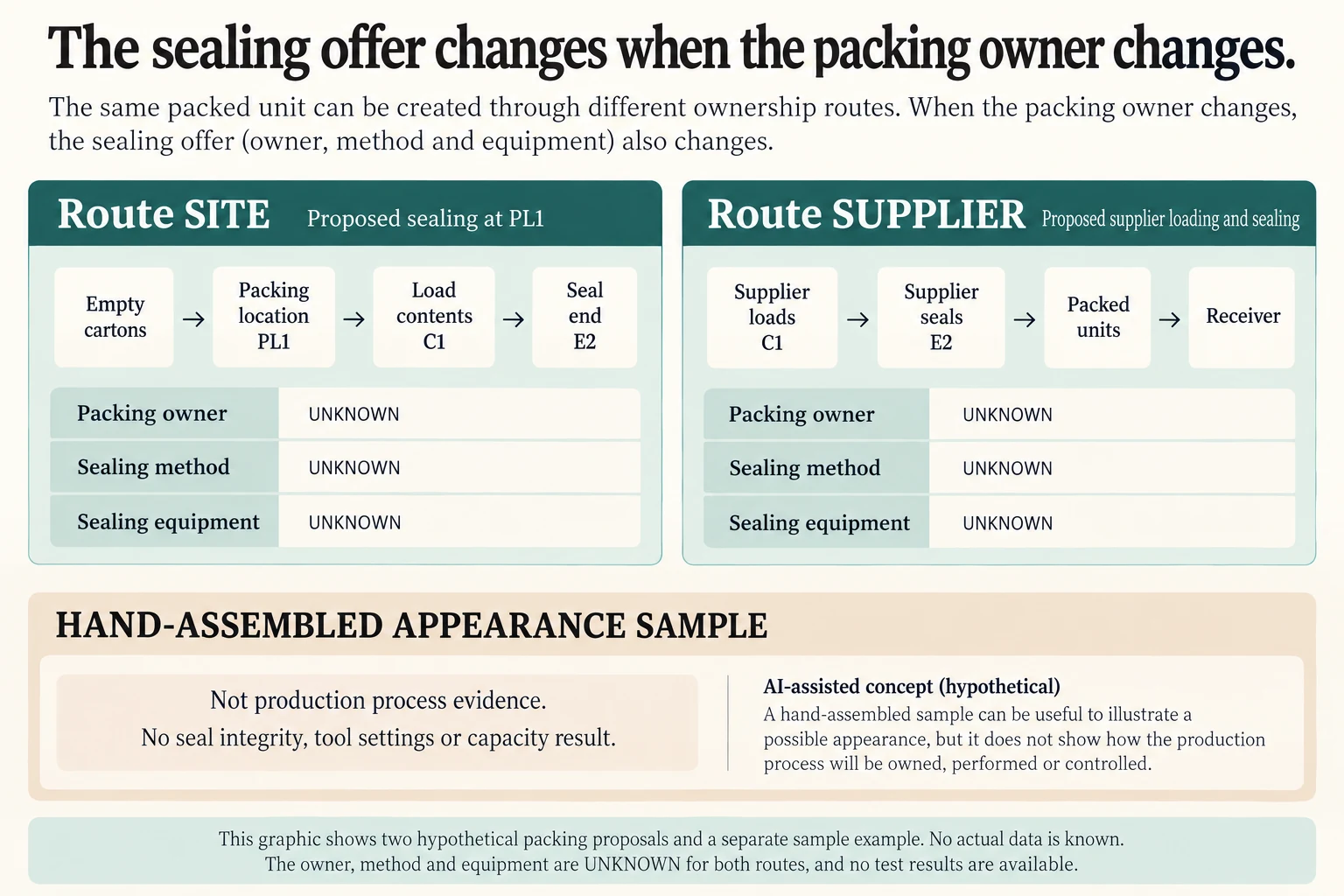
Use new hypothetical route references SITE_PL1 and SUPPLIER_LOADED. SITE_PL1 receives empty cartons and the required contents for packing at PL1. SUPPLIER_LOADED instead proposes that the supplier loads C1 and seals the finished units before handover. These are alternative scopes, not confirmed services.
Scroll horizontally if columns extend beyond the view.
| Scenario scope | Exact object or route | Hypothetical input or output | Calculation or record boundary |
|---|---|---|---|
| Receive contents | SITE_PL1 | Unobserved; actual fields blank | Alternative included-work route; actual responsible party, location, method, equipment and evidence unknown |
| Form | SITE_PL1 | Unobserved; actual fields blank | Alternative included-work route; actual responsible party, location, method, equipment and evidence unknown |
| Load c1 | SITE_PL1 | Unobserved; actual fields blank | Alternative included-work route; actual responsible party, location, method, equipment and evidence unknown |
| Seal e1 | SITE_PL1 | Unobserved; actual fields blank | Alternative included-work route; actual responsible party, location, method, equipment and evidence unknown |
| Seal e2 | SITE_PL1 | Unobserved; actual fields blank | Alternative included-work route; actual responsible party, location, method, equipment and evidence unknown |
| Dispatch | SITE_PL1 | Unobserved; actual fields blank | Alternative included-work route; actual responsible party, location, method, equipment and evidence unknown |
| Receive packed | SITE_PL1 | Unobserved; actual fields blank | Alternative included-work route; actual responsible party, location, method, equipment and evidence unknown |
| Receive contents | SUPPLIER_LOADED | Unobserved; actual fields blank | Alternative included-work route; actual responsible party, location, method, equipment and evidence unknown |
| Form | SUPPLIER_LOADED | Unobserved; actual fields blank | Alternative included-work route; actual responsible party, location, method, equipment and evidence unknown |
| Load c1 | SUPPLIER_LOADED | Unobserved; actual fields blank | Alternative included-work route; actual responsible party, location, method, equipment and evidence unknown |
| Seal e1 | SUPPLIER_LOADED | Unobserved; actual fields blank | Alternative included-work route; actual responsible party, location, method, equipment and evidence unknown |
| Seal e2 | SUPPLIER_LOADED | Unobserved; actual fields blank | Alternative included-work route; actual responsible party, location, method, equipment and evidence unknown |
| Dispatch | SUPPLIER_LOADED | Unobserved; actual fields blank | Alternative included-work route; actual responsible party, location, method, equipment and evidence unknown |
| Receive packed | SUPPLIER_LOADED | Unobserved; actual fields blank | Alternative included-work route; actual responsible party, location, method, equipment and evidence unknown |
Keep forming, loading, E1 sealing, E2 sealing and both handoff ends separate in each route. The question about E2 begins after C1 is loaded, so a reply about an empty carton or board grade cannot close the owner, equipment or method fields. Actual responsibilities and evidence remain blank.
The hand-assembled appearance sample retains its separate record. If the offered scope changes to supplier-loaded units, update the contents and ownership boundary before comparing price. Neither the attractive sample nor the operation map establishes seal integrity, safe machinery use, productivity or security performance.
Download the seal end carton packing process record (.csv). It covers the original scenarios and this added comparison. HYPOTHETICAL rows are invented planning examples. Actual quantity, value, configuration, method, owner, observation, condition, decision, evidence and dates are blank because no actual project record has been obtained. Copy a relevant row and replace its type with ACTUAL only when entering permitted project evidence; keep the example and actual record separate. ACTUAL_BLANK is an empty starting row. A blank is unknown, never approval.
The related Custom Packaging Quote Comparison Checklist guide concerns a separate requirement. Use this record for the specific comparison above rather than treating that guide as evidence of a completed result.
Keep reusable tools and consumables distinct with the assembly tool and consumable map. Retain a changed process sample in the sample-version comparison.
References retain their stated general-guidance or manufacturer-example scope. Worked figures and records are teaching examples, not observed orders, stock, prices or measured performance.
Discuss this packaging specification with Packrivo. We coordinate independent suppliers. MOQ: 500 pieces per product/design; illustrative quantities are not production offers. Confirm materials, samples, price and timing for your project.