
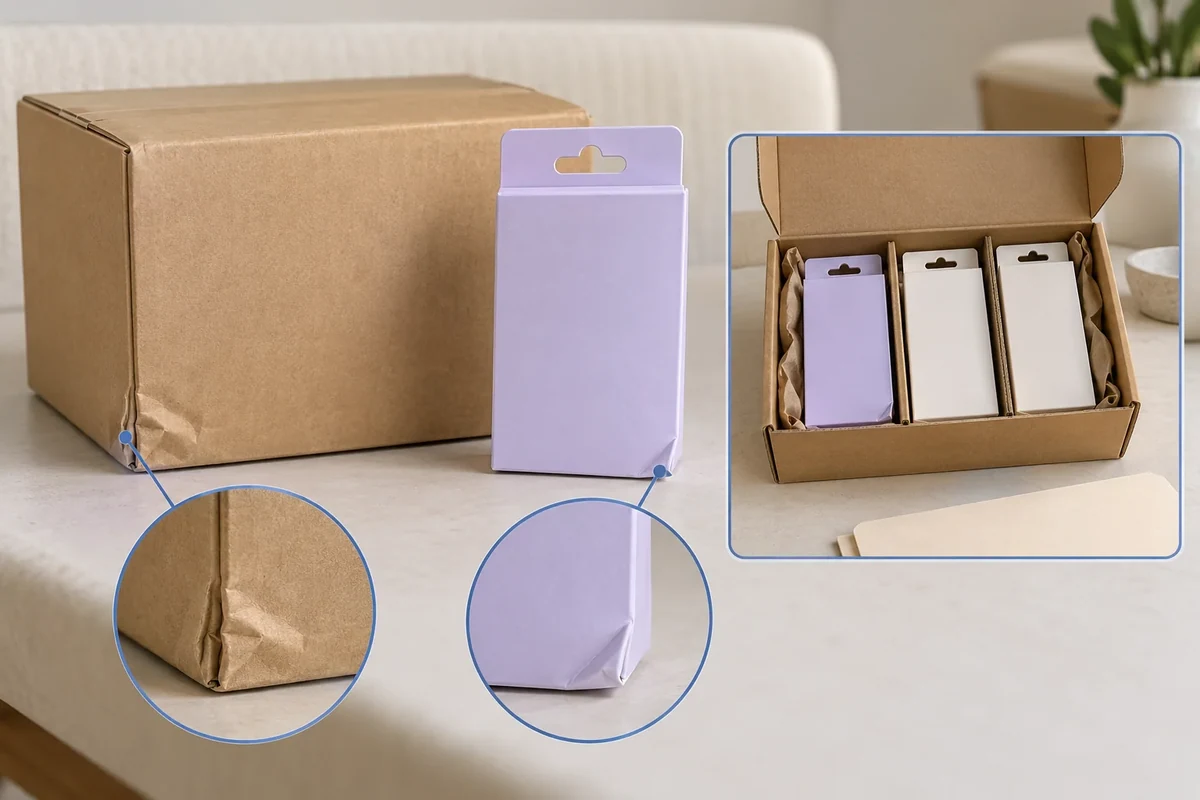
Describe observed transit damage by item, location and pack configuration before requesting a solution. Preserve the received state in the authorized project record before rearranging components. A damaged corner photograph alone doesn’t establish the cause, the route event or which packaging revision was used.
The useful output is a located incident sheet with source images and an explicit cause status. It gives the responsible reviewer evidence to assess without turning a buyer observation into a technical diagnosis.
Record the received state first
Identify the shipment reference through the authorized project process, keeping personal addresses and private data out of public concept material. Name the product and packaging versions actually known. Mark unknown identities as gaps.
Photograph the outer pack, loaded arrangement and affected item before moving them where practical. Keep original images and wider context with any close-up. A later staged arrangement should be labelled separately.
ISTA’s evaluation overview treats product/package combinations within defined scopes. That supports retaining the system context, not claiming that an incident proves failure of a particular procedure or material.
Locate damage without diagnosing it
Give each affected area a location ID. Describe visible condition in plain terms, such as a bent card edge at one corner. Keep possible causes, route events and requested changes in separate fields.
Record what was observed, by whom and when. Preserve a missing starting condition or unknown route event as a limitation instead of filling it with an assumed explanation.
| Incident field | Entry | Evidence/limit |
|---|---|---|
| Received configuration | Known product and pack identities | Unknown versions flagged |
| Location | Item and marked area ID | Wide and close photos |
| Visible condition | Factual description | No cause inferred |
| Contents arrangement | Received rows/holders/closures | Before rearrangement view |
| History | Known handling/receipt facts | Unobserved events remain unknown |
| Next review | Responsible source and question | Cause and response statuses separate |
Use the acceptance record for the later decision and closure. Recording an incident and accepting a proposed correction are different jobs.
Follow a hypothetical corner incident
Suppose a gift brand receives an outer carton with a visibly affected corner and one retail pack with a bent card edge. The buyer records both locations and the loaded arrangement before moving the units.
The record links outer location OC1 and card location CC1 but leaves cause unconfirmed. The responsible source can assess those facts with the actual pack version and known route history.
If the source proposes a divider or closure change, identify that proposal separately. The incident photo does not automatically prove that the proposed change will prevent another occurrence.
Keep the next question evidence-based
Ask: ‘Please review incident locations OC1/CC1 against known configuration PS1 and identify the additional evidence needed.’ It names the system and limits. A general request for stronger packaging can skip the useful diagnosis work.
If a later investigation or evaluation produces a conclusion, retain its source and scope. Keep it separate from the original visible observation so another reviewer can see how the conclusion was reached.
This original incident sheet does not establish fault, insurance entitlement, a test failure or a universal material defect. Any such decision belongs to its responsible process and evidence.
Send a located incident record
Bring the authorized image references, known configuration and open evidence gaps through Packrivo’s enquiry. The next response should address the actual received state and identify a review path before a correction is treated as validated.
A staged reconstruction cannot replace the received-state record
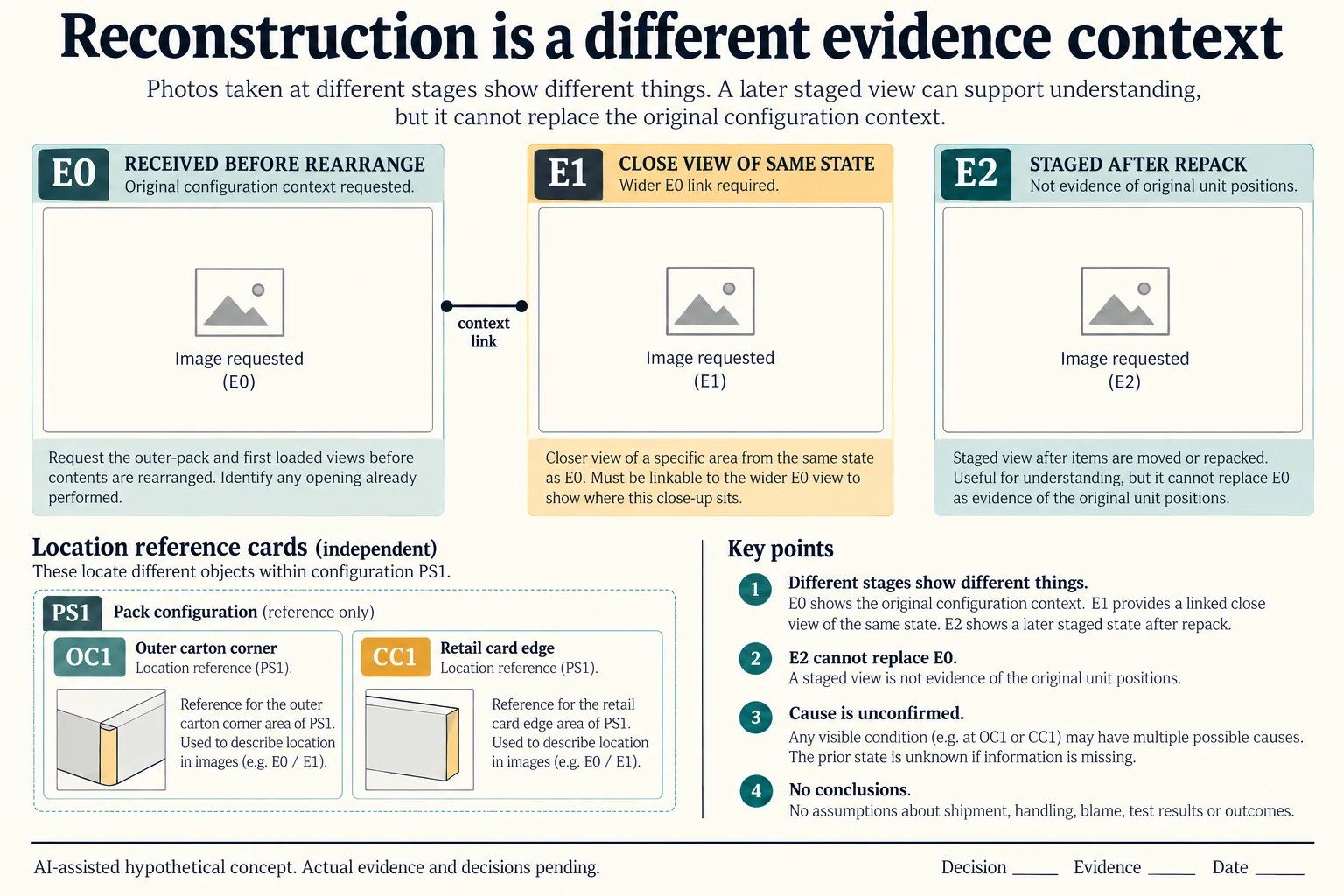
Give proposed evidence contexts separate references before assessing OC1 and CC1. E0 requests the received configuration before rearrangement. E1 requests a close view of the same state with its wider E0 context identified. E2 is a later staged-after-repack view. These are fictional evidence categories and empty requests, not actual incident photographs or a claim that a received condition was documented.
Scroll horizontally if columns extend beyond the view.
| Hypothetical configuration | Named object | Relationship | Input or next scope |
|---|---|---|---|
| IMAGE_CONTEXT25 | E0 | has phase | RECEIVED_BEFORE_REARRANGE |
| IMAGE_CONTEXT25 | E0 | has scope | ORIGINAL_CONFIGURATION_CONTEXT_REQUEST |
| IMAGE_CONTEXT25 | E1 | has phase | CLOSE_VIEW_OF_E0_STATE |
| IMAGE_CONTEXT25 | E1 | has scope | LOCATION_DETAIL_WITH_WIDE_VIEW_LINK |
| IMAGE_CONTEXT25 | E2 | has phase | STAGED_AFTER_REPACK |
| IMAGE_CONTEXT25 | E2 | has scope | NOT_EVIDENCE_OF_ORIGINAL_UNIT_POSITIONS |
| IMAGE_CONTEXT25 | E1 | requires context | E0 |
| IMAGE_CONTEXT25 | E2 | does not replace | E0 |
The CSV keeps each context’s phase, scope, source-file request, version, date and wider relationship separate. E1 needs its E0 context rather than becoming an unlinked close-up. E2 may help explain a proposed arrangement, but it cannot supply the original unit positions missing from E0. Keep a reconstructed view labelled as reconstructed even if it resembles the intended layout.
The hypothetical affected outer corner OC1 and bent card edge CC1 remain two located observations associated with PS1, not a causal chain. An earlier condition record, if available, creates another source to assess; if it is missing, preserve that limitation. Neither a matching location nor a later reconstruction establishes when the condition arose, which route event occurred or who was responsible.
Ask the responsible reviewer what additional evidence is needed before selecting a divider or closure change. Record any later conclusion beside its source and scope without rewriting the original observation. ISTA’s overview addresses packaged-product evaluation contexts; it does not diagnose an incident, establish insurance entitlement or prove that a proposed correction prevents recurrence. Keep real private shipment and image information in the authorized project process.
Download the transit damage evidence context record (.csv). It includes the original table fields and scenarios alongside the added relationships. HYPOTHETICAL rows are editorial examples or required review scopes, not actual records. Actual quantity, configuration, component and file identities, materials, process, specification, copy, method, condition, observation, owner, decision, evidence and dates are blank. ACTUAL_BLANK is a separate empty starting row; enter permitted project evidence before using an actual record. A blank means unknown.
Use the Carton Opening Needs a Map of Retail Packs Beneath the Seam for its separate question. Use the Packaging Sample Revisions: Compare Versions Before Approval for its separate question. Use the Mailer Box With Insert: Build a Fit Brief From the Product for its separate question.
Source scope checked 16 October 2026. References cover only the named materials, processes or guidance. Added configurations and geometry are hypothetical, not supplier specifications, tests or production approval; they set no universal tolerances or machine limits. Confirm the actual material, process, drawing and formed sample for the project.
Discuss this packaging specification with Packrivo. We coordinate independent suppliers. MOQ: 500 pieces per product/design; illustrative quantities are not production offers. Confirm materials, samples, price and timing for your project.