

Keep the original quoted currency and unit basis separate from any conversion used for comparison. Record the conversion’s rate source, direction and date without replacing the actual offer. A converted figure is a planning calculation under stated assumptions, not the supplier’s new price or a confirmed payment rate.
The useful output preserves the original offer and makes the added comparison transparent. It doesn’t predict exchange rates or recommend a currency transaction.
Preserve the original price record
Record the currency exactly as stated, along with the quoted unit and included scope. Keep pieces, sets, components or another unit named. A currency symbol without the unit basis can leave two offers incomparable.
Store the actual original amount through the authorized project record. Public examples on this page do not provide real prices. If a quotation changes, identify its new version before converting it.
The ECB reference-rate page states that its rates are informational and discourages using them for transactions. A reference can describe an assumption while leaving the actual payment arrangement to its responsible source.
Write the conversion direction
State which currency is the base and which is the result. Record whether the calculation multiplies or divides under that stated rate convention. Keep the original and converted figures in separate cells.
Name the source date and the calculation purpose. Do not label the converted amount as the seller’s price. Fees, actual transaction rates and other agreed charges need their own facts if they belong to the comparison.
| Currency-comparison field | Original offer | Added comparison |
|---|---|---|
| Identity | Quote reference and version | Same reference retained |
| Currency/unit | Actual currency and quoted unit | Chosen comparison currency/unit |
| Amount | Original quoted figure privately | Calculated figure with method |
| Rate direction | Not inferred from unit label | Base/result convention stated |
| Source/date | Offer source and date | Named rate source and date |
| Purpose/limits | Actual offer scope | Planning assumption, not payment rate |
Use the offer comparison checklist to keep quantities and included work comparable. Currency conversion cannot repair a different scope or unit basis.
Follow a hypothetical two-currency comparison
Suppose two packaging offers use different currencies. The buyer first records each original currency, unit and scope. Only after the units are aligned is a separate dated comparison field added.
The rate convention is written before the calculation. A reviewer can then check the direction and method without assuming that a currency label contains the conversion rule.
The original offers remain unchanged. A later rate date creates another comparison assumption, not a revised supplier quotation. Any actual payment rate is confirmed through the responsible transaction process.
Keep assumptions from becoming commitments
Ask: ‘Please confirm the original currency, unit basis and validity of quote Q1.’ That requests actual offer facts. A reference-rate screenshot cannot answer what the supplier quoted.
If the comparison uses another rate source, record its identity and purpose. Do not combine amounts converted on different dates while labelling them one current price comparison without explanation.
This original record organizes arithmetic and provenance. It does not estimate future currency movements, guarantee savings or provide financial advice about payment timing.
Send the original and assumed fields
Bring quote references, original units and any dated comparison method through the packaging enquiry. The next response should resolve actual offer facts separately from calculations the buyer has chosen for planning.
Align both the rate convention and the quoted unit
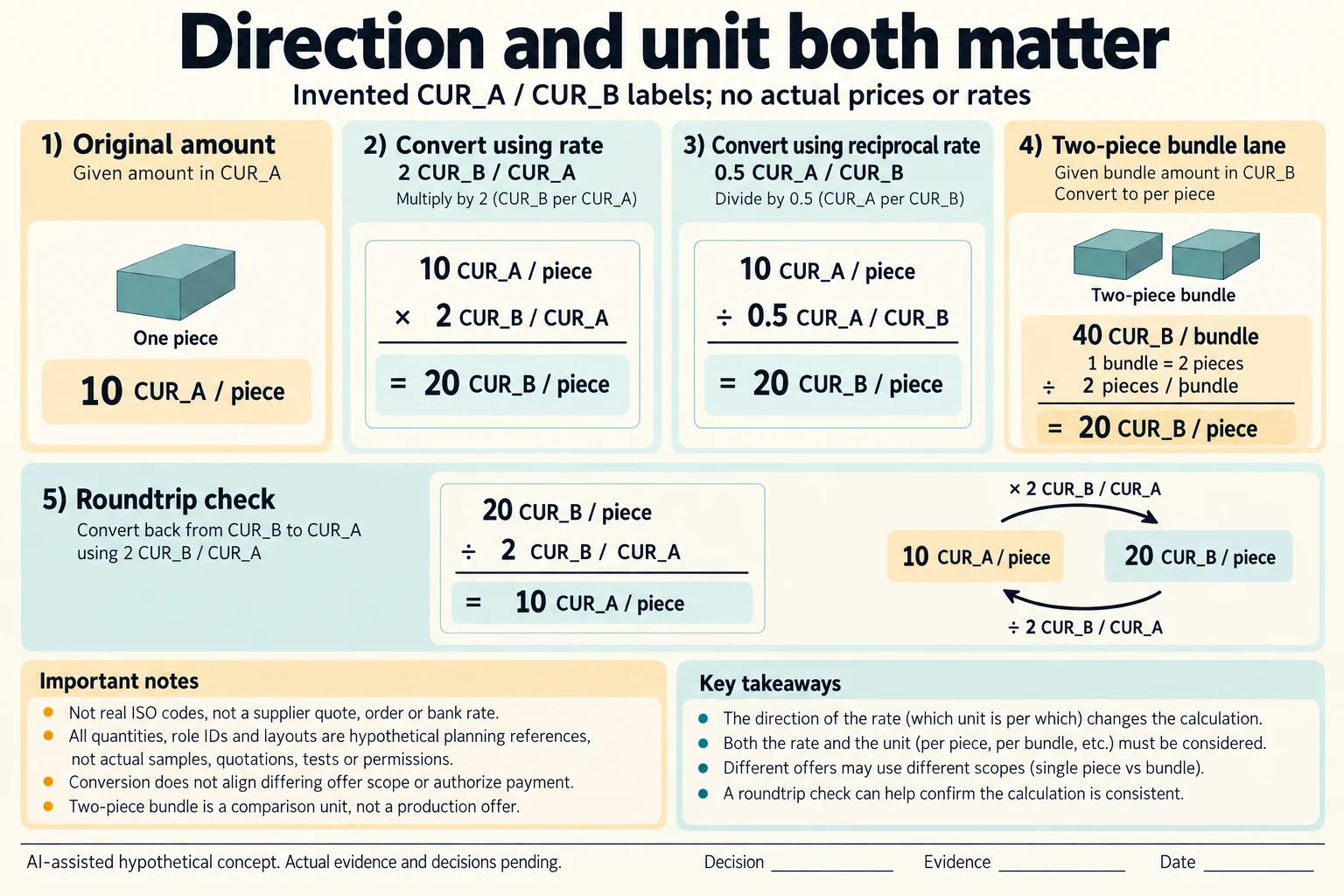
Use invented labels CUR_A and CUR_B solely for unit arithmetic; they are not ISO currency codes or payment options offered by anyone. Assume an original amount of 10 CUR_A per piece. A rate of 2 CUR_B per CUR_A gives 20 CUR_B per piece by multiplication. The reciprocal convention, 0.5 CUR_A per CUR_B, gives the same 20 by division. These are hypothetical inputs, not live exchange rates or supplier prices.
Scroll horizontally if columns extend beyond the view.
| Hypothetical configuration | Named object | Relationship | Input or next scope |
|---|---|---|---|
| UNIT_MODEL25 | A_ORIGINAL | assumed input | FICTIONAL_CURRENCY_UNIT_MODEL; 10 CUR_A/piece |
| UNIT_MODEL25 | B_PER_A | assumed input | FICTIONAL_CURRENCY_UNIT_MODEL; 2 CUR_B/CUR_A |
| UNIT_MODEL25 | A_PER_B | assumed input | FICTIONAL_CURRENCY_UNIT_MODEL; 0.5 CUR_A/CUR_B |
| UNIT_MODEL25 | B_BUNDLE | assumed input | FICTIONAL_CURRENCY_UNIT_MODEL; 40 CUR_B/bundle |
| UNIT_MODEL25 | B_PIECES | assumed input | FICTIONAL_CURRENCY_UNIT_MODEL; 2 pieces/bundle |
| UNIT_MODEL25 | A_MULTIPLY | calculated from | A_ORIGINAL*B_PER_A; 20 CUR_B/piece |
| UNIT_MODEL25 | A_DIVIDE | calculated from | A_ORIGINAL/A_PER_B; 20 CUR_B/piece |
| UNIT_MODEL25 | B_NORMALIZED | calculated from | B_BUNDLE/B_PIECES; 20 CUR_B/piece |
| UNIT_MODEL25 | ROUNDTRIP | calculated from | A_MULTIPLY/B_PER_A; 10 CUR_A/piece |
Keep a second independent unit question visible. An invented 40 CUR_B bundle containing two pieces normalizes to20 CUR_B per piece. Its bundle amount should not be compared directly with a per-piece figure. The CSV preserves original inputs, rate direction, converted results, bundle quantity and normalized output as separate rows with formula dependencies. Dividing the converted 20 by 2 also returns the original 10 CUR_A per piece as an arithmetic direction check.
Matching these modeled numbers does not make offers commercially comparable. Actual structure, design quantity, delivery scope, fees, validity and transaction conditions still require their own evidence. A two-piece comparison bundle is only a counting basis in this example, not a custom-production offer below Packrivo’s published MOQ. Actual amounts, source dates, transaction rates and decisions remain blank.
The ECB publishes reference rates for information and discourages transaction use; its current numbers have not been imported into this example. A later comparison date changes the conversion assumption, not the original quotation. The separate sensitivity article examines rate-dependent rankings; this model checks convention and unit consistency and provides no forecast, savings claim, hedging suggestion or payment-timing advice.
Download the quote currency rate direction unit model record (.csv). It includes the original table fields and scenarios alongside the added relationships. HYPOTHETICAL rows are editorial examples or required review scopes, not actual records. Actual quantity, configuration, component and file identities, materials, process, specification, copy, method, condition, observation, owner, decision, evidence and dates are blank. ACTUAL_BLANK is a separate empty starting row; enter permitted project evidence before using an actual record. A blank means unknown.
Use the Foreign-Currency Packaging Quotes Need a Rate Sensitivity Test for its separate question. Use the Custom Packaging Quote Comparison Checklist for its separate question.
Source scope checked 16 October 2026. References cover only the named materials, processes or guidance. Added configurations and geometry are hypothetical, not supplier specifications, tests or production approval; they set no universal tolerances or machine limits. Confirm the actual material, process, drawing and formed sample for the project.
Discuss this packaging specification with Packrivo. We coordinate independent suppliers. MOQ: 500 pieces per product/design; illustrative quantities are not production offers. Confirm materials, samples, price and timing for your project.