
Plan a Necklace and Earring Set as One Packaging System
Plan the jewelry holder, presentation box and outward parcel in that order. Record how the necklace and earrings sit, where packaging may touch them, and how a customer lifts each piece out before choosing the outer dimensions.
Illustrative planning walkthrough. The scenario and records below are hypothetical; they show work to prepare rather than a completed client result.
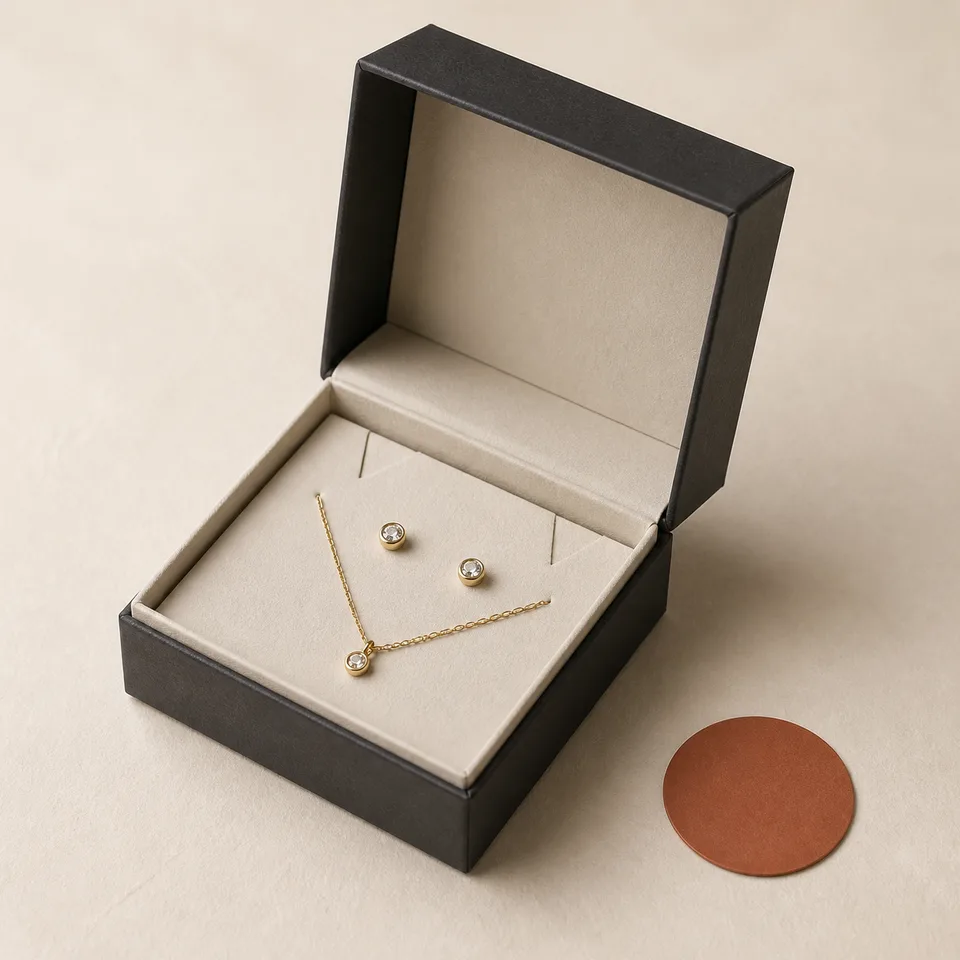
Start with the pendant, chain and posts
In this example, a gift brand wants one necklace and a pair of stud earrings displayed together. The buyer provides separate product references for the pendant, clasp, chain and earrings. A front photograph explains the intended arrangement; a side view reveals posts and other projections that the insert must accommodate.
The buyer marks the pendant face as an area where rubbing needs review and identifies where the chain should be routed. The exact contact material and proposed allowance remain supplier questions. This creates a holder brief rather than an arbitrary cutout size.
Give each component its own dependency
| Component | Buyer input | Proposal to request | Decision needed before the next step |
|---|---|---|---|
| Pendant and chain | Measured envelope, chain route, contact restrictions | Holder positions and accessible lift point | Approve the display and removal route |
| Stud earrings | Post length, backs and pair spacing | Two positions with room for the complete pieces | Review the rear projection and removal access |
| Holder | Material direction and complete jewelry references | Drawing and proposed contact surfaces | Name the material and record the sample revision |
| Presentation box | Holder envelope and lid movement | Internal cavity and closed-lid arrangement | Review the loaded holder and lid together |
| Parcel | Finished presentation-pack envelope and destination | Outer pack and any additional cushioning | Agree the complete transport review scope |
On a small screen, scroll the table sideways to read every field.
Separate an open display check from a closed-pack check
A neat open-box arrangement is one observation. The sample review should also record the closed condition with both earring backs and the routed chain in place. Ask whether a component changes position as the lid closes. If it does, identify the contact point in a photograph and return that question against the same drawing version.
Record removal as a separate action: which piece moves first, where a finger enters, and whether a chain catches on another component. A later supplier proposal may change the insert without changing the printed artwork; keep both revision identities in the record.
Use a sample note that names the next action
| Illustrative record | Observation or unknown | Next question and owner |
|---|---|---|
| Holder proposal H1 / open display | Pendant and earrings shown in proposed positions; geometry still to confirm | Buyer supplies side views and complete dimensions |
| H1 / closed condition | Lid-to-post relationship unresolved | Supplier proposes a loaded section view for review |
| H1 / customer removal | Chain lift route not yet described | Buyer names the desired removal order |
| Presentation pack / parcel | Finished outer envelope not available | Confirm presentation pack before sizing the parcel |
On a small screen, scroll the table sideways to read every field.
These rows describe an example planning state, not a test result. A project record should attach its actual drawing, sample identifier, dated observations and named decision owner.
Send one connected brief
Start with 250 pieces per design. Include the complete jewelry references, proposed display, contact restrictions and open questions. Keep the parcel quantity and presentation-box design quantities explicit if their scopes differ.
Use the jewelry insert record sheet to collect the inputs. The measurement guide explains the geometry behind those fields. Compare the box-with-insert direction when preparing the structural proposal.